
Soledades: Aproximación a la obra de Yufei Ma
Por Juan Pablo Torres Muñiz
Especialmente en las grandes ciudades, cuando hay silencio, éste parece imponerse. Por sobre cualquier afán individual. O somos ruidosos todos, o nadie lo es.
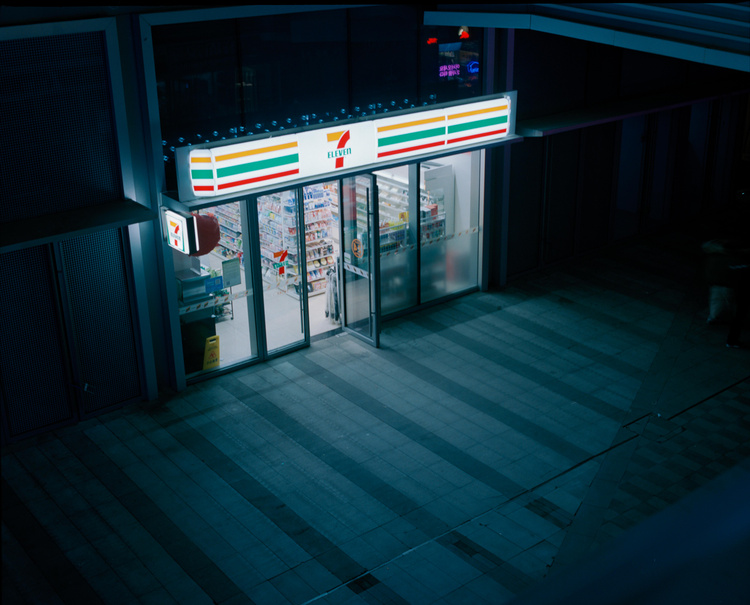
La obra de Yufei Ma no se anuncia con estridencias, sino como uno de estos. Ni figuras humanas, ni rostros, ni gestos, ni historias explícitas. Sin embargo, el ser humano está allí, presente en su ausencia, inscrito en la geometría de los espacios, en la disposición de las líneas, en el eco de los colores. Ma no retrata personas, retrata la huella que la institución social ha dejado sobre el mundo material: la ciudad como archivo de la soledad, el comercio como ritual sin fieles, la arquitectura como liturgia de lo funcional. Cada imagen suya es una escena post-humana, no en sentido apocalíptico, sino en el más crítico: un mundo que sigue funcionando como si estuviéramos, aunque ya no estemos plenamente, aunque ya no sepamos bien quiénes somos dentro de ese marco que nosotros mismos construimos.
Sus composiciones, aparentemente espontáneas, son en verdad ejercicios de precisión racional. La línea horizontal del horizonte corta el encuadre con una frialdad casi matemática; las paredes, los techos, los pasillos, las escaleras, se organizan en estructuras que no buscan armonía estética, sino coherencia con un orden preestablecido, con una lógica de producción y consumo que ha colonizado hasta el último rincón del espacio público. El color, lejos de ser ornamento, es aquí un operador crítico. Ma emplea una paleta de tonos apagados —grises, ocres desvaídos, azules cenicientos, verdes desleídos— que no evocan tanto una estética como una condición: la del desgaste… existencial. No son colores tristes, sino colores de lo que sigue funcionando, aunque nadie lo mire, de lo que ilumina, aunque nadie pase. En ese uso del color reside una de las formas más sutiles de crítica: no se denuncia el deterioro, se exhibe la indiferencia del sistema hacia su propio estado de conservación.
Lo que Ma pone en tela de juicio no es solo la ciudad, sino la noción misma de sociedad como colectivo viviente. En sus imágenes, no hay multitudes, no hay tránsito, no hay vida callejera; hay espacios diseñados para la multitud, pero vacíos de ella. Hay sillas alineadas frente a pantallas apagadas, pasarelas que conducen a ninguna parte, vitrinas iluminadas sin mercancía visible, escaleras mecánicas que suben y bajan sin pasajeros. Estas escenas no son distopías, sino realidades cotidianas capturadas en un instante de suspensión: el momento en que el espectáculo se detiene y deja ver su mecanismo. La soledad no aparece como emoción, sino como estructura. Una condición neta del individuo contemporáneo, que habita espacios colectivos sin pertenecer de veras a ningún colectivo preciso, que circula por instituciones sin integrarse a ellas. Despojado. Tristemente, eso sí, a voluntad. Presa de la tentación de la libertad mal entendida.
Las edificaciones, los comercios, las infraestructuras, como si la institución, pese a todo, hubiera superado a sus fundadores. Es una visión que recuerda el arte como institución desacralizante: Ma no hace de la ciudad un monumento, ni la idealiza como logro de la civilización. Por el contrario, la desmitifica, mostrando cómo lo que llamamos progreso no es sino una acumulación de formas carentes de espíritu por sí mismas. Las luces encendidas en mitad del día, las puertas automáticas que se abren sin nadie que entre, los anuncios digitales que parpadean sin mensaje claro: todo ello conforma un teatro sin actores, un guion sin trama. Y en ese teatro, el espectador —el que mira la fotografía— se convierte en el último testigo de un orden que no precisa de ellos.
Pero la seducción está presente. Sus imágenes son bellas, indudablemente, y esa belleza es parte de su estrategia. No se trata de una estética complaciente, sino de una seducción que desarma. Al principio, uno se detiene por el equilibrio, por el color, por la calma. Luego, poco a poco, se da cuenta de que esa calma es inquietante, de que el orden es opresivo, de que la ausencia es sistemática. La melancolía, entonces, no es el tema, sino la puerta de entrada a un cuestionamiento más profundo: ¿para quién construimos? ¿Qué relación mantenemos con lo que hemos creado? ¿Es la civilización un refugio o una prisión de la que no sabemos salir?
Cada línea, cada sombra, cada reflejo, está allí porque debe estar, porque revela algo del sistema. La cámara no es un ojo inocente, sino un instrumento de análisis. Y el resultado no es documental, sino conceptual: cada fotografía es una proposición sobre la forma en que vivimos, sobre cómo la institución —la ciudad, el comercio, la arquitectura— nos configura antes de que nosotros la habituemos.
La obra de Yufei Ma es un ejemplo de cómo el arte puede cuestionar sin caer en el maniqueísmo. Es arte que desinstala. Al eliminar al ser humano de sus imágenes, Ma lo pone, paradójicamente, en el centro: como ausencia fundante, como falta que estructura todo lo demás.
[Todas las imágenes, de la sitio web del artista: Yufei Ma 马羽非]




ENGLISH VERSION
Solitudes: An Approach to the Work of Yufei Ma
Translated by Rebeca Sanz
Especially in large cities, when there is silence, it seems to impose itself. Over any individual endeavor. Either we are all noisy, or no one is.
The work of Yufei Ma is not announced with stridency, but as one of these silences. No human figures, no faces, no gestures, no explicit stories. Yet, the human being is there, present in its absence, inscribed in the geometry of the spaces, in the arrangement of the lines, in the echo of the colors. Ma does not portray people; she portrays the trace that the social institution has left upon the material world: the city as an archive of solitude, commerce as a ritual without faithful, architecture as a liturgy of the functional. Each of her images is a post-human scene, not in an apocalyptic sense, but in the most critical one: a world that continues to function as if we were there, even though we are no longer fully present, even though we no longer quite know who we are within this framework we ourselves built.
Her compositions, seemingly spontaneous, are in truth exercises in rational precision. The horizontal line of the horizon cuts the frame with an almost mathematical coldness; the walls, ceilings, hallways, staircases are organized into structures that seek not aesthetic harmony, but coherence with a pre-established order, with a logic of production and consumption that has colonized even the farthest corner of public space. Color, far from being ornament, is here a critical operator. Ma employs a palette of muted tones—grays, faded ochers, ashen blues, diluted greens—that evoke not so much an aesthetic as a condition: that of existential… wear. They are not sad colors, but colors of what keeps functioning, even if no one is looking, of what illuminates, even if no one passes by. In this use of color resides one of the most subtle forms of critique: it does not denounce deterioration, it exhibits the system’s indifference towards its own state of preservation.
What Ma calls into question is not just the city, but the very notion of society as a living collective. In her images, there are no crowds, no traffic, no street life; there are spaces designed for the multitude, but empty of it. There are chairs lined up facing switched-off screens, walkways leading nowhere, illuminated shop windows with no visible merchandise, escalators going up and down without passengers. These scenes are not dystopias, but everyday realities captured in a moment of suspension: the moment when the spectacle stops and reveals its mechanism. Solitude does not appear as an emotion, but as a structure. A clear condition of the contemporary individual, who inhabits collective spaces without truly belonging to any specific collective, who circulates through institutions without integrating into them. Stripped bare. Sadly, however, by their own will. Prey to the temptation of misunderstood freedom.
The edifices, the shops, the infrastructures, as if the institution, despite everything, had outlived its founders. It is a vision reminiscent of art as a desacralizing institution: Ma does not turn the city into a monument, nor does she idealize it as an achievement of civilization. On the contrary, she demystifies it, showing how what we call progress is but an accumulation of forms lacking spirit in themselves. The lights on in the middle of the day, the automatic doors opening with no one entering, the digital ads blinking with no clear message: all this constitutes a theater without actors, a script without a plot. And in that theater, the viewer—the one looking at the photograph—becomes the final witness of an order that does not need them.
But seduction is present. Her images are beautiful, undoubtedly, and that beauty is part of her strategy. It is not a complacent aesthetic, but a disarming seduction. At first, one stops for the balance, the color, the calm. Then, little by little, one realizes that this calm is unsettling, that the order is oppressive, that the absence is systematic. Melancholy, then, is not the subject, but the gateway to a deeper questioning: For whom are we building? What relationship do we maintain with what we have created? Is civilization a refuge or a prison from which we do not know how to escape?
Every line, every shadow, every reflection, is there because it must be, because it reveals something of the system. The camera is not an innocent eye, but an instrument of analysis. And the result is not documentary, but conceptual: each photograph is a proposition about the way we live, about how the institution—the city, commerce, architecture—configures us before we even inhabit it.
The work of Yufei Ma is an example of how art can question without falling into Manichaeism. It is art that unsettles. By eliminating the human being from her images, Ma paradoxically places it at the center: as a founding absence, as a lack that structures everything else.
[All images, from the artist’s website: https://yufeima.com/]