
Persistencia y plenitud: tiempo, revelación y subjetividad entre Occidente y Oriente
Por Juan Pablo Torres Muñiz
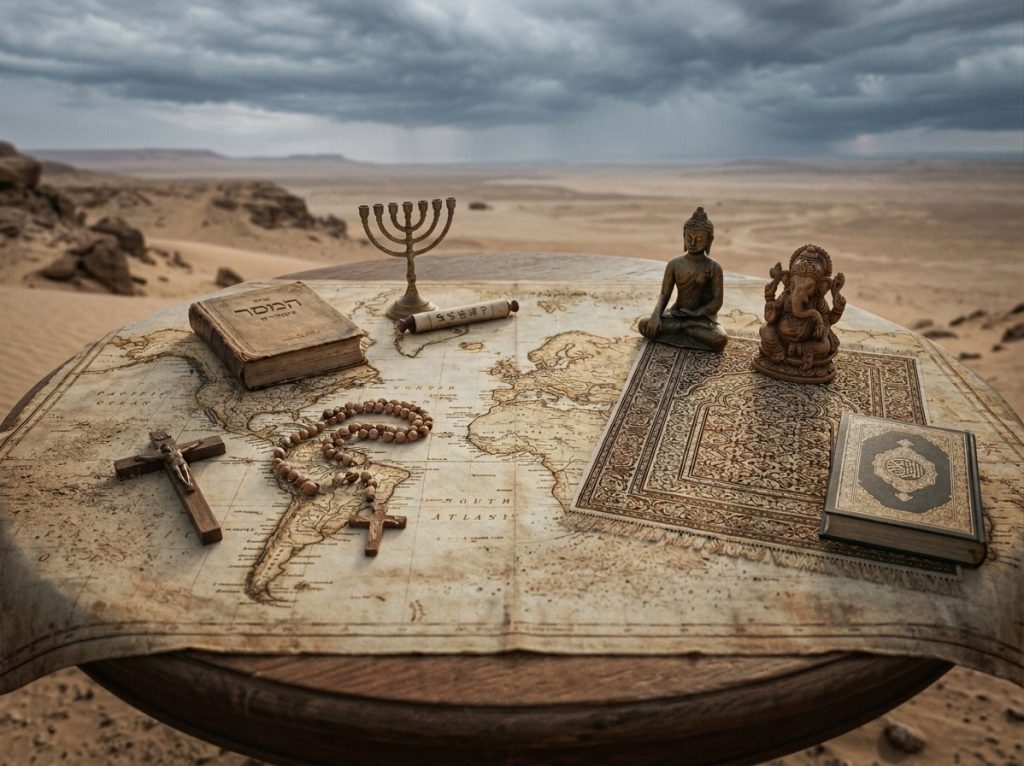
El tiempo. Pocas categorías resultan tan transparentes en la experiencia cotidiana pero tan cargadas de supuestos metafísicos en el análisis filosófico. Se lo da por sentado y, sin embargo, ninguna cultura lo ha vivido, pensado ni explicado de la misma manera. El monje benedictino que organiza su jornada en torno a las horas canónicas y el monje zen que se sienta cada mañana frente al mismo jardín de piedra habitan, literalmente, tiempos distintos. El primero avanza —o cree avanzar— hacia una meta escatológica que da sentido retrospectivo a cada instante; el segundo busca, en cada instante, la plenitud que ninguna meta futura podría añadir. El rabino que cuenta el ómer, uno a uno, los cuarenta y nueve días que van de Pésaj a Shavuot, y el musulmán que cinco veces al día interrumpe su quehacer para orientarse hacia La Meca habitan también tiempos distintos, que no son los del zen ni los de la hora canónica, sino los del pacto que se recuerda y del juicio que se acerca.
La cuestión que se plantea va a lo más profundo: si el tiempo no es una forma vacía y neutral —como pretendió cierta física clásica— sino una matriz que configura la subjetividad, el sentido, la relación con lo divino y la concepción misma de lo real, entonces las civilizaciones que han pensado el tiempo de modos irreconciliables han producido, con él, ontologías, epistemologías y teologías irreconciliables. Conviene precisar, antes de avanzar, el estatuto metodológico de los términos «Occidente» y «Oriente» que aquí se emplearán. No se trata de esencias homogéneas ni de bloques civilizatorios cerrados sobre sí mismos, sino de tipos ideales en el sentido weberiano del término: construcciones conceptuales que acentúan deliberadamente ciertos rasgos —nunca la totalidad empírica de un fenómeno— con el fin de hacerlos comparables y pensables (Weber, 2012). Como todo tipo ideal, «Occidente» y «Oriente» no describen realidades puras, sino que iluminan tendencias dominantes, dejando fuera de foco —a sabiendas— las corrientes internas que las contradicen: el eterno retorno estoico dentro de la propia tradición grecolatina, o la escatología lineal de ciertas corrientes del budismo Mahāyāna dentro de la tradición asiática. Se volverá sobre esta cautela metodológica al examinar los contra-argumentos.
Con esa salvedad, proponemos distinguir dos matrices temporales: una temporalidad de la persistencia —dominante, aunque no exclusiva, en la tradición que llamamos Occidente—, lineal, histórica, escatológica, orientada a asegurar el sentido mediante la memoria, el proyecto, la acumulación y la subjetividad reflexiva; y una temporalidad de la plenitud —dominante, aunque tampoco exclusiva, en la tradición que llamamos Oriente—, cíclica, instantánea, no-dual, orientada a la realización del eterno presente y a la integración del yo con el infinito. De estas dos matrices se sigue, como intentaremos mostrar, no solo una diferencia de sensibilidad, sino configuraciones religiosas divergentes. A lo largo del texto mostraremos que estas dos matrices no agotan el mapa de las religiones históricas: el judaísmo y el islam, las otras dos tradiciones monoteístas del mundo mediterráneo y del Próximo Oriente, las asumen, las tensan y, en algunos de sus regímenes internos, las combinan.
Sostenemos que la temporalidad de la persistencia y la temporalidad de la plenitud no son variantes accidentales de una misma experiencia humana del tiempo, sino matrices generativas que producen, cada una, su propia ontología (ser como devenir histórico frente a ser como plenitud no-dual), su propia epistemología (conocimiento discursivo y progresivo frente a conocimiento intuitivo e inmediato) y su propia teología (la certeza subjetiva de la fe frente a la disolución del sujeto en el Absoluto); y que la tradición greco-latina, asumida y transformada por el catolicismo mediante la analogía del ser, ofrece un tercer espacio capaz de integrar razón y revelación, naturaleza y gracia, tiempo y eternidad, sin disolver la subjetividad histórica en la pura inmediatez ni la aspiración a lo absoluto en la pura interioridad —y que, por ello, puede entrar en diálogo crítico y complementario tanto con el subjetivismo luterano como con la integración oriental.
[«Occidente», «Oriente» y el tiempo]
Los términos mismos llevan inscrita su relatividad: occidens y oriens son, en latín, participios del verbo cadere/oriri —«caer» y «nacer»— aplicados al sol: Occidente es, literalmente, el lugar donde el sol cae, y Oriente el lugar donde nace. La propia etimología revela que no se trata de categorías geográficas objetivas sino de un sistema de orientación construido desde un punto de observación —el observador europeo o mediterráneo situándose a sí mismo como centro—, lo cual autoriza, desde el inicio, a tratarlas como lo que son: tipos ideales relativos a una perspectiva, y no coordenadas absolutas del espacio ni, menos aún, esencias metafísicas de los pueblos que habitan uno u otro extremo del mapa.
El teólogo luterano Oscar Cullmann fijó, en su influyente Cristo y el tiempo (2008/1946), la distinción entre chronos —el tiempo cuantitativo, el mero transcurrir cronológico— y kairos —el instante cualitativamente decisivo, cargado de significación salvífica—, para mostrar que el cristianismo primitivo concibe la historia entera como una línea que atraviesa una serie de kairoi (la elección de Israel, la encarnación, la cruz, la resurrección, la parusía futura) hacia una consumación escatológica. Esta Heilsgeschichte o «historia de la salvación» es, para Cullmann, mucho más que un ropaje accidental del mensaje cristiano, se trata de su estructura misma: el tiempo se vuelve el escenario necesario de la revelación, porque solo en la sucesión irreversible de acontecimientos históricos concretos puede Dios manifestarse y el hombre responder mediante la memoria y la esperanza.
Frente a esta temporalidad lineal, Mircea Eliade describió, en El mito del eterno retorno (2011/1949), la mentalidad de las sociedades arcaicas y de buena parte de las cosmovisiones asiáticas como una estructura antitética: el tiempo profano, histórico, es vivido como una caída, una dispersión, incluso un terror del que el ser humano busca liberarse mediante ritos que reactualizan periódicamente el illud tempus —el tiempo mítico y sagrado del origen—, de manera que la existencia se ordena no como progreso lineal sino como repetición cíclica de arquetipos (Eliade, 2011). El taoísmo clásico radicaliza esta orientación: el Tao Te Ching no propone una meta futura que dé sentido al presente, sino el wu wei —la «acción sin esfuerzo»— como vía hacia el ziran, el estado de «ser-tal-como-se-es» en armonía con el ritmo natural, cíclico y siempre presente del cosmos (Lao Tzu, 2022). En el otro extremo del arco temporal oriental, el budismo zen radicaliza aún más la instantaneidad: el satori no es el resultado acumulativo de un progreso espiritual gradual, sino una irrupción súbita e intuitiva que puede ocurrir en cualquier instante, precisamente porque —según enseña esta tradición— no hay ningún estado futuro que alcanzar: la naturaleza búdica ya está plenamente presente (Suzuki, citado en Theosophical Publishing House, s.f.).
[La temporalidad de la persistencia: devenir histórico y subjetividad reflexiva]
Allí donde el tiempo se concibe como línea escatológica, el ser mismo se concibe como devenir orientado —y el sujeto, como una instancia reflexiva que debe recordar, proyectar y responder ante ese devenir—. Si cada instante (kairos) adquiere su sentido por su lugar en una secuencia irreversible que va del origen a la consumación, entonces el sujeto no puede limitarse a estar en el presente —debe situarse en la historia, retener el pasado mediante la memoria y anticipar el futuro mediante la esperanza o el proyecto—. La subjetividad reflexiva —esa instancia que se distancia de su propio presente para juzgarlo a la luz de lo que fue y de lo que se espera— es así, la consecuencia ontológica necesaria de vivir en una temporalidad de persistencia. Cullmann, con la tesis de que la Heilsgeschichte constituye el «centro temático unificador» de toda la Biblia, con el acontecimiento de Cristo como punto medio que otorga sentido retrospectivo a la historia de Israel y sentido prospectivo a la historia de la Iglesia, hace del tiempo lineal la condición misma de posibilidad de la revelación cristiana. Eliade, por su parte, documenta desde la orilla opuesta —la de las sociedades que rechazan esa linealidad— cómo la irrupción de la conciencia histórica lineal es vivida, allí donde ocurre, como una fuente de angustia —lo que él llama el «terror de la historia»—, precisamente porque obliga al sujeto a cargar con la irreversibilidad de sus actos sin la posibilidad de un retorno purificador al origen (Eliade, 2011).
[La temporalidad de la plenitud]
Allí donde el tiempo se concibe como eterno presente cíclico, el ser mismo se concibe como plenitud siempre ya dada —y el sujeto, lejos de tener que proyectarse hacia una meta futura, es llamado a reconocer una identidad que ya es, disolviendo la distancia reflexiva entre el yo empírico y lo real último—. La razón es, de nuevo, estructural: si no hay una línea escatológica que otorgue sentido acumulativo al tiempo, entonces la salvación o liberación no puede consistir en llegar a ser algo que aún no se es, sino en reconocer lo que ya se es desde siempre. El sujeto reflexivo —esa instancia que Occidente valora como el lugar de la certeza y la responsabilidad— se convierte, en esta matriz, en el velo mismo (avidya, la ignorancia) que impide ver la identidad última. En el núcleo mismo de la Advaita Vedanta: la enseñanza upanishádica tat tvam asi («eso eres tú») afirma la identidad no-dual entre el Atman —el yo más íntimo— y el Brahman —la realidad absoluta e infinita—, de modo que la liberación (moksha) no se alcanza mediante ningún proceso acumulativo en el tiempo sino mediante el conocimiento (vidya) que disuelve la ilusión (maya) de una individualidad separada (Hernández Rodríguez, 2019). El satori zen aporta lo suyo desde el budismo: se trata, según Suzuki, de «el súbito destello de una verdad nueva jamás antes soñada», una intuición no discursiva en la que «sus opuestos y contradicciones se unen y armonizan en un todo orgánico y consistente» (citado en Theosophical Publishing House, s.f.) —fórmula que describe bastante bien la disolución de la distancia sujeto-objeto que la temporalidad de la persistencia, en cambio, necesita preservar.
[La culminación de la temporalidad de la persistencia]
La Reforma luterana, al desplazar el lugar de la certeza salvífica desde la mediación sacramental-institucional hacia la conciencia individual del creyente, radicaliza —en el terreno religioso— la subjetividad reflexiva que la temporalidad de la persistencia ya exigía en el plano ontológico. Ocurre que si la justificación se obtiene sola fide —por la fe sin las obras— y sola gratia —por la gracia sin mérito alguno—, entonces el lugar donde esa justificación debe registrarse y certificarse ya no puede ser un rito objetivo verificable externamente, sino la conciencia (conscientia) del propio creyente, que debe alcanzar la certeza interior de estar salvado. El tiempo de la persistencia —que exige al sujeto situarse reflexivamente respecto de su propia historia— se convierte así, en Lutero, en el tiempo de un examen de conciencia perpetuo. Esto consta en la arquitectura misma de De servo arbitrio (1525), cuyo segundo gran apartado Lutero dedica enteramente a lo que él mismo titula «la certeza que proviene de la fe» (Lutero, 1976), y en la insistencia programática de la Reforma en que el creyente pueda —y deba— saberse justificado sin depender del juicio eclesiástico. Para Lutero, la fe no es un asentimiento intelectual a un cuerpo de doctrina sino una confianza (fiducia) que se aloja en el fuero íntimo del sujeto, distinguida expresamente de la piedad (Frömmigkeit) entendida como práctica colectiva y ritual (UNIR, s.f.). Como ha señalado la investigación contemporánea, en Lutero la certeza de la fe se convierte en el factor determinante de la salvación, de modo que la fides qua creditur —la fe por la que se cree— queda irrevocablemente marcada por la subjetividad del creyente (Racmyp, 2023). Max Weber, por su parte, mostró cómo esta interiorización de la certeza salvífica —radicalizada después por el calvinismo bajo la forma de la vocación (Beruf)— terminaría por generar una ética de la responsabilidad individual ante el propio tiempo histórico que él consideró decisiva para la formación del sujeto moderno occidental (Weber, 2003), y que derivó en la justificación de las mayores atrocidades: del colonialismo más cruel al nacismo, pasando por la más amplia variedad de excéntricos caminos en las coordenadas del Destino Manifiesto.
[La revelación oriental]
Las grandes tradiciones religiosas de Oriente —el Vedānta no-dualista, el budismo y el taoísmo— convergen en concebir la experiencia religiosa culminante no como la certeza subjetiva de un sujeto que permanece distinto de su objeto de fe, sino como la integración o identificación de ese sujeto con una realidad infinita que lo desborda y lo disuelve. Dado que, desde su perspectiva, el tiempo es plenitud siempre presente y no progresión hacia una meta futura, entonces no hay lugar para una instancia subjetiva que se mantenga reflexivamente aparte de lo real para juzgarlo o creer en él: la culminación religiosa solo puede consistir en el colapso de esa distancia.
En el Vedānta, la identidad Atman-Brahman convierte la liberación en reconocimiento de una unidad ya dada, no en el establecimiento de una relación personal entre un yo y un Dios distinto de él (Hernández Rodríguez, 2019); en el budismo, el nirvana se describe clásicamente como la extinción (nirvāṇa, literalmente «apagarse») de la sed (tṛṣṇā) que sostiene la ilusión de un yo separado, y no como la recompensa futura de un sujeto que persiste (Rahula, 1959); en el taoísmo, el sabio que ha alcanzado el wu wei ya no actúa desde una voluntad individual enfrentada al curso de las cosas, sino en armonía indistinguible con el Tao (Lao Tzu, 2022). En los tres casos, la revelación no aumenta el conocimiento que un sujeto tiene sobre un objeto trascendente, sino que suprime la distancia misma entre uno y otro.
[Judaísmo: la persistencia del pacto y la espera mesiánica]
Si alguna tradición vive la temporalidad de la persistencia no como matriz importada sino como el hilo mismo de su auto-comprensión, esa es la de Israel. La línea sagrada que Cullmann reconstruye comienza, propiamente hablando, mucho antes de la encarnación: comienza con la creación, con la elección de Abraham, con el pacto del Sinaí, con la tierra prometida, con el exilio y el retorno (Cullmann, 2008). El judaísmo rabínico organiza la vida entera como respuesta a esa línea: el calendario no celebra la renovación cósmica, sino que conmemora acontecimientos irrepetibles —el Éxodo, la entrega de la Torá en el Sinaí, la destrucción del Templo—, y la memoria no es allí rememoración nostálgica sino reactualización obligada: en cada generación, ordena la Hagadá de Pésaj, cada uno está obligado a verse a sí mismo como si él mismo hubiera salido de Egipto (Mishná, Pésajim 10:5).
La diferencia con el illud tempus eliádico es decisiva: la reactualización rabínica no cancela la historia sino que la interioriza; el pasado que se hace presente es un pasado histórico irreversible, y el pueblo que lo conmemora sigue siendo un pueblo en camino, es decir, un sujeto situado en la línea —lo que Heschel describe como la aportación específica de Israel frente a las religiones del espacio: el Dios de Israel es un Dios de acontecimientos, y su santidad habita en el tiempo antes que en los lugares (Heschel, 1951). Como ha mostrado Yerushalmi en su obra capital Zajor: historia judía y memoria judía (1982), el judaísmo premoderno no cultivó una historiografía lineal al modo moderno, sino una memoria ritual que integra los acontecimientos históricos en el ciclo litúrgico, de modo que la exhortación divina —zajor, «recuerda»— no apunta a la curiosidad por el pasado, sino a la respuesta del pueblo a la voluntad divina manifestada en la historia (Yerushalmi, 2002). La línea sagrada no se contempla, se habita; no se escribe, se recita.
Y, sin embargo, el judaísmo no es una pura linealidad. Heschel observó que su contribución específica no fue tanto la conquista de lugares santos como la santificación del tiempo: el Shabat es «un palacio en el tiempo», una arquitectura temporal que cada semana restaura el estado de la creación y anticipa, sin confundirse con él, el mundo venidero (Heschel, 1951). El ciclo semanal y el ciclo anual introducen una periodicidad que a primera vista parecería afín a la cosmovisión arcaica, pero con una inversión de sentido fundamental: el Shabat no reactualiza un mito primordial para anular el tiempo profano, sino que inaugura dentro del tiempo profano una plenitud que es, a la vez, memorial de la creación y prefiguración escatológica; el ciclo está siempre anclado a la línea. Como señala Heschel, «sólo podemos dominar el tiempo con el tiempo» y en este reino la finalidad última «no es tener sino ser, no poseer sino dar» (citado en Ribet, s.f.). Lo mismo cabe decir de la lectura anual de la Torá, que culmina y recomienza en Simjat Torá bajo el mandamiento del tratado de los Padres: «Vuélvela y vuelve a volverla, porque todo está en ella» (Pirkei Avot 5:25). El teshuvá —el «retorno», a la vez arrepentimiento y conversión— introduce, además, una categoría ausente en la dicotomía Occidente/Oriente: la posibilidad de un retorno que no es anulación del pasado sino transformación del sujeto ante el pasado, pues las puertas del arrepentimiento permanecen abiertas mientras dura la vida (Talmud de Babilonia, Yomá 86b). La irreversibilidad del tiempo —el «terror de la historia» que Eliade documenta— aparece así ni como un destino inapelable que deba soportarse con angustia ni como una ilusión que deba disolverse, sino como una responsabilidad histórica.
En cuanto a la consumación, el mesianismo judío mantiene la línea abierta sin dejar de ser línea. Scholem describe la espera mesiánica como una tensión dialéctica entre catástrofe y redención, en la que la redención no es un progreso continuo sino una irrupción que puede surgir «en el momento de la catástrofe más profunda» (Scholem, 1971). Para Maimónides, el mesías será ante todo el restaurador de la soberanía histórica de Israel, de su paz y de su justicia, no la abolición de la historia ni la absorción del alma en lo divino (Maimonides, 1949). Y la cábala añadirá que la consumación no le está vedada a la iniciativa humana: la tarea del hombre en el tiempo es el tikkún, la reparación de los vasos rotos de la creación, de modo que la redención se configura como obra conjunta de la fidelidad divina y la fidelidad humana (Scholem, 1971). El pueblo de Israel vive así, en la feliz fórmula de Levenson, dentro del drama permanente de una creación cuya consumación está confiada en parte a la respuesta histórica del hombre (Levenson, 1988): una persistencia que exige del sujeto no solo memoria y esperanza, sino reparación activa del mundo —del mundo, se advierte, y no de la propia conciencia.
[Islam: el decreto, el juicio y la disolución mística]
El islam hereda de Israel y del cristianismo primitivo la matriz lineal y la lleva, si cabe, a su formulación más pura. El Corán jura «por el tiempo» (wa-l-‘asr: Corán 103:1) y declara que la humanidad —salvo quienes creen y obran lo recto— está en pérdida; entre el dunyá, el mundo próximo y transitorio, y el ájira, lo último y venidero, no hay tercera instancia (Rahman, 1979). La historia sagrada corre de la creación del hombre, hecho con propósito (fitra), al sello de los profetas en Mahoma, y de ahí al día del juicio (yawm al-din), en el que cada alma comparecerá con su libro de obras (Corán 39:68-70). La investigación contemporánea sobre la temporalidad coránica ha mostrado que el Corán distingue entre dos niveles de percepción temporal: el tiempo humano, calendario y cuantificable, y el tiempo divino, cualitativo y cualitativamente diverso, como lo evidencian las referencias a un día que equivale a mil años o a cincuenta mil (Salahshoor, 2023). Esta distinción revela una estructura temporal compleja que, sin abandonar la linealidad escatológica, incorpora una dimensión de sacralidad cualitativa que trasciende el mero transcurrir cronológico.
La línea es tan central que el kalām la llevó hasta sus consecuencias lógicas extremas: el ocasionalismo asharí, que hace de Dios el único verdadero agente de cada instante, convierte el tiempo en un tejido ininterrumpido de actos divinos (Griffel, 2009). Según esta cosmología, el tiempo es una secuencia de momentos atómicos —un «atomismo del tiempo»— en la que Dios recrea el mundo a cada instante sin conexión causal necesaria con el anterior (Griffel, 2009). El debate sobre el qadar —el decreto divino— escenificó, tres siglos antes que Lutero, la controversia entre la libertad y la gracia: los qadaritas defendieron la responsabilidad humana, los yabriyya la determinación absoluta, y los asharíes una mediación (el kasb, la «adquisición» de los actos) que, como la fiducia luterana, desplaza el centro de gravedad de la salvación hacia la disposición íntima del creyente (Watt, 1998). La subjetividad que esta matriz genera no es, sin embargo, la conciencia solitaria del examen perpetuo: es el yo responsable ante un decreto que lo precede y ante una comunidad (la umma) que lo trasciende, orando cinco veces al día a horas fijas, de modo que el tiempo mismo de su cuerpo queda cosido a la línea sagrada (Hodgson, 1974).
Y, no obstante, el islam conoce también sus gestos de plenitud. La tawaf —la circunvalación de la Kaaba— es un movimiento circular, innumerables veces repetido, que estructura la peregrinación y acompaña la vida entera del creyente; el hach reactualiza los acontecimientos de Abraham, Agar e Ismael en el valle de Miná y en la estación de Arafat (Hodgson, 1974). Pero una vez más la circularidad queda integrada en la línea: la tawaf no suspende el tiempo, sino que lo ordena hacia el encuentro con el Creador, y el rito abrahámico no anula la historia profana, sino que la sacraliza en su transcurso. Es en el sufismo donde la matriz de la plenitud aflora con plena conciencia de sí misma: el fanā —la aniquilación del yo en Dios—, su correlativo baqā —la permanencia en Él mediante Él—, la doctrina de la unidad del ser (wahdat al-wuyūd) de Ibn ʿArabī y esa atención al waqt, al instante presente como única morada de lo real, describen la culminación religiosa como disolución de la distancia sujeto-objeto que la persistencia exige conservar (Ibn Arabi, 1980; Schimmel, 1975). Para Ibn ʿArabī, el waqt es «la verdad del momento, aquello con lo que estás y sobre lo que estás» (Ibn Arabi, citado en Ibn Arabi Society, 2020), y el tiempo (al-dahr) es idéntico a la Esencia divina, un eterno «ahora» que comprende la eternidad y la everlastingness (Ibn Arabi, 1980). Aun allí, empero, la disolución no abolió jamás la escatología lineal: el sufí aniquilado permanece llamado al día del juicio, y el propio Ibn ʿArabī hiló su metafísica de la unidad sobre la revelación coránica y la ley que la custodia (Schimmel, 1975). El islam preserva así, dentro de una misma tradición y sin disolverse en un tipo ideal, ambas matrices y su tensión productiva —lo cual constituye, para la tesis que aquí se sostiene, una prueba interna de que persistencia y plenitud no son propiedades geográficas, sino tensiones que atraviesan toda religión histórica.
[La tradición greco-latina]
La tradición filosófico-teológica greco-latina, sistematizada por el catolicismo mediante la analogia entis (analogía del ser), constituye un tercer modo de concebir la relación entre el tiempo humano y lo eterno divino: ni la pura persistencia histórica sin plenitud, ni la pura plenitud intemporal sin historia, sino una participación analógica de lo temporal en lo eterno que preserva, a la vez, la distinción entre Creador y criatura y la semejanza real entre ambos. La razón teológica es la doctrina de la analogía tal como la retoma el teólogo jesuita Erich Przywara: frente al riesgo protestante de una fe puramente subjetiva sin mediación (el peligro que el propio Karl Barth denunciaba, aunque desde una posición distinta) y frente al riesgo, simétricamente opuesto, de una identificación panteísta entre el alma y lo Absoluto (el riesgo que la no-dualidad oriental, llevada a su extremo, podría sugerir), la analogía sostiene que toda perfección creatural es «una parábola de la perfección infinita del Creador», de modo que Dios se automanifiesta en las criaturas sin disolverse en ellas ni dejarlas disueltas en Él (Betz, 2010; citado también en Jesuit Online Bibliography, 2009). Przywara formuló esta doctrina como el «principio formal del pensamiento católico», apoyado en la fórmula del IV Concilio de Letrán según la cual, por grande que sea la semejanza entre Creador y criatura, siempre es mayor la desemejanza (maior dissimilitudo) (revistas.unav.edu, 2012). La estructura de la analogía, tal como Przywara la desarrolla, implica una tensión dinámica entre lo temporal y lo eterno, entre la inmanencia y la trascendencia, que no se resuelve en una síntesis estática, sino que permanece en un movimiento continuo de referencia mutua (Akademia Katolicka, 2015).
El sacramento —a diferencia de la certeza puramente interior luterana y a diferencia también de la disolución no-dual oriental— es, precisamente, un signo temporal (un gesto, una materia, un instante histórico irrepetible) que hace presente una realidad eterna sin abolir ni el tiempo ni la distinción entre el signo y lo significado. Como advierte la teología eucarística contemporánea, la clave sacramental «rompe con una concepción [puramente] lineal del tiempo» sin caer, por ello, en la disolución no-dual, precisamente porque el acontecimiento de Cristo se hace actual en cada celebración sin dejar de ser, a la vez, un hecho histórico ya consumado y una promesa todavía no cumplida en plenitud (Uríbarri, 2005).
El sacramento no es, por lo demás, la única liturgia de lo eterno dentro del tiempo que conocen las tradiciones monoteístas: el shabat y las cinco oraciones diarias ordenan igualmente el tiempo profano hacia lo santo sin abolirlo (Heschel, 1951); la diferencia, decisiva para nuestro argumento, es que la analogía articula filosóficamente lo que el judaísmo y el islam encarnan jurídicamente en la ley y en la liturgia.
[La dicotomía Occidente/Oriente]
Podría objetarse —con razón, en su formulación fuerte— que oponer una «temporalidad occidental» lineal a una «temporalidad oriental» cíclica repite el gesto que Edward Said denunció como orientalismo: la proyección, desde Europa, de un «Oriente» imaginario, homogéneo y estático, construido como espejo invertido de las propias categorías occidentales, que ignora las profundas diferencias internas —entre India, China y Japón, por ejemplo— y las corrientes cíclicas y escatológicas que atraviesan, respectivamente, tanto a Occidente como a Oriente. Esto es parcialmente correcto y, precisamente por eso, queda incorporado de antemano al inicio de este texto: no se ha sostenido que «Occidente» y «Oriente» sean esencias homogéneas, sino tipos ideales en sentido weberiano, cuya función no es describir exhaustivamente la totalidad empírica de cada civilización sino volver comparables sus tendencias dominantes (Weber, 2012). Que existan, dentro de la tradición occidental, corrientes que se aproximan a la plenitud no-dual —el eterno retorno estoico, la mística renana de un Eckhart, cuya fórmula del «fondo del alma» indistinto de Dios roza el vocabulario advaítico— no refuta la tesis, sino que confirma su carácter de tipo ideal: precisamente porque la matriz dominante en Occidente es la persistencia histórica, esas corrientes místicas fueron vividas, casi siempre, como heterodoxias en tensión con la corriente principal, mientras que en el Vedānta o en el Zen la no-dualidad es la corriente principal. Del mismo modo, que existan corrientes escatológicas y lineales dentro del budismo Mahāyāna —la espera del Buda futuro Maitreya, por ejemplo— no invalida el tipo ideal de la plenitud, sino que recuerda, como el propio Weber advertía, que ningún tipo ideal se realiza jamás de manera pura en la historia empírica; su valor es heurístico, no ontológico.
Los casos del judaísmo y del islam complican todavía más el mapa —y, al complicarlo, lo confirman. El judaísmo es una tradición de matriz radicalmente lineal que no pasa por la síntesis greco-latina ni por el subjetivismo reformado: su persistencia es comunitaria, pactal y escrita, anclada en la memoria de un pueblo y no en la certeza de una conciencia. El islam, geográficamente «oriental» en los mapas de los europeos, es teológicamente occidental en su temporalidad, pues su historia corre hacia un juicio; y, sin embargo, alberga en su propio seno —en el sufismo— la corriente de disolución que en el cristianismo debió vivir casi siempre al margen, como heterodoxia perseguida o apenas tolerada. Si la distinción entre persistencia y plenitud ha de ser heurística, entonces, no puede anclarse a coordenadas geográficas: lo que divide no es el mapa, sino la respuesta que cada tradición da a la irreversibilidad del tiempo —memoria y esperanza, retorno y reparación, o disolución—, y esa respuesta puede variar dentro de una misma civilización mucho más de lo que la imagen de dos bloques sugiere.
Y si el judaísmo y el islam despliegan, dentro de una misma matriz de persistencia, modos alternativos de subjetividad temporal —el yo comunitario del pacto y del libro, el yo responsable ante el decreto y el juicio—, su inclusión en este mapa confirma que la alternativa frente a la disolución no es una sola: ni toda persistencia converge en el subjetivismo luterano ni toda plenitud es oriental.
[Fe luterana y subjetivismo]
Un lector atento a la teología luterana podría objetar que caracterizar a Lutero como «subjetivista» invierte el sentido de su propia doctrina: para Lutero, la fe no nace de la introspección del sujeto ni de un esfuerzo de la conciencia, sino que es suscitada, dizque, enteramente desde fuera por la Palabra y el Espíritu —fides ex auditu—, de modo que hablar de «subjetivismo» atribuiría a Lutero justamente la autonomía del yo que él combatió en De servo arbitrio, donde niega con vehemencia el libre albedrío del hombre caído (Lutero, 1976). Es cierto que, en el origen de la fe, Lutero insiste en la pasividad radical del sujeto ante la gracia; pero el lugar donde esa gracia recibida debe manifestarse y certificarse como tal permanece siendo, en su doctrina, la conciencia individual del creyente, y no ningún signo objetivo externo verificable por la comunidad eclesial: de ahí que Lutero dedique un tratado entero a explicar cómo el creyente puede llegar a la certeza subjetiva de su propia salvación (Lutero, 1976), problema que, en el catolicismo tridentino, carece de sentido en esos mismos términos, porque la certeza de la gracia no se busca introspectivamente sino que se recibe objetivamente a través del signo sacramental, externo al sujeto y anterior a su experiencia interior de él. El subjetivismo luterano, en suma, no reside en el origen de la fe —que Lutero atribuye enteramente a Dios— sino en la fenomenología de su certeza: el escenario donde la salvación se hace reconocible es, para Lutero, la conciencia y solo la conciencia —lo cual basta para sostener cuanto aquí decimos. Se trata de una arbitrariedad complicada y fallidamente justificada.
[De modo que…]
Los elementos aquí reunidos —la distinción cullmanniana entre chronos y kairos como estructura del tiempo bíblico, el «terror de la historia» que Eliade documenta en la huida arcaica y oriental hacia el eterno retorno, la identidad Atman-Brahman como culminación no-dual de la temporalidad de la plenitud, la centralidad de la certeza subjetiva en la doctrina luterana de la justificación, y la analogía del ser como fórmula católica capaz de integrar, sin confundir, tiempo y eternidad— confirman que persistencia y plenitud no son dos estilos culturales intercambiables, sino dos matrices temporales generativas de ontologías, epistemologías y teologías divergentes, cuya expresión religiosa culminante son, respectivamente, el subjetivismo luterano y la revelación oriental por integración con el infinito; y la síntesis greco-latina asumida por el catolicismo, lejos de ser una tercera vía meramente ecléctica, ofrece una articulación analógica capaz de dialogar crítica y complementariamente con ambas, precisamente porque no reduce el tiempo a la pura persistencia subjetiva ni lo disuelve en la pura plenitud intemporal. Esto, siempre que se la preserve de la luteranización —tendencia por demás evidente— y la mistificación orientalista —no menos popular—.
La inclusión del judaísmo y el islam en este mapa enriquece la conclusión: el judaísmo muestra que la persistencia lineal puede albergar una plenitud litúrgica que se actualiza cíclicamente sin clausurar la espera mesiánica; el islam muestra que la línea escatológica puede coexistir con una vía mística de disolución del yo en el instante. Ninguna de las dos tradiciones se deja reducir a un solo polo, lo que no invalida el instrumento analítico, sino que demuestra su productividad heurística. La pregunta por la persistencia y la plenitud no es, por tanto, una cuestión de geografía, sino de la respuesta que cada tradición da a la irreversibilidad del tiempo.
Si la crisis moderna de sentido —el individualismo que privatiza la certeza, la dificultad para narrar biografías dotadas de un télos reconocible, la fascinación contemporánea por espiritualidades orientales despojadas de su marco doctrinal original— puede leerse, al menos en parte, como la radicalización de una temporalidad de la persistencia que ha perdido su horizonte escatológico sin encontrar todavía una plenitud que lo sustituya, entonces recuperar la vía analógica —esa que integra sin disolver, que hace presente lo eterno en el tiempo sin abolir ni uno ni otro— no es solo un ejercicio de teología comparada, sino una tarea con consecuencias directas para el diálogo interreligioso contemporáneo y para las formas mismas en que el sujeto institucional de hoy puede concebir la verdad, la salvación y la comunidad. En ese sentido, la pregunta por la persistencia y la plenitud no es ajena al problema, más amplio, de qué tipo de sujeto —histórico, deliberante, capaz de habitar instituciones que ni lo disuelven en el todo ni lo encierran en su propia certeza interior— puede seguir siendo posible.
Referencias bibliográficas:
Al-Ghazali. (2000). The incoherence of the philosophers (M. E. Marmura, Trad.). Brigham Young University Press. (Obra original publicada hacia 1095).
Akademia Katolicka. (2015). Byt i analogia: Wokół myśli Ericha Przywary [Ser y analogía: En torno al pensamiento de Erich Przywara]. Akademia Katolicka w Warszawie.
Betz, J. R. (2010). After Barth: A new introduction to Erich Przywara’s Analogia entis. En T. J. White (Ed.), The analogy of being: Invention of the Antichrist or wisdom of God? (pp. 35-87). Eerdmans.
Cullmann, O. (2008). Cristo y el tiempo: el tiempo y la historia en el cristianismo primitivo. Ediciones Cristiandad. (Obra original publicada en 1946).
El Corán. (2004). The Qur’an: A new translation (M. A. S. Abdel Haleem, Trad.). Oxford University Press.
Eliade, M. (2011). El mito del eterno retorno: arquetipos y repetición (R. Anaya, Trad.). Alianza Editorial. (Obra original publicada en 1949).
Griffel, F. (2009). Al-Ghazali’s philosophical theology. Oxford University Press.
Hernández Rodríguez, J. C. (2019). Advaita Vedānta: la no-dualidad como fundamento de la realidad. Aporía. Revista Internacional de Investigaciones Filosóficas, (18), 73-91.
Heschel, A. J. (1951). The Sabbath: Its meaning for modern man. Farrar, Straus and Young.
Hodgson, M. G. S. (1974). The venture of Islam: Conscience and history in a world civilization. University of Chicago Press.
Ibn Arabi. (1980). The bezels of wisdom (R. W. J. Austin, Trad.). Paulist Press. (Obra original compuesta hacia 1229-1230).
Ibn Arabi Society. (2020). Time is not real. Muhyiddin Ibn Arabi Society.
Jesuit Online Bibliography. (2009). El enigma Erich Przywara: cómo interpretar el hecho de que Dios se revela en palabras y acciones intrínsecamente conexas entre sí. Gregorianum, 90(4).
Labendz, J. R. (2026). Already/Not yet: Rabbinic eschatology of Late Antiquity in comparative perspective. En Beyond Hope. Oxford University Press.
Lao Tzu. (2022). Tao Te Ching (J. Legge, Trad.). Warbler Press. (Obra original compuesta hacia los siglos VI-IV a.C.).
Levenson, J. D. (1988). Creation and the persistence of evil: The Jewish drama of divine omnipotence. Princeton University Press.
Lutero, M. (1976). De servo arbitrio [La voluntad determinada]. En Obras de Lutero (Vol. 4). Paidós. (Obra original publicada en 1525).
Maimonides, M. (1949). The code of Maimonides (Mishneh Torah), book fourteen: The book of judges (A. M. Hershman, Trad.). Yale University Press.
Mishná, Pésajim 10:5.
Pirkei Avot 5:25.
Racmyp. (2023). La certeza de la fe en Lutero: subjetividad y conciencia. Real Academia de Ciencias Morales y Políticas.
Rahman, F. (1979). Islam (2.ª ed.). University of Chicago Press.
Rahula, W. (1959). What the Buddha taught. Grove Press.
Revistas Universidad de Navarra. (2012). Reseña: The analogy of being: Invention of the Antichrist or wisdom of God? Scripta Theologica, 44, 491.
Ribet. (s.f.). Heschel y el Shabat: el tiempo como santuario. Revista Iberoamericana de Teología.
Salahshoor, A. (2023). Representation of sacred time in the Quran: A comparative study of the exegetes and Mircea Eliade’s theory. Pajouheshnameh-e Qom, 25(1), 1-24.
Schimmel, A. (1975). Mystical dimensions of Islam. University of North Carolina Press.
Scholem, G. (1971). The messianic idea in Judaism and other essays on Jewish spirituality. Schocken Books.
Spiegel, G. M. (2002). Memory and history: Liturgical time and historical time. History and Theory, 41(2), 149-162.
Talmud de Babilonia (Bavli). (s.f.). Tratado Sanedrín 97a-97b.
Talmud de Babilonia (Bavli). (s.f.). Tratado Yomá 86b.
Theosophical Publishing House. (s.f.). Satori. En The Theosophy World Encyclopedia.
Treccani. (s.f.). La civiltà islamica: condizioni materiali e intellettuali. La storiografia. Enciclopedia.
Treccani. (2023). Il tempo duplice: la concezione ebraica del tempo come intreccio di linearità e circolarità.
UNIR (Universidad Internacional de La Rioja). (s.f.). Lutero, su peca mucho y cree más, y la justificación por la fe.
Uríbarri, G. (2005). Escatología y eucaristía: notas para una escatología sacramental. Estudios Eclesiásticos, 80(312), 51-67.
Watt, W. M. (1998). The formative period of Islamic thought. Oneworld. (Obra original publicada en 1973).
Weber, M. (2003). La ética protestante y el espíritu del capitalismo. Fondo de Cultura Económica. (Obra original publicada en 1905).
Weber, M. (2012). El político y el científico (F. Rubio Llorente, Trad.). Alianza Editorial. (Obra original publicada en 1919).
Yerushalmi, Y. H. (2002). Zajor: historia judía y memoria judía. Anthropos. (Obra original publicada en 1982).
Zenodo. (2025). The convergence of temporal limits: A comparative analysis of six-millennial eschatology in Judaism, Christianity, and Islam.
(ENGLISH VERSION)
Persistence and Plenitude: Time, Revelation, and Subjectivity between West and East
Translation by Tiffany Amber Elías Trimble
Time. Few categories are so transparent in everyday experience yet so loaded with metaphysical assumptions in philosophical analysis. It is taken for granted and yet no culture has lived, thought, or explained it in the same way. The Benedictine monk who organizes his day around the canonical hours and the Zen monk who sits every morning before the same stone garden inhabit, literally, different times. The first advances—or believes he advances—toward an eschatological goal that gives retrospective meaning to each instant; the second seeks, in each instant, the plenitude that no future goal could add. The rabbi who counts the omer, one by one, the forty-nine days from Pesach to Shavuot, and the Muslim who five times a day interrupts his work to orient himself toward Mecca also inhabit different times, which are not those of Zen nor those of the canonical hour, but those of the covenant that is remembered and the judgment that draws near.
The question posed goes to the deepest level: if time is not an empty and neutral form—as a certain classical physics claimed—but a matrix that configures subjectivity, meaning, the relation with the divine, and the very conception of the real, then civilizations that have thought time in irreconcilable ways have produced, with it, irreconcilable ontologies, epistemologies, and theologies. It is advisable to specify, before proceeding, the methodological status of the terms West and East that will be employed here. They are not homogeneous essences nor civilizational blocs closed upon themselves, but ideal types in the Weberian sense of the term: conceptual constructions that deliberately accentuate certain traits—never the empirical totality of a phenomenon—in order to make them comparable and thinkable (Weber, 2012). Like every ideal type, West and East do not describe pure realities, but illuminate dominant tendencies, leaving out of focus—knowingly—the internal currents that contradict them: the Stoic eternal return within the Greco-Latin tradition itself, or the linear eschatology of certain currents of Mahāyāna Buddhism within the Asian tradition. We will return to this methodological caution when examining the counter-arguments.
With that caveat, we propose to distinguish two temporal matrices: a temporality of persistence—dominant, though not exclusive, in the tradition we call West—linear, historical, eschatological, oriented toward ensuring meaning through memory, project, accumulation, and reflective subjectivity; and a temporality of plenitude—dominant, though also not exclusive, in the tradition we call East—cyclical, instantaneous, non-dual, oriented toward the realization of the eternal present and the integration of the self with the infinite. From these two matrices follows, as we will attempt to show, not only a difference of sensibility, but divergent religious configurations. Throughout the text we will show that these two matrices do not exhaust the map of historical religions: Judaism and Islam, the other two monotheistic traditions of the Mediterranean world and the Near East, assume them, tense them, and, in some of their internal regimes, combine them.
We maintain that the temporality of persistence and the temporality of plenitude are not accidental variants of the same human experience of time, but generative matrices that produce, each one, its own ontology (being as historical becoming versus being as non-dual plenitude), its own epistemology (discursive and progressive knowledge versus intuitive and immediate knowledge), and its own theology (the subjective certainty of faith versus the dissolution of the subject in the Absolute); and that the Greco-Latin tradition, assumed and transformed by Catholicism through the analogy of being, offers a third space capable of integrating reason and revelation, nature and grace, time and eternity, without dissolving historical subjectivity in pure immediacy nor the aspiration to the absolute in pure interiority—and which, for that reason, can enter into critical and complementary dialogue both with Lutheran subjectivism and with Eastern integration.
[West, East, and Time]
The terms themselves carry their relativity inscribed: occidens and oriens are, in Latin, participles of the verb cadere/oriri—»to fall» and «to be born»—applied to the sun: West is, literally, the place where the sun falls, and East the place where it is born. The very etymology reveals that they are not objective geographical categories but a system of orientation constructed from a point of observation—the European or Mediterranean observer situating himself as center—which authorizes, from the outset, treating them as what they are: ideal types relative to a perspective, and not absolute coordinates of space, much less metaphysical essences of the peoples who inhabit one or the other extreme of the map.
The Lutheran theologian Oscar Cullmann fixed, in his influential Christ and Time (2008/1946), the distinction between chronos—quantitative time, mere chronological passage—and kairos—the qualitatively decisive instant, charged with salvific significance—in order to show that primitive Christianity conceives all of history as a line that traverses a series of kairoi (the election of Israel, the incarnation, the cross, the resurrection, the future parousia) toward an eschatological consummation. This Heilsgeschichte or «history of salvation» is, for Cullmann, much more than an accidental garment of the Christian message: it is its very structure: time becomes the necessary stage of revelation, because only in the irreversible succession of concrete historical events can God manifest himself and man respond through memory and hope.
Against this linear temporality, Mircea Eliade described, in The Myth of the Eternal Return (2011/1949), the mentality of archaic societies and of a good part of Asian cosmovisions as an antithetical structure: profane, historical time is lived as a fall, a dispersion, even a terror from which the human being seeks to liberate himself through rites that periodically reactualize the illud tempus—the mythical and sacred time of origin—so that existence is ordered not as linear progress but as cyclical repetition of archetypes (Eliade, 2011). Classical Taoism radicalizes this orientation: the Tao Te Ching does not propose a future goal that gives meaning to the present, but wu wei—»action without effort»—as the path toward ziran, the state of «being-as-one-is» in harmony with the natural, cyclical, and ever-present rhythm of the cosmos (Lao Tzu, 2022). At the other extreme of the Eastern temporal arc, Zen Buddhism radicalizes instantaneity even further: satori is not the cumulative result of gradual spiritual progress, but a sudden and intuitive irruption that can occur in any instant, precisely because—according to this tradition—there is no future state to reach: the Buddha-nature is already fully present (Suzuki, cited in Theosophical Publishing House, n.d.).
[The Temporality of Persistence: Historical Becoming and Reflective Subjectivity]
Where time is conceived as an eschatological line, being itself is conceived as oriented becoming—and the subject, as a reflective instance that must remember, project, and respond before that becoming. If each instant (kairos) acquires its meaning from its place in an irreversible sequence that goes from origin to consummation, then the subject cannot limit himself to being in the present—he must situate himself in history, retain the past through memory, and anticipate the future through hope or project. Reflective subjectivity—that instance that distances itself from its own present in order to judge it in the light of what was and what is hoped for—is thus the necessary ontological consequence of living in a temporality of persistence. Cullmann, with the thesis that the Heilsgeschichte constitutes the «unifying thematic center» of the entire Bible, with the event of Christ as the midpoint that grants retrospective meaning to the history of Israel and prospective meaning to the history of the Church, makes linear time the very condition of possibility of Christian revelation. Eliade, for his part, documents from the opposite shore—that of societies that reject that linearity—how the irruption of linear historical consciousness is lived, wherever it occurs, as a source of anguish—what he calls the «terror of history»—precisely because it obliges the subject to bear the irreversibility of his acts without the possibility of a purifying return to origin (Eliade, 2011).
[The Temporality of Plenitude]
Where time is conceived as an eternal cyclical present, being itself is conceived as plenitude always already given—and the subject, far from having to project himself toward a future goal, is called to recognize an identity that already is, dissolving the reflective distance between the empirical self and the ultimate real. The reason is, again, structural: if there is no eschatological line that grants cumulative meaning to time, then salvation or liberation cannot consist in becoming something that one is not yet, but in recognizing what one already is from always. The reflective subject—that instance that the West values as the place of certainty and responsibility—becomes, in this matrix, the very veil (avidya, ignorance) that prevents seeing the ultimate identity. At the very core of Advaita Vedanta: the Upanishadic teaching tat tvam asi («that thou art») affirms the non-dual identity between Atman—the innermost self—and Brahman—the absolute and infinite reality—so that liberation (moksha) is not attained through any cumulative process in time but through knowledge (vidya) that dissolves the illusion (maya) of a separate individuality (Hernández Rodríguez, 2019). Zen satori contributes its own from Buddhism: it is, according to Suzuki, «the sudden flash of a new truth never before dreamed,» a non-discursive intuition in which «its opposites and contradictions unite and harmonize in an organic and consistent whole» (cited in Theosophical Publishing House, n.d.)—a formula that describes quite well the dissolution of the subject-object distance that the temporality of persistence, by contrast, needs to preserve.
[The Culmination of the Temporality of Persistence]
The Lutheran Reformation, by displacing the place of salvific certainty from sacramental-institutional mediation toward the individual consciousness of the believer, radicalizes—in the religious terrain—the reflective subjectivity that the temporality of persistence already demanded on the ontological plane. It happens that if justification is obtained sola fide—by faith without works—and sola gratia—by grace without any merit—then the place where that justification must be registered and certified can no longer be an externally verifiable objective rite, but the conscience (conscientia) of the believer himself, who must attain the interior certainty of being saved. The time of persistence—which demands that the subject situate himself reflectively with respect to his own history—thus becomes, in Luther, the time of a perpetual examination of conscience. This is evident in the very architecture of De servo arbitrio (1525), whose second great section Luther dedicates entirely to what he himself titles «the certainty that comes from faith» (Luther, 1976), and in the programmatic insistence of the Reformation that the believer can—and must—know himself justified without depending on ecclesiastical judgment. For Luther, faith is not an intellectual assent to a body of doctrine but a confidence (fiducia) that lodges in the intimate forum of the subject, expressly distinguished from piety (Frömmigkeit) understood as collective and ritual practice (UNIR, n.d.). As contemporary research has noted, in Luther the certainty of faith becomes the determining factor of salvation, so that the fides qua creditur—the faith by which one believes—is irrevocably marked by the subjectivity of the believer (Racmyp, 2023). Max Weber, for his part, showed how this interiorization of salvific certainty—radicalized afterward by Calvinism under the form of vocation (Beruf)—would end up generating an ethic of individual responsibility before one’s own historical time that he considered decisive for the formation of the modern Western subject (Weber, 2003), and which derived in the justification of the greatest atrocities: from the cruelest colonialism to Nazism, passing through the broadest variety of eccentric paths in the coordinates of Manifest Destiny.
[The Eastern Revelation]
The great religious traditions of the East—non-dualist Vedanta, Buddhism, and Taoism—converge in conceiving the culminating religious experience not as the subjective certainty of a subject who remains distinct from his object of faith, but as the integration or identification of that subject with an infinite reality that overflows and dissolves him. Since, from their perspective, time is plenitude always present and not progression toward a future goal, then there is no place for a subjective instance that remains reflectively apart from the real in order to judge it or believe in it: religious culmination can only consist in the collapse of that distance.
In Vedanta, the Atman-Brahman identity converts liberation into recognition of a unity already given, not into the establishment of a personal relation between a self and a God distinct from it (Hernández Rodríguez, 2019); in Buddhism, nirvana is classically described as the extinction (nirvana, literally «to blow out») of the thirst (trishna) that sustains the illusion of a separate self, and not as the future reward of a subject who persists (Rahula, 1959); in Taoism, the sage who has attained wu wei no longer acts from an individual will confronted with the course of things, but in indistinguishable harmony with the Tao (Lao Tzu, 2022). In all three cases, revelation does not increase the knowledge that a subject has about a transcendent object, but suppresses the very distance between the one and the other.
[Judaism: The Persistence of the Covenant and the Messianic Waiting]
If any tradition lives the temporality of persistence not as an imported matrix but as the very thread of its self-understanding, that is the tradition of Israel. The sacred line that Cullmann reconstructs begins, properly speaking, long before the incarnation: it begins with creation, with the election of Abraham, with the covenant of Sinai, with the promised land, with exile and return (Cullmann, 2008). Rabbinic Judaism organizes the whole of life as a response to that line: the calendar does not celebrate cosmic renewal but commemorates unrepeatable events—the Exodus, the giving of the Torah at Sinai, the destruction of the Temple—and memory there is not nostalgic remembrance but obligatory reactualization: in each generation, the Haggadah of Pesach orders, each one is obliged to see himself as if he himself had gone out of Egypt (Mishnah, Pesachim 10:5).
The difference with the Eliadian illud tempus is decisive: Rabbinic reactualization does not cancel history but interiorizes it; the past that becomes present is an irreversible historical past, and the people who commemorate it continue to be a people on the way, that is, a subject situated in the line—what Heschel describes as the specific contribution of Israel before the religions of space: the God of Israel is a God of events, and his holiness dwells in time before places (Heschel, 1951). As Yerushalmi has shown in his capital work Zakhor: Jewish History and Jewish Memory (1982), premodern Judaism did not cultivate a linear historiography in the modern manner, but a ritual memory that integrates historical events into the liturgical cycle, so that the divine exhortation—zakhor, «remember»—does not point to curiosity about the past, but to the people’s response to the divine will manifested in history (Yerushalmi, 2002). The sacred line is not contemplated, it is inhabited; it is not written, it is recited.
And yet, Judaism is not a pure linearity. Heschel observed that its specific contribution was not so much the conquest of holy places as the sanctification of time: Shabbat is «a palace in time,» a temporal architecture that each week restores the state of creation and anticipates, without confusing itself with it, the world to come (Heschel, 1951). The weekly cycle and the annual cycle introduce a periodicity that at first sight would seem akin to the archaic cosmovision, but with a fundamental inversion of meaning: Shabbat does not reactualize a primordial myth to annul profane time, but inaugurates within profane time a plenitude that is, at once, memorial of creation and eschatological prefiguration; the cycle is always anchored to the line. As Heschel notes, «we can only dominate time with time» and in this realm the ultimate purpose «is not to have but to be, not to possess but to give» (cited in Ribet, n.d.). The same can be said of the annual reading of the Torah, which culminates and begins again on Simchat Torah under the commandment of the treatise of the Fathers: «Turn it and turn it again, for everything is in it» (Pirkei Avot 5:25). Teshuvah—the «return,» at once repentance and conversion—introduces, moreover, a category absent from the West/East dichotomy: the possibility of a return that is not annulment of the past but transformation of the subject before the past, for the gates of repentance remain open as long as life lasts (Talmud of Babylonia, Yoma 86b). The irreversibility of time—the «terror of history» that Eliade documents—appears thus neither as an unappealable destiny that must be borne with anguish nor as an illusion that must be dissolved, but as a historical responsibility.
As for consummation, Jewish messianism keeps the line open without ceasing to be line. Scholem describes the messianic wait as a dialectical tension between catastrophe and redemption, in which redemption is not a continuous progress but an irruption that can arise «in the moment of the deepest catastrophe» (Scholem, 1971). For Maimonides, the messiah will be above all the restorer of the historical sovereignty of Israel, of its peace and its justice, not the abolition of history nor the absorption of the soul in the divine (Maimonides, 1949). And the Kabbalah will add that consummation is not forbidden to human initiative: the task of man in time is tikkun, the repair of the broken vessels of creation, so that redemption is configured as a joint work of divine fidelity and human fidelity (Scholem, 1971). The people of Israel live thus, in Levenson’s felicitous formula, within the permanent drama of a creation whose consummation is entrusted in part to the historical response of man (Levenson, 1988): a persistence that demands of the subject not only memory and hope, but active repair of the world—of the world, it is noted, and not of one’s own conscience.
[Islam: The Decree, the Judgment, and Mystical Dissolution]
Islam inherits from Israel and primitive Christianity the linear matrix and carries it, if possible, to its purest formulation. The Quran swears «by time» (wa-l-‘asr: Quran 103:1) and declares that humanity—except those who believe and do righteous deeds—is in loss; between the dunya, the near and transitory world, and the akhirah, the last and coming, there is no third instance (Rahman, 1979). Sacred history runs from the creation of man, made with purpose (fitrah), to the seal of the prophets in Muhammad, and from there to the day of judgment (yawm al-din), in which each soul will appear with its book of deeds (Quran 39:68-70). Contemporary research on Quranic temporality has shown that the Quran distinguishes between two levels of temporal perception: human time, calendrical and quantifiable, and divine time, qualitative and qualitatively diverse, as evidenced by references to a day that equals a thousand years or fifty thousand (Salahshoor, 2023). This distinction reveals a complex temporal structure that, without abandoning eschatological linearity, incorporates a dimension of qualitative sacredness that transcends mere chronological passage.
The line is so central that kalam carried it to its extreme logical consequences: Ash’ari occasionalism, which makes God the only true agent of each instant, converts time into an uninterrupted fabric of divine acts (Griffel, 2009). According to this cosmology, time is a sequence of atomic moments—an «atomism of time»—in which God recreates the world at each instant without necessary causal connection with the previous one (Griffel, 2009). The debate over qadar—the divine decree—staged, three centuries before Luther, the controversy between freedom and grace: the Qadarites defended human responsibility, the Jabriyya absolute determination, and the Ash’arites a mediation (kasb, the «acquisition» of acts) that, like Lutheran fiducia, displaces the center of gravity of salvation toward the intimate disposition of the believer (Watt, 1998). The subjectivity that this matrix generates is not, however, the solitary conscience of perpetual examination: it is the self responsible before a decree that precedes it and before a community (the umma) that transcends it, praying five times a day at fixed hours, so that the very time of his body is sewn to the sacred line (Hodgson, 1974).
And nevertheless, Islam also knows its gestures of plenitude. The tawaf—the circumambulation of the Kaaba—is a circular movement, countless times repeated, that structures the pilgrimage and accompanies the entire life of the believer; the hajj reactualizes the events of Abraham, Hagar, and Ishmael in the valley of Mina and at the station of Arafat (Hodgson, 1974). But once again circularity is integrated into the line: the tawaf does not suspend time, but orders it toward the encounter with the Creator, and the Abrahamic rite does not annul profane history, but sacralizes it in its course. It is in Sufism that the matrix of plenitude emerges with full consciousness of itself: fana—the annihilation of the self in God—, its correlative baqa—permanence in Him through Him—, the doctrine of the unity of being (wahdat al-wujud) of Ibn Arabi and that attention to waqt, to the present instant as the only dwelling of the real, describe religious culmination as dissolution of the subject-object distance that persistence demands to conserve (Ibn Arabi, 1980; Schimmel, 1975). For Ibn Arabi, waqt is «the truth of the moment, that with which you are and over which you are» (Ibn Arabi, cited in Ibn Arabi Society, 2020), and time (al-dahr) is identical to the divine Essence, an eternal «now» that comprehends eternity and everlastingness (Ibn Arabi, 1980). Even there, however, dissolution never abolished linear eschatology: the annihilated Sufi remains called to the day of judgment, and Ibn Arabi himself wove his metaphysics of unity over Quranic revelation and the law that guards it (Schimmel, 1975). Islam thus preserves, within a single tradition and without dissolving into an ideal type, both matrices and their productive tension—which constitutes, for the thesis sustained here, an internal proof that persistence and plenitude are not geographical properties, but tensions that traverse every historical religion.
[The Greco-Latin Tradition]
The Greco-Latin philosophical-theological tradition, systematized by Catholicism through the analogia entis (analogy of being), constitutes a third mode of conceiving the relation between human time and the eternal divine: neither pure historical persistence without plenitude, nor pure timeless plenitude without history, but an analogical participation of the temporal in the eternal that preserves, at once, the distinction between Creator and creature and the real similarity between both. The theological reason is the doctrine of analogy as retaken by the Jesuit theologian Erich Przywara: against the Protestant risk of a purely subjective faith without mediation (the danger that Karl Barth himself denounced, although from a different position) and against the symmetrically opposite risk of a pantheistic identification between the soul and the Absolute (the risk that Eastern non-duality, taken to its extreme, could suggest), analogy maintains that every creatural perfection is «a parable of the infinite perfection of the Creator,» so that God manifests himself in creatures without dissolving in them nor leaving them dissolved in Him (Betz, 2010; also cited in Jesuit Online Bibliography, 2009). Przywara formulated this doctrine as the «formal principle of Catholic thought,» supported by the formula of the Fourth Lateran Council according to which, however great the similarity between Creator and creature, the dissimilarity is always greater (maior dissimilitudo) (revistas.unav.edu, 2012). The structure of analogy, as Przywara develops it, implies a dynamic tension between the temporal and the eternal, between immanence and transcendence, which is not resolved in a static synthesis, but remains in a continuous movement of mutual reference (Akademia Katolicka, 2015).
The sacrament—unlike the purely interior Lutheran certainty and unlike also the Eastern non-dual dissolution—is, precisely, a temporal sign (a gesture, a matter, an unrepeatable historical instant) that makes an eternal reality present without abolishing either time or the distinction between the sign and the signified. As contemporary Eucharistic theology warns, the sacramental key «breaks with a [purely] linear conception of time» without thereby falling into non-dual dissolution, precisely because the event of Christ becomes actual in each celebration without ceasing to be, at the same time, a historical fact already consummated and a promise not yet fulfilled in plenitude (Uribarri, 2005).
The sacrament is not, moreover, the only liturgy of the eternal within time that the monotheistic traditions know: Shabbat and the five daily prayers also order profane time toward the holy without abolishing it (Heschel, 1951); the difference, decisive for our argument, is that analogy articulates philosophically what Judaism and Islam embody juridically in law and liturgy.
[The West/East Dichotomy]
It could be objected—with reason, in its strong formulation—that opposing a linear «Western temporality» to a cyclical «Eastern temporality» repeats the gesture that Edward Said denounced as Orientalism: the projection, from Europe, of an imaginary, homogeneous, and static «East,» constructed as an inverted mirror of Western categories themselves, which ignores the profound internal differences—between India, China, and Japan, for example—and the cyclical and eschatological currents that traverse, respectively, both West and East. This is partially correct and, precisely for that reason, is incorporated in advance at the beginning of this text: it has not been maintained that West and East are homogeneous essences, but ideal types in the Weberian sense, whose function is not to describe exhaustively the empirical totality of each civilization but to make their dominant tendencies comparable (Weber, 2012). That there exist, within the Western tradition, currents that approach non-dual plenitude—the Stoic eternal return, the Rhenish mysticism of an Eckhart, whose formula of the «ground of the soul» indistinct from God brushes Advaitic vocabulary—does not refute the thesis, but confirms its character as ideal type: precisely because the dominant matrix in the West is historical persistence, those mystical currents were lived, almost always, as heterodoxies in tension with the main current, while in Vedanta or Zen non-duality is the main current. In the same way, that there exist eschatological and linear currents within Mahāyāna Buddhism—the expectation of the future Buddha Maitreya, for example—does not invalidate the ideal type of plenitude, but reminds us, as Weber himself warned, that no ideal type is ever realized purely in empirical history; its value is heuristic, not ontological.
The cases of Judaism and Islam complicate the map even more—and, by complicating it, confirm it. Judaism is a tradition of radically linear matrix that does not pass through the Greco-Latin synthesis nor through Reformed subjectivism: its persistence is communal, covenantal, and written, anchored in the memory of a people and not in the certainty of a conscience. Islam, geographically «Eastern» on European maps, is theologically Western in its temporality, for its history runs toward a judgment; and, nevertheless, it harbors in its own bosom—in Sufism—the current of dissolution that in Christianity had to live almost always on the margin, as a persecuted or barely tolerated heterodoxy. If the distinction between persistence and plenitude is to be heuristic, then, it cannot be anchored to geographical coordinates: what divides is not the map, but the response that each tradition gives to the irreversibility of time—memory and hope, return and repair, or dissolution—and that response can vary within a single civilization much more than the image of two blocs suggests.
And if Judaism and Islam deploy, within a single matrix of persistence, alternative modes of temporal subjectivity—the communal self of the covenant and the book, the self responsible before the decree and the judgment—their inclusion in this map confirms that the alternative before dissolution is not one alone: neither does all persistence converge in Lutheran subjectivism nor is all plenitude Eastern.
[Lutheran Faith and Subjectivism]
A reader attentive to Lutheran theology could object that characterizing Luther as «subjectivist» inverts the meaning of his own doctrine: for Luther, faith is not born from the introspection of the subject nor from an effort of consciousness, but is aroused, supposedly, entirely from outside by the Word and the Spirit—fides ex auditu—so that speaking of «subjectivism» would attribute to Luther precisely the autonomy of the self that he combated in De servo arbitrio, where he vehemently denies the free will of fallen man (Luther, 1976). It is true that, in the origin of faith, Luther insists on the radical passivity of the subject before grace; but the place where that received grace must manifest and certify itself as such remains, in his doctrine, the individual conscience of the believer, and not any objective external sign verifiable by the ecclesial community: hence Luther dedicates an entire treatise to explaining how the believer can reach the subjective certainty of his own salvation (Luther, 1976), a problem that, in Tridentine Catholicism, lacks meaning in those same terms, because the certainty of grace is not sought introspectively but is received objectively through the sacramental sign, external to the subject and prior to his interior experience of it. Lutheran subjectivism, in short, does not reside in the origin of faith—which Luther attributes entirely to God—but in the phenomenology of its certainty: the stage where salvation becomes recognizable is, for Luther, conscience and only conscience—which is enough to sustain what we say here. It is a complicated and unsuccessfully justified arbitrariness.
[So Then…]
The elements gathered here—the Cullmannian distinction between chronos and kairos as the structure of biblical time, the «terror of history» that Eliade documents in the archaic and Eastern flight toward the eternal return, the Atman-Brahman identity as the non-dual culmination of the temporality of plenitude, the centrality of subjective certainty in the Lutheran doctrine of justification, and the analogy of being as a Catholic formula capable of integrating, without confusing, time and eternity—confirm that persistence and plenitude are not two interchangeable cultural styles, but two temporal matrices generative of divergent ontologies, epistemologies, and theologies, whose culminating religious expression is, respectively, Lutheran subjectivism and the Eastern revelation by integration with the infinite; and the Greco-Latin synthesis assumed by Catholicism, far from being a merely eclectic third way, offers an analogical articulation capable of dialoguing critically and complementarily with both, precisely because it reduces time neither to pure subjective persistence nor dissolves it in pure timeless plenitude. This, provided it is preserved from Lutherization—an all too evident tendency—and Orientalist mystification—no less popular.
The inclusion of Judaism and Islam in this map enriches the conclusion: Judaism shows that linear persistence can harbor a liturgical plenitude that is cyclically actualized without closing the messianic wait; Islam shows that the eschatological line can coexist with a mystical path of dissolution of the self in the instant. Neither of the two traditions lets itself be reduced to a single pole, which does not invalidate the analytical instrument, but demonstrates its heuristic productivity. The question of persistence and plenitude is not, therefore, a question of geography, but of the response that each tradition gives to the irreversibility of time.
If the modern crisis of meaning—the individualism that privatizes certainty, the difficulty of narrating biographies endowed with a recognizable telos, the contemporary fascination for Eastern spiritualities stripped of their original doctrinal framework—can be read, at least in part, as the radicalization of a temporality of persistence that has lost its eschatological horizon without yet finding a plenitude that substitutes for it, then recovering the analogical way—which integrates without dissolving, which makes the eternal present in time without abolishing either one or the other—is not only an exercise in comparative theology, but a task with direct consequences for contemporary interreligious dialogue and for the very forms in which the institutional subject of today can conceive truth, salvation, and community. In that sense, the question of persistence and plenitude is not alien to the broader problem of what type of subject—historical, deliberative, capable of inhabiting institutions that neither dissolve him in the whole nor enclose him in his own interior certainty—can continue to be possible.