
Oscuridad primordial: Aproximación a la obra de Opal Mae Ong
Por Juan Pablo Torres Muñiz
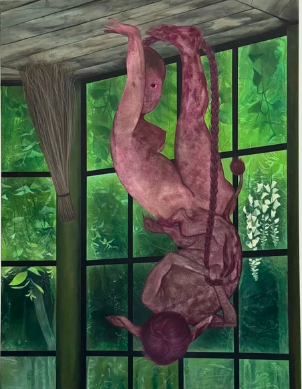
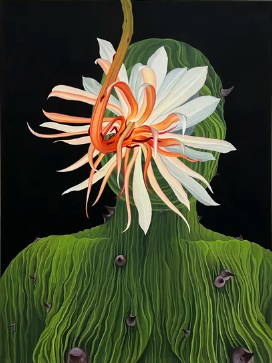
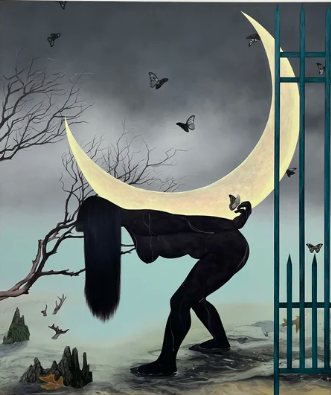
La representación simbólica, en su vertiente más elevada, no se contenta con la ilustración de mitologías conocidas, sino que las somete a una torsión que revela su vigencia o su fractura. Opal Mae Ong participa de esta forma de crítica cuando convierte la iconografía femenina, doméstica y vegetal en un campo de fuerzas donde lo primigenio y lo íntimo cotidiano se reconfiguran sin concesiones al idealismo fácil.
Su fuerza radica en una suerte de reconfiguración institucional que parte del cuerpo femenino como territorio simbólico primario para luego desplegarse en una geometría de lo sagrado y lo doméstico, de la luz milagrosa y el abismo instintivo. Su obra se inscribe así, en una tradición de representación simbólica que roza los límites mismos del diseño impresionista, esa zona fronteriza donde la figura amenaza con disolverse en mancha y la mancha, sin embargo, se pliega para alumbrar formas reconocibles. Ong, en lugar de limitarse a esta tradición, la retuerce desde una sensibilidad que integra el legado del modernismo abstracto, la iconografía filipina precolonial y una mitología personal que opera como un aparato crítico de primer orden.
La temática de su obra aborda, entre muchos otros, conceptos como la femineidad entendida en tanto fuente de vida y también como oscuridad primordial. En sus lienzos, la mujer no es únicamente la dadora de luz o la matriz amorosa que expande el mundo hacia la plenitud; es también el pozo sin fondo del instinto, la fuerza telúrica que puede ser tanto refugio como amenaza. Esta duplicidad se manifiesta en títulos como Mutter, Bitch’s Maldoror (Inner Saboteur) o The Gift & the Curse, donde el asunto de la maternidad se tensa hasta la ambigüedad, y la oscuridad de la pasión humana, despojada de todo idealismo romántico, aparece como un campo de fuerzas que la conciencia debe negociar sin posibilidad de dominio absoluto. La artista explora así una institución elemental —la de lo femenino como principio ordenador y desordenador a la vez— que la modernidad tardía ha intentado reducir a arquetipos complacientes o a meras construcciones discursivas. Ong la restituye en su materialidad conflictiva.
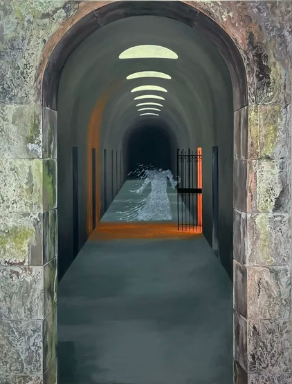
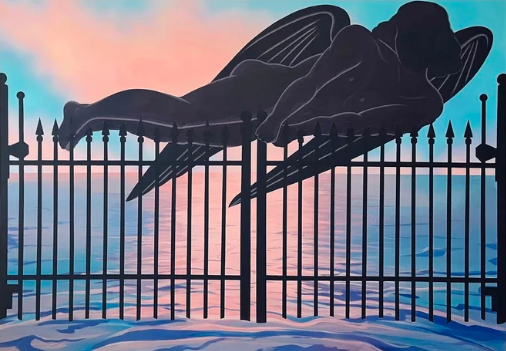
Esta indagación se complementa con una reflexión sobre el lugar del humano ante la creación racionalizada, especialmente a través de la geometría. Sus composiciones despliegan estructuras que evocan arquitecturas imaginarias, vitrales fracturados, retículas que contienen y a la vez fragmentan la figura. La geometría opera aquí como un dispositivo de tematización: pregunta por los límites entre lo natural y lo construido, por la posibilidad de dar forma racional a lo que en el fondo sigue siendo misterio. Las flores, los cuerpos entrelazados, los elementos vegetales que proliferan en su obra no se someten dócilmente a la cuadrícula; la desbordan, la interrumpen, la habitan de manera incómoda. Así, la pintura de Ong se convierte en un laboratorio donde se ensaya la coexistencia entre la necesidad humana de orden y la inagotable potencia de lo orgánico, entre el diseño y el accidente, entre la tradición simbólica heredada y la invención de nuevas formas.
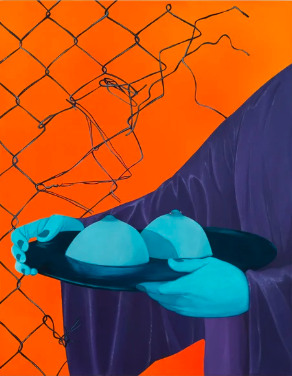
Uno de los aciertos más notables de su trabajo es la integración de la vida hogareña y las decisiones subconscientes como materiales de la misma dignidad pictórica. Títulos como Fingers Crossed, Hard to Hold, Knot With Want o Get Well Soon remiten a lo doméstico, al gesto íntimo, a la cotidianidad que la historia del arte ha solido relegar a la esfera de lo menor. Lo hogareño se vuelve entonces un espacio de resistencia y de revelación, el lugar donde la oscuridad del subconsciente se manifiesta en gestos mínimos, y donde la luz de la plenitud amorosa puede surgir de los objetos más comunes. De este modo se cuestiona la separación moderna entre lo público y lo privado, entre la esfera de lo trascendente y la esfera de lo doméstico, entre la gran narrativa mítica y la historia familiar.
La técnica empleada por Ong merece mención aparte. Su dominio de medios mixtos —acrílico, gouache, flashe y pastel sobre lienzo— le permite una flexibilidad expresiva que va desde la opacidad densa de las zonas más trabajadas hasta la transparencia casi acuarelesca de los fondos. Esta versatilidad técnica se corresponde con la ambigüedad temática que persigue: las figuras emergen y se disuelven, se afirman y se niegan, como si la materia pictórica misma estuviera sometida a la misma dialéctica entre presencia y ausencia que sus personajes. El uso del gouache, en particular, le otorga una capacidad para construir veladuras y texturas que acercan su trabajo a la caligrafía o al fresco, pero también a la mancha expresionista, sin que ninguna de estas referencias canónicas agote la singularidad de su propuesta.
Un mundo pictórico que parece ilustrar y, en cambio, cuestiona ideas, a la vez que reinventa mitologías desde una sensibilidad contemporánea anclada en la diáspora de la especie entera. Digno de abordaje.
[Todas las imágenes, el sitio web del artista: Opal Mae Ong]
(ENGLISH VERSION)
Primordial Darkness: An Approach to the Work of Opal Mae Ong
Translation by Tiffany Amber Elías Trimble
Symbolic representation, in its most elevated form, is not content with illustrating known mythologies, but subjects them to a torsion that reveals their validity or their fracture. Opal Mae Ong participates in this form of critique when she transforms feminine, domestic, and vegetal iconography into a field of forces where the primordial and the intimate everyday are reconfigured without concessions to easy idealism.
Her strength lies in a kind of institutional reconfiguration that starts with the female body as a primary symbolic territory and then unfolds into a geometry of the sacred and the domestic, of miraculous light and the instinctual abyss. Her work thus inscribes itself within a tradition of symbolic representation that brushes against the very limits of impressionist design—that border zone where the figure threatens to dissolve into stains and the stain, however, folds back to illuminate recognizable forms. Ong, rather than limiting herself to this tradition, twists it with a sensibility that integrates the legacy of abstract modernism, pre-colonial Filipino iconography, and a personal mythology that operates as a critical apparatus of the first order.
The thematic focus of her work addresses, among many others, concepts such as femininity understood both as a source of life and as primordial darkness. On her canvases, woman is not only the giver of light or the loving matrix that expands the world towards fullness; she is also the bottomless well of instinct, the telluric force that can be both refuge and threat. This duality manifests in titles such as Mutter, Bitch’s Maldoror (Inner Saboteur), or The Gift & the Curse, where the subject of motherhood is stretched to ambiguity, and the darkness of human passion, stripped of all romantic idealism, appears as a field of forces that consciousness must negotiate without the possibility of absolute dominion. The artist thus explores an elemental institution—the feminine as both ordering and disordering principle—that late modernity has attempted to reduce to complacent archetypes or mere discursive constructions. Ong restores it in its conflicting materiality.
This inquiry is complemented by a reflection on the place of the human in the face of rationalized creation, especially through geometry. Her compositions deploy structures that evoke imaginary architectures, fractured stained-glass windows, and grids that contain and simultaneously fragment the figure. Geometry operates here as a device of thematization: it questions the boundaries between the natural and the constructed, and the possibility of giving rational form to what remains, fundamentally, a mystery. The flowers, the intertwined bodies, and the vegetal elements that proliferate in her work do not docilely submit to the grid; they overflow it, interrupt it, and inhabit it uncomfortably. Thus, Ong’s painting becomes a laboratory where the coexistence between the human need for order and the inexhaustible potency of the organic, between design and accident, between inherited symbolic tradition and the invention of new forms, is rehearsed.
One of the most notable achievements of her work is the integration of domestic life and subconscious decisions as materials of the same pictorial dignity. Titles such as Fingers Crossed, Hard to Hold, Knot With Want, or Get Well Soon refer to the domestic, to the intimate gesture, to the everyday that the history of art has often relegated to the sphere of the minor. The domestic thus becomes a space of resistance and revelation, the place where the darkness of the subconscious manifests in minimal gestures, and where the light of loving fullness can emerge from the most common objects. In this way, the modern separation between the public and the private, between the sphere of the transcendent and the sphere of the domestic, and between the great mythical narrative and family history, is called into question.
The technique employed by Ong deserves special mention. Her mastery of mixed media—acrylic, gouache, flashe, and pastel on canvas—allows her an expressive flexibility that ranges from the dense opacity of the most worked areas to the almost watercolor-like transparency of the backgrounds. This technical versatility corresponds to the thematic ambiguity she pursues: figures emerge and dissolve, affirm and deny themselves, as if the pictorial matter itself were subject to the same dialectic between presence and absence as her characters. The use of gouache, in particular, gives her the capacity to build glazes and textures that bring her work closer to calligraphy or fresco, but also to the expressionist stain, without any of these canonical references exhausting the singularity of her proposal.
A pictorial world that seems to illustrate but instead questions ideas, while reinventing mythologies from a contemporary sensibility anchored in the diaspora of the entire species. Worthy of engagement.