
La vida no espera: Conversación con Krzysztof Powalka sobre su obra
Por Juan Pablo Torres Muñiz
La interrogación del cuerpo desde la fractura… La pintura de Krzysztof Powalka lo muestra en fragmentos, en planos facetados que niegan la continuidad anatómica, con un contraste intenso que evade el claroscuro barroco para plegarse más bien a una suerte de iluminación forense… sobre la condición humana. Cada figura parece suspendida, doblada por fuerzas que no controla. Ese cuerpo partido, que resiste la coherencia clásica, claramente niega la permanencia de uno mismo y expone la plasticidad forzosa de quien no puede esperar a que la vida se detenga. No hay tiempo para la pose ni para la consolidación identitaria o sus derivados, más o menos idealistas: el devenir arrastra y Powalka lo fija en gestos de tensión contenida, donde la fuerza personal se revela siempre como un empuje hacia el borde. Hacia la definición. Lo que queda, en la materia espesa del óleo, es la huella de una pregunta sobre la forma, ya no como atributo, sino como prueba: qué perdura cuando la figura se descompone en sus propias aristas.
Conversamos con él. Krzysztof despliega generosamente sus ideas…
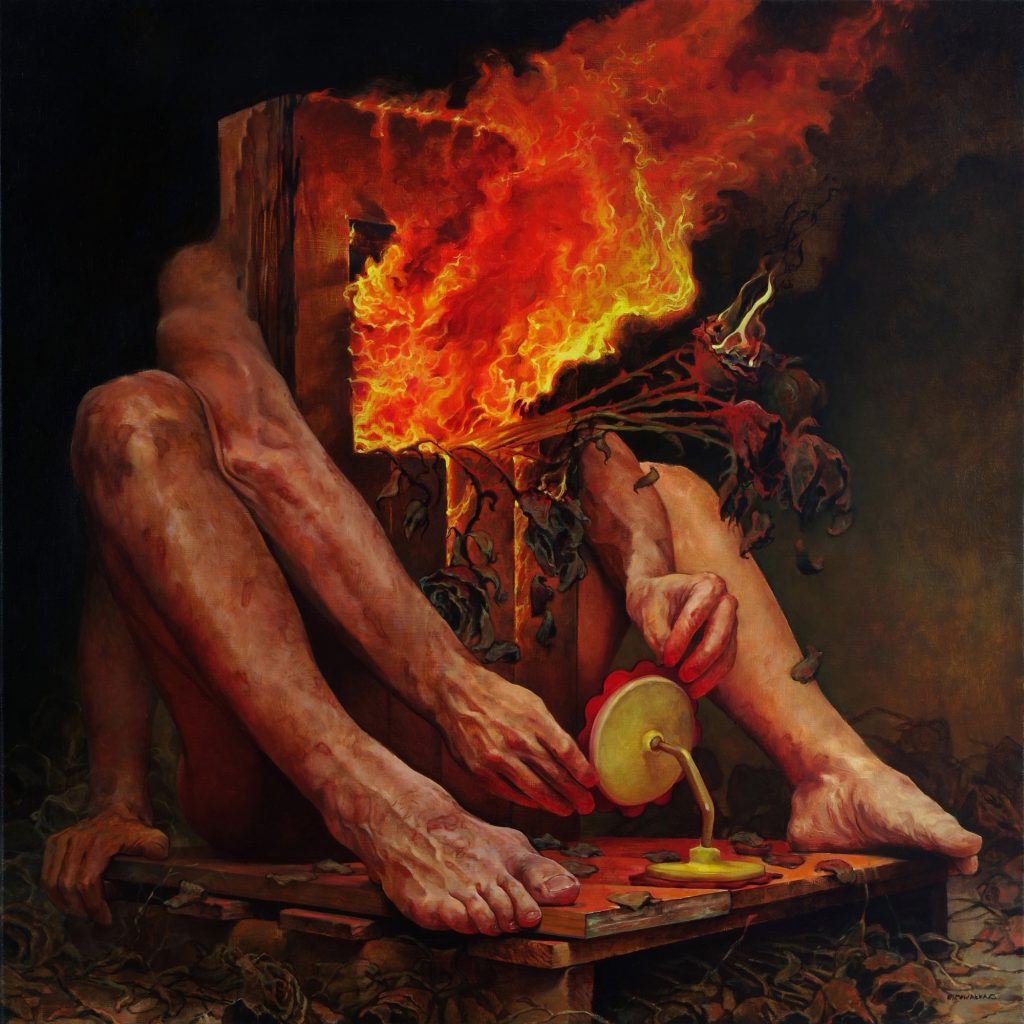
¿Desde cuándo y por qué la pintura? ¿Surge tu labor, acaso, como respuesta a un reclamo?
Cada una de mis pinturas nace de experiencias y vivencias personales. Todo aquello en lo que habitan las emociones influye en mi creación: desde el sentimiento de aislamiento y la lucha del individuo, pasando por caídas y ascensos, traiciones, pérdidas, muerte, alegría, felicidad y realización, hasta la política, la devastación de la naturaleza, las guerras, las ideologías y la religión.
Soy pintor psicorrealista. El psicorrealismo es mi manifiesto artístico, muy distinto del concepto de psicorrealismo surrealista desarrollado en el libro A Tale of Mother’s Bones. Mi psicorrealismo, es decir, un realismo psicológico, hunde sus raíces en el género literario de finales del siglo XIX y comienzos del XX. Mi narrativa pictórica se construye a partir de un lenguaje basado en el uso de objetos realistas, la figuración y formas reconocibles para el espectador contemporáneo. Al combinarse en la composición de manera no evidente e inquietante, estos elementos generan un discurso de carácter alegórico.
Considero que la pintura del realismo psicológico alcanza su mayor fuerza expresiva cuando los temas surgen de las propias vivencias y experiencias del psicorrealista. Este las somete a un proceso de análisis y reflexión internos, y las conclusiones resultantes se trasladan al lienzo. Resulta imposible representar la sensación de hambre de forma convincente y auténtica si no se ha experimentado; de lo contrario, solo sería una imagen incompleta de ese estado y, por tanto, algo artificial.
Recuerdo que uno de los factores que me llevó a dedicarme a la creación, y en consecuencia a la pintura, fue el sentimiento de incomprensión y desacuerdo con el mundo que me rodeaba, especialmente con el de mis coetáneos: un mundo a menudo cruel e injusto. Pensé en dedicarme al derecho, a la actividad benéfica, a la filosofía, a la enseñanza… a trabajar en ámbitos donde es posible ayudar, intentar resolver o al menos orientar la resolución de problemas existenciales y reales. También en ello veo el papel del creador contemporáneo, del artista. La idea de «el arte por el arte» no termina de convencerme. Al final elegí la pintura.
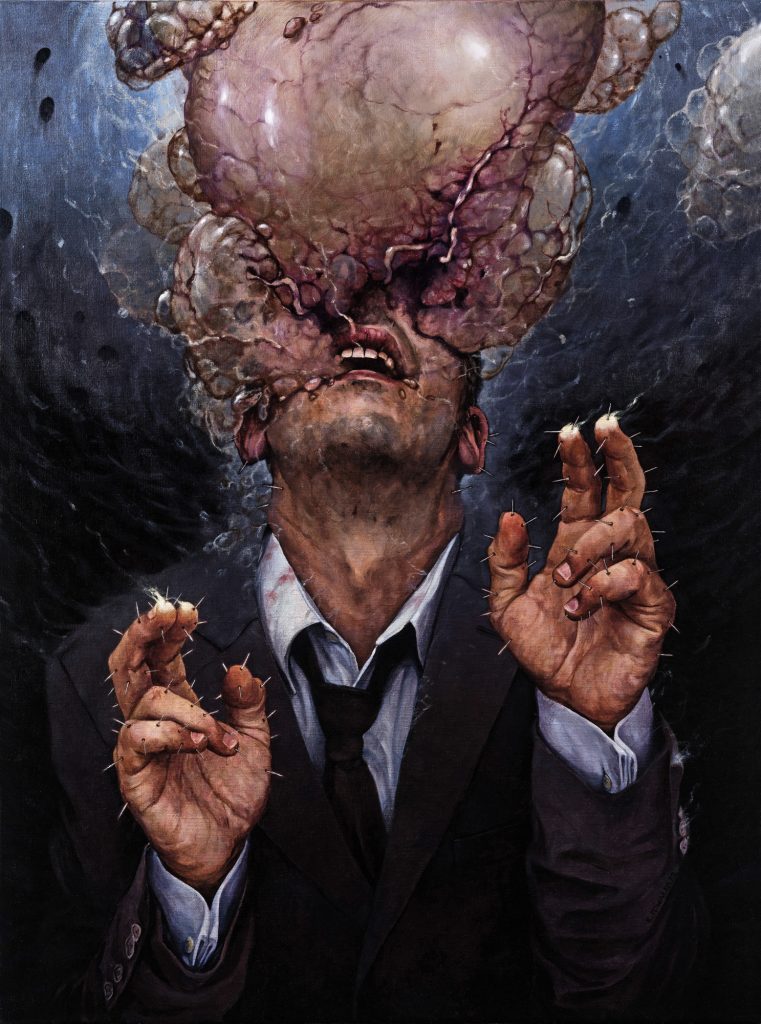
Tus principales influencias…
¿Por qué cuerpos? ¿Por qué nunca quietos? A menudo, incluso, se aprecia un facetado elocuente. ¿Qué relación ves entre la carne y el tiempo y el movimiento?
La verdad es que no tengo un artista favorito. Me atraen obras concretas de distintos creadores: desde la prehistoria, pasando por la Edad Media, el Renacimiento, el Barroco y otras épocas, hasta la contemporaneidad. Desde la pintura, que amo, hasta la ilustración, la arquitectura, el diseño, la artesanía, la cerámica, el cómic, el cine, la música, la poesía, el teatro o la ópera… En todos esos ámbitos, allí donde percibo y siento belleza, hacia allí se dirige mi atención, independientemente del nombre del autor.
Me interesa especialmente cuando, además de la belleza formal —la que percibimos con la vista y el oído—, aparece también la belleza de la idea, del mensaje: un contenido valioso que, más allá de la experiencia puramente estética, puede aportar algo a nuestra vida. Una cierta «sabiduría» que quizá llegue a manifestarse en lo cotidiano.
En el centro de mis reflexiones ideológicas y artísticas sitúo al ser humano: un individuo lleno de contradicciones, de virtudes, pero también de múltiples limitaciones. En el roce entre ellas se desarrolla la lucha entre los eternos dilemas de la condición humana: el bien y el mal, lo instintivo y lo primitivo… Un ser que se coloca en un pedestal por encima de todas las especies y, al mismo tiempo, es profundamente imperfecto, extraviándose cada día en los caminos de la vida.
Sus acciones, elecciones, decisiones, formas de sentir, conflictos y pensamientos son para mí una fuente inagotable de inspiración pictórica. A través de la idea del psicorrealismo intento levantar el velo de lo que ocurre en la psique humana: ese mundo interior, intuitivamente tangible pero invisible, que influye de manera decisiva en el mundo exterior que compartimos.
Con mi pintura quiero llamar la atención sobre los problemas de la existencia humana y su trasfondo psicológico. Es ahí donde, a mi juicio, la creación encuentra su razón de ser y una fuente inagotable de inspiración. No es una tarea sencilla, ya que el mundo actual dispone cada vez de menos tiempo para el análisis y la reflexión. Sin embargo, a pesar del paso de los años, sigo creyendo que vale la pena intentarlo, porque está en juego lo más importante: el ser humano.
El interior del ser humano, su psique y sus emociones, es un campo de batalla constante: es ahí donde nacen tanto el bien como el mal. Se trata de territorios aún no del todo explorados ni comprendidos, incluso con el desarrollo de la tecnología. Mientras tanto, la humanidad piensa en la conquista del espacio, en nuevas tecnologías, en sustituir el cuerpo por la robótica… pero parece olvidar lo esencial. Si no logra imponerse en esta batalla eterna entre el bien y el mal, cualquier nuevo mundo —por lejano que sea— estará condenado al fracaso.
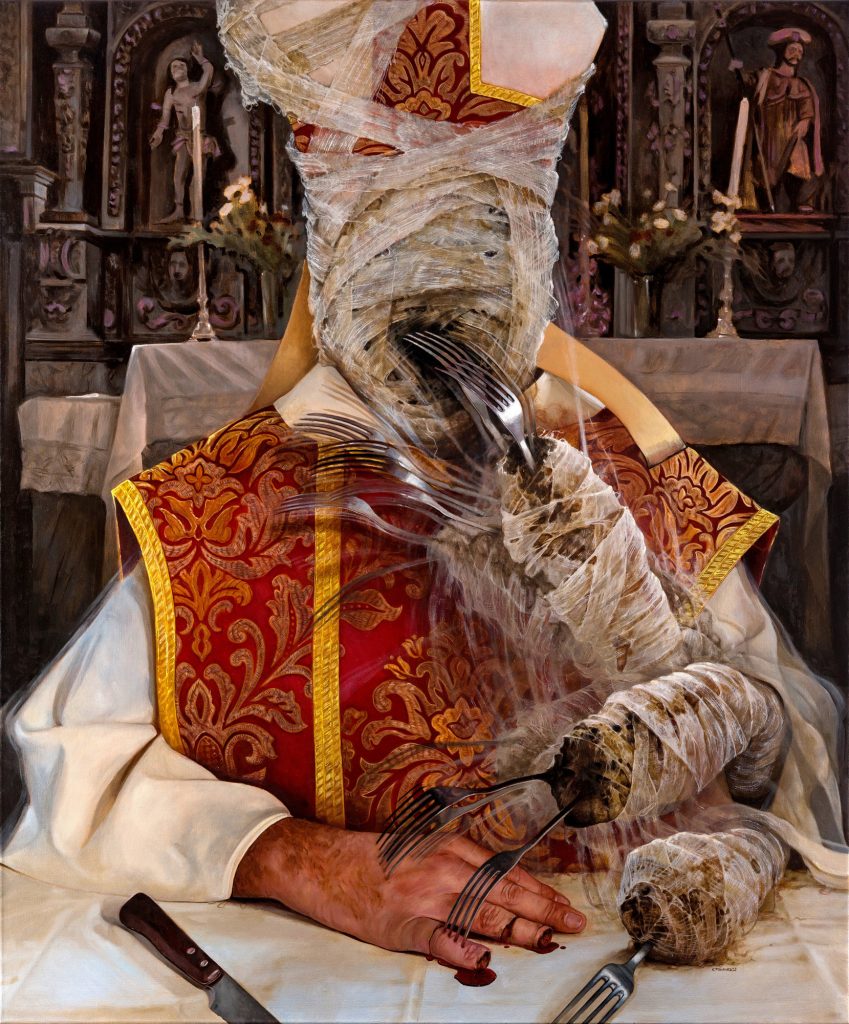
¿En qué medida cabe entender tu planteamiento como una aproximación a la fragilidad humana desde la anatomía? Los cuerpos se comunican; cada pose, gesto o ademán lleva consigo una carga…, pero la interpretación es un asunto aparte. ¿Cómo concibes el balance entre expresión y alegoría en tu obra?
Hoy, el mundo contemporáneo —y, por tanto, las personas que lo habitan— vive marcado por problemas urgentes que siguen sin resolverse. Desde cuestiones globales como la guerra en Ucrania, la tragedia en Gaza o el espectro de una nueva “guerra fría”, con el consiguiente temor a un conflicto nuclear, hasta el hambre y la pobreza en las regiones más desfavorecidas, en contraste con la prosperidad y la acumulación de riqueza en manos de unos pocos. A esto se suman la devastación del medio ambiente, el calentamiento global, la omnipresencia del plástico, la desaparición de especies animales y vegetales, la contaminación y la escasez de agua potable, así como la deforestación y la desertificación de amplias zonas del planeta.
En el ámbito social, persisten luchas como la del reconocimiento pleno de los derechos de las mujeres y de las personas LGBT. Se evidencian también las carencias de los sistemas educativos, sanitarios y de bienestar. Los desafíos relacionados con las migraciones, la integración y la incomprensión entre culturas generan con frecuencia miedo y rechazo hacia «el otro». A ello se añade la crisis —moral y práctica— de diversas religiones que durante siglos se consideraron guías infalibles de la humanidad. Y, por si fuera poco, emerge el lado más oscuro de la digitalización, la tecnología y la inteligencia artificial, que ya ha comenzado a mostrar su impacto sobre el Homo sapiens. Y esto no es más que el inicio de una transformación que podría incluso llegar a desplazar al ser humano: un ser que, pese a su inteligencia, sensibilidad y capacidad, sigue siendo frágil e incapaz de resolver incluso algunos de sus problemas más básicos.
Me parece que cualquier persona creativa, empática y sensible no puede permanecer indiferente ante estas cuestiones —aquí solo esbozadas—. Todas ellas influyen también en mi pintura; podría decir que están presentes, de una u otra forma, en casi todas mis obras. Considero que una pintura, y en particular una pintura psicorrealista, debe ser polisémica, abierta a múltiples interpretaciones.
Uno de los objetivos del psicorrealismo es buscar caminos que contribuyan a mejorar la condición humana o, al menos, a visibilizar determinados problemas, rozando las preguntas fundamentales de la existencia. En los «psico-cuadros», el pintor expresa su postura sobre cuestiones sociales o políticas mediante la combinación de símbolos. Sin embargo, en el psicorrealismo nada se expone de forma literal: el mensaje debe construirse pictóricamente de tal manera que conmueva la sensibilidad, altere la calma y despierte emociones intensas, invitando a la reflexión.
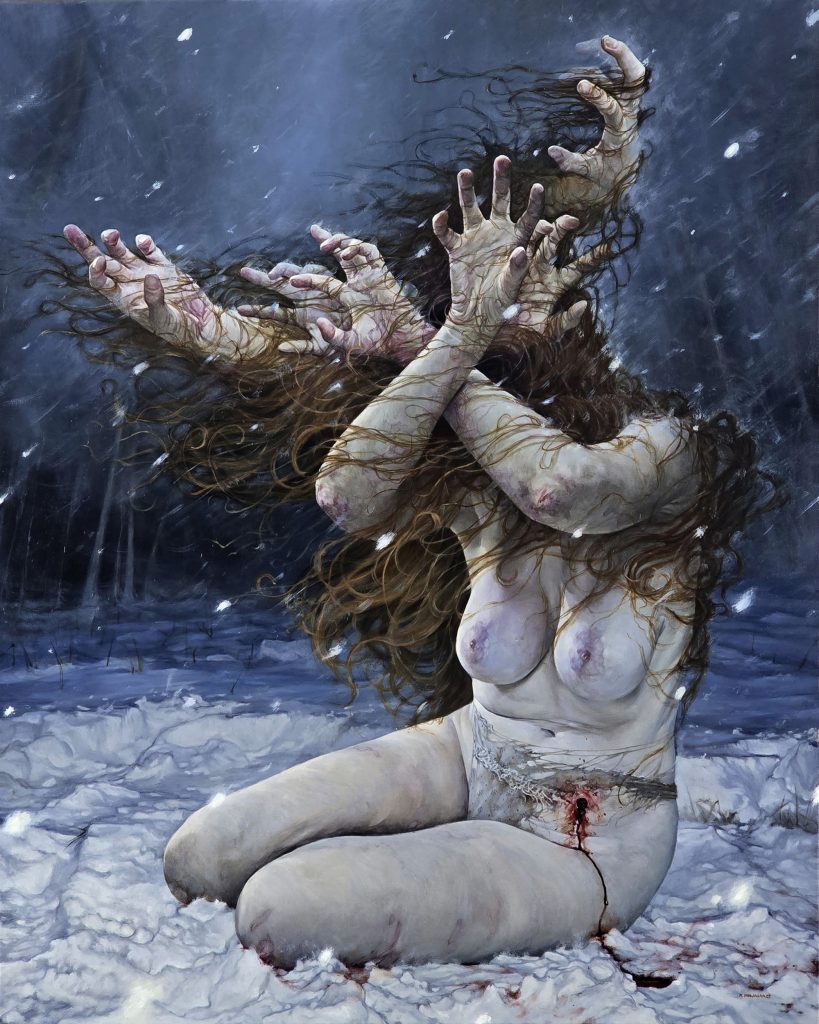
La pintura psicorrealista busca establecer un diálogo con el espectador a través de los recursos expresivos del propio cuadro. La figuración y el simbolismo constituyen su alfabeto, el medio por el cual la obra «habla». No pretende convertirse en un monólogo hermético que relegue al espectador al papel de oyente pasivo. El psicorrealista no puede eliminarse por completo de ese intercambio, pero sí deja siempre abierta la interpretación. El artista crea el pretexto y el motivo de ese encuentro, sugiriendo y orientando con sutileza la mirada del espectador.
De ahí la importancia de los títulos en la pintura del realismo psicológico: sirven para señalar que ese «encuentro-diálogo» gira en torno a un determinado problema. Entiendo que cada espectador, condicionado por sus propias experiencias, su estado de ánimo y sus emociones, percibirá algo distinto de lo que el pintor tenía en mente durante el proceso creativo. Es natural: somos personas diferentes. Y, sin embargo, eso no impide que podamos dialogar sobre un mismo tema desde perspectivas diversas, enriqueciéndonos con experiencias ajenas. Porque es precisamente en el diálogo y en la confrontación con el otro —en este caso, con el ser humano que se oculta tras el lienzo— donde podemos definirnos, cuestionarnos y quizá llegar a conclusiones nuevas. En ese intercambio reside la posibilidad de crecer, transformarnos y evolucionar.
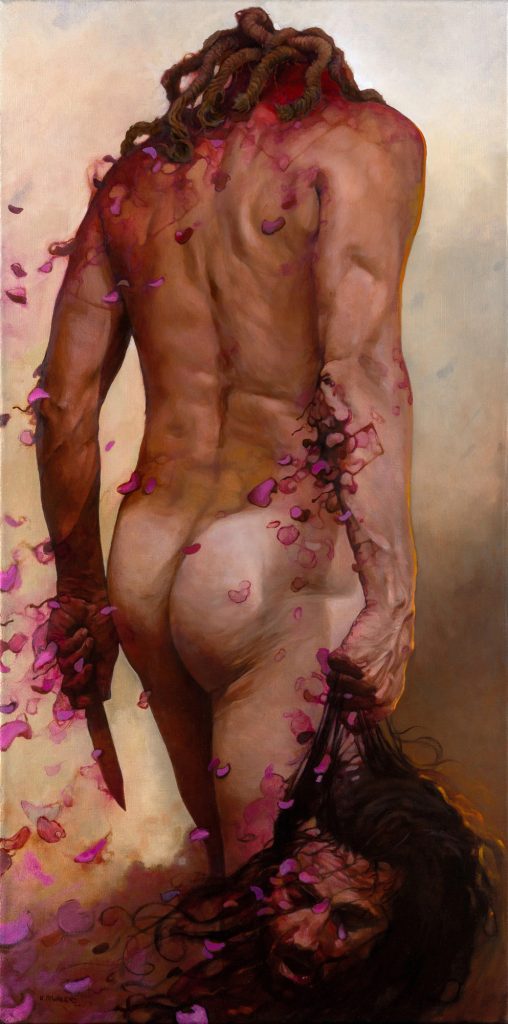
¿Qué papel cumplen en tu obra, el desgarro y lo monstruoso?
A menudo abordo temas bastante oscuros, controvertidos, considerados «problemáticos», aunque no siempre lo sean para mí de manera personal. Donde unos siguen viendo oscuridad, otros quizá ya perciben la luz. Aun así, creo que es necesario hablar —y pintar— más sobre los problemas, los miedos y las controversias. Al fin y al cabo, el simple hecho de articularlos —en este caso, de representarlos pictóricamente— y reconocer su existencia nos acerca un paso más a su posible resolución.
Al comprender la complejidad de la naturaleza humana, percibo claramente su carácter dicotómico. Veo una tensión constante, una división entre la luz y la oscuridad, entre lo corporal y lo espiritual, entre la emoción y el intelecto. Y, sin embargo, aunque por un lado estas esferas parecen excluirse mutuamente, por otro se complementan, dando lugar a una totalidad, a una forma de armonía. Esa misma armonía es la que intento plasmar en mi pintura.
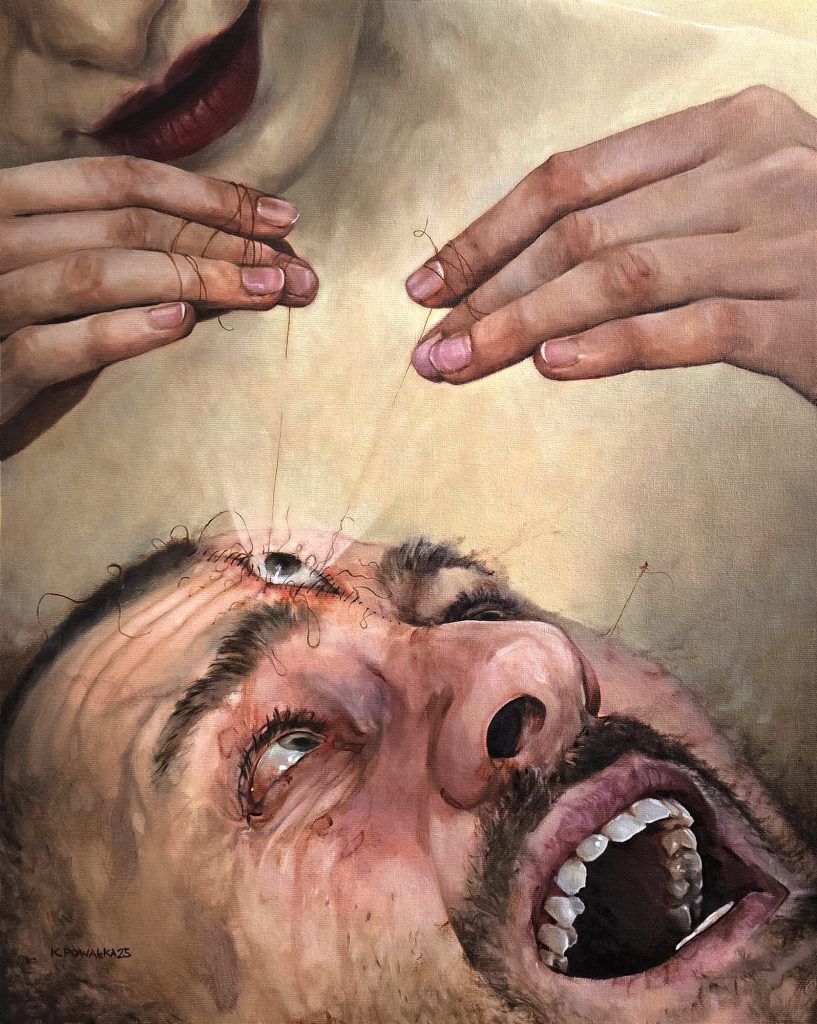
La composición, las formas y el color dicen en conjunto lo suyo, pero ¿cómo fragua cada imagen? ¿Qué tanto ocurre fuera del lienzo y qué tanto dentro de él?
Al comienzo, lo primero es que aparezca una idea, un concepto. Después, necesito responderme a una pregunta fundamental: «¿Por qué querría pintarlo? ¿Por qué debería dedicarle varios meses de trabajo a este cuadro en concreto? ¿Realmente lo merece? Y, si es así, ¿por qué?». Si encuentro respuestas afirmativas y convincentes, entonces puedo seguir adelante.
En una segunda etapa, reflexiono sobre la composición, la forma, el color… qué elegir para expresar de la mejor manera posible —según mi criterio— el conjunto del tema en el lienzo. Luego vienen los primeros bocetos: composiciones, distribución de la luz (si es relevante), etc. Suelen ser pequeños dibujos que, a veces, adquieren una forma más definida y, otras, no.
Cuando este punto está más o menos resuelto, comienzo a buscar y reunir lo que llamo “material de apoyo pictórico”: por lo general, fotografías, sesiones con modelos, referencias cromáticas, notas, bocetos antiguos… todo aquello que pueda servirme durante el proceso creativo. Mientras tanto, sigo analizando y transformando la idea que quiero plasmar en el lienzo. En mi caso, esa idea inicial nunca es definitiva, ya que evoluciona durante el propio acto de pintar. Confío más en el proceso y en la intuición pictórica que en un cálculo frío o en la simple traslación de una imagen o idea ya cerrada al lienzo.
Es solo entonces cuando entro en el estudio. Preparo el lienzo —ensamblo el bastidor, lo tenso, lo encolo y aplico la imprimación—, un proceso que suele llevar varios días. Cuando todo está listo y el lienzo blanco descansa sobre el caballete, me siento frente a él y contemplo ese vacío.
Antes de empezar, necesito realizar una serie de pequeños “rituales” sin los cuales me resulta imposible crear: elegir la música adecuada, preparar té, barrer el suelo y preparar una mezcla de frutos secos y pasas. Puede sonar curioso, pero sé que, si no cumplo con estas sencillas acciones, mi proceso creativo no se pone en marcha.
Por lo general, empiezo a pintar por la mañana y hago la primera pausa hacia la hora de comer, para después regresar al estudio y continuar hasta tarde. A menudo, además de los días laborales habituales, también vuelvo a pintar durante los fines de semana.
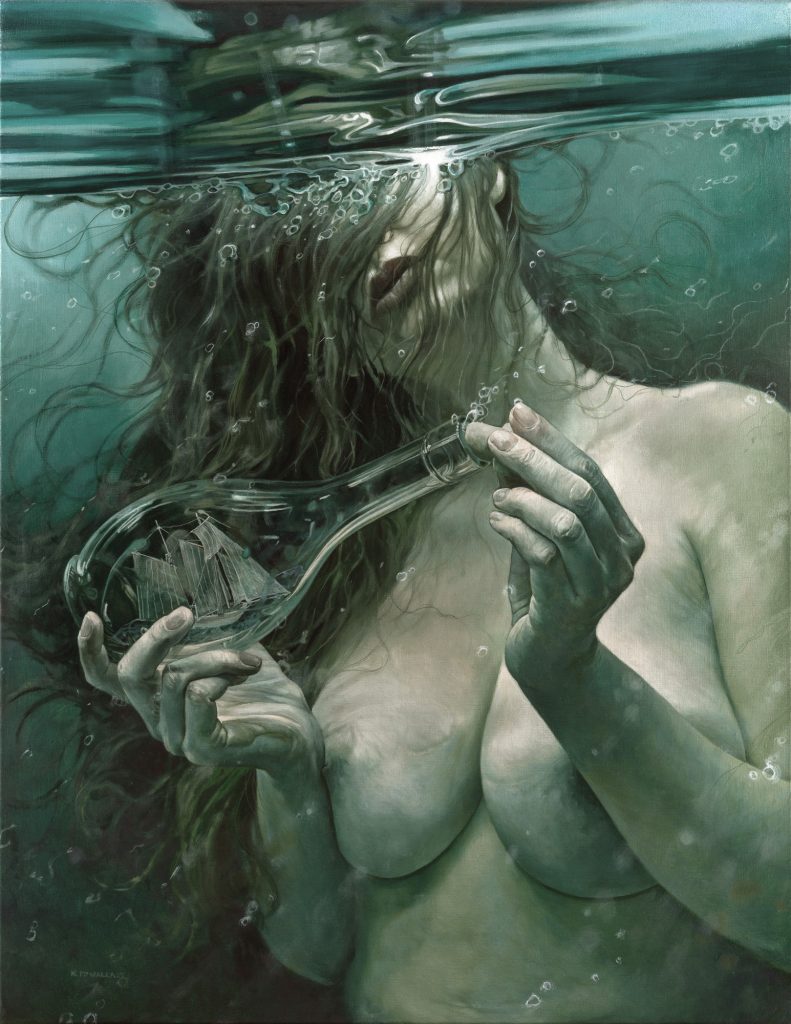
¿Hacia dónde se dirige tu obra a futuro?
En este momento estoy planificando varias exposiciones en lugares interesantes, pero hasta que no se tomen decisiones definitivas, prefiero no hablar de ellas. Mi mayor dificultad es reunir una cantidad suficiente de obras para una muestra: prácticamente todas se encuentran en colecciones privadas y el proceso de préstamo no siempre es sencillo.
No suelo pensar en el futuro ni en la evolución de mi trabajo creativo… Eso no se puede prever: hay que pintarlo y disfrutar del propio proceso de creación. Percibo ciertos cambios en mi pintura —y es positivo comprobar que evoluciona con el paso de los años—, pero no tengo claro adónde me llevarán. Es una gran incógnita, y el horizonte siempre parece alejarse.
Lo único seguro es que, como en el verso de Alfred Tennyson en Ulises, «la voluntad permanece firme: luchar, buscar, encontrar y no ceder».
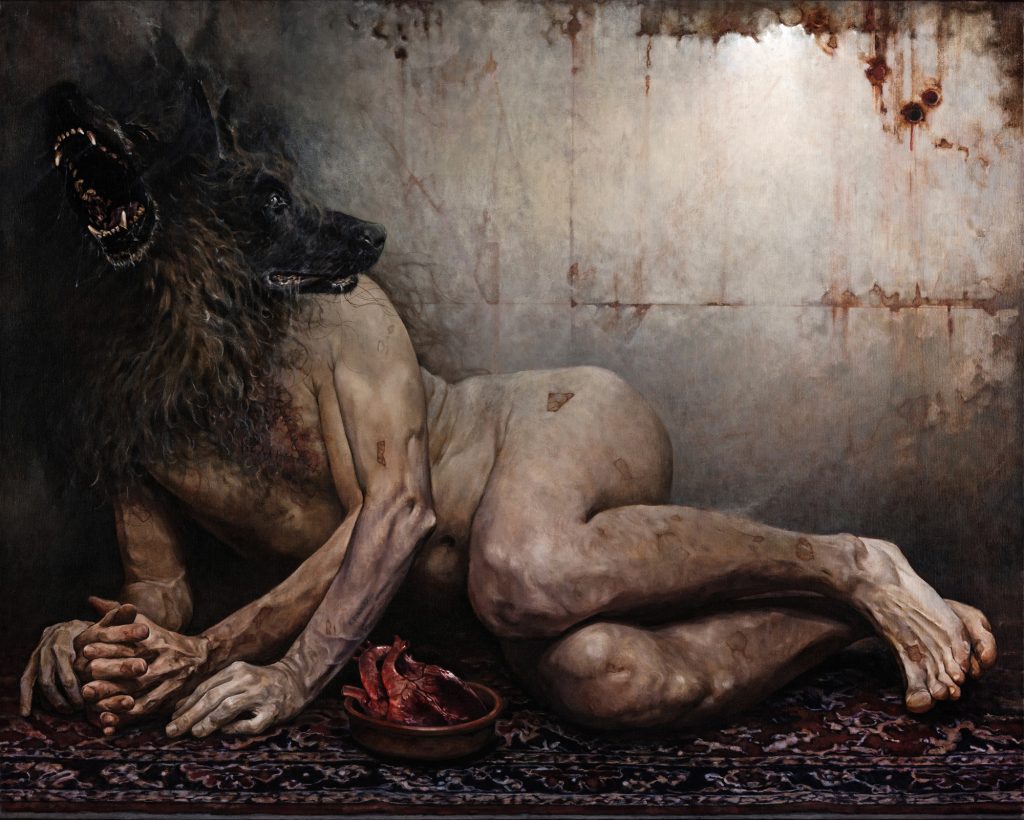
(ENGLISH VERSION)
Life Does Not Wait: A Conversation with Krzysztof Powalka about His Work
Translated by Tiffany Amber Elías Trimble
The interrogation of the body from fracture… Krzysztof Powalka’s painting shows it in fragments, in faceted planes that deny anatomical continuity, with an intense contrast that avoids Baroque chiaroscuro rather leaning towards a kind of forensic illumination… about the human condition. Each figure appears suspended, bent by forces it does not control. That broken body, resisting classical coherence, clearly denies the permanence of the self and exposes the forced plasticity of one who cannot wait for life to stop. There is no time for the pose nor for identity consolidation or its derivatives, more or less idealistic: becoming drags us along and Powalka fixes it in gestures of contained tension, where personal strength always reveals itself as a push towards the edge. Towards definition. What remains, in the dense matter of oil, is the trace of a question about form, no longer as an attribute, but as a test: what endures when the figure decomposes into its own edges.
We spoke with him. Krzysztof generously unfolds his ideas…
Since when and why painting? Does your work arise, perhaps, as a response to a demand?
Each of my paintings is born from personal experiences and events. Everything in which emotions dwell influences my creation: from the feeling of isolation and the individual’s struggle, through falls and rises, betrayals, losses, death, joy, happiness and fulfillment, to politics, the devastation of nature, wars, ideologies, and religion.
I am a psychorealist painter. Psychorealism is my artistic manifesto, very different from the concept of surrealist psychorealism developed in the book A Tale of Mother’s Bones. My psychorealism, that is, a psychological realism, sinks its roots into the literary genre of the late 19th and early 20th centuries. My pictorial narrative is constructed from a language based on the use of realistic objects, figuration, and forms recognizable to the contemporary viewer. When combined in the composition in a non-evident and unsettling way, these elements generate a discourse of an allegorical nature.
I consider that painting of psychological realism achieves its greatest expressive strength when the themes arise from the psychorealist’s own experiences and events. He subjects these to a process of internal analysis and reflection, and the resulting conclusions are transferred to the canvas. It is impossible to represent the sensation of hunger convincingly and authentically if one has not experienced it; otherwise, it would only be an incomplete image of that state and, therefore, something artificial.
I recall that one of the factors that led me to devote myself to creation, and consequently to painting, was the feeling of incomprehension and disagreement with the world around me, especially with that of my contemporaries: a world often cruel and unjust. I thought about studying law, charitable activity, philosophy, teaching… working in fields where it is possible to help, try to solve, or at least guide the resolution of existential and real problems. I also see this as the role of the contemporary creator, of the artist. The idea of «art for art’s sake» does not fully convince me. In the end, I chose painting.
Your main influences…
Why bodies? Why never still? Often, even, an eloquent faceting is appreciated. What relationship do you see between flesh, time, and movement?
The truth is, I don’t have a favorite artist. I am attracted to specific works by different creators: from prehistory, through the Middle Ages, the Renaissance, the Baroque, and other eras, to the contemporary. From painting, which I love, to illustration, architecture, design, craftsmanship, ceramics, comics, film, music, poetry, theater, or opera… In all these fields, wherever I perceive and feel beauty, my attention is drawn, regardless of the author’s name.
I am especially interested when, in addition to formal beauty —that which we perceive with sight and hearing— the beauty of the idea, of the message, also appears: a valuable content that, beyond the purely aesthetic experience, can contribute something to our lives. A certain «wisdom» that might even manifest in everyday life.
At the center of my ideological and artistic reflections I place the human being: an individual full of contradictions, virtues, but also multiple limitations. In the friction between these, the struggle between the eternal dilemmas of the human condition unfolds: good and evil, the instinctive and the primitive… A being who places himself on a pedestal above all other species and, at the same time, is deeply imperfect, losing his way every day on the paths of life.
His actions, choices, decisions, ways of feeling, conflicts, and thoughts are for me an inexhaustible source of pictorial inspiration. Through the idea of psychorealism, I try to lift the veil on what happens in the human psyche: that inner world, intuitively tangible but invisible, which decisively influences the outer world we share.
With my painting, I want to draw attention to the problems of human existence and its psychological background. It is there that, in my opinion, creation finds its reason for being and an inexhaustible source of inspiration. It is not a simple task, since the current world has less and less time for analysis and reflection. However, despite the passage of years, I still believe it is worth trying, because what is at stake is the most important thing: the human being.
The interior of the human being, his psyche and emotions, is a constant battlefield: it is there that both good and evil are born. These are territories not yet fully explored or understood, even with the development of technology. Meanwhile, humanity thinks about conquering space, new technologies, replacing the body with robotics… but seems to forget the essential. If it does not succeed in this eternal battle between good and evil, any new world —no matter how distant— will be doomed to failure.
To what extent can your approach be understood as an approximation to human fragility through anatomy? The bodies communicate; each pose, gesture, or movement carries a charge… but interpretation is a separate matter. How do you conceive the balance between expression and allegory in your work?
Today, the contemporary world —and therefore the people who inhabit it— lives marked by urgent problems that remain unresolved. From global issues such as the war in Ukraine, the tragedy in Gaza, or the specter of a new «cold war,» with the consequent fear of nuclear conflict, to hunger and poverty in the most disadvantaged regions, in contrast to the prosperity and accumulation of wealth in the hands of a few. Added to this are the devastation of the environment, global warming, the omnipresence of plastic, the disappearance of animal and plant species, pollution, and the scarcity of drinking water, as well as deforestation and desertification of vast areas of the planet.
In the social sphere, struggles persist such as the full recognition of women’s and LGBT people’s rights. Deficiencies in educational, health, and welfare systems are also evident. Challenges related to migration, integration, and misunderstanding between cultures often generate fear and rejection of «the other.» Added to this is the crisis —moral and practical— of various religions that for centuries were considered infallible guides of humanity. And, as if that were not enough, the darkest side of digitalization, technology, and artificial intelligence emerges, which has already begun to show its impact on *Homo sapiens*. And this is only the beginning of a transformation that could even end up displacing the human being: a being who, despite his intelligence, sensitivity, and capacity, remains fragile and incapable of solving even some of his most basic problems.
It seems to me that any creative, empathetic, and sensitive person cannot remain indifferent to these issues —only sketched out here. All of them also influence my painting; I could say that they are present, in one way or another, in almost all my works. I believe that a painting, and particularly a psychorealist painting, must be polysemic, open to multiple interpretations.
One of the objectives of psychorealism is to seek paths that contribute to improving the human condition or, at least, to making certain problems visible, touching on the fundamental questions of existence. In «psycho-paintings,» the painter expresses his stance on social or political issues through the combination of symbols. However, in psychorealism, nothing is presented literally: the message must be constructed pictorially in such a way that it moves the sensibility, disturbs the calm, and awakens intense emotions, inviting reflection.
Psychorealist painting seeks to establish a dialogue with the viewer through the expressive resources of the painting itself. Figuration and symbolism constitute its alphabet, the means by which the work «speaks.» It does not aim to become a hermetic monologue that relegates the viewer to the role of passive listener. The psychorealist cannot completely eliminate themselves from that exchange, but they always leave interpretation open. The artist creates the pretext and the reason for that encounter, subtly suggesting and guiding the viewer’s gaze.
Hence the importance of titles in psychological realism painting: they serve to indicate that this «encounter-dialogue» revolves around a specific problem. I understand that each viewer, conditioned by their own experiences, mood, and emotions, will perceive something different from what the painter had in mind during the creative process. It is natural: we are different people. And yet, that does not prevent us from dialoguing about the same topic from diverse perspectives, enriching ourselves with others’ experiences. Because it is precisely in dialogue and confrontation with the other —in this case, with the human being hidden behind the canvas— that we can define ourselves, question ourselves, and perhaps reach new conclusions. In that exchange lies the possibility of growing, transforming, and evolving.
What role do tearing and the monstrous play in your work?
I often address quite dark, controversial themes considered «problematic,» although they are not always so for me personally. Where some still see darkness, others may already perceive light. Even so, I believe it is necessary to speak —and paint— more about problems, fears, and controversies. After all, the simple act of articulating them —in this case, representing them pictorially— and acknowledging their existence brings us one step closer to their possible resolution.
In understanding the complexity of human nature, I clearly perceive its dichotomous character. I see a constant tension, a division between light and darkness, between the corporeal and the spiritual, between emotion and intellect. And yet, although on one hand these spheres seem to exclude each other, on the other they complement each other, giving rise to a totality, a form of harmony. That very harmony is what I try to capture in my painting.
Composition, forms, and color each say something, but how does each image take shape? How much happens outside the canvas and how much inside it?
At the beginning, the first thing is for an idea or concept to appear. Then, I need to answer a fundamental question: «Why would I want to paint it? Why should I dedicate several months of work to this particular painting? Does it really deserve it? And, if so, why?» If I find affirmative and convincing answers, then I can move forward.
In a second stage, I reflect on composition, form, color… what to choose to express in the best possible way —according to my criteria— the entirety of the theme on the canvas. Then come the first sketches: compositions, light distribution (if relevant), etc. They are usually small drawings that sometimes take on a more defined shape and other times not.
When this point is more or less resolved, I begin to search for and gather what I call «pictorial support material»: generally, photographs, sessions with models, color references, notes, old sketches… everything that might serve me during the creative process. Meanwhile, I continue analyzing and transforming the idea I want to capture on the canvas. In my case, that initial idea is never definitive, as it evolves during the very act of painting. I trust more in the process and pictorial intuition than in a cold calculation or the simple transfer of a closed image or idea onto the canvas.
Only then do I enter the studio. I prepare the canvas —assemble the stretcher, stretch it, size it, and apply the primer— a process that usually takes several days. When everything is ready and the white canvas rests on the easel, I sit in front of it and contemplate that void.
Before starting, I need to perform a series of small «rituals» without which I find it impossible to create: choose the right music, prepare tea, sweep the floor, and prepare a mix of nuts and raisins. It may sound curious, but I know that if I don’t comply with these simple actions, my creative process doesn’t get started.
I usually start painting in the morning and take my first break around lunchtime, then return to the studio and continue until late. Often, in addition to the regular workdays, I also go back to paint during weekends.
Where is your work headed in the future?
Right now, I am planning several exhibitions in interesting places, but until final decisions are made, I prefer not to talk about them. My biggest difficulty is gathering enough works for an exhibition: practically all of them are in private collections, and the loan process is not always simple.
I don’t usually think about the future or the evolution of my creative work… That cannot be foreseen: you have to paint it and enjoy the creative process itself. I perceive certain changes in my painting —and it is positive to see that it evolves over the years— but I am not sure where they will lead me. It is a great unknown, and the horizon always seems to recede.
The only sure thing is that, as in Alfred Tennyson’s verse in *Ulysses*, «the will remains firm: to strive, to seek, to find, and not to yield.»