
La intimidad quebrada: Aproximación a la obra de Taner Yilmaz
Por Juan Pablo Torres Muñiz
Hay en la tradición pictórica de la representación familiar —esa que va del retrato burgués holandés a las escenas domésticas decimonónicas— un impulso fundamentalmente legitimador: mostrar el orden, la continuidad, la calidez del hogar como institución afectiva. La familia comparece ante el lienzo en su mejor compostura, exhibiendo aquello que desea ser visto y, sobre todo, recordado. Pero esta ceremonia de lo aparentemente sólido esconde, como cualquier rito, aquello que precisamente busca conjurar: el desorden, lo que no encaja, la grieta por donde la intimidad se desfonda. La obra de Taner Yilmaz irrumpe en esta tradición para desmontarla.
Nacido en Frankfurt en 1981 y afincado en Turquía, Yilmaz ha construido una obra que, desde una formación en los grandes maestros del retrato —Velázquez, Rembrandt—, opera una inversión de sus presupuestos. Donde el retrato clásico buscaba la fijación de una identidad estable, reconocible, casi legible en su fisonomía, Yilmaz presenta rostros parcialmente borrados, superposiciones de capas transparentes, rasgos que se disuelven en la misma textura pictórica. Aquí, la identidad es una memoria que se reescribe sin cesar sobre lo que alguna vez se creyó definitivo.
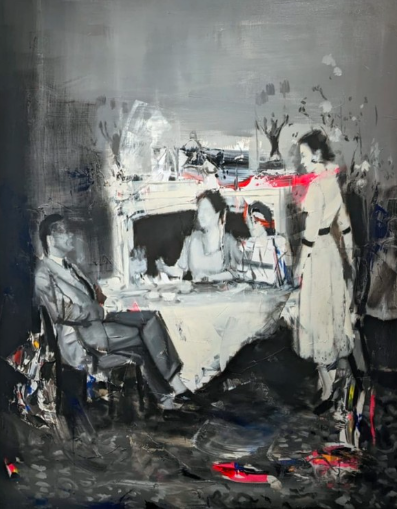
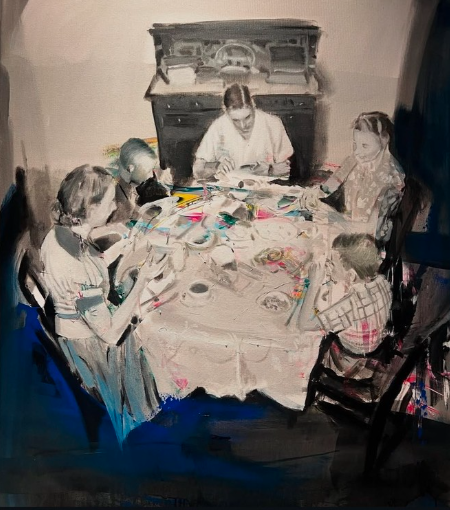
La escena familiar —una comida, la mesa puesta, los utensilios de colores vibrantes— se ve atravesada por una iluminación de claroscuro que recuerda a Caravaggio, pero aplicada a un contexto deliberadamente anodino. Lo que debiera ser cálido se vuelve escenario de una intensidad notablemente dramática, como si tras la normalidad de la convivencia se ocultara algo que no termina de decirse. El hogar, ese espacio de supuesto resguardo, se revela en la obra de Yilmaz como la cede de la desfiguración de uno mismo. No porque ocurran allí eventos trágicos, sino porque la propia intimidad —esa promesa de autenticidad— se construye sobre la repetición de gestos heredados, sobre rituales cuyo significado se ha perdido y que, sin embargo, seguimos ejecutando. La familia, lejos de ser el refugio del individuo frente al mundo, es el primer elemento que moldea —y por tanto limita— lo que ese individuo puede llegar a ser.
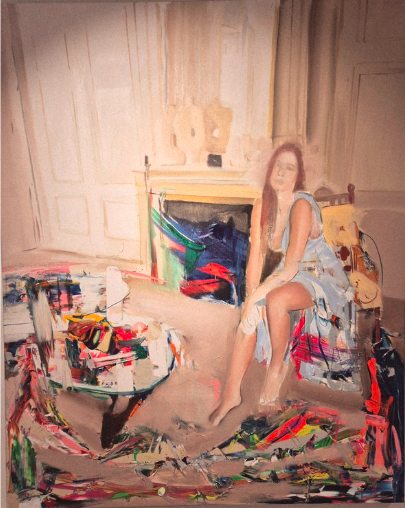
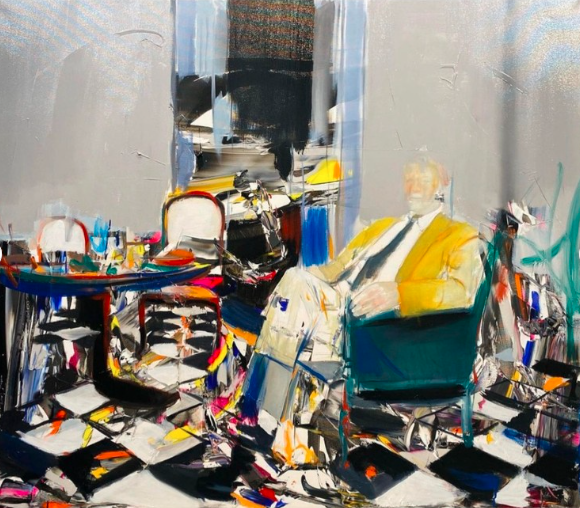
Esta desfiguración opera con especial virulencia en el tratamiento del espacio doméstico. Los muebles tradicionales aparecen tratados con manchas audaces de color, fragmentados, como si la estabilidad del hogar fuera una ilusión sostenida apenas por la convención. La pincelada expresionista y el recurso al cubismo constituyen la forma misma de una pregunta sobre la consistencia de lo que llamamos «nuestro» entorno. ¿Acaso los objetos que nos rodean nos pertenecen, o más bien nos pertenecen a nosotros, fijándonos en una red de significaciones que no hemos elegido?
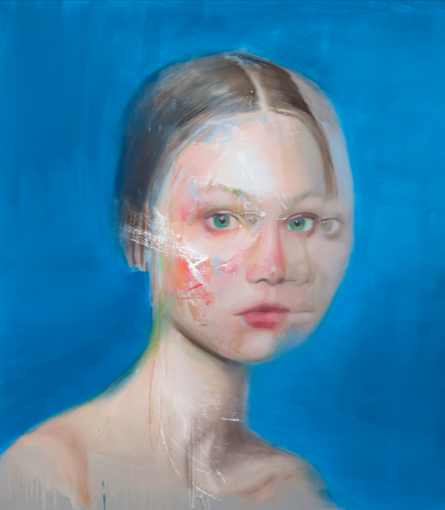
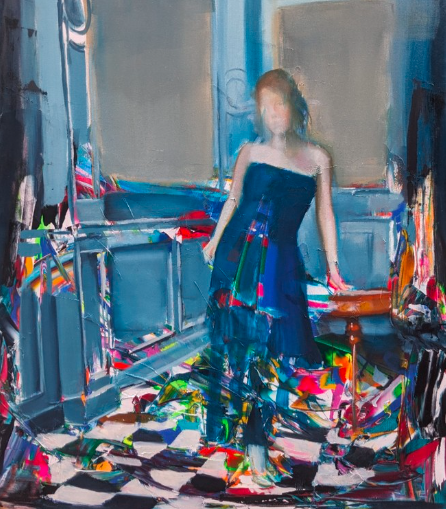
En los retratos, el rostro femenino aparece parcialmente erosionado por la técnica: capas superpuestas, texturas dinámicas, rasgos que se difuminan en los bordes. La mirada, sin embargo, permanece intensa, casi punzante, como si la identidad se resistiera a desaparecer incluso cuando el soporte que la contiene se disuelve. Esta tensión entre presencia y ausencia, entre lo que se muestra y lo que se retira, es el núcleo mismo de la propuesta del artista. No se trata de representar a alguien, sino de hacer visible el proceso por el cual alguien deviene en lo que es —o, más bien, en lo que parece ser.
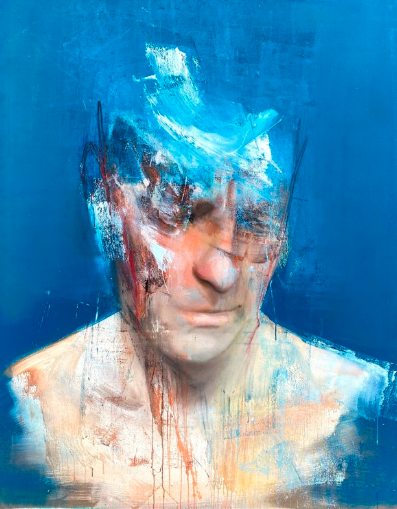
En vario cuadros, el fondo vibrante acentúa el contraste con el rostro tratado mediante veladuras transparentes, creando un efecto de movimiento y profundidad que sugiere la imposibilidad de fijar definitivamente una identidad. Lo que Yilmaz captura no es una esencia, sino precisamente su imposibilidad. El retrato triunfa con la hipnosis del espectador, incluso durante un breve instante, el de la suspensión del juicio clasificatorio, el momento en que la mirada deja de buscar «quién es» y se enfrenta a la pregunta más incómoda: cómo se es, con qué materiales, qué silencios, qué borraduras.
Frente a la confusión contemporánea que sustituye la creación artística por el mero dominio técnico, Yilmaz recuerda que la pintura no es un saber hacer sino un saber ver y develar lo que se oculta en lo aparente. Somos, sugiere su pintura, aquello que hemos decidido olvidar tanto como aquello que recordamos. La familia, el hogar, los objetos que nos rodean: es el escenario donde representamos el papel de «nosotros mismos», sin saber muy bien cuándo empezó la función ni si hay algo detrás del personaje, especialmente, en soledad.
El artista utiliza una técnica que combina el claroscuro de los maestros antiguos con la fragmentación cubista y la pincelada expresionista. Esta hibridación alude a la imposibilidad de un solo registro para dar cuenta de la experiencia subjetiva. Las formas se rompen, los colores se saturan en unas zonas y se atenúan en otras, los rostros se superponen en capas transparentes que sugieren la simultaneidad de tiempos vividos. El espectador no puede fijar la mirada en un punto de certeza: se ve obligado a recorrer la superficie, a aceptar que la imagen no le entregará un significado unívoco.
Yilmaz opone la lentitud de la mirada hipnótica. Pero no se trata de una hipnosis que anule la conciencia, sino de la que despierta la capacidad de asombro frente a lo que siempre estuvo ahí y nunca fue realmente visto: la fragilidad de todo lo que llamamos «yo», la provisionalidad de cada certeza sobre quienes somos. Sus cuadros constituyen un archivo de esa fragilidad. Mucho menos una colección de identidades, que una suerte de atlas de sus imposibilidades.
El artista muestra que lo oscuro —lo callado, lo borrado, lo que arde tras las cortinas— no es un accidente de la vida familiar, sino su condición de posibilidad. Hipnotizar, en su sentido etimológico, es adormecer; pero la hipnosis que propone este pintor es de signo contrario: despertar a la extrañeza de lo más próximo, a la inquietante familiaridad de lo que creíamos conocer. Nada menos.
[Todas las imágenes, de las redes sociales del artista.]
(ENGLISH VERSION)
Broken Intimacy: An Approach to the Work of Taner Yilmaz
Translation by Tiffany Amber Elías Trimble
In the pictorial tradition of family representation — that which ranges from the Dutch bourgeois portrait to nineteenth-century domestic scenes — there is a fundamentally legitimizing impulse: to show the order, the continuity, the warmth of the home as an affective institution. The family appears before the canvas in its best composure, exhibiting what it wishes to be seen and, above all, remembered. But this ceremony of the apparently solid hides, like any ritual, precisely what it seeks to conjure away: disorder, what does not fit, the crack through which intimacy collapses. The work of Taner Yilmaz bursts into this tradition to dismantle it.
Born in Frankfurt in 1981 and based in Turkey, Yilmaz has built a body of work that, stemming from a training in the great masters of portraiture — Velázquez, Rembrandt — carries out an inversion of their assumptions. Where the classical portrait sought the fixing of a stable, recognizable identity, almost legible in its physiognomy, Yilmaz presents partially erased faces, overlays of transparent layers, features that dissolve into the very pictorial texture. Here, identity is a memory that ceaselessly rewrites itself over what was once believed to be definitive.
The family scene — a meal, the set table, the vibrantly colored utensils — is traversed by a chiaroscuro lighting reminiscent of Caravaggio, but applied to a deliberately anodyne context. What should be warm becomes the setting for a notably dramatic intensity, as if behind the normality of coexistence hides something that never quite gets said. The home, that space of supposed refuge, is revealed in Yilmaz’s work as the site of the disfiguration of the self. Not because tragic events occur there, but because intimacy itself — that promise of authenticity — is constructed upon the repetition of inherited gestures, upon rituals whose meaning has been lost and which, nevertheless, we continue to perform. The family, far from being the individual’s refuge from the world, is the primary element that shapes — and therefore limits — what that individual can become.
This disfiguration operates with particular virulence in the treatment of domestic space. Traditional furniture appears treated with bold stains of color, fragmented, as if the stability of the home were an illusion sustained only by convention. The expressionist brushstroke and the recourse to cubism constitute the very form of a question about the consistency of what we call «our» environment. Do the objects that surround us belong to us, or rather do they belong to us, fixing us in a network of significations we did not choose?
In the portraits, the female face appears partially eroded by technique: superimposed layers, dynamic textures, features that blur at the edges. The gaze, however, remains intense, almost piercing, as if identity resists disappearing even when the support containing it dissolves. This tension between presence and absence, between what is shown and what is withdrawn, is the very core of the artist’s proposal. It is not a matter of representing someone, but of making visible the process by which someone becomes what they are — or, rather, what they appear to be.
In several paintings, the vibrant background accentuates the contrast with the face treated through transparent glazes, creating an effect of movement and depth that suggests the impossibility of definitively fixing an identity. What Yilmaz captures is not an essence, but precisely its impossibility. The portrait triumphs with the hypnosis of the viewer, even if for a brief instant — that of the suspension of classificatory judgment, the moment when the gaze stops looking for «who it is» and confronts the more uncomfortable question: how one is, with what materials, what silences, what erasures.
Faced with contemporary confusion that substitutes artistic creation for mere technical mastery, Yilmaz reminds us that painting is not a know-how but a way of seeing and revealing what is hidden within the apparent. We are, his painting suggests, what we have decided to forget as much as what we remember. The family, the home, the objects that surround us: it is the stage where we play the role of «ourselves,» without really knowing when the performance began or if there is anything behind the character, especially in solitude.
The artist uses a technique that combines the chiaroscuro of the old masters with Cubist fragmentation and the Expressionist brushstroke. This hybridization alludes to the impossibility of a single register to account for subjective experience. Forms break apart, colors saturate in some areas and attenuate in others, faces overlap in transparent layers suggesting the simultaneity of lived times. The viewer cannot fix their gaze on a point of certainty; they are forced to traverse the surface, to accept that the image will not deliver a univocal meaning.
Yilmaz opposes the slowness of the hypnotic gaze. But it is not a hypnosis that nullifies consciousness, but rather one that awakens the capacity for wonder before what has always been there and was never truly seen: the fragility of everything we call «I,» the provisional nature of every certainty about who we are. His paintings constitute an archive of that fragility. Much less a collection of identities than a kind of atlas of their impossibilities.
The artist shows that the dark — the silent, the erased, what burns behind the curtains — is not an accident of family life, but its condition of possibility. To hypnotize, in its etymological sense, is to put to sleep; but the hypnosis proposed by this painter is of the opposite sign: to awaken to the strangeness of what is closest, to the uncanny familiarity of what we believed we knew. Nothing less.