
La carne como cuestionamiento: Un abordaje filosófico-estético de «Ib y su marido» (1992) de Lucian Freud desde la perspectiva del Homo Institutionalis
Por Juan Pablo Torres Muñiz
La tradición pictórica de la figura humana constituye uno de los territorios más densamente poblados de la historia del arte occidental. Desde las estatuillas paleolíticas de Willendorf hasta los desnudos contemporáneos, el cuerpo ha sido simultáneamente objeto de culto, territorio de exploración formal y espejo de las ansiedades de cada época, hasta acabar como supuesto campo de batalla ideológico. El retrato, en particular, ha servido para afirmar el poder —pensemos en la iconografía imperial romana o en la majestad de los retratos cortesanos de Velázquez—, para cuestionar la identidad —como en las máscaras de Picasso o en las deformaciones expresionistas— y para registrar la condición humana en su vulnerabilidad más extrema —desde las figuras de Giotto hasta las de Käthe Kollwitz—. En este arco histórico, el retrato más bien descarnado ocupa un lugar particular: aquel que renuncia a la idealización para confrontar al espectador con la materialidad irreductible del cuerpo, con su peso, su deterioro, su mortalidad.
Lucian Freud (1922-2011) representa una de las contribuciones más radicales a esta tradición que, paradójicamente, empieza propiamente en el Barroco. Formado en la escuela de Londres, pero con raíces que se hunden en el expresionismo alemán de la primera mitad del siglo XX, Freud desarrolló a lo largo de siete décadas una práctica pictórica que desafió sistemáticamente las convenciones del retrato académico, del desnudo idealizado y de la pintura de género. Su método —sesiones de posado exhaustivas, observación clínica, técnica del impasto, paleta terrosa, perspectiva elevada— plantea una posición filosófica sobre qué puede ser la pintura cuando renuncia a la belleza convencional y se inscribe en el asombro que provoca el desbordamiento de nuestro marco institucional, nuestro mundo. Freud, en tal sentido, pintó cuerpos presentes, que resisten la mirada y exigen ser vistos como materia antes de ser reconocidos siquiera como personas. Su obra constituye una de las confrontaciones más severas que la pintura moderna ha producido contra el idealismo que domina la representación del cuerpo desde la Antigüedad griega y que peca, en el otro extremo, de simple deformación.
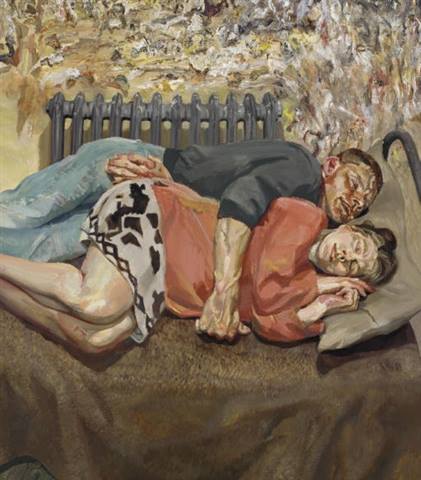
Ib y su marido (1992) es un óleo sobre lienzo de 168,3 × 146,7 cm que Freud pintó en su estudio de Holland Park, Londres, durante un periodo de varios meses en los que su hija Isobel —conocida familiarmente como «Ib»— y su pareja, Pat Costelloe, posaron para él estando ella en avanzado estado de gestación de su tercer hijo, Alice. La escena representa a la pareja acurrucada sobre una cama estrecha, en un interior desnudo: paredes manchadas de pintura, un radiador utilitario, una alfombra marrón desgastada. Nada en esta imagen remite a la iconografía tradicional del retrato de familia, del desnudo académico o de la escena doméstica pintoresca. La desnudez, aquí, es conceptual: vemos a los protagonistas de la escena desnudos en tanto y cuanto personas; son quienes vemos a través de sus cuerpos, sus prendas de vestir, sus actitudes y gestos.
La pregunta que este ensayo se propone responder no es si la obra «gusta» o si es «importante» dentro del mercado del arte, sino si constituye una obra de arte auténtica en el sentido filosófico riguroso: esto es, si cumple la función específica que ninguna otra actividad humana puede cumplir, y que la tradición estética ha intentado definir con mayor o menor fortuna a lo largo de veinticinco siglos. Para responder, es preciso recorrer los principales planteamientos al respecto; así demostraremos que el marco teórico del Homo Institutionalis permite dar cuenta de la autenticidad de esta obra sin reducirla ni a mera expresión subjetiva, ni a objeto de contemplación desinteresada, ni a producto del «mundo del arte». Afirmamos, de hecho, que Ib y su marido constituye una obra de arte auténtica debido, fundamentalmente, a su potencia cuestionadora, lograda mediante una conjugación notable entre fondo (temas que aborda) y forma (la concepción y técnica mediante la cual se expresa el cuestionamiento de instituciones y conceptos del marco institucional).
Ante este cuadro, la primera impresión es de incomodidad. El espectador no encuentra un punto de vista cómodo. La pareja ocupa el centro del lienzo, pero no en actitud de ofrecimiento o exhibición: están recogidos, casi en posición fetal, abrazados, mas no mirándose, cada uno perdido en su propio interior. La mujer, con el vientre abultado, mira hacia abajo; el hombre, con la cabeza apoyada en su hombro, parece dormir o sostener una vigilia resignada. La perspectiva es ligeramente elevada —Freud pintaba de pie desde 1956, lo que le confería a sus composiciones un punto de vista que enfatiza la volumetría de los cuerpos—, de modo que el espectador no contempla a la pareja desde una posición de igualdad, sino desde una suerte de mirada clínica, casi forense.
La paleta es terrosa, reducida a ocres, marrones, grises y blancos sucios. No hay color que distraiga. La luz parece artificial —Freud trabajaba tanto de día como de noche, y cuando pintaba de noche usaba bombillas de alto voltaje que proyectaban sombras duras—, creando planos de luz y oscuridad que esculpen o tallan los cuerpos. La pincelada es visible, gruesa, casi escultórica. Freud aplicaba la pintura con brochas de cerda de jabalí, construyendo capa sobre capa en un proceso que podía extenderse meses. La textura de la piel dista de cualquier suavidad: es materia, carne, peso.
Esta descripción perceptiva corresponde a lo que Baumgarten denominó claritas extensiva: la riqueza simultánea de determinaciones sensibles que no puede resolverse en análisis conceptual sin pérdida esencial. Describir verbalmente los tonos de piel de Ib no equivale a verlos; enumerar las cualidades de la pincelada no reproduce la experiencia de su materialidad. La pintura de Freud opera en este registro de la claridad extensiva con maestría deliberada: cuanto más se mira, más se descubre, y nunca se agota.
Kant habría reconocido en esta obra un candidato al juicio de gusto. El placer que produce no depende de la existencia del objeto: no necesitamos que Ib y su marido sigan juntos, ni que el niño haya nacido sano, para que la pintura nos afecte. Tampoco depende de un concepto previo: no juzgamos que la obra es bella porque encaje en la definición de «buen retrato». El placer es, en el sentido kantiano, desinteresado. Sin embargo, el análisis kantiano encuentra aquí un límite estructural decisivo. La teoría del juicio de gusto analiza las condiciones subjetivas de la recepción estética —el libre juego de imaginación y entendimiento—, pero no puede decir nada sustantivo sobre el contenido de la obra ni sobre la función que cumple en la vida social e institucional de los seres humanos. El supuesto sujeto trascendental de Kant que juzga sin interés, sin concepto y sin historia es una abstracción filosófica que no corresponde a ningún receptor real, situado en un mundo histórico, social e institucional. Ib y su marido no produce únicamente placer contemplativo: produce incomodidad, intranquilidad, una sensación de vulnerabilidad compartida que remite a algo más que la armonía formal de las facultades cognitivas. El juicio de gusto kantiano no puede dar cuenta de esta dimensión, porque su análisis se detiene en la recepción y no alcanza la función crítica del arte.
Podría argumentarse que la obra produce algo análogo a lo sublime kantiano: la confrontación con cuerpos en toda su materialidad —vientre gestante, carne pesada, piel imperfecta— desborda la capacidad de la imaginación de contenerlos en una representación armónica. Pero lo sublime, para Kant, era la revelación de la razón y la libertad moral ante lo inconmensurable. En Freud no hay montaña ni tormenta: hay un interior doméstico, una cama estrecha, una pared manchada. Lo que desborda no es la magnitud, sino la presencia: la imposibilidad de reducir estos cuerpos a categorías estéticas o morales preestablecidas. Esta es una versión domesticada, casi invertida, del sublime: no la grandeza que trasciende la naturaleza, sino la pequeñez que la contiene toda. El cuerpo humano, en su condición más vulnerable, se vuelve el territorio donde se juega la dignidad misma de lo humano.
La técnica de Freud requiere, a propósito, especial atención. Su uso del impasto —capas gruesas de pintura que esculpen la superficie del lienzo— es constitutivo del sentido. Freud afirmó: «Quiero que la pintura funcione como carne». Esta afirmación no es metafórica en sentido laxo: el artista busca que el material pictórico reproduzca no la apariencia visual de la carne, sino su peso, su textura, su resistencia. La pintura de Freud es casi táctil antes que óptica: exige ser vista como superficie rugosa, no como ventana transparente. La elección de materiales es, en este sentido, una decisión filosófica. Freud podría haber pintado a su hija y a su yerno con la precisión lineal de sus primeras obras, influenciadas por el dibujo y el detalle minucioso. En cambio, optó por la pintura como materia que responde a la original. He aquí el instrumento mediante el cual la obra evita caer en la idealización. Fuerza al espectador a reconocer que está ante una construcción material, no ante una ilusión transparente ni simplemente deformante.
El fondo de la pintura es tan significativo como las figuras. La pared manchada de pintura —donde Freud limpiaba sus pinceles durante décadas— es el registro material de su propia práctica artística. El radiador, la cama estrecha, la alfombra desgastada: todos son objetos reales de su estudio, testigos de innumerables sesiones. Freud no pintaba fondos sin el modelo presente; creía que la presencia física del sitter alteraba sutilmente la atmósfera del espacio. Esta decisión formal tiene consecuencias filosóficas directas. En la tradición del retrato occidental, el fondo suele cumplir una función contextual o simbólica: paisaje, cortinaje, arquitectura que enmarca al sujeto. En Freud, el fondo es residuo: lo que queda de la actividad pictórica previa, lo que la historia del trabajo ha depositado. La pareja no está en un espacio; está entre los restos de la producción artística. Tal elección desestabiliza la distinción entre figura y fondo, entre sujeto y entorno, entre propuesta y mundo.
Adorno habría reconocido en esta obra un ejemplo de arte genuino: aquel que resiste la reducción a la intercambiabilidad del mercado, que conserva la huella negativa de lo que la sociedad existente niega. Ib y su marido no ofrece placer inmediato ni confirma expectativas, dicho de otro modo: no se deja consumir pasivamente. Su dificultad formal —la aspereza de la pincelada, la fealdad deliberada de los cuerpos, la ausencia de narrativa— es cuanto la hace resistente. Sin embargo, la posición de Adorno presenta un límite que el análisis debe reconocer. Adorno privilegiaba el arte difícil y oscuro como única forma genuina de resistencia. Esta jerarquía elitista no puede dar cuenta de otras formas de resistencia cultural que operan con lenguajes más accesibles. Freud, en este sentido, ocupa una posición intermedia: su obra es exigente, pero no hermética; es cruda, pero, a través del impacto que provoca, fácilmente comprensible. La negatividad de Ib y su marido no reside en su dificultad técnica, sino en su función crítica: en la manera en que confronta al receptor con instituciones que da por sentadas.
Si Adorno representa el horizonte más exigente de la estética de la negatividad, las décadas posteriores a su muerte en 1969 produjeron diversos intentos de superar los límites de la Escuela de Frankfurt, cada uno con resultados que, desde la perspectiva del Homo Institutionalis, resultan igualmente insuficientes, aunque por vías distintas. El análisis de estos planteamientos es indispensable para situar con precisión la superioridad explicativa del marco que aquí se defiende.
La estética de la recepción, desarrollada por Hans Robert Jauss y Wolfgang Iser en la Universidad de Constanza a partir de 1967, constituye uno de los intentos más ambiciosos de restituir el papel activo del receptor en la constitución del sentido artístico. Para Jauss, la historia literaria no puede reducirse al establecimiento de hechos estilísticos, sino que debe atender a la experiencia de las lecturas a través del tiempo, en lo que denomina «horizontes de expectativas»: sistemas referenciales que el lector trae consigo y que la obra puede confirmar, desafiar o reconfigurar (Jauss, 1987, p. 57). Iser, por su parte, centra su atención en la textualidad misma y en los «espacios vacíos» (Leerstellen) que el texto contiene y que el lector debe llenar mediante su imaginación: la obra literaria, según él, posee un polo artístico (el texto creado por el autor) y un polo estético (la concretización que realiza el lector), de modo que solo la convergencia de ambos otorga existencia a la obra (Iser, 1976, citado en Morón Hernández, s.f., p. 6). Esta perspectiva tiene el mérito de reconocer que el arte no es un objeto cerrado sino un evento comunicativo que involucra necesariamente al receptor como co-productor del sentido.
Sin embargo, desde la perspectiva del Homo Institutionalis, la estética de la recepción presenta una limitación decisiva: al centrar su análisis en el proceso de lectura o de contemplación, desatiende la función crítica que la obra ejerce sobre las instituciones del mundo del receptor. Jauss e Iser describen con precisión cómo el receptor construye el sentido, pero no pueden decir qué instituciones cuestiona la obra ni mucho menos por qué esa confrontación es filosóficamente relevante. El «horizonte de expectativas» de Jauss es un concepto descriptivo, no normativo: permite analizar cómo una obra fue recibida en un momento dado, pero no puede establecer por qué esa recepción fue o no fue una experiencia de arte en sentido pleno. En Ib y su marido, el receptor no solo completa espacios vacíos del texto pictórico: es confrontado con la institución del retrato de familia, con la institución del desnudo femenino y con la institución misma de la pintura como actividad noble. La estética de la recepción no dispone de categorías para dar cuenta de esta triple confrontación institucional, porque su marco conceptual se detiene en la dinámica texto-lector sin alcanzar la dimensión crítica que constituye la función específica del arte.
Arthur Danto, en su ensayo The End of Art (1984) y en su obra After the End of Art (1997) argumenta que el arte occidental alcanzó su «fin» no en el sentido de que dejara de producirse, sino en el sentido hegeliano de que la narrativa histórica que lo definía —la progresiva conquista de la mimesis, seguida de la autoconciencia modernista— ha concluido. Después de Warhol y sus Brillo Boxes, el arte entró en una era «post-histórica» donde «cualquier dirección es tan buena como cualquier otra» y donde la única pregunta que permanece es «¿qué es el arte?» (Danto, 1997, p. 47). Para Danto, el estatus de arte no reside en propiedades perceptibles, sino en una «teoría del arte» que lo eleva al «mundo del arte» y lo distingue del objeto real que materialmente es (Danto, 1964, p. 571). Esta posición, desarrollada también por George Dickie en su «teoría institucional», tiene la virtud de explicar por qué un urinal de Duchamp o una caja de Brillo de Warhol acaban siendo calificados como arte.
No obstante, la teoría dantiana presenta una limitación crítica que el Homo Institutionalis no acepta de ninguna manera: al reducir el estatus de arte al reconocimiento institucional, Danto desarma la capacidad del arte para cuestionar las propias instituciones que lo consagran. Si una obra es arte porque el «mundo del arte» la reconoce como tal, entonces no hay criterio interno para distinguir entre arte genuino y simulacro consagrado, entre obra que cuestiona y producto que confirma, entre planteamiento crítico y provocación vacía. Danto mismo reconoce esta dificultad cuando admite que «uno puede aprehender el arte post-histórico sin ningún compromiso con las cuestiones filosóficas» que él considera centrales (Danto, 1997, p. 56). En Ib y su marido, la autenticidad no reside en que Christie’s la subastara en 2007 o en que figure en colecciones prestigiosas: reside en su capacidad de confrontar al receptor con instituciones que el propio «mundo del arte» ha contribuido a naturalizar. La perspectiva del Homo Institutionalis no niega el reconocimiento institucional, pero lo subordina a la función cuestionadora: el arte es aquella institución que cuestiona a las instituciones, incluidas las del propio mundo del arte. Danto no puede dar cuenta de esta circularidad crítica porque su marco conceptual la excluye por principio.
Nicolas Bourriaud, en su influyente Esthétique relationnelle (1998), propuso una vía alternativa para pensar el arte contemporáneo: el arte ya no sería un objeto de contemplación, sino un «conjunto de prácticas culturales» que generan «formas de convivencia» y «modos de coexistencia social» (Bourriaud, 1998, citado en Otra Parte, 2023). La «estética relacional» se centra en el intercambio humano que la obra produce: no en lo que la obra es, sino en lo que la obra hace en el espacio social. Artistas como Rirkrit Tiravanija o Liam Gillick ejemplifican esta tendencia al crear situaciones donde el espectador deja de ser mero contemplador para convertirse en participante activo de una experiencia colectiva. Esta perspectiva tiene el mérito de reconocer que el arte opera en el mundo social y que su valor no puede reducirse a propiedades formales o perceptivas.
Desde la óptica del Homo Institutionalis, sin embargo, la estética relacional incurre en una reducción complementaria a la de Danto: mientras Danto desmaterializa el arte hasta convertirlo en mero objeto de teoría, Bourriaud lo disuelve en la interacción social, perdiendo de vista la especificidad del texto artístico como construcción racional que confronta al receptor con sus categorías. En Ib y su marido, el valor de la obra no reside en la «convivencia» que genera entre los espectadores que la contemplan juntos, sino en la confrontación individual y colectiva con instituciones como la familia, el desnudo y la pintura misma. La «forma relacional» de Bourriaud, aunque valiosa como descripción de ciertas prácticas artísticas contemporáneas, no puede dar cuenta de la función crítica que la obra de Freud cumple, porque su marco conceptual carece de la distinción entre materiales, procesos psicológicos y estructuras institucionales que permite identificar qué es lo que la obra cuestiona y cómo lo hace.
Jacques Rancière, por su parte, ha propuesto una de las síntesis más ambiciosas entre estética y política en la filosofía contemporánea. En Le partage du sensible (2000), Rancière define la estética no como una disciplina sobre la belleza, sino como un «régimen de identificación de lo arte» que determina qué puede ser visto, dicho y pensado en una configuración social dada. La «distribución de lo sensible» (le partage du sensible) es el sistema de evidencias perceptivas que establece quién puede participar en lo común y quién queda excluido; el arte, en este marco, opera como una «redistribución» que hace visible lo invisible y audible lo que antes era solo ruido (Rancière, 2000, citado en Revista Otra Parte, 2023). Esta concepción tiene la virtud de situar el arte en su dimensión política sin reducirlo a propaganda, y de reconocer que la percepción misma está atravesada por relaciones de poder.
No obstante, desde la perspectiva del Homo Institutionalis, la estética rancieriana presenta una limitación estructural: al definir el arte como «redistribución de lo sensible», Rancière confunde la función del arte con su mecanismo. Es cierto que Ib y su marido hace visible lo que la tradición del retrato de familia ocultaba —la precariedad doméstica, la carne, el trabajo—, pero esa visibilización no es un fin en sí misma: es el medio mediante el cual la obra obliga al receptor a revisar sus categorías sobre la familia, el cuerpo y la pintura. Rancière describe con precisión el efecto perceptivo de la obra, pero no puede explicar por qué ese efecto constituye una experiencia de arte en sentido pleno y no simplemente una perturbación política. La distinción entre «estetización de la política» (que Rancière rechaza) y «política de la estética» (que él defiende) permanece oscura, porque su marco no dispone de criterios para distinguir entre una obra que cuestiona instituciones y un discurso político que simplemente las denuncia. El Homo Institutionalis, en cambio, sostiene que el arte cuestiona mediante la construcción de un texto elocuente, no mediante la explicación conceptual (que sería filosofía) ni mediante la acción política directa (que sería militancia). Esta especificidad del arte como texto ficcional que habla por sí mismo es precisamente lo que Rancière, al disolver la obra en la «distribución de lo sensible», no puede preservar.
Finalmente, Hans Belting, en su Bild-Anthropologie (2001), propuso una vía radicalmente distinta: abandonar la historia del arte como disciplina para fundar una «antropología de la imagen» que estudie cómo las imágenes operan en la mente y en el cuerpo humano, independientemente de su estatus como «arte». Para Belting, la imagen no es una propiedad del objeto sino un evento que se realiza en la interacción entre «imagen» (como concepto), «medio» (como soporte) y «cuerpo» (como lugar de realización) (Belting, 2001, citado en Center-Recent, 2024). Esta perspectiva tiene el mérito de desplazar el foco desde la obra como objeto estético hacia la imagen como fenómeno antropológico, reconociendo que muchas culturas no disponen del concepto occidental de «arte» y sin embargo producen y usan imágenes de modo sofisticado.
Desde la perspectiva del Homo Institutionalis, la antropología de la imagen de Belting representa una ampliación legítima del campo de estudio, pero no una sustitución de la filosofía del arte. Belting puede describir cómo Ib y su marido opera como imagen en la mente del espectador, pero no puede decir por qué esa operación constituye una experiencia de arte y no simplemente una experiencia de imagen. El Homo Institutionalis no niega la relevancia de la dimensión antropológica, pero la sitúa: la imagen es el vehículo, no el fin; el cuerpo del espectador es el lugar donde la confrontación tiene lugar, no el criterio de su valor artístico. Lo que distingue a Ib y su marido de una imagen publicitaria o de una fotografía documental no es su operación en la mente del espectador, sino su capacidad de confrontarlo con instituciones que daba por sentadas mediante una construcción textual que exige atención, competencia y trabajo racional.
En síntesis, los planteamientos estéticos posteriores a Adorno —la estética de la recepción, la teoría institucional de Danto, la estética relacional de Bourriaud, la política de la estética de Rancière y la antropología de la imagen de Belting— capturan cada uno un aspecto legítimo de la experiencia artística: la participación del receptor, el reconocimiento institucional, la dimensión social, la política de la percepción y la operación antropológica de la imagen. Pero todos ellos reducen el arte a uno solo de sus materiales, olvidando que el arte existe solo en la symploké de los cuatro elementos de la situación comunicativa: autor, obra, receptor y marco institucional. El Homo Institutionalis no descarta estas categorías: las sitúa. La función crítica del arte no depende de la dificultad formal (contra Adorno), ni de la participación del receptor (contra la estética de la recepción), ni del reconocimiento institucional (contra Danto), ni de la interacción social (contra Bourriaud), ni de la redistribución de lo sensible (contra Rancière), ni de la operación antropológica de la imagen (contra Belting). Depende de la capacidad de la obra de confrontar al receptor con conceptos e instituciones de su mundo de manera que lo obligue a revisar sus categorías. Ib y su marido lo hace mediante una conjugación específica de fondo y forma que ninguna de las teorías examinadas puede dar cuenta en su plenitud, porque todas ellas prescinden de la noción de institución que cuestiona instituciones, que es el núcleo de la perspectiva aquí defendida.
El retrato de familia es una de las instituciones pictóricas más arraigadas en la tradición occidental. Desde las Sacra Conversazione del Renacimiento hasta la fotografía burguesa del siglo XIX, la familia ha sido representada como unidad armoniosa, jerarquía natural, refugio de afectos. Las convenciones son estables, incluso cuando la modernidad fracturó esta iconografía —pensemos en las Familias de Goya o en las escenas domésticas de Vuillard—, el género conservó una carga normativa: la familia como institución social fundamental. Ib y su marido desmonta esta institución desde su interior. Freud no pinta a una familia en el sentido tradicional: Ib y Pat no están casados en el registro civil durante la ejecución de la obra, la relación es extra-matrimonial en origen (Ib es hija de Suzy Boyt, una de las amantes de Freud), y la escena muestra una pareja en situación de precariedad doméstica, no de estabilidad burguesa. Pero no es que Freud haya elegido un tema «transgresor», sino que la forma de la representación impide cualquier lectura edificante. Los cuerpos no son hermosos; la composición no es equilibrada; el afecto no es evidente. Lo que la obra muestra es la familia como hecho biológico y social, no como valor trascendente.
La historia del arte occidental está atravesada por la representación del cuerpo femenino como objeto de contemplación estética —y, frecuentemente, erótica—. El desnudo académico, con sus proporciones canónicas y su suavidad idealizada, era el vehículo privilegiado de esta institución. En Ib y su marido, el cuerpo de la mujer está presente —vientre gestante, senos pesados, muslos robustos— pero no es ofrecido a la mirada. Recogida sobre sí misma, se protege en lugar de exhibirse. El cuerpo opera como tal, en su funcionalidad biológica y su vulnerabilidad. Freud pinta la maternidad como estado, sin auras loables ni mucho menos solemnidades: aquí es cansancio, peso, espera. Niega al espectador la posición de consumo estético o erótico. Las prendas de vestir son, en tal sentido, fundamentales, pero porque implican un desnudamiento diferente: el de la personalidad de los sujetos. No hay placer escópico disponible: en cambio, tenemos una materialidad que resiste la apropiación.
El tercer cuestionamiento —y el más radical— atañe a la propia pintura. La pared manchada de pigmento que aparece en el fondo no es solo un detalle contextual: es la evidencia del proceso pictórico. Freud muestra las huellas de décadas de trabajo. Esta decisión remite a una tradición que va desde Las Meninas de Velázquez hasta la pintura moderna. Pero en Freud no hay juego barroco de espejos ni autorreferencia intelectualista; sí, suciedad, desgaste, acumulación material. La obra cuestiona la institución de la pintura como actividad noble, elevada, separada de la vida ordinaria. El estudio de Freud es un taller donde se trabaja con materiales tóxicos, se acumulan trapos sucios y el artista come vitaminas para contrarrestar el envenenamiento por plomo. La representación de este espacio desmitifica la figura del artista como genio inspirado —la petrificación romántica que el Homo Institutionalis denuncia— y lo restituye como trabajador, como sujeto que opera sobre materiales concretos mediante técnicas normadas.
Abordemos primero los objetos físicos y corpóreos que constituyen el soporte material de la obra. En Ib y su marido, este nivel es ineludible: el óleo sobre lienzo, la escala considerable (168,3 × 146,7 cm), la textura del impasto, el peso de los cuerpos representados. Pero, además, incluye los objetos representados —la cama, el radiador, la pared manchada— que son tan reales como la pintura misma. La resistencia del óleo, la absorción del lienzo, el brillo del pigmento son elementos activos en la producción del sentido. La carne pintada no simula carne: es carne en el sentido pictórico, materia organizada que produce efectos sobre el cuerpo del espectador.
En cuanto a los procesos psicológicos, las vivencias internas y las operaciones del sujeto operatorio. En Ib y su marido, este nivel se activa de manera inmediata: la incomodidad perceptiva, la identificación conflictiva, la empatía reprimida. El espectador no contempla serenamente: se ve obligado a situarse frente a una escena que no ofrece posición cómoda. Pero la emocionalidad no es el efecto final de la obra. El subjetivismo estético —tanto en su versión psicológica (Croce) como en su versión experiencial (Dewey)— reduce el arte a este nivel: la intuición lírica, la experiencia integrada, el placer desinteresado. El Homo Institutionalis reconoce la emoción como necesaria, pero insuficiente por sí sola. Sirve como combustible del proceso creativo, mientras el dominio técnico y conceptual es el motor, y la intención crítica, el timón. Sin los tres, no hay obra que merezca ser llamada arte en el sentido de la situación comunicativa. En esta pintura, la conmoción funciona como gancho: la incomodidad inicial obliga al espectador a prestar atención, a no distraerse. Pero si la obra se quedara en este nivel, sería mera provocación o terapia emocional —el expresionismo sentimental que denunciamos—. Lo que eleva la obra es el paso que sigue.
Veamos ahora las estructuras abstractas e ideales que organizan la obra: los conceptos, las normas, las instituciones que la obra pone en cuestión. En Ib y su marido, la racionalidad opera en tres registros simultáneos: el retrato de familia, el desnudo femenino, la pintura misma. La obra no menciona estas instituciones: las problematiza mediante su organización formal. La symploké —el entretejimiento de los tres géneros— es lo que distingue al arte de la mera expresión o del mero objeto. En Freud, la textura del óleo produce la incomodidad perceptiva que activa el cuestionamiento de las instituciones. No hay una sin las otras. La pincelada gruesa opera como mucho más que un rasgo estilístico, como el mecanismo que impide la idealización. La escala monumental no es una elección decorativa: es lo que instala al espectador en una posición de confrontación. El fondo del estudio supera por mucho la mera ambientación, es la evidencia de que la pintura equivale a trabajo, no a magia.
Platón condenó la mimesis como copia de copia, alejada de la verdad de las Ideas. Para el filósofo ateniense, el pintor de camas no conoce la cama en sí, sino solo su apariencia desde un ángulo particular. Freud, en apariencia, confirma este diagnóstico: pinta apariencias, cuerpos concretos, situaciones particulares. Pero la diferencia es decisiva: Freud seduce en la similitud inicial, para luego revelar la cuestión de fondo. Su mimesis, por lo tanto, no es ilusoria, sino disposición y, finalmente, medio de crítica. Al mostrar lo que la tradición ocultaba —la carne, el trabajo, la precariedad—, Freud hace de la imitación un instrumento de conocimiento, no de alienación. Aristóteles ya había señalado este camino cuando afirmó que la poesía es más filosófica que la historia porque narra lo que podría ser, no lo que fue. Freud narra lo que es —esta pareja, este momento—, pero lo hace de modo tal que revela la intimidad como refugio, el cuerpo como territorio de la existencia.
Tomás de Aquino definió la belleza mediante tres condiciones: integritas, consonantia, claritas. Ib y su marido parece violarlas todas: la integridad es precaria (los cuerpos están parcialmente ocultos, el espacio está desordenado), la proporción es inestable (la composición no busca el equilibrio clásico), la claridad es opaca (la luz es artificial, los colores son terrosos). Sin embargo, desde la perspectiva del Homo Institutionalis, la belleza no es una propiedad objetiva exclusiva de las cosas, sino cuanto de ellas provoca el reconocimiento de un desborde conceptual y de las instituciones del mundo del sujeto, generando un asombro cuestionador irreductible a mera impresión sensible. La obra de Freud es bella no a pesar de su fealdad, sino mediante ella. El desbordamiento no es placentero: es perturbador. Pero es precisamente esta perturbación la que abre al receptor a una ampliación de su mundo. La belleza como desbordamiento desestabiliza lo que se daba por sentado.
La tradición romántica, heredera del Ion platónico y de la teoría kantiana del genio, convirtió al artista en figura excepcional, dotada de facultades que trascienden la razón y la técnica. Freud desmiente esta mitología con cada centímetro de su obra. Su método era laborioso, rutinario, casi industrial: sesiones de mañana y de noche, meses de trabajo sobre el mismo lienzo, acumulación de capas que el propio artista a veces raspaba para recomenzar. El mérito, para Freud, no se debía a ningún don recibido, sino que era una capacidad de atención, una disciplina de la mirada que se ejercitaba día tras día. El autor, no como un canal de fuerzas irracionales, sino como sujeto racional que aplica competencias intelectivas y una técnica normada para generar un texto que confronta al receptor con los conceptos e instituciones de su mundo. Freud podía dar razón de sus decisiones formales: sabía por qué elegía una brocha y no otra, por qué pintaba de pie y no sentado, por qué el fondo debía incluir las manchas de pintura. Esta responsabilidad racional es exactamente lo que la petrificación romántica del artista niega.
Danto y Dickie dijeron en su momento que el estatus de arte no reside en propiedades perceptibles, sino en el reconocimiento institucional: una obra es arte porque el «mundo del arte» la reconoce como tal. Esta teoría explica por qué un urinario de Duchamp o una caja de Brillo de Warhol son calificados como arte, pero su limitación es crítica: no puede distinguir entre arte genuino y simulacro consagrado, entre obra que cuestiona y producto que confirma, entre planteamiento y provocación. La definición de arte que manejamos refiere a ella como una institución que cuestiona a las instituciones, incluidas las del propio mundo del arte. Ib y su marido es reconocida por el mundo del arte —fue subastada por Christie’s en 2007, forma parte de colecciones privadas prestigiosas—, pero su autenticidad no reside en este reconocimiento. Reside en su capacidad de confrontar al receptor con instituciones que el mundo del arte también ha contribuido a naturalizar. La obra es arte porque a pesar de ser vendida por Christie’s, sigue cuestionando.
La autenticidad de una obra no puede establecerse mediante una sola categoría filosófica. Ni la mimesis platónica, ni el juicio de gusto kantiano, ni la intuición croceana, ni la experiencia deweyana, ni la negatividad adorniana —por valiosas que sean— pueden por sí solas dar cuenta de lo que hace esta obra. Cada una de estas categorías captura un aspecto legítimo, pero la reduce a su propio marco conceptual. El marco del Homo Institutionalis no descarta estas categorías: las sitúa. La función crítica del arte no depende de su dificultad formal ni de su accesibilidad, sino de su capacidad de confrontar al receptor con conceptos e instituciones de su mundo que desafía lo que ese mundo da por sentado. Ib y su marido lo hace mediante una conjugación específica de fondo y forma: el tema de la pareja gestante en un interior precario se articula con la técnica del impasto, la escala monumental y el fondo del estudio para producir un cuestionamiento que opera simultáneamente en tres registros institucionales. El artista auténtico no es el genio romántico ni el artesano académico, sino el sujeto racional que domina su técnica, que puede dar razón de sus decisiones formales y que utiliza la obra como instrumento de confrontación crítica. Freud encarna aquí esta figura: su método era disciplinado, su técnica era excepcional, su intención era clara. La belleza, entendida como desbordamiento de los conceptos e instituciones del mundo del sujeto, es compatible con la fealdad perceptiva. La obra de Freud es bella en el sentido de que desborda las categorías mediante las que solemos juzgar la representación del cuerpo, la familia y la intimidad. Este desbordamiento genera una ampliación del mundo del receptor, y por consiguiente de su libertad.
Ib y su marido cuestiona, pero no mediante la explicación conceptual —que sería filosofía—, ni mediante la acción política directa —que sería militancia—, sino mediante la construcción de un texto elocuente, una ficción que habla por sí misma, sin muletas explicativas externas. Que el espectador comprenda este cuestionamiento no depende de un manual de instrucciones, sino de su capacidad de atender, de su disposición a dejar que la obra desestabilice lo que daba por cierto.
Referencias bibliográficas:
Adorno, T. W. (1970/2004). Teoría estética (F. Riaza, Trad.). Akal.
Aristóteles. (s. IV a.C./1990). Poética (J. Alsina Clota, Trad.). Bosch.
Baumgarten, A. G. (1750/2010). Aesthetica / Estética breve (R. Ibarlucía, Trad.). Prometeo.
Belting, H. (2001). Bild-Anthropologie: Entwürfe für eine Bildwissenschaft. Fink.
Bourriaud, N. (1998/2006). Estética relacional (Trad. española). Adriana Hidalgo Editora.
Christie’s. (2007, 14 de noviembre). Lucian Freud (b. 1922), Ib and her Husband. Recuperado de https://www.christies.com/en/lot/lot-4978824
Danto, A. C. (1964). El mundo del arte. Journal of Philosophy, 61(19), 571-584.
Danto, A. C. (1997/1998). After the End of Art: Contemporary Art and the Pale of History. Princeton University Press.
Dewey, J. (1934/2008). El arte como experiencia (J. Claramonte, Trad.). Paidós.
Dickie, G. (1984/2005). El círculo del arte: una teoría del arte (C. Beljon, Trad.). Paidós.
Hegel, G. W. F. (1835-1838/1989). Lecciones de estética, vols. I-III (A. Brotons Muñoz, Trad.). Akal.
Iser, W. (1976/1987). El acto de leer: teoría del efecto estético (Trad. española). Taurus.
Jauss, H. R. (1987). Estética de la recepción (Trad. española). Visor.
Kant, I. (1790/1977). Crítica del juicio (M. García Morente, Trad.). Espasa-Calpe.
Morón Hernández, L. (s.f.). Estética de la recepción literaria. Recuperado de https://profesorsergiogarcia.wordpress.com
Platón. (s. IV a.C./1988). La República (J. M. Pabón y M. Fernández-Galiano, Trads.). Alianza.
Rancière, J. (2000/2014). El reparto de lo sensible: estética y política (Trad. española). Prometeo Libros.
Tate. (2021). Lucian Freud: Real Lives. Recuperado de https://www.tate.org.uk/whats-on/tate-liverpool/lucian-freud-real-lives/exhibition-guide
The Times. (s.f.). The secrets that still lie in the paint-strewn lair of Lucian Freud. Recuperado de https://www.acquavellagalleries.com/news/the-times
Tomás de Aquino. (1265-1274/1952). Suma Teológica (Edición bilingüe). BAC.
Torres Muñiz, J. P. (2022). Homo Institutionalis. Grupo Editorial Caja Negra.
Torres Muñiz, J. P. (2026a, febrero). Ejercicio de libertad: síntesis dialéctica de una filosofía del arte desde el enfoque del Homo Institutionalis. Criba. Recuperado de https://formacionsaro.com/ejercicio-de-libertad-sintesis-dialectica-de-una-filosofia-del-arte-desde-el-enfoque-del-homo-institutionalis/
Torres Muñiz, J. P. (2026b). La estética en su lugar: disciplina, historia y límites desde la perspectiva del Homo Institutionalis. Criba. Recuperado de https://formacionsaro.com/la-estetica-en-su-lugar-disciplina-historia-y-limites-desde-la-perspectiva-del-homo-institutionalis/
WikiArt. (s.f.). Ib and her Husband, 1992 – Lucian Freud. Recuperado de https://www.wikiart.org/en/lucian-freud/ib-and-her-husband-1992
(ENGLISH VERSION)
Flesh as Questioning: A Philosophical-Aesthetic Approach to «Ib and Her Husband» (1992) by Lucian Freud from the Perspective of Homo Institutionalis
Translation by Tiffany Amber Elías Trimble
The pictorial tradition of the human figure constitutes one of the most densely populated territories in the history of Western art. From the Paleolithic figurines of Willendorf to contemporary nudes, the body has been simultaneously an object of worship, a territory of formal exploration, and a mirror of the anxieties of each era, ultimately ending up as a supposed ideological battlefield. The portrait, in particular, has served to affirm power —think of Roman imperial iconography or the majesty of Velázquez’s courtly portraits—, to question identity —as in Picasso’s masks or expressionist deformations— and to record the human condition in its most extreme vulnerability —from Giotto’s figures to those of Käthe Kollwitz. In this historical arc, the rather unsparing portrait occupies a particular place: one that renounces idealization to confront the viewer with the irreducible materiality of the body, with its weight, its decay, its mortality.
Lucian Freud (1922-2011) represents one of the most radical contributions to this tradition which, paradoxically, truly begins in the Baroque. Trained at the London school but with roots extending into the German Expressionism of the first half of the 20th century, Freud developed over seven decades a pictorial practice that systematically challenged the conventions of academic portraiture, idealized nude, and genre painting. His method —exhaustive posing sessions, clinical observation, impasto technique, earthy palette, elevated perspective— posits a philosophical stance on what painting can be when it renounces conventional beauty and enters the astonishment provoked by the overflowing of our institutional framework, our world. Freud, in this sense, painted present bodies that resist the gaze and demand to be seen as matter before being even recognized as persons. His work constitutes one of the most severe confrontations that modern painting has produced against the idealism that has dominated the representation of the body since Greek Antiquity and which errs, at the other extreme, in mere deformation.
Ib and Her Husband (1992) is an oil on canvas measuring 168.3 × 146.7 cm that Freud painted in his Holland Park studio in London over several months during which his daughter Isobel —familiarly known as «Ib»— and her partner, Pat Costelloe, posed for him while she was in an advanced state of pregnancy with their third child, Alice. The scene depicts the couple huddled on a narrow bed, in a bare interior: paint-stained walls, a utilitarian radiator, a worn brown rug. Nothing in this image refers to the traditional iconography of the family portrait, the academic nude, or the picturesque domestic scene.
The question this essay proposes to answer is not whether the work is «pleasing» or «important» within the art market, but whether it constitutes an authentic work of art in the rigorous philosophical sense: that is, whether it fulfills the specific function that no other human activity can fulfill, and which the aesthetic tradition has attempted to define with greater or lesser success over twenty-five centuries. To answer this, it is necessary to review the main approaches on the subject; thus we will demonstrate that the theoretical framework of Homo Institutionalis allows us to account for the authenticity of this work without reducing it either to mere subjective expression, nor to an object of disinterested contemplation, nor to a product of the «art world.» Indeed, we affirm that Ib and her husband constitutes an authentic work of art, fundamentally, due to its questioning power, achieved through a notable combination of content (the themes it addresses) and form (the conception and technique through which the questioning of institutions and concepts of the institutional framework is expressed).
Before this painting, the first impression is one of discomfort. The viewer does not find a comfortable point of view. The couple occupies the center of the canvas, but not in an attitude of offering or exhibition: they are withdrawn, almost in a fetal position, embracing, yet not looking at each other, each lost in their own interior. The woman, with her prominent belly, looks downward; the man, with his head resting on her shoulder, seems to sleep or maintain a resigned vigil. The perspective is slightly elevated —Freud painted standing from 1956 onwards, which gave his compositions a viewpoint that emphasizes the volume of the bodies—, so that the viewer does not contemplate the couple from a position of equality, but rather from a kind of clinical, almost forensic gaze.
The palette is earthy, reduced to ochres, browns, grays, and dirty whites. There is no distracting color. The light appears artificial —Freud worked both day and night, and when painting at night he used high-voltage light bulbs that projected harsh shadows—, creating planes of light and shadow that sculpt or carve the bodies. The brushstroke is visible, thick, almost sculptural. Freud applied paint with hog bristle brushes, building layer upon layer in a process that could extend for months. The texture of the skin is far from any softness: it is matter, flesh, weight.
This perceptive description corresponds to what Baumgarten termed claritas extensiva: the simultaneous richness of sensory determinations that cannot be resolved into conceptual analysis without essential loss. Describing verbally the skin tones of Ib does not equate to seeing them; enumerating the qualities of the brushstroke does not reproduce the experience of its materiality. Freud’s painting operates in this register of extensive clarity with deliberate mastery: the more one looks, the more one discovers, and it is never exhausted.
Kant would have recognized in this work a candidate for the judgment of taste. The pleasure it produces does not depend on the existence of the object: we do not need Ib and her husband to still be together, nor the child to have been born healthy, for the painting to affect us. Nor does it depend on a prior concept: we do not judge the work beautiful because it fits the definition of a «good portrait.» The pleasure is, in the Kantian sense, disinterested. However, the Kantian analysis encounters a decisive structural limit here. The theory of the judgment of taste analyzes the subjective conditions of aesthetic reception —the free play of imagination and understanding— but cannot say anything substantive about the content of the work nor about the function it fulfills in the social and institutional life of human beings. Kant’s transcendental subject who judges without interest, without concept, and without history is a philosophical abstraction that does not correspond to any real receiver, situated in a historical, social, and institutional world. Ib and her husband does not produce only contemplative pleasure: it produces discomfort, unease, a sense of shared vulnerability that refers to something more than the formal harmony of cognitive faculties. The Kantian judgment of taste cannot account for this dimension, because its analysis stops at reception and does not reach the critical function of art.
It could be argued that the work produces something analogous to the Kantian sublime: the confrontation with naked bodies in all their materiality —pregnant belly, heavy flesh, imperfect skin— overwhelms the capacity of the imagination to contain them in a harmonious representation. But the sublime, for Kant, was the revelation of reason and moral freedom before the immeasurable. In Freud there is no mountain or storm: there is a domestic interior, a narrow bed, a stained wall. What overflows is not magnitude, but presence: the impossibility of reducing these bodies to pre-established aesthetic or moral categories. This is a domesticated, almost inverted version of the sublime: not the greatness that transcends nature, but the smallness that contains it all. The human body, in its most vulnerable condition, becomes the territory where the very dignity of the human is played out.
Freud’s technique requires, in this regard, special attention. His use of impasto —thick layers of paint that sculpt the canvas surface— is constitutive of meaning. Freud stated: «I want the paint to work as flesh.» This statement is not metaphorical in a loose sense: the artist seeks the pictorial material to reproduce not the visual appearance of flesh, but its weight, its texture, its resistance. Freud’s painting is almost tactile before optical: it demands to be seen as a rough surface, not as a transparent window. The choice of materials is, in this sense, a philosophical decision. Freud could have painted his daughter and son-in-law with the linear precision of his early works, influenced by drawing and meticulous detail. Instead, he opted for painting as matter that responds to the original. Here is the instrument through which the work avoids falling into idealization. It forces the viewer to recognize that they are facing a material construction, not a transparent illusion nor merely deformation.
The background of the painting is as significant as the figures. The paint-stained wall —where Freud cleaned his brushes for decades— is the material record of his own artistic practice. The radiator, the narrow bed, the worn rug: all are real objects from his studio, witnesses to countless sessions. Freud did not paint backgrounds without the sitter present; he believed the physical presence of the sitter subtly altered the atmosphere of the space. This formal decision has direct philosophical consequences. In the Western portrait tradition, the background often serves a contextual or symbolic function: landscape, drapery, architecture framing the subject. In Freud, the background is residue: what remains of previous pictorial activity, what the history of work has deposited. The couple is not in a space; they are among the remnants of artistic production. This choice destabilizes the distinction between figure and ground, between subject and environment, between proposal and world.
Adorno would have recognized in this work an example of genuine art: that which resists reduction to the interchangeability of the market, which retains the negative trace of what existing society denies. Ib and her husband does not offer immediate pleasure nor confirm expectations; in other words, it does not allow itself to be consumed passively. Its formal difficulty —the roughness of the brushstroke, the deliberate ugliness of the bodies, the absence of narrative— is what makes it resistant. However, Adorno’s position presents a limit that the analysis must recognize. Adorno privileged difficult and dark art as the only genuine form of resistance. This elitist hierarchy cannot account for other forms of cultural resistance that operate with more accessible languages. Freud, in this sense, occupies an intermediate position: his work is demanding, but not hermetic; it is raw, but, through the impact it provokes, easily comprehensible. The negativity of Ib and her husband does not reside in its technical difficulty, but in its critical function: in the way it confronts the receiver with institutions taken for granted.
If Adorno represents the most demanding horizon of the aesthetics of negativity, the decades following his death in 1969 produced various attempts to overcome the limits of the Frankfurt School, each with results that, from the perspective of Homo Institutionalis, are equally insufficient, though for different reasons. The analysis of these approaches is indispensable to precisely situate the explanatory superiority of the framework defended here.
Reception aesthetics, developed by Hans Robert Jauss and Wolfgang Iser at the University of Constance starting in 1967, constitutes one of the most ambitious attempts to restore the active role of the receiver in the constitution of artistic meaning. For Jauss, literary history cannot be reduced to establishing stylistic facts but must attend to the experience of reading over time, in what he calls «horizons of expectation»: referential systems that the reader brings and which the work can confirm, challenge, or reconfigure (Jauss, 1987, p. 57). Iser, for his part, focuses his attention on textuality itself and the «gaps» (Leerstellen) that the text contains and which the reader must fill with their imagination: the literary work, according to him, possesses an artistic pole (the text created by the author) and an aesthetic pole (the concretization carried out by the reader), so that only the convergence of both gives existence to the work (Iser, 1976, cited in Morón Hernández, n.d., p. 6). This perspective has the merit of recognizing that art is not a closed object but a communicative event that necessarily involves the receiver as co-producer of meaning.
However, from the perspective of Homo Institutionalis, reception aesthetics presents a decisive limitation: by focusing its analysis on the process of reading or contemplation, it neglects the critical function that the work exercises on the institutions of the receiver’s world. Jauss and Iser precisely describe how the receiver constructs meaning, but they cannot say which institutions the work questions nor why that confrontation is philosophically relevant. Jauss’s «horizon of expectation» is a descriptive, not normative, concept: it allows analyzing how a work was received at a given time, but it cannot establish why that reception was or was not an experience of art in the fullest sense. In Ib and her husband, the receiver not only fills gaps in the pictorial text: they are confronted with the institution of the family portrait, with the institution of the female nude, and with the institution of painting itself as a noble activity. Reception aesthetics lacks categories to account for this triple institutional confrontation, because its conceptual framework stops at the text-reader dynamic without reaching the critical dimension that constitutes the specific function of art.
Arthur Danto, in his essay The End of Art (1984) and his work After the End of Art (1997) argues that Western art reached its «end» not in the sense that it ceased to be produced, but in the Hegelian sense that the historical narrative that defined it —the progressive conquest of mimesis, followed by modernist self-consciousness— has concluded. After Warhol and his Brillo Boxes, art entered a «post-historical» era where «any direction is as good as any other» and where the only question that remains is «what is art?» (Danto, 1997, p. 47). For Danto, the status of art does not reside in perceptible properties, but in an «art theory» that elevates it to the «art world» and distinguishes it from the real object it materially is (Danto, 1964, p. 571). This position, also developed by George Dickie in his «institutional theory,» has the virtue of explaining why a Duchamp urinal or a Warhol Brillo box are ultimately classified as art.
Nevertheless, Danto’s theory presents a critical limitation that Homo Institutionalis does not accept in any way: by reducing the status of art to institutional recognition, Danto disarms art’s capacity to question the very institutions that consecrate it. If a work is art because the «art world» recognizes it as such, then there is no internal criterion to distinguish between genuine art and consecrated simulacrum, between a work that questions and a product that confirms, between critical approach and empty provocation. Danto himself recognizes this difficulty when he admits that «one can grasp post-historical art without any commitment to the philosophical questions» that he considers central (Danto, 1997, p. 56). In Ib and her husband, authenticity does not reside in the fact that Christie’s auctioned it in 2007 or that it appears in prestigious collections: it resides in its capacity to confront the receiver with institutions that the «art world» itself has helped naturalize. The Homo Institutionalis perspective does not deny institutional recognition, but subordinates it to the questioning function: art is that institution which questions institutions, including those of the art world itself. Danto cannot account for this critical circularity because his conceptual framework excludes it by principle.
Nicolas Bourriaud, in his influential Esthétique relationnelle (1998), proposed an alternative path for thinking about contemporary art: art would no longer be an object of contemplation, but a «set of cultural practices» that generate «forms of coexistence» and «modes of social coexistence» (Bourriaud, 1998, cited in Otra Parte, 2023). «Relational aesthetics» focuses on the human exchange that the work produces: not on what the work is, but on what the workdoes in the social space. Artists like Rirkrit Tiravanija or Liam Gillick exemplify this tendency by creating situations where the spectator ceases to be a mere contemplator to become an active participant in a collective experience. This perspective has the merit of recognizing that art operates in the social world and that its value cannot be reduced to formal or perceptible properties.
From the perspective of Homo Institutionalis, however, relational aesthetics incurs a reduction complementary to that of Danto: while Danto dematerializes art into mere object of theory, Bourriaud dissolves it into social interaction, losing sight of the specificity of the artistic text as a rational construction that confronts the receiver with their categories. In Ib and her husband, the value of the work does not reside in the «coexistence» it generates among spectators contemplating it together, but in the individual and collective confrontation with institutions such as family, the nude, and painting itself. Bourriaud’s «relational form,» although valuable as a description of certain contemporary artistic practices, cannot account for the critical function that Freud’s work fulfills, because its conceptual framework lacks the distinction between materials, psychological processes, and institutional structures that allows identifying what the work questions and how it does so.
Jacques Rancière, for his part, has proposed one of the most ambitious syntheses between aesthetics and politics in contemporary philosophy. In Le partage du sensible (2000), Rancière defines aesthetics not as a discipline on beauty, but as a «regime of identification of art» that determines what can be seen, said, and thought in a given social configuration. The «distribution of the sensible» (le partage du sensible) is the system of perceptive evidence that establishes who can participate in the common and who remains excluded; art, in this framework, operates as a «redistribution» that makes visible the invisible and audible what was before only noise (Rancière, 2000, cited in Revista Otra Parte, 2023). This conception has the virtue of situating art in its political dimension without reducing it to propaganda, and of recognizing that perception itself is traversed by power relations.
Nevertheless, from the perspective of Homo Institutionalis, Rancière’s aesthetics presents a structural limitation: by defining art as «redistribution of the sensible,» Rancière confuses the function of art with its mechanism. It is true that Ib and her husband makes visible what the family portrait tradition concealed —domestic precariousness, flesh, labor— but this making visible is not an end in itself: it is the means by which the work forces the receiver to revise their categories on family, body, and painting. Rancière precisely describes the perceptual effect of the work, but cannot explain why that effect constitutes an experience of art in the fullest sense and not simply a political perturbation. The distinction between «aestheticization of politics» (which Rancière rejects) and «politics of aesthetics» (which he defends) remains obscure, because his framework lacks criteria to distinguish between a work that questions institutions and a political discourse that merely denounces them. Homo Institutionalis, in contrast, maintains that art questions through the construction of an eloquent text, not through conceptual explanation (which would be philosophy) nor through direct political action (which would be activism). This specificity of art as a fictional text that speaks for itself is precisely what Rancière, by dissolving the work into the «distribution of the sensible,» cannot preserve.
Finally, Hans Belting, in his Bild-Anthropologie (2001), proposed a radically different path: abandoning the history of art as a discipline to found an «anthropology of the image» that studies how images operate in the human mind and body, regardless of their status as «art.» For Belting, the image is not a property of the object but an event that occurs in the interaction between «image» (as concept), «medium» (as support), and «body» (as place of realization) (Belting, 2001, cited in *Center-Recent*, 2024). This perspective has the merit of shifting the focus from the work as aesthetic object towards the image as anthropological phenomenon, recognizing that many cultures do not possess the Western concept of «art» and yet produce and use images in sophisticated ways.
From the perspective of Homo Institutionalis, Belting’s anthropology of the image represents a legitimate expansion of the field of study, but not a substitution for the philosophy of art. Belting can describe how Ib and her husband operates as an image in the viewer’s mind, but cannot say why that operation constitutes an experience of art and not simply an experience of an image. Homo Institutionalis does not deny the relevance of the anthropological dimension, but situates it: the image is the vehicle, not the end; the spectator’s body is the place where the confrontation occurs, not the criterion of its artistic value. What distinguishes Ib and her husband from an advertising image or a documentary photograph is not its operation in the viewer’s mind, but its capacity to confront them with institutions they took for granted through a textual construction that demands attention, competence, and rational work.
In summary, the aesthetic approaches subsequent to Adorno —reception aesthetics, Danto’s institutional theory, Bourriaud’s relational aesthetics, Rancière’s politics of aesthetics, and Belting’s anthropology of the image— each capture a legitimate aspect of the artistic experience: the participation of the receiver, institutional recognition, the social dimension, the politics of perception, and the anthropological operation of the image. But all of them reduce art to only one of its materials, forgetting that art exists only in the symploké of the four elements of the communicative situation: author, work, receiver, and institutional framework. Homo Institutionalis does not discard these categories: it situates them. The critical function of art does not depend on formal difficulty (against Adorno), nor on the participation of the receiver (against reception aesthetics), nor on institutional recognition (against Danto), nor on social interaction (against Bourriaud), nor on the redistribution of the sensible (against Rancière), nor on the anthropological operation of the image (against Belting). It depends on the ability of the work to confront the receiver with concepts and institutions of their world in such a way that it forces them to revise their categories. Ib and her husband does this through a specific combination of content and form that none of the examined theories can fully account for, because they all lack the notion of institution that questions institutions, which is the core of the perspective defended here.
The family portrait is one of the most deeply rooted pictorial institutions in the Western tradition. From the Sacra Conversazione of the Renaissance to the bourgeois photography of the 19th century, the family has been represented as a harmonious unit, a natural hierarchy, a refuge of affections. The conventions are stable, even when modernity fractured this iconography —think of Goya’s Familias or Vuillard’s domestic scenes—, the genre retained a normative charge: the family as a fundamental social institution. Ib and her husband dismantles this institution from within. Freud does not paint a family in the traditional sense: Ib and Pat were not married in the civil registry during the execution of the work, the relationship is extramarital in origin (Ib is the daughter of Suzy Boyt, one of Freud’s lovers), and the scene shows a couple in a situation of domestic precariousness, not bourgeois stability. But it is not that Freud chose a «transgressive» theme, but rather the form of representation prevents any edifying reading. The bodies are not beautiful; the composition is not balanced; the affection is not evident. What the work shows is the family as a biological and social fact, not as a transcendent value.
The history of Western art is traversed by the representation of the female body as an object of aesthetic —and frequently erotic— contemplation. The academic nude, with its canonical proportions and idealized smoothness, was the privileged vehicle of this institution. In Ib and her husband, the woman’s body is present —pregnant belly, heavy breasts, robust thighs— but it is not offered to the gaze. Withdrawn into itself, it protects itself rather than exhibiting itself. The body operates as such, in its biological functionality and its vulnerability. Freud paints motherhood as a state, without praiseworthy auras nor solemnities: here it is tiredness, weight, waiting. It denies the viewer the position of aesthetic or erotic consumption. There is no scopic pleasure available: instead, we have a materiality that resists appropriation.
The third questioning —and the most radical— concerns painting itself. The pigment-stained wall appearing in the background is not just a contextual detail: it is the evidence of the pictorial process. Freud shows the traces of decades of work. This decision refers to a tradition that goes from Velázquez’s Las Meninas to modern painting. But in Freud there is no Baroque play of mirrors nor intellectualist self-reference; there is dirt, wear, material accumulation. The work questions the institution of painting as a noble activity, elevated, separated from ordinary life. Freud’s studio is a workshop where toxic materials are handled, dirty rags accumulate, and the artist eats vitamins to counteract lead poisoning. The representation of this space demystifies the figure of the artist as an inspired genius —the romantic petrification that Homo Institutionalis denounces— and restores it as a worker, as a subject who operates on concrete materials through regulated techniques.
Let us first address the physical and corporeal objects that constitute the material support of the work. In Ib and her husband, this level is unavoidable: oil on canvas, considerable scale (168.3 × 146.7 cm), the texture of the impasto, the weight of the represented bodies. But, in addition, it includes the objects represented —the bed, the radiator, the stained wall— which are as real as the painting itself. The resistance of the oil, the absorption of the canvas, the shine of the pigment are active elements in the production of meaning. The painted flesh does not simulate flesh: it is flesh in the pictorial sense, organized matter that produces effects on the viewer’s body.
Regarding the psychological processes, internal experiences, and operations of the operating subject. In Ib and her husband, this level is activated immediately: perceptual discomfort, conflicting identification, repressed empathy. The viewer does not contemplate serenely: they are forced to position themselves before a scene that offers no comfortable position. But emotionality is not the final effect of the work. Aesthetic subjectivism —both in its psychological (Croce) and experiential (Dewey) versions— reduces art to this level: lyrical intuition, integrated experience, disinterested pleasure. Homo Institutionalis recognizes emotion as necessary, but insufficient on its own. It serves as fuel for the creative process, while technical and conceptual mastery is the engine, and critical intention is the rudder. Without all three, there is no work that deserves to be called art in the sense of the communicative situation. In this painting, shock functions as a hook: the initial discomfort forces the viewer to pay attention, not to be distracted. But if the work were to remain at this level, it would be mere provocation or emotional therapy —the sentimental expressionism we denounce. What elevates the work is the next step.
Now let us look at the abstract and ideal structures that organize the work: the concepts, norms, institutions that the work questions. In Ib and her husband, rationality operates on three simultaneous registers: the family portrait, the female nude, painting itself. The work does not mention these institutions: it problematizes them through its formal organization. The symploké —the intertwining of the three genres— is what distinguishes art from mere expression or mere object. In Freud, the texture of the oil produces the perceptual discomfort that activates the questioning of institutions. There is none without the others. The thick brushstroke operates as much more than a stylistic feature, as the mechanism that prevents idealization. The monumental scale is not a decorative choice: it is what places the viewer in a position of confrontation. The studio background far exceeds mere setting; it is the evidence that painting equals labor, not magic.
Plato condemned mimesis as a copy of a copy, far from the truth of the Ideas. For the Athenian philosopher, the painter of beds does not know the bed itself, only its appearance from a particular angle. Freud, in appearance, confirms this diagnosis: he paints appearances, concrete bodies, particular situations. But the difference is decisive: Freud seduces in the initial similarity, only to later reveal the underlying issue. His mimesis, therefore, is not illusory, but a disposition and, finally, a means of critique. By showing what tradition concealed —flesh, labor, precariousness— Freud turns imitation into an instrument of knowledge, not alienation. Aristotle had already pointed out this path when he affirmed that poetry is more philosophical than history because it narrates what could be, not what was. Freud narrates what is —this couple, this moment— but does so in such a way that it reveals intimacy as a refuge, the body as a territory of existence.
Thomas Aquinas defined beauty through three conditions: integritas, consonantia, claritas. Ib and her husband seems to violate them all: integrity is precarious (the bodies are partially hidden, the space is disordered), proportion is unstable (the composition does not seek classical balance), clarity is opaque (the light is artificial, the colors are earthy). However, from the perspective of Homo Institutionalis, beauty is not an objective property exclusive to things, but rather that which provokes the recognition of a conceptual overflow and of the institutions of the subject’s world, generating an questioning astonishment irreducible to mere sensory impression. Freud’s work is beautiful not despite its ugliness, but through it. The overflow is not pleasant: it is disturbing. But it is precisely this disturbance that opens the receiver to an expansion of their world. Beauty as overflow destabilizes what was taken for granted.
The romantic tradition, heir to Plato’s Ion and the Kantian theory of genius, turned the artist into an exceptional figure, endowed with faculties that transcend reason and technique. Freud refutes this mythology with every centimeter of his work. His method was laborious, routine, almost industrial: morning and evening sessions, months of work on the same canvas, accumulation of layers that the artist himself sometimes scraped off to start again. Merit, for Freud, was not due to any received gift, but was a capacity for attention, a discipline of the gaze exercised day after day. The author, not as a channel of irrational forces, but as a rational subject who applies intellectual competencies and a regulated technique to generate a text that confronts the receiver with the concepts and institutions of their world. Freud could give an account of his formal decisions: he knew why he chose one brush over another, why he painted standing and not sitting, why the background had to include the paint stains. This rational responsibility is exactly what the romantic petrification of the artist denies.
Danto and Dickie argued in their time that the status of art does not reside in perceptible properties, but in institutional recognition: a work is art because the «art world» recognizes it as such. This theory explains why a Duchamp urinal or a Warhol Brillo box are classified as art, but its limitation is critical: it cannot distinguish between genuine art and consecrated simulacrum, between a work that questions and a product that confirms, between an approach and provocation. The definition of art we handle refers to it as an institution that questions institutions, including those of the art world itself. Ib and her husband is recognized by the art world —it was auctioned by Christie’s in 2007, it is part of prestigious private collections— but its authenticity does not reside in this recognition. It resides in its capacity to confront the receiver with institutions that the art world has also helped naturalize. The work is art because, despite being sold by Christie’s, it continues to question.
The authenticity of a work cannot be established by a single philosophical category. Neither Platonic mimesis, nor Kantian taste judgment, nor Crocean intuition, nor Deweyan experience, nor Adornian negativity —valuable as they may be— can alone account for what this work does. Each of these categories captures a legitimate aspect, but reduces it to its own conceptual framework. The Homo Institutionalis framework does not discard these categories: it situates them. The critical function of art does not depend on its formal difficulty nor its accessibility, but on its capacity to confront the receiver with concepts and institutions of their world that challenge what that world takes for granted. Ib and her husband does this through a specific combination of content and form: the theme of the pregnant couple in a precarious interior is articulated with the technique of impasto, the monumental scale, and the studio background to produce a questioning that operates simultaneously on three institutional registers. The authentic artist is not the romantic genius nor the academic artisan, but the rational subject who masters their technique, can account for their formal decisions, and uses the work as an instrument of critical confrontation. Freud embodies this figure here: his method was disciplined, his technique was exceptional, his intention was clear. Beauty, understood as an overflow of the concepts and institutions of the subject’s world, is compatible with perceptual ugliness. Freud’s work is beautiful in the sense that it overflows the categories through which we usually judge the representation of the body, family, and intimacy. This overflow generates an expansion of the receiver’s world, and consequently of their freedom.