La carne como argumento: Denis Sarazhin y la pregunta por la persona en la pintura figurativa contemporánea
Por Juan Pablo Torres Muñiz
Hay una paradoja que la teoría del arte contemporáneo ha preferido ignorar antes que resolver: la pintura figurativa no sólo no ha muerto, sino que tiene, en las primeras décadas del siglo XXI, uno de sus momentos de mayor vitalidad desde la irrupción del expresionismo alemán. Mientras la academia y el mercado del arte conceptual se disputaban el monopolio de lo que debía contar como arte serio, miles de pintores en todo el mundo continuaron con la obstinación de quienes saben que hay una tradición que no se agota, desarrollando lenguajes figurativos de una sofisticación que ninguna instalación de neón ni ningún manifiesto de arte relacional ha conseguido replicar. La pintura figurativa no es un anacronismo ni una reacción conservadora: es, sencillamente, la forma más difícil, más exigente y, acaso, más honesta de producir una imagen. Y es que en ella no hay donde esconderse: el dominio del oficio es visible o no lo es, la idea existe o no existe, la obra confronta o… solo decora. La temática en cada caso varía, pero no es posible plantearla sin el debido equilibrio entre fondo y forma. En este punto, a propósito del cómo, de qué manera se consigue, la obra del ucraniano Denis Sarazhin (n. Nikopol, 1982), merece especial atención.
¿De qué manera ha planteado y desarrollado su temática a lo largo de su carrera? Consideramos que Sarazhin no es un pintor de cuerpos, sino de entidades complejas, mucho más amplias —sí: instituciones— en crisis. A través de una evolución artística rigurosa y coherente, que va desde las series iniciales de la figura suspendida hasta los bestiarios híbridos y las psicosquías de su etapa de madurez, Sarazhin ha construido una obra elocuente sobre la identidad personal, la comunicación, la razón frente al instinto, la posibilidad misma de la forma en un mundo desfigurado, y más.
[Ante todo…]
En la perspectiva del Homo Institutionalis, el arte no es la expresión de emociones individuales, ni la externalización de contenidos espirituales, ni el producto de una inspiración que escapa a la razón: es una institución. Esto significa que el arte existe únicamente dentro de una situación comunicativa constituida por cuatro materiales irreductibles: el autor, que aplica competencias intelectivas y técnicas específicas para generar una visión cuestionadora de la realidad; la obra, que constituye un texto elocuente capaz de confrontar dialécticamente al receptor sin necesitar explicaciones externas; el receptor, que atiende y comprende el cuestionamiento planteado desde sus propias categorías y experiencias; y el marco institucional, el aparato de interpretación crítica que reconoce la obra como aquello que es y permite que su función se realice. Lo que distingue al arte de otras actividades humanas no es la sola armonía, ni la originalidad, ni el impacto emocional que produce, sino una función específica e insustituible: el arte es la institución que cuestiona a todas las demás, incluida ella misma, con lo que ciertamente logra la belleza (en tanto asombro y desbordamiento categorial). Cuando un texto pictórico, literario, cinematográfico o de cualquier otro tipo cumple esa función —cuando pone en crisis los conceptos y las instituciones del mundo del receptor de modo que este no puede resolverlo con las categorías que ya tenía—, estamos ante arte en sentido pleno.
Ahora bien, el término figuración proviene del latín figuratio, derivado de figura (forma, imagen, apariencia), que a su vez desciende de fingere: modelar, formar, configurar. Fíngere es el verbo con el que los latinos designaban tanto el trabajo del alfarero sobre el barro como el del poeta sobre el lenguaje. La figuración, entendida en su raíz, no es la representación servil de lo que se ve: es la operación de dar forma, de extraer de la materia una imagen que no estaba ahí antes de que el artista interviniera sobre ella. La pintura figurativa no reproduce la realidad: la interroga a través de la forma.
Este punto es fundamental para comprender por qué la figuración, lejos de ser una tradición agotada, sigue siendo el territorio más fecundo para la investigación artística. Porque la figura humana —el cuerpo, el gesto, la postura, la mirada o su ausencia— es el campo donde las instituciones más profundas de la vida humana se manifiestan de manera más inmediata y más irreducible. No hay institución que no pase por el cuerpo: la familia, el trabajo, la guerra, el amor, la identidad, el poder, el dolor, la muerte. El pintor que elige la figura como objeto de investigación no opta por un tema; se decide por un territorio desde el que puede cuestionar la totalidad de las instituciones que organizan la existencia del hombre. Y esa elección, cuando es consciente y rigurosa, es ya en sí misma una posición filosófica.
[La identidad como incógnita]
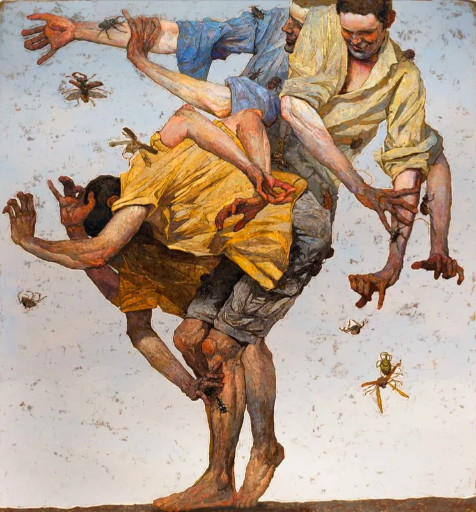
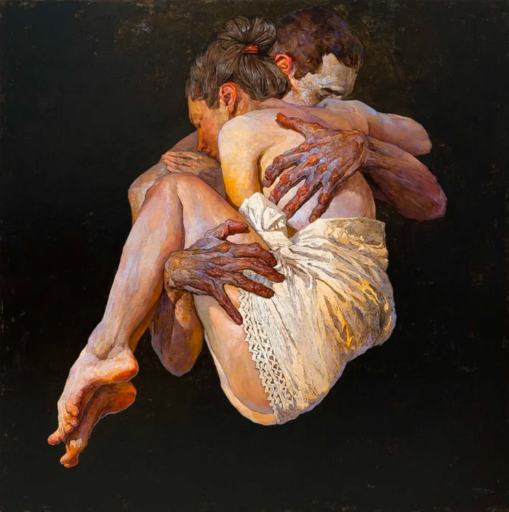
En Pantomime (2014-2017), Sarazhin pinta figuras humanas —a menudo en movimiento, a menudo en poses de tensión extrema— a las que niega consistentemente el recurso más elemental de la pintura figurativa occidental: el rostro visible. Las figuras se encuentran de espaldas, o con la cabeza inclinada, o con el cabello cubriendo la cara, o con las manos superpuestas sobre los rasgos. No hay mirada que devolver. No hay expresión facial que leer. El desafío a reconsiderar el potencial comunicativo del cuerpo es evidente: eso de que para saber quién es alguien hay que verle los ojos, con el grueso de la tradición pictórica occidental, desde los retratos flamencos del siglo XV hasta las fotografías del siglo XX, es suprimido y surge la pregunta: ¿qué queda? ¿Qué tipo de conocimiento del otro es posible cuando no hay rostro? ¿Puede el cuerpo solo —su postura, su tensión muscular, su relación con el espacio— comunicar algo que el rostro comunica de otra manera, o hay dimensiones de la persona que el rostro oculta antes de revelar?
Aquí, la respuesta es formal. Las manos, en particular, se convierten en el centro semiótico de estas obras. Éstas, sin embargo, no ilustran ningún principio de comunicación gestual, sino que lo demuestran, brutalmente: desde sus límites, alumbrando la cuestión de la incomprensión y el desespero que acarrea la ausencia de espejos para el alma, por decirlo de algún modo: en los ojos, sobre todo, en la boca y el complejo de gestos del rostro. Manos y más manos entrelazadas sobre una tela anulan cualquier empatía —esa pretensión de diagnóstico—, si bien resguardan la compasión —compartir el dolor—, justamente en la frustración de no poder anclarse en ninguna expresión que permita el trazo de un sentido pleno.
La pantomima es el arte de comunicar sin palabras, mediante el gesto y el movimiento del cuerpo. La palabra proviene del griego pantómimos: el que imita todo. En la pantomima, el cuerpo asume la función que ordinariamente delega al lenguaje verbal. En cierto sentido, constituye no una ilustración de un texto previo, sino el texto mismo.
Sarazhin trabaja sobre esa tensión: entre la institución del lenguaje verbal y el cuerpo como alternativa, que depende en mucha mayor medida del receptor, a riesgo de desbarrar en relativismo. La polisemia, aunque irreductible a una proposición cerrada encuentra sus límites, nuevamente en la compasión, merced de la carnalidad, de los nervios tensionados.
El manejo técnico es notable: claroscuro clásico con un uso fresco y vibrante del color. Confiere las figuras carnosidad luminosa, para mayor énfasis aún de la cinética.
[La gravedad y el escape]
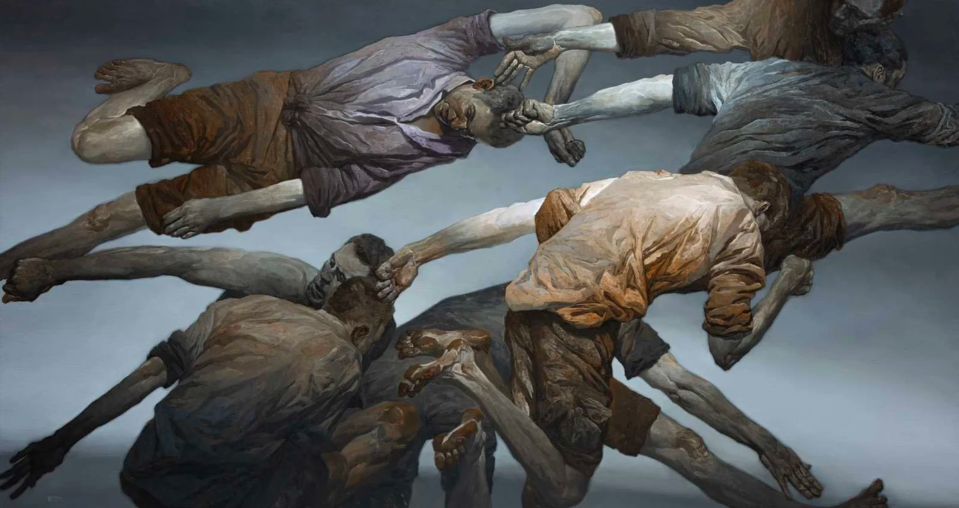
La exposición Gravity (Galerie Thomas Fuchs, Stuttgart, 2019) y la posterior Escape (Arcadia Contemporary, Los Ángeles, 2020) articulan un tercer nivel de cuestionamiento institucional: la relación del cuerpo con las fuerzas que lo sujetan. La gravedad como metáfora de todo cuanto mantiene a los individuos anclados a sus posiciones —sociales, culturales, históricas, familiares— y que determinan su margen de acción. Las figuras de este conjunto están sometidas a tensiones que las jalan en direcciones opuestas: hacia el suelo y hacia arriba, hacia la permanencia y hacia el movimiento, hacia la pertenencia y hacia la fuga.
Escape, ciertamente, radicaliza este cuestionamiento. La figura que escapa es la figura que rechaza la institución que la sujeta, pero sin tener todavía claro hacia dónde se dirige. Se trata de una ilusión de libertad. Puro desespero. Así, el escape no es un destino, sino apenas un gesto de ruptura. Romanticismo.
En la pintura de Sarazhin, esto se encarna en la postura, en la dirección de las extremidades, en la tensión del cuerpo que huye sin haber terminado de decidir.
Llegado este punto, la lectura de las series a la luz de la biografía de Sarazhin podría resultar engañosamente sencilla: Nacido en Nikopol, formado en Járkov, emigrado a los Estados Unidos por etapas, el artista es consciente de que su país lleva años en un estado de tensión irresuelta entre pertenencia e identidad, entre herencia soviética y futuro europeo. Pero reducir el cuestionamiento de la obra a su contexto biográfico sería justamente eso de lo que el artista nos previene: sus figuras son deliberadamente anónimas, sin rostro, sin nombre, sin pertenencia geográfica legible. Lo que cuestionan es la condición universal de quien resulta arrastrado por fuerzas que no eligió y busca un espacio propio sin tener garantías de encontrarlo. El precio del desengaño: el peligro de la ilusión de libertad y, en consecuencia, una nueva sujeción excesiva.
[La metamorfosis y la guerra]
El 24 de febrero de 2022, el ejército ruso inició la invasión a gran escala de Ucrania. Sarazhin, cuya familia permanecía en el país, se mudó definitivamente a los Estados Unidos. La exposición Bestiary (Arcadia Contemporary, diciembre de 2022) es el registro pictórico de ese momento: no un testimonio documental sino una respuesta formal al tránsito de una realidad a otra, más atroz, que irrumpe en el mundo de quien había construido su práctica sobre la figura humana como territorio de investigación.
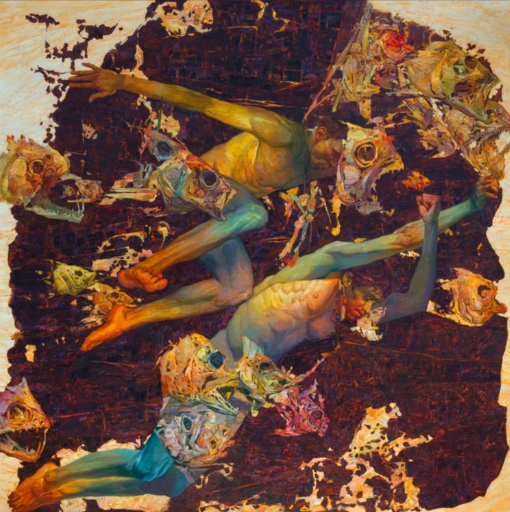
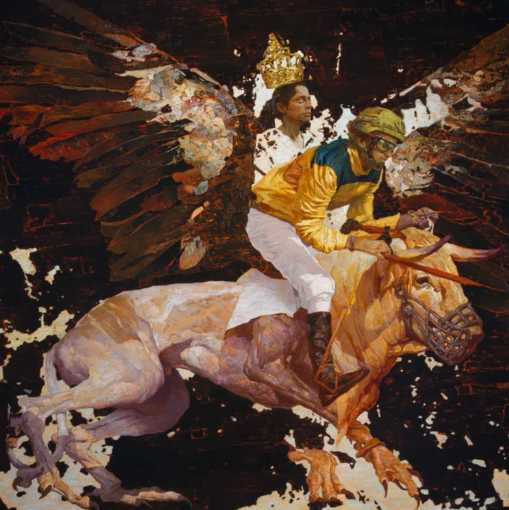
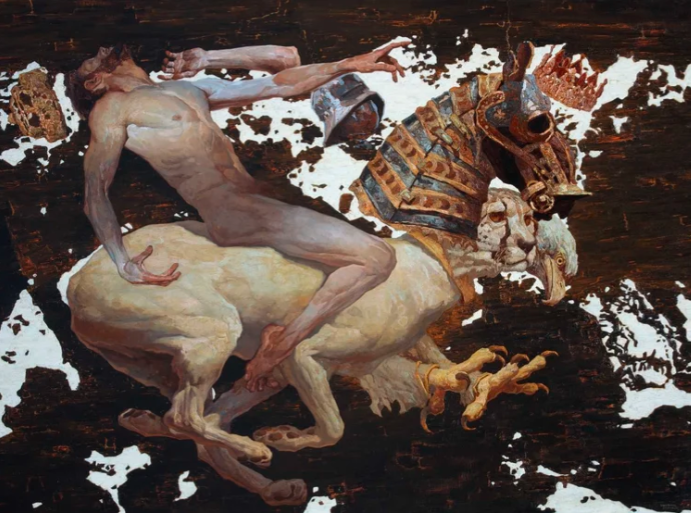
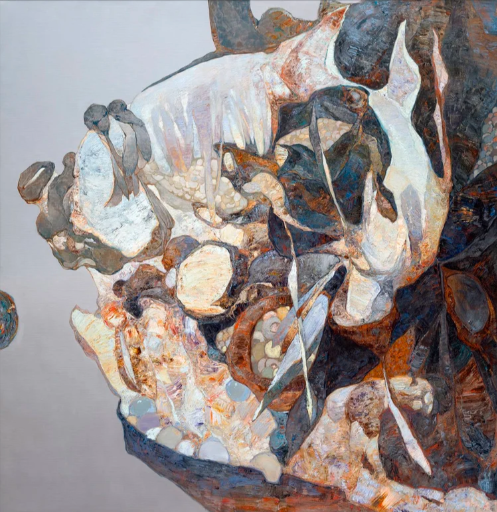
En lugar de pintar la guerra —las víctimas, los combatientes, las ruinas—, Sarazhin muestra lo que ella produce en quien la vive: una metamorfosis. Sus figuras en Bestiary empiezan a fundirse con elementos animales. Aparecen cuerpos con rasgos de ave, fusiones de hombre y bestia, pieles que se disuelven en el color como si la frontera entre lo humano y lo animal se diluyera. En cuestión: la institución de la forma humana como límite claro y estable entre el hombre instituido y lo salvaje. La guerra, lejos de desmentir el supuesto, lo hace colapsar sobre la ilusión que suponía: libertad, igualdad y fraternidad. Porque no hay, en verdad, mayor exposición de sofisticación que el empleo de toda la capacidad humana en el enfrentamiento a muerte. Con lo que de bestial se manifiesta. Sarazhin, en lugar de narrar una crisis, la exhibe: hace que la forma humana misma se fracture, que sus límites se vuelvan porosos con los símbolos de naturaleza fiera, y el cuerpo que hasta entonces había sido el territorio de la investigación sobre la persona comience a perder la claridad que le era propia. Por pretender trascender.
[La batalla del alma]
La palabra psychomachia proviene del griego: psyché (alma) y machía (batalla, combate). Es el título de un poema latino del siglo IV escrito por Prudencio, en el que las virtudes y los vicios combaten entre sí por la posesión del alma humana. Sarazhin la recupera para la exposición de 2024 en Arcadia Contemporary porque nombra exactamente el territorio donde su investigación se ha instalado en su etapa de madurez: la lucha interna, la dualidad constitutiva de la persona, la tensión entre lo que el ser humano es y lo que aspira a ser.
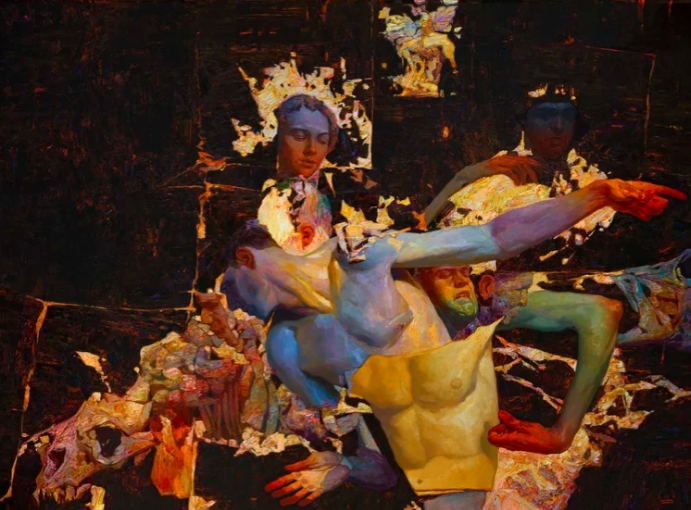
La institución que Psychomachia cuestiona más claramente es la razón ilustrada, idealismo soberano que organiza y domina las fuerzas que operan en el interior de la mayoría de hombres así llamados occidentales. Esta institución —uno de los pilares del proyecto ilustrado, contra la tradición filosófica grecolatina hispánica— afirma que el ser humano puede y debe alcanzar sus sueños como cuestión de gobierno. Las pinturas de Psychomachia muestran un panorama muy diferente: figuras que se desdoblan, se fragmentan, se contradicen a sí mismas en el mismo lienzo; espacios que oscilan entre la figuración y la abstracción como si la identidad personal no pudiera ser contenida en ninguna de las dos por separado; colores que se confrontan sin resolverse en armonía. La uniformidad ni la armonía plena gobiernan aquí, pues la razón compite, y el resultado nunca es absoluto, sino probable. Y es se requiere una auténtica dialéctica. Además, por supuesto, aceptar que la realidad es mucho más compleja y por demás irreductible a los afanes de paz y felicidad absolutos.
[La bestia y el cielo]
La más reciente de las grandes exposiciones de Sarazhin, The Beast and the Sky (Mriya Gallery, Nueva York, octubre de 2025), lleva la investigación de toda su carrera a una síntesis que no es resolución sino profundización de la tensión constitutiva. El comunicado de la exposición lo formula con precisión: «La exposición explora la dualidad del ser humano como bestia y soñador, anclado a la tierra, pero aspirando sin cesar al cielo, con esa hambre insaciable alimentada por nuestra arma más bella y más destructiva: la imaginación» (Mriya Gallery / Bergali, 2025).
La tensión que organiza esta exposición es nuevamente radical, pero no ya entre identidad y anonimato, ni entre razón e instinto, sino entre la condición material del ser humano y su obstinación de trascender su actualidad mediante la imaginación, la abstracción y la creación. Lo que puede llevarlo a plantearse objetivos y metas, ejercer la razón de veras, alcanzar el desengaño y conseguir instantes de plenitud, o a continuar hundido en espejismos, creyendo que sus delirios son en realidad profecías.
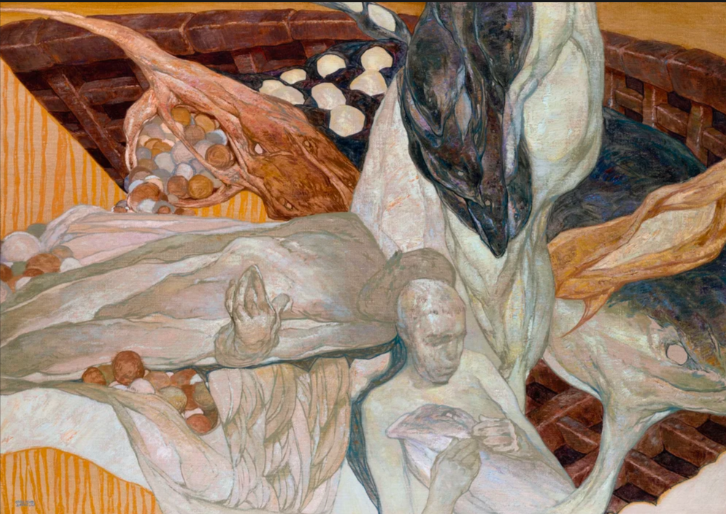
Las figuras semi-abstractas de Sarazhin no apuntan a ningún sentido en particular. Ponen sobre la mesa una realidad complejísima de abordar e invitan a cada quien a vivir la experiencia del asomo en su propio territorio institucional.
[El trabajo reciente]
Los títulos de las obras más recientes de Sarazhin —I Remember It Differently (2026), We Have Come Through (2026), It Was Almost There (2026), The Road Beyond Maps (2026)— señalan un desplazamiento del cuestionamiento hacia el territorio de la memoria y el tiempo. Lucen la condición de quien ha salido del territorio que conoce y se adentra en uno para el que los mapas existentes no sirven. Un mapa es una institución: un sistema de coordenadas que permite orientarse. Más allá del mapa, la orientación tiene que construirse de otra manera, con otros instrumentos, con la experiencia directa antes que con la representación previa. Es exactamente la condición del artista que ha llevado su investigación más allá de donde sus referentes lo hicieron.
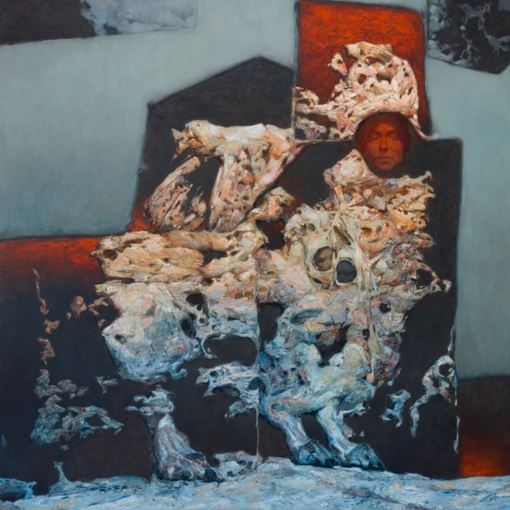
Sarazhin describe un movimiento de alejamiento de la figura que, en sus exposiciones más recientes, lo acerca peligrosamente a la abstracción: si las figuras se disuelven, si los cuerpos pierden sus contornos, ¿no pierde la obra la ancla en lo humano que le daba su especificidad?
Lo que hace a la obra de Sarazhin específica es que el cuerpo humano —en cualquier grado de resolución o de disolución— es el territorio donde su investigación se desarrolla. Una figura que se disuelve en el espacio no ha abandonado la figuración: ha llevado la pregunta sobre la forma humana a su punto de tensión mayor, donde la forma se encuentra a punto de desaparecer y donde la idea de límite se convierte en el objeto de la investigación.
[La técnica como argumento]
Sarazhin fue formado en la tradición académica de la Kharkiv State Academy of Design and Arts, que en el periodo soviético y postsoviético mantenía una enseñanza rigurosa del dibujo anatómico, la composición clásica y el trabajo con modelos vivos. Esta formación le proporcionó lo que él mismo ha descrito como el fundamento invisible de toda su libertad posterior.
El proceso de trabajo de Sarazhin comienza con un dibujo estructural directo sobre el lienzo, en el que define proporciones, ejes de movimiento y puntos de tensión antes de aplicar ningún color. Esta fase establece la arquitectura de la obra: la disposición de las masas en el espacio, las relaciones entre las partes, la dirección de las fuerzas que atraviesan la composición. Es una fase de pensamiento, no de ejecución, y Sarazhin la trata como tal: no se precipita hacia el color hasta haber resuelto el problema compositivo. Sobre esa estructura dibujada aplica una primera capa tonal con tierras y ocres, que establece los grandes valores de luz y sombra sin comprometerse todavía con ningún color específico. Es la técnica del claroscuro llevada al punto de partida: antes de colorear, ver la luz.
A partir de esa base, Sarazhin construye el volumen y el color mediante capas sucesivas de óleo, trabajando con pinceladas de diferentes anchos y direcciones que no obedecen a la anatomía de la figura sino a la lógica interna de la composición. Las pinceladas direccionales son el elemento técnico más característico de su lenguaje maduro: en lugar de seguir el contorno de los músculos o las articulaciones, crean una tensión entre la forma anatómica y la forma pictórica que es exactamente análoga a la tensión conceptual que sus obras plantean. La comparación con Egon Schiele que frecuentemente se hace es parcialmente pertinente en lo que respecta a la distorsión expresiva de la figura, pero no alcanza a dar cuenta del uso del color: donde Schiele construye con líneas sobre fondos neutros, Sarazhin construye con masa cromática que crea su propio espacio.
Su paleta trabaja con una lógica de contraste interno: busca la tensión cromática que mantiene el ojo en movimiento sobre la superficie. El azul cerúleo, que utiliza con frecuencia como color dominante en sus composiciones, tiene una transparencia y una frialdad que contrasta productivamente con los rojos y amarillos de cadmio con los que modela las carnes. El violeta y el verde indio aparecen en las sombras, complejizándolas más allá de la oscuridad convencional. El blanco de titanio —opaco, denso— y el blanco de zinc —más transparente, más luminoso— se utilizan para matices diferentes de la luz: uno para los puntos de máxima intensidad, el otro para las medias luces que mantienen la vibración de la forma.
[De modo que…]
La obra de Sarazhin exige ver el cuerpo como texto, uno dentro del lienzo, que es en sí, otro, de notable complejidad. Confirma, desde luego, la vigencia de la pintura figurativa. Pero también que la vuelta a la figura no es la vuelta a ninguna certeza: es, en los mejores casos, la vuelta a la cuestión de qué significa ser persona en un mundo cuyas instituciones tambalean.
Denis Sarazhin, desde luego, no ofrece respuestas. Hace más.
[Todas las imágenes, del sitio web del artista: https://www.denissarazhin.com/]
Referencias bibliográficas:
Arcadia Contemporary. (2022). Denis Sarazhin: Bestiary [Catálogo de exposición]. Nueva York.
Arcadia Contemporary. (2024). Denis Sarazhin: Psychomachia [Catálogo de exposición]. Nueva York. https://arcadiacontemporary.com/exhibitions/73-denis-sarazhin-psychomachia/overview/
Arcadia Contemporary. (2024, 8 de diciembre). Denis Sarazhin Psychomachia [Catálogo digital]. Issuu. https://issuu.com/arcadiafinearts/docs/denis_sarazhin_2024_solo_catalog
Artaesthetics.net. (2018, 5 de junio). The figurative communication of Denis Sarazhin. Art Aesthetics Magazine. https://www.artaesthetics.net/publications/2017/6/18/the-figurative-communication-of-denis-sarazhin
Artsy. (s.f.). Denis Sarazhin: art & prints for sale. https://www.artsy.net/artist/denis-sarazhin
Hi-Fructose Magazine. (2016, 28 de diciembre). Denis Sarazhin’s dramatic, textured oil paintings. https://hifructose.com/2016/12/28/denis-sarazhins-dramatic-textured-oil-paintings/
Idea Seed. (2016). Idea Seed Interview: Denis Sarazhin [Entrevista]. Tumblr. https://www.tumblr.com/idea-seed/148787293300/idea-seed-interview-denis-sarazhin
Luyten Gallery / Serrano, D. (2025, 8 de noviembre). Denis Sarazhin: energía, cuerpo y pintura en la figuración contemporánea. Luyten Gallery. https://www.luytengallery.com/post/denis-sarazhin
Mriya Gallery / Bergali, A. (2025, 1 de octubre). The Beast and the Sky: Denis Sarazhin [Comunicado de prensa]. UP Magazine. https://upmag.com/press-release-the-beast-and-the-sky/
Pearce, M. (2022). A Bestiary Born of War. Ensayo crítico para Arcadia Contemporary. American Art Collector, 206.
Sarazhin, D. (s.f.). About. Denis Sarazhin Official Website. https://www.denissarazhin.com/about
Sarazhin, D. (s.f.). Selected works. Denis Sarazhin Official Website. https://www.denissarazhin.com/selected-works
Torres Muñiz, J. P. (2022). Homo Institutionalis. Lima: Grupo Editorial Caja Negra.
WooArts. (s.f.). Denis Sarazhin gallery: paintings. https://wooarts.com/denis-sarazhin-gallery
(ENGLISH VERSION)
Flesh as Argument: Denis Sarazhin and the Question of the Person in Contemporary Figurative Painting
Translation by Tiffany Amber Elias Trimble
There is a paradox that contemporary art theory has preferred to ignore rather than resolve: figurative painting has not only not died, but in the early decades of the 21st century, it is experiencing one of its moments of greatest vitality since the emergence of German Expressionism. While academia and the conceptual art market disputed the monopoly of what should count as serious art, thousands of painters around the world continued with the obstinacy of those who know that there is a tradition that is not exhausted, developing figurative languages of a sophistication that no neon installation nor any relational art manifesto has managed to replicate. Figurative painting is not an anachronism nor a conservative reaction: it is, simply, the most difficult, most demanding, and perhaps most honest way to produce an image. In it, there is nowhere to hide: mastery of the craft is visible or it is not, the idea exists or it does not, the work confronts or… it merely decorates. The thematic focus in each case varies, but it is not possible to address it without the proper balance between content and form. In this regard, regarding how it is achieved, the work of the Ukrainian Denis Sarazhin (b. Nikopol, 1982) deserves special attention.
In what way has he addressed and developed his thematic focus throughout his career? We consider that Sarazhin is not a painter of bodies, but of complex entities, much broader – yes: institutions – in crisis. Through a rigorous and coherent artistic evolution, from the early series of the suspended figure to the hybrid bestiaries and the psychomachias of his mature stage, Sarazhin has constructed an eloquent body of work on personal identity, communication, reason versus instinct, the very possibility of form in a disfigured world, and more.
[First of all…]
In the perspective of Homo Institutionalis, art is not the expression of individual emotions, nor the externalization of spiritual contents, nor the product of an inspiration that escapes reason: it is an institution. This means that art exists only within a communicative situation constituted by four irreducible materials: the author, who applies specific intellectual and technical competencies to generate a questioning vision of reality; the work, which constitutes an eloquent text capable of dialectically confronting the receiver without needing external explanations; the receiver, who attends to and understands the questioning posed from their own categories and experiences; and the institutional framework, the apparatus of critical interpretation that recognizes the work as what it is and allows its function to be realized. What distinguishes art from other human activities is not harmony alone, nor originality, nor the emotional impact it produces, but a specific and irreplaceable function: art is the institution that questions all others, including itself, thereby achieving beauty (as astonishment and categorical overflow). When a pictorial, literary, cinematographic, or any other type of text fulfills this function – when it puts into crisis the concepts and institutions of the receiver’s world so that they cannot resolve it with the categories they already had – we are facing art in the fullest sense.
Now, the term figuration comes from the Latin figuratio, derived from figura (form, image, appearance), which in turn descends from fingere: to model, to form, to configure. Fingere is the verb with which the Latins designated both the potter’s work on clay and the poet’s work on language. Figuration, understood in its root, is not the servile representation of what is seen: it is the operation of giving form, of extracting from matter an image that was not there before the artist intervened upon it. Figurative painting does not reproduce reality: it interrogates it through form.
This point is fundamental for understanding why figuration, far from being an exhausted tradition, remains the most fertile territory for artistic research. Because the human figure – the body, the gesture, the posture, the gaze or its absence – is the field where the deepest institutions of human life manifest themselves most immediately and most irreducibly. There is no institution that does not pass through the body: family, work, war, love, identity, power, pain, death. The painter who chooses the figure as an object of research does not opt for a theme; they decide on a territory from which they can question the totality of the institutions that organize human existence. And that choice, when conscious and rigorous, is in itself a philosophical position.
[Identity as an unknown]
In Pantomime (2014-2017), Sarazhin paints human figures – often in motion, often in poses of extreme tension – to which he consistently denies the most elementary resource of Western figurative painting: the visible face. The figures are shown from behind, or with heads tilted, or with hair covering the face, or with hands superimposed over the features. There is no gaze to return. There is no facial expression to read. The challenge to reconsider the communicative potential of the body is evident: the notion that to know who someone is one must see their eyes, with the bulk of Western pictorial tradition from 15th-century Flemish portraits to 20th-century photography, is suppressed and the question arises: what remains? What kind of knowledge of the other is possible when there is no face? Can the body alone – its posture, its muscular tension, its relationship with space – communicate something that the face communicates differently, or are there dimensions of the person that the face hides before it reveals?
Here, the answer is formal. The hands, in particular, become the semiotic center of these works. These, however, do not illustrate any principle of gestural communication, but rather demonstrate it, brutally: from their limits, illuminating the question of misunderstanding and the despair that accompanies the absence of mirrors for the soul, so to speak: in the eyes, above all, in the mouth, and the complex of facial gestures. Hands and more hands intertwined over a canvas annul any empathy – that diagnostic pretension – although they preserve compassion – sharing pain – precisely in the frustration of not being able to anchor themselves in any expression that allows the tracing of a full meaning.
Pantomime is the art of communicating without words, through gesture and body movement. The word comes from the Greek pantomimos: the one who imitates everything. In pantomime, the body assumes the function ordinarily delegated to verbal language. In a certain sense, it constitutes not an illustration of a prior text, but the text itself.
Sarazhin works on that tension: between the institution of verbal language and the body as an alternative, which depends to a much greater degree on the receiver, at the risk of straying into relativism. Polysemy, although irreducible to a closed proposition, finds its limits, again in compassion, by virtue of carnality, of taut nerves.
The technical mastery is notable: classical chiaroscuro with a fresh and vibrant use of color. It gives the figures a luminous fleshiness, to further emphasize the kinetics.
[Gravity and escape]
The exhibition Gravity (Galerie Thomas Fuchs, Stuttgart, 2019) and the subsequent Escape (Arcadia Contemporary, Los Angeles, 2020) articulate a third level of institutional questioning: the relationship of the body to the forces that hold it. Gravity as a metaphor for everything that keeps individuals anchored to their positions – social, cultural, historical, familial – and that determines their margin of action. The figures in this set are subjected to tensions that pull them in opposite directions: towards the ground and upwards, towards permanence and towards movement, towards belonging and towards flight.
Escape, certainly, radicalizes this questioning. The figure that escapes is the figure that rejects the institution that holds it, but without yet being clear about where it is heading. It is an illusion of freedom. Pure despair. Thus, escape is not a destination, but merely a gesture of rupture. Romanticism.
In Sarazhin’s painting, this is embodied in posture, in the direction of the limbs, in the tension of the body that flees without having finished deciding.
At this point, reading the series in light of Sarazhin’s biography could be deceptively simple: Born in Nikopol, trained in Kharkiv, emigrated to the United States in stages, the artist is aware that his country has been in a state of unresolved tension for years between belonging and identity, between Soviet heritage and European future. But reducing the work’s questioning to its biographical context would be precisely what the artist warns us against: his figures are deliberately anonymous, faceless, nameless, without readable geographical belonging. What they question is the universal condition of one who is dragged by forces they did not choose and seeks a space of their own without guarantees of finding it. The price of disillusionment: the danger of the illusion of freedom and, consequently, a new excessive subjection.
[Metamorphosis and war]
On February 24, 2022, the Russian army began the large-scale invasion of Ukraine. Sarazhin, whose family remained in the country, moved permanently to the United States. The exhibition Bestiary (Arcadia Contemporary, December 2022) is the pictorial record of that moment: not a documentary testimony but a formal response to the transition from one reality to another, more atrocious, that bursts into the world of one who had built their practice on the human figure as a territory of research.
Instead of painting the war – the victims, the combatants, the ruins – Sarazhin shows what it produces in those who live it: a metamorphosis. His figures in Bestiary begin to merge with animal elements. Bodies with avian features appear, fusions of man and beast, skins that dissolve into color as if the boundary between the human and the animal were blurring. In question: the institution of human form as a clear and stable limit between instituted man and the wild. War, far from disproving the assumption, makes it collapse upon the illusion it supposed: freedom, equality, and fraternity. Because there is, in truth, no greater exposure of sophistication than the use of all human capacity in mortal confrontation. With what is bestial manifested. Sarazhin, instead of narrating a crisis, exhibits it: he makes human form itself fracture, its limits become porous with symbols of fierce nature, and the body that until then had been the territory of research on the person begins to lose the clarity that was proper to it. By pretending to transcend.
[The battle of the soul]
The word psychomachia comes from the Greek: psyche (soul) and machia (battle, combat). It is the title of a 4th-century Latin poem written by Prudentius, in which virtues and vices fight each other for possession of the human soul. Sarazhin recovers it for the 2024 exhibition at Arcadia Contemporary because it names exactly the territory where his research has settled in his mature stage: the internal struggle, the constitutive duality of the person, the tension between what the human being is and what they aspire to be.
The institution that Psychomachia most clearly questions is enlightened reason, sovereign idealism that organizes and dominates the forces operating within most so-called Western men. This institution – one of the pillars of the Enlightenment project, against the Hispanic Greco-Latin philosophical tradition – affirms that the human being can and should achieve their dreams as a matter of governance. The paintings of Psychomachia show a very different panorama: figures that unfold, fragment, contradict themselves on the same canvas; spaces that oscillate between figuration and abstraction as if personal identity could not be contained in either separately; colors that confront each other without resolving into harmony. Uniformity nor full harmony govern here, for reason competes, and the result is never absolute, but probable. And a true dialectic is required. Moreover, of course, accepting that reality is much more complex and otherwise irreducible to the aspirations of absolute peace and happiness.
[The beast and the sky]
The most recent of Sarazhin’s major exhibitions, The Beast and the Sky (Mriya Gallery, New York, October 2025), brings the research of his entire career to a synthesis that is not resolution but a deepening of the constitutive tension. The exhibition press release formulates it precisely: The exhibition explores the duality of the human being as beast and dreamer, anchored to the earth, but ceaselessly aspiring to the sky, with that insatiable hunger fueled by our most beautiful and most destructive weapon: imagination (Mriya Gallery / Bergali, 2025).
The tension organizing this exhibition is again radical, but no longer between identity and anonymity, nor between reason and instinct, but between the material condition of the human being and their obstinacy to transcend their current reality through imagination, abstraction, and creation. Which can lead them to set objectives and goals, exercise reason genuinely, achieve disillusionment, and attain moments of fullness, or to remain sunk in mirages, believing that their delusions are in fact prophecies.
Sarazhin’s semi-abstract figures do not point to any particular meaning. They place on the table a highly complex reality to address and invite each person to live the experience of the glimpse in their own institutional territory.
[Recent work]
The titles of Sarazhin’s most recent works – I Remember It Differently (2026), We Have Come Through (2026), It Was Almost There (2026), The Road Beyond Maps (2026) – indicate a displacement of questioning towards the territory of memory and time. They show the condition of one who has left the territory they know and ventures into one for which existing maps do not serve. A map is an institution: a coordinate system that allows one to orient oneself. Beyond the map, orientation must be built differently, with other instruments, with direct experience rather than prior representation. It is exactly the condition of the artist who has taken their research beyond where their references took them.
Sarazhin describes a movement away from the figure that, in his most recent exhibitions, brings him dangerously close to abstraction: if figures dissolve, if bodies lose their contours, does the work not lose the anchor in the human that gave it its specificity?
What makes Sarazhin’s work specific is that the human body – in any degree of resolution or dissolution – is the territory where his research unfolds. A figure that dissolves in space has not abandoned figuration: it has taken the question of human form to its point of greatest tension, where form is about to disappear and where the idea of limit becomes the object of research.
[Technique as argument]
Sarazhin was trained in the academic tradition of the Kharkiv State Academy of Design and Arts, which in the Soviet and post-Soviet period maintained rigorous teaching of anatomical drawing, classical composition, and work with live models. This training provided him with what he himself has described as the invisible foundation of all his subsequent freedom.
Sarazhin’s working process begins with a structural drawing directly on the canvas, in which he defines proportions, axes of movement, and points of tension before applying any color. This phase establishes the architecture of the work: the arrangement of masses in space, the relationships between parts, the direction of the forces that traverse the composition. It is a phase of thought, not execution, and Sarazhin treats it as such: he does not rush towards color until he has resolved the compositional problem. On that drawn structure, he applies a first tonal layer with earths and ochres, which establishes the large values of light and shadow without yet committing to any specific color. It is the technique of chiaroscuro taken to its starting point: before coloring, see the light.
From that base, Sarazhin builds volume and color through successive layers of oil, working with brushstrokes of different widths and directions that do not obey the anatomy of the figure but the internal logic of the composition. Directional brushstrokes are the most characteristic technical element of his mature language: instead of following the contour of muscles or joints, they create a tension between anatomical form and pictorial form that is exactly analogous to the conceptual tension that his works pose. The comparison with Egon Schiele frequently made is partially pertinent with respect to the expressive distortion of the figure, but it does not fully account for the use of color: where Schiele constructs with lines on neutral backgrounds, Sarazhin constructs with chromatic mass that creates its own space.
His palette works with a logic of internal contrast: it seeks the chromatic tension that keeps the eye moving over the surface. Cerulean blue, which he frequently uses as a dominant color in his compositions, has a transparency and coldness that contrasts productively with the cadmium reds and yellows with which he models flesh. Violet and Indian green appear in the shadows, complicating them beyond conventional darkness. Titanium white – opaque, dense – and zinc white – more transparent, more luminous – are used for different nuances of light: one for points of maximum intensity, the other for the half-tones that maintain the vibration of form.
[So then…]
Sarazhin’s work demands seeing the body as a text, one within the canvas, which is itself another text of notable complexity. It confirms, of course, the validity of figurative painting. But also that the return to the figure is not a return to any certainty: it is, in the best cases, a return to the question of what it means to be a person in a world whose institutions are faltering.
Denis Sarazhin, of course, does not offer answers. He does more.