
Geometría impuesta: Aproximación a la obra de J. Carino
Por Juan Pablo Torres Muñiz
A veces, basta con representar una misma imagen de modo distinto al habitual para poner de relieve lo que acaso sobra, falta o es dudoso de la versión popular. Cuando la nueva representación se sirve, solventemente, de una rica tradición para, no obstante, traicionar el discurso ideal imperante, merece atención.
La obra pictórica de J. Carino se inscribe en una línea que, lejos de la expresión ingenua, opera con racionalidad y claro propósito. Carino no pinta para representar un mundo dado, sino para interrogarlo, para hacer visible cómo las categorías mismas que damos por sentadas —como ser humano, naturaleza, familia, amor, identidad— son construcciones institucionales que requieren revisión crítica permanente.
Su trabajo avanza por caminos sutiles, donde la forma misma del cuadro, su estructura interna, sus colores y composiciones geométricas, funcionan como operaciones racionales sobre la realidad. En este sentido, su enfoque impresionista no es una adhesión estilística fortuita, sino una elección deliberada que permite una aproximación sensible pero controlada al caos del mundo, sin caer en el mimetismo primitivo que caracteriza a cierta pintura que pretende acercarse a lo ancestral o a lo «auténtico». Carino no busca la sencillez elemental ni la pureza tribal; más bien, su técnica se aleja deliberadamente de ella, mostrando cómo incluso lo más aparentemente natural, desde nuestra perspectiva, es siempre mediado por instituciones, por formas culturales de ver y organizar el entorno.
Cada uno de sus cuadros se presenta como una construcción precisa. Su geometría es funcional: sirve para articular una visión particular del mundo, una que confronta directamente con la idea romántica de que el ser humano es algo dado, inmediato, accesible desde la intuición o la sensibilidad sin mediación conceptual. De hecho, muestra cómo el hombre o, más bien, quiérase o no, la persona, tal como la conocemos, es producto de instituciones que la nombran, organizan y contienen, y cómo estas mismas instituciones pueden ser objeto de crítica y transformación.
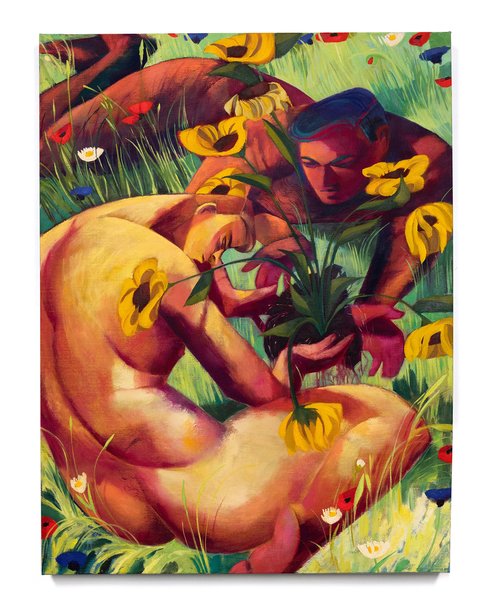
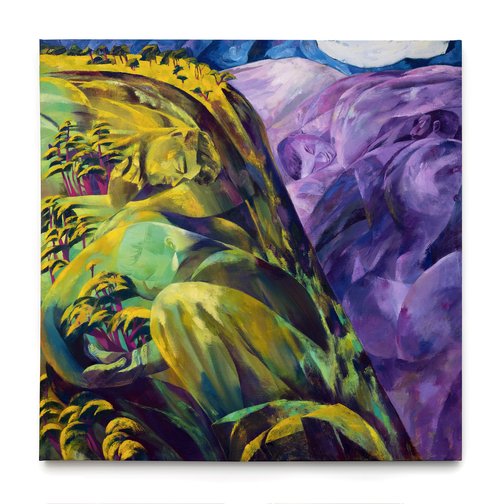
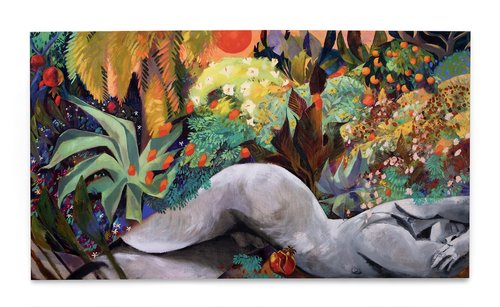
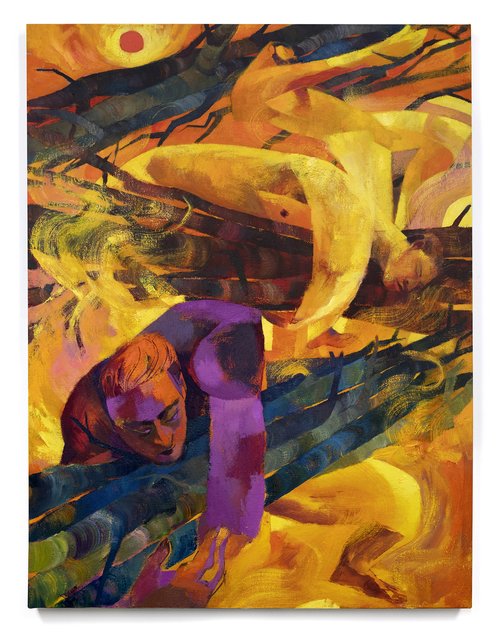
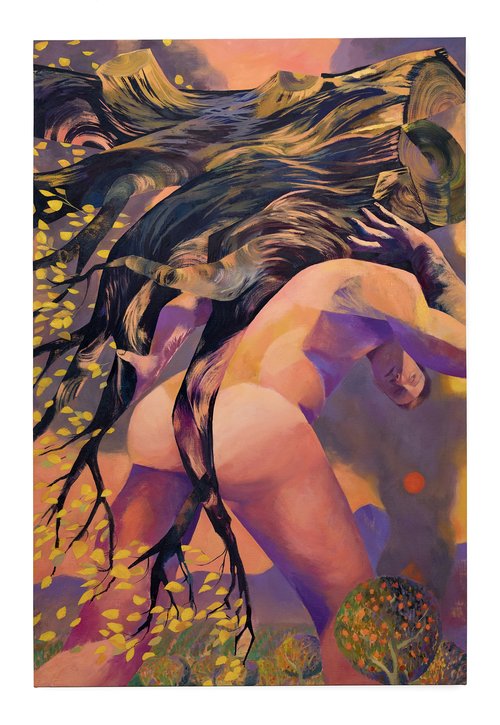
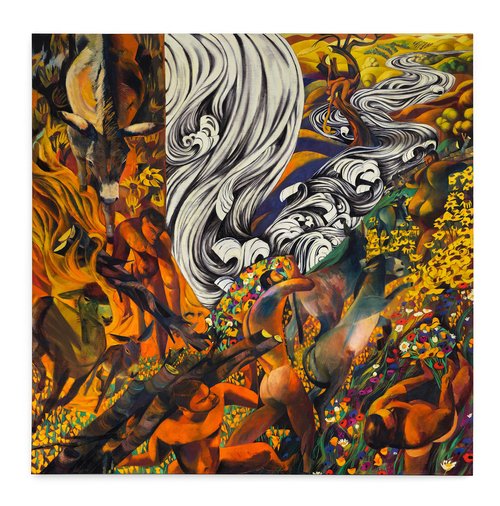
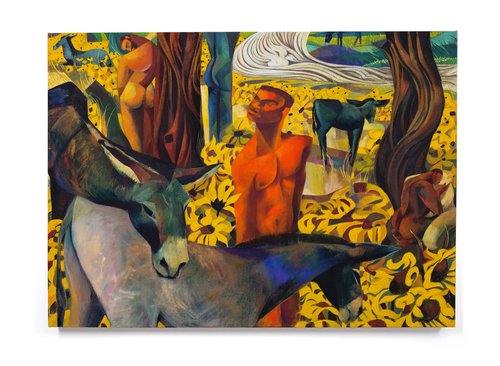
En series como Carry It With You, el artista aborda temas centrales como la relación entre individuo y naturaleza, la noción de comunidad y la identidad sexual; plantea, a propósito, una visión afirmativa, aunque no complaciente, que reconoce tanto el conflicto como la posibilidad de reconstrucción. No se queda en la gracia ni en la catástrofe, propone una suerte de epopeya visual que sitúa a hombres que aman y desean a otros hombres, entre bestias, en el centro de una mitología edénica reimaginada. Ficción sin disfraz. Este giro no es solo político, sino metodológico: está tomando un conjunto de instituciones (la Historia, la familia tradicional, la relación con el paisaje) y proponiendo una reinterpretación que las desestabiliza sin destruirlas, que obliga a su revisión.
La representación pictórica de hombres, sobre todo, y unas pocas mujeres, en la obra de J. Carino no responde a un impulso naturalista ni mucho menos a una visión fideísta del ser humano en estado originario de inocencia o de armonía espontánea con el entorno. No hay en ella rastro de ese idealismo que pretende encontrar en lo «primitivo» una pureza moral, una sabiduría ancestral o el absurdo de una libertad no institucional, al margen de otras instituciones. Al contrario, la forma en que las figuras humanas interactúan entre sí y con el paisaje revela una intención claramente apolínea: una estructura racional que organiza la percepción, que impone sentido y orden al caos vegetal y emocional.
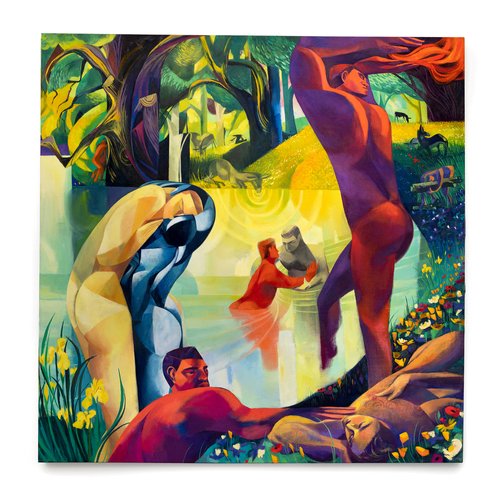
Las parejas no aparecen como datos inmediatos de la naturaleza, ni como consecuencias directa del instinto, sino como configuración voluntaria, como forma establecida por medio de operaciones racionales que van más allá de lo biológico, arbitrariamente, con plena consciencia. El trazo firme, la composición geométrica, la paleta controlada y la luz precisa son elementos que denotan esta voluntad de instituir, digamos, a contracorriente; de dar forma visible a una realidad que no surge espontáneamente del deseo o de la pulsión, sino que se construye a partir de criterios compartidos, de decisiones conscientes que articulan lo individual con lo colectivo, sin negación alguna de la realidad material, de la carne y los órganos, de la vida como opera por sí misma.
El paisaje, muchas veces compuesto como un jardín artificial inserto en medio de una selva o bosque indomable, funciona como metáfora visual de este proceso. No se presenta la naturaleza como fuente última de verdad ni como redención posible, sino como materia prima que requiere de intervención humana para adquirir sentido. Así, la geometría del jardín contrasta deliberadamente con la irregularidad salvaje del fondo arbóreo, señalando cómo el orden institucional no surge espontáneamente, sino que debe ser pensado, diseñado y mantenido.
Carino no solo cuestiona visiones románticas del amor homosexual como retorno a la naturaleza o como manifestación espontánea de la identidad verdadera. Más profundamente, afirma que cualquier relación humana significativa es, por definición, una construcción racional que se vincula con otras en symploqué.
Así, la impronta humana no se manifiesta en la capacidad de imitar al animal ni en la búsqueda de un estado previo a la civilización, sino en la posibilidad de instituir, de crear formas que den estructura al caos, que permitan vivir juntos con sentido y propósito.
El simbolismo presente en esta obra dista de lo místico, responde a un sistema de referencias claras, inteligibles, que exige del espectador una lectura activa, consciente, no meramente sensorial. La tensión entre orden e incertidumbre, entre domesticación y salvajismo, entre civilización y naturaleza no se resuelve fácilmente, Carino la deja operar visualmente, permitiendo que el espectador perciba cómo cada elemento pictórico está en relación con otro, cómo el orden del hombre no es absoluto ni definitivo, sino provisional, histórico, institucional.
La naturaleza pinta como algo bien distinto de fuente de sabiduría ni como seno de redención última, sino como escenario de nuestra intervención como especie, campo de batalla simbólica donde se juegan valores y visiones del mundo.
Por todo ello, la pintura del artista no puede entenderse como simple manifestación de identidad o como registro de experiencias personales. Mucho menos como parte de un discurso de marchantes. Es, como ha de ser el arte, una institución que cuestiona otras instituciones, una situación comunicativa que articula una visión crítica del mundo.
He aquí su mayor contribución: no dar nuevas certezas, sino poner en movimiento las ya existentes, forzarlas a adaptarse, a responder a nuevas preguntas.
[Todas las imágenes, obtenidas del sitio oficial del artista: J. Carino]
English Version:
Imposed Geometry: An Approach to the Work of J. Carino
Sometimes, it is enough to represent the same image in a way that is different from the habitual to highlight what is perhaps superfluous, missing, or dubious in the popular version. When this new representation competently draws upon a rich tradition to, nonetheless, betray the prevailing ideal discourse, it deserves attention.
The pictorial work of J. Carino falls within a line that, far from naive expression, operates with rationality and clear purpose. Carino does not paint to represent a given world, but to interrogate it, to make visible how the very categories we take for granted—such as human being, nature, family, love, identity—are institutional constructions that require permanent critical revision.
His work progresses along subtle paths, where the very form of the painting, its internal structure, its colors and geometric compositions, function as rational operations upon reality. In this sense, his impressionist approach is not a fortuitous stylistic adherence, but a deliberate choice that allows for a sensitive yet controlled approach to the chaos of the world, without falling into the primitive mimicry that characterizes certain painting which seeks to approach the ancestral or the «authentic.» Carino does not seek elemental simplicity or tribal purity; rather, his technique deliberately moves away from it, showing how even the most apparently natural, from our perspective, is always mediated by institutions, by cultural ways of seeing and organizing the environment.
Each of his paintings presents itself as a precise construction. Its geometry is functional: it serves to articulate a particular vision of the world, one that directly confronts the romantic idea that the human being is something given, immediate, accessible through intuition or sensitivity without conceptual mediation. In fact, it shows how man, or rather—whether one likes it or not—the person, as we know it, is a product of institutions that name, organize, and contain it, and how these very institutions can be the object of critique and transformation.
In series such as Carry It With You, the artist addresses central themes like the relationship between the individual and nature, the notion of community, and sexual identity; he deliberately proposes an affirmative, though not complacent, vision that acknowledges both conflict and the possibility of reconstruction. It does not linger in grace nor in catastrophe; it proposes a sort of visual epic that places men who love and desire other men, among beasts, at the center of a reimagined Edenic mythology. Fiction undisguised. This turn is not only political but methodological: he is taking a set of institutions (History, the traditional family, the relationship with the landscape) and proposing a reinterpretation that destabilizes them without destroying them, forcing their revision.
The pictorial representation of men, above all, and a few women, in J. Carino’s work does not respond to a naturalistic impulse, let alone a fideistic vision of the human being in an original state of innocence or spontaneous harmony with the environment. There is no trace in it of that idealism which seeks to find in the «primitive» a moral purity, an ancestral wisdom, or the absurdity of a non-institutional freedom, existing outside of other institutions. On the contrary, the way the human figures interact with each other and with the landscape reveals a clearly Apollonian intention: a rational structure that organizes perception, that imposes meaning and order upon vegetable and emotional chaos.
The couples do not appear as immediate data of nature, nor as direct consequences of instinct, but as voluntary configuration, as a form established through rational operations that go beyond the biological, arbitrarily, with full awareness. The firm stroke, the geometric composition, the controlled palette, and the precise light are elements that denote this will to institute, let’s say, against the current; to give visible form to a reality that does not spontaneously arise from desire or drive, but is constructed from shared criteria, from conscious decisions that articulate the individual with the collective, without any denial of material reality, of flesh and organs, of life as it operates by itself.
The landscape, often composed like an artificial garden inserted within an untamable jungle or forest, functions as a visual metaphor for this process. Nature is not presented as the ultimate source of truth nor as a possible redemption, but as raw material that requires human intervention to acquire meaning. Thus, the geometry of the garden deliberately contrasts with the wild irregularity of the arboreal background, signaling how the institutional order does not arise spontaneously, but must be thought, designed, and maintained.
Carino not only questions romantic visions of homosexual love as a return to nature or as a spontaneous manifestation of true identity. More profoundly, he affirms that any meaningful human relationship is, by definition, a rational construction that connects with others in a symploké.
Thus, the human imprint is not manifested in the capacity to imitate the animal nor in the search for a state prior to civilization, but in the possibility to institute, to create forms that give structure to chaos, that allow us to live together with meaning and purpose.
The symbolism present in this work is far from mystical; it responds to a system of clear, intelligible references that demands an active, conscious reading from the viewer, not a merely sensory one. The tension between order and uncertainty, between domestication and savagery, between civilization and nature is not easily resolved; Carino lets it operate visually, allowing the viewer to perceive how each pictorial element relates to another, how the order of man is not absolute nor definitive, but provisional, historical, institutional.
Nature is portrayed as something quite distinct from a source of wisdom or the bosom of ultimate redemption, but rather as the stage for our intervention as a species, a symbolic battlefield where values and worldviews are at stake.
For all these reasons, the artist’s painting cannot be understood as a simple manifestation of identity or as a record of personal experiences. Much less as part of a dealers’ discourse. It is, as art ought to be, an institution that questions other institutions, a communicative situation that articulates a critical vision of the world.
Herein lies its greatest contribution: not to provide new certainties, but to set existing ones in motion, forcing them to adapt, to respond to new questions.