
Fragmentación íntima: Aproximación a la obra de Martin Veigl
Por Juan Pablo Torres Muñiz
La pretensión de revelar complejas historias a partir de detalles mínimos de escenas domésticas tiene sus antecedentes conceptuales más reconocibles en el Gótico flamenco, con Jan van Eyck como principal representante. La pintura de género holandesa del siglo XVII representa su sistematización, de la mano de Pieter de Hooch, Gabriel Metsu y, de modo supremo, Vermeer. Con él, la escena doméstica abandona la representación costumbrista para convertirse plenamente en un texto visual que el espectador debe leer, interpretar y reconstruir. Así, la «historia» de cada cuadro se constituye en una red de conexiones y relaciones sugeridas por elementos dispersos.
Este método sentaría las bases para desarrollos posteriores, desde el intimismo de Jean-Baptiste-Siméon Chardin en el siglo XVIII hasta la fragmentación narrativa de artistas contemporáneos, entre quienes merece especial atención, recientemente, Martin Veigl, quien, desde coordenadas técnicas y conceptuales distintas, reactiva y reformula aquel principio fundamental.
En su trabajo, queda clara la convicción de que el detalle, el fragmento, contiene la esencia de una situación, una historia mayor. Si los clásicos construían universos de verosimilitud absoluta a partir de la minuciosidad de un tapiz o la textura de la leche en un jarro, Veigl opera una descomposición metodológica. No parte de la escena completa para luego refinar el detalle, sino que invierte el proceso: el detalle —un mechón de cabello, la curva de una espalda, la sombra bajo una barbilla— es la unidad primaria de significado desde la cual se infiere, se construye, digamos, su narrativa.
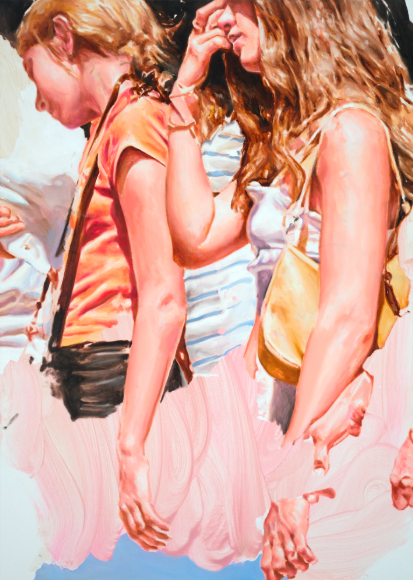
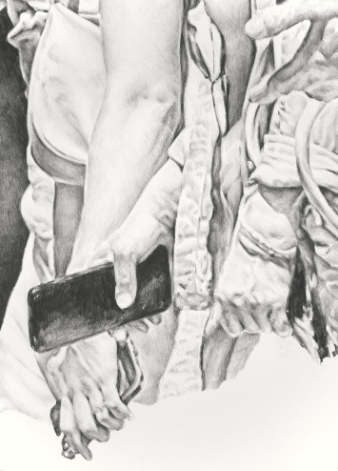
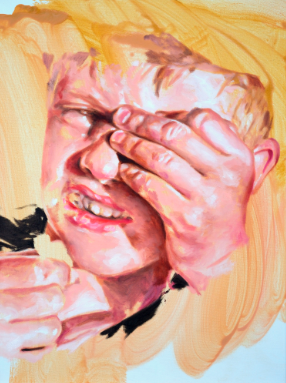
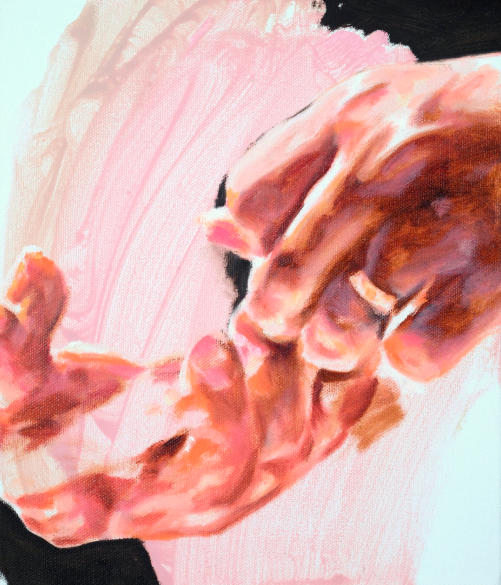
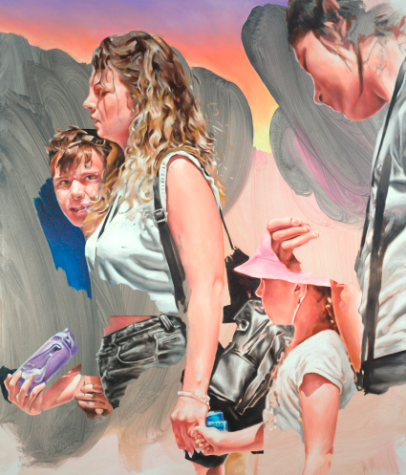
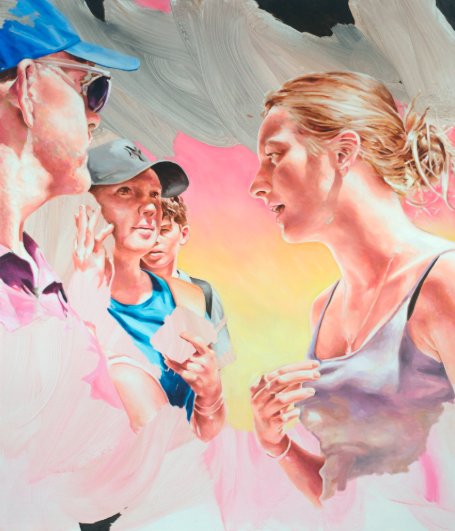
La riqueza temática de Veigl es, ante todo, su problematización de la la mirada misma y, por extensión, de la representación plástica. Se sirve de la fotografía, no como fin, sino como material bruto, un texto inicial que somete a una hermenéutica pictórica. La fotografía le proporciona la descomposición inicial de la realidad en instantes congelados, en encuadres que ya son, de por sí, una selección sesgada. Sobre este sustrato, Veigl ejecuta su verdadera labor: desarticula más y más la imagen. Algunos segmentos son representados con una fidelidad obsesiva a la realidad material de la piel, la tela o la luz; otros, en cambio, son deliberadamente dejados en un estado de gestualidad abierta, donde el trazo se hace patente, la mancha de color se afirma a sí misma, la textura del óleo o del acrílico se impone como materia. Esta estrategia dual constituye la clave de su cuestionamiento. Subraya, de forma elocuente, que lo que tenemos ante nosotros no es la realidad, sino una parte de ella, condicionada por una doble mediación: primero, la del objetivo fotográfico, y después, la de la mano, el ojo y la mente del artista. Veigl actúa como ese prisma del que se habla varias veces en Homo Institutionalis: no refleja pasivamente, sino que refracta la luz de lo real, descomponiéndola en un espectro de interpretaciones posibles. Su obra es la demostración material de que toda visión es una construcción, una versión, y que la pretensión de objetividad absoluta, en la representación fidelísima, es un idealismo tan ingenuo como peligroso.
¿Temas, aparte? Maternidad e infancia, por ejemplo. Veigl no pinta madonas ni ángeles. Sus mujeres y niños están inmersos en la cotidianidad más prosaica y, por ello, más auténtica. Los capta en momentos de cansancio, de ensimismamiento, de juego absorto, de conexión silenciosa. La vitalidad no brota de sonrisas forzadas, sino de la energía contenida en un cuerpo relajado, en la suavidad de una piel bañada por la luz natural que se filtra por una ventana. Esta luz, otro de sus grandes temas, es una materia tangible que modela volúmenes, que acaricia formas, que revela la textura de lo real y, al mismo tiempo, esconde secretos en las sombras que genera. Es la luz como principio de conocimiento parcial, como agente que al mostrar algo, oculta otra cosa.
El secreto de las intenciones, el mundo interior de sus modelos, es el territorio que Veigl explora con mayor perspicacia. Y lo hace a través de una precisión formal: los ojos. En muchos de sus retratos y escenas fragmentadas, los ojos no son, ni mucho menos, el dizque espejo del alma romántico, sino el umbral de una subjetividad opaca, en gran medida inaccesible. A veces los pinta con un detalle minucioso, pero la mirada está perdida, dirigida a un punto fuera del cuadro, sumida en pensamientos privados. Otras, los deja sin definir, borrosos, o en la sombra. De este modo desmonta la expectativa voyeurística del espectador, esa demanda de que el retrato nos «entregue» al personaje. Veigl nos recuerda que la persona —sí, como institución— posee una interioridad que se resiste a la aprehensión total, incluso en la máxima intimidad. La conexión entre las figuras —madre e hijo, hermanos— se sugiere más a través de la composición, de la proximidad de los cuerpos, de la armonía cromática, que a través de miradas cómplices explícitas. Es una conexión material, táctil, presente, pero que preserva el misterio de cada individuo.
Su técnica es el instrumento bien calibrado. El empleo de una paleta terrosa, de tierras, ocres, azules apagados y verdes musgo, contribuye a esa sensación de calidez íntima y, al mismo tiempo, de temporalidad suspendida. La pincelada varía, como se ha dicho. En las zonas de hiperrealismo, la pintura parece anularse a sí misma para dar paso a la ilusión, para afirmar la materialidad de lo representado. En las zonas de gesto, la pintura se afirma como tal, recordándonos que estamos ante una construcción, un artificio… La aplicación práctica de la operación de contraste, que nos obliga a estar simultáneamente dentro y fuera de la escena.
Martin Veigl no ofrece ningún refugio en lo sentimental, sino un campo de batalla conceptual donde se enfrentan la ilusión y la materia, lo completo y lo fragmentario, lo revelado y lo oculto. En un mundo inundado de imágenes banales que pretenden decirnos toda la verdad de un golpe, la obra de Veigl se erige como un recordatorio necesario y elocuente de que la realidad, como la persona, solo se nos concede a retazos…
[Todas las imágenes, del sitio web del artista: Martin Veigl | Painter, Visual Artist]
ENGLISH VERSION
Intimate Fragmentation: An Approach to the Work of Martin Veigl
Translation by Rebeca Sanz
The ambition to reveal complex stories from minimal details of domestic scenes has its most recognizable conceptual antecedents in Flemish Gothic, with Jan van Eyck as its main representative. Dutch genre painting of the 17th century represents its systematization, led by Pieter de Hooch, Gabriel Metsu and, supremely, Vermeer. With him, the domestic scene abandons costumbrista representation to fully become a visual text that the viewer must read, interpret, and reconstruct. Thus, the «story» of each painting constitutes itself as a network of connections and relationships suggested by scattered elements.
This method would lay the groundwork for later developments, from the intimacy of Jean-Baptiste-Siméon Chardin in the 18th century to the narrative fragmentation of contemporary artists, among whom Martin Veigl deserves special attention recently. From different technical and conceptual coordinates, he reactivates and reformulates that fundamental principle.
His work makes clear the conviction that the detail, the fragment, contains the essence of a situation, a larger story. If the classics built universes of absolute verisimilitude from the meticulousness of a tapestry or the texture of milk in a jug, Veigl performs a methodological decomposition. He does not start from the complete scene to then refine the detail, but reverses the process: the detail—a lock of hair, the curve of a back, the shadow under a chin—is the primary unit of meaning from which his narrative is inferred, is constructed, let’s say.
The thematic richness of Veigl is, above all, his problematization of the gaze itself and, by extension, of visual representation. He uses photography, not as an end, but as raw material, an initial text that he subjects to a pictorial hermeneutics. Photography provides him with the initial decomposition of reality into frozen instants, into frames that are already, in themselves, a biased selection. Upon this substrate, Veigl carries out his true work: he further and further disarticulates the image. Some segments are represented with an obsessive fidelity to the material reality of skin, fabric, or light; others, in contrast, are deliberately left in a state of open gesturality, where the brushstroke becomes evident, the stain of color asserts itself, the texture of oil or acrylic imposes itself as matter. This dual strategy constitutes the key to his questioning. It underlines, eloquently, that what we have before us is not reality, but a part of it, conditioned by a double mediation: first, that of the photographic lens, and second, that of the hand, eye, and mind of the artist. Veigl acts as that prism spoken of several times in Homo Institutionalis: he does not reflect passively, but refracts the light of the real, decomposing it into a spectrum of possible interpretations. His work is the material demonstration that all vision is a construction, a version, and that the pretense of absolute objectivity, in the most faithful representation, is an idealism as naive as it is dangerous.
Themes, besides? Motherhood and childhood, for example. Veigl does not paint madonnas or angels. His women and children are immersed in the most prosaic and, therefore, most authentic everyday life. He captures them in moments of tiredness, of self-absorption, of absorbed play, of silent connection. Vitality does not spring from forced smiles, but from the energy contained in a relaxed body, in the softness of skin bathed by natural light filtering through a window. This light, another of his great themes, is a tangible substance that models volumes, that caresses forms, that reveals the texture of the real and, at the same time, hides secrets in the shadows it generates. It is light as a principle of partial knowledge, as an agent that, by showing something, hides something else.
The secret of intentions, the inner world of his models, is the territory that Veigl explores with the greatest insight. And he does so through a formal precision: the eyes. In many of his portraits and fragmented scenes, the eyes are far from being the so-called romantic mirror of the soul, but rather the threshold of an opaque subjectivity, largely inaccessible. Sometimes he paints them with meticulous detail, but the gaze is lost, directed at a point outside the painting, immersed in private thoughts. Other times, he leaves them undefined, blurry, or in shadow. In this way, he dismantles the viewer’s voyeuristic expectation, that demand for the portrait to «deliver» the character to us. Veigl reminds us that the person—yes, as an institution—possesses an interiority that resists total apprehension, even in the utmost intimacy. The connection between the figures—mother and child, siblings—is suggested more through composition, through the proximity of bodies, through chromatic harmony, than through explicit complicit glances. It is a material, tactile, present connection, but one that preserves the mystery of each individual.
His technique is the well-calibrated instrument. The use of an earthy palette, of umbers, ochres, muted blues, and mossy greens, contributes to that sensation of intimate warmth and, simultaneously, of suspended temporality. The brushstroke varies, as mentioned. In the hyperrealism areas, the paint seems to annul itself to give way to the illusion, to affirm the materiality of the represented. In the gestural areas, the paint asserts itself as such, reminding us that we are before a construction, an artifice… The practical application of the contrast operation, which forces us to be simultaneously inside and outside the scene.
Martin Veigl offers no refuge in sentimentality, but a conceptual battlefield where illusion and matter, the complete and the fragmentary, the revealed and the hidden, confront each other. In a world flooded with banal images that claim to tell us the whole truth at once, Veigl’s work stands as a necessary and eloquent reminder that reality, like the person, is only granted to us in fragments…