
Entre la marea: Aproximación a la obra de Claire Cansick
Por Juan Pablo Torres Muñiz
La marea varía. Cambia también quien la observa, una vez toma consciencia de lo que implica haberse detenido, roto el tiempo, en su vientre escamado…
La obra de Cansick abandona la función básica de representación visual, para cobrar elocuencia e interpelar al observador —a quien mira e interpreta— desde un marco institucional que no es sólo el del arte contemporáneo, sino el de una crisis epistemológica más profunda: la del sentido frente a la plenitud, del cálculo frente al desbordamiento, de la estructura frente al abismo.
Entonces, nos vemos ante el mar no sólo como un fenómeno natural, sino también como un acontecimiento ontológico, como el lugar donde se juega la dialéctica más antigua y más urgente: la que enfrenta al orden racional, lineal, previsible, con la vida en su estado bruto, imprevisible, devoradora. Matemáticas. Con la expresividad de la pintura, una crítica institucional disfrazada de paisaje.
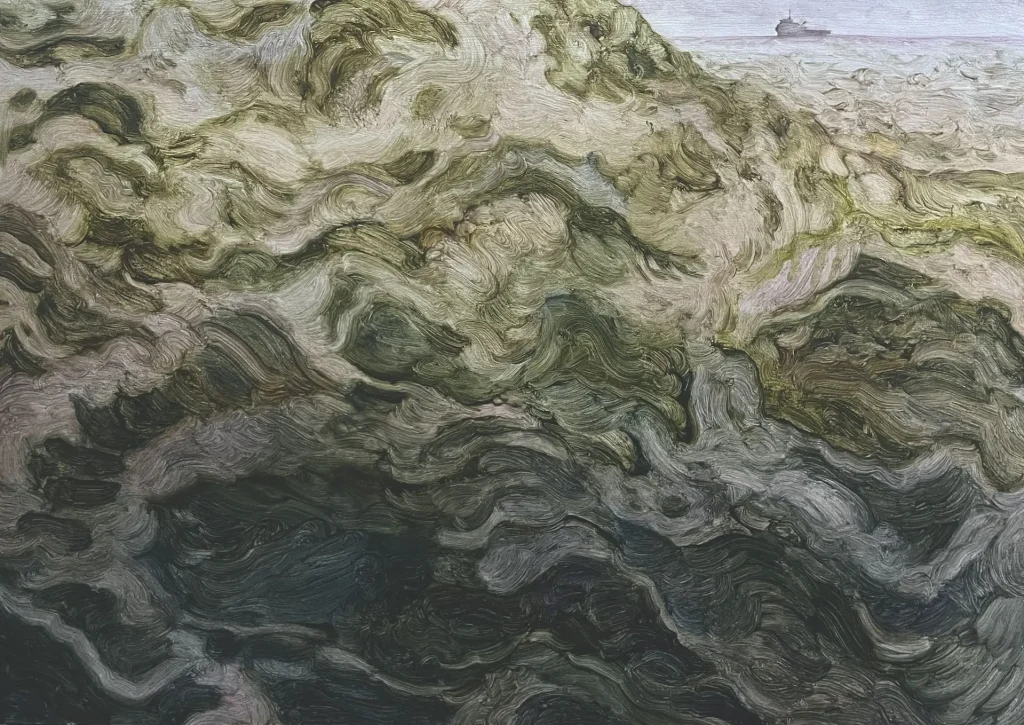
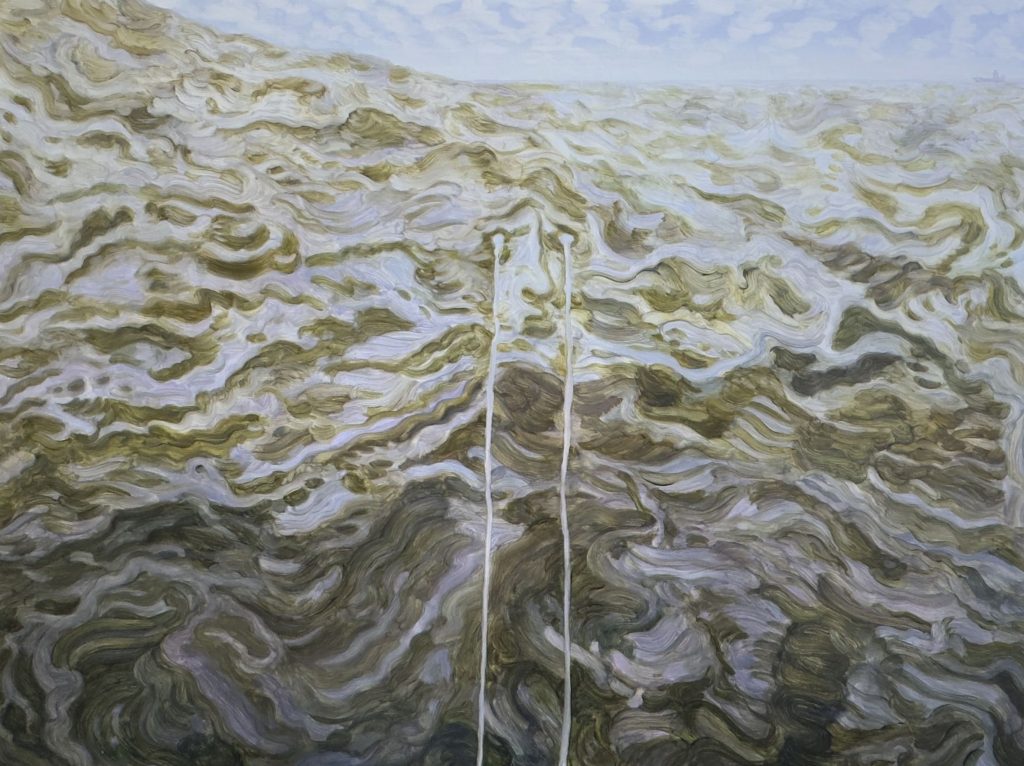
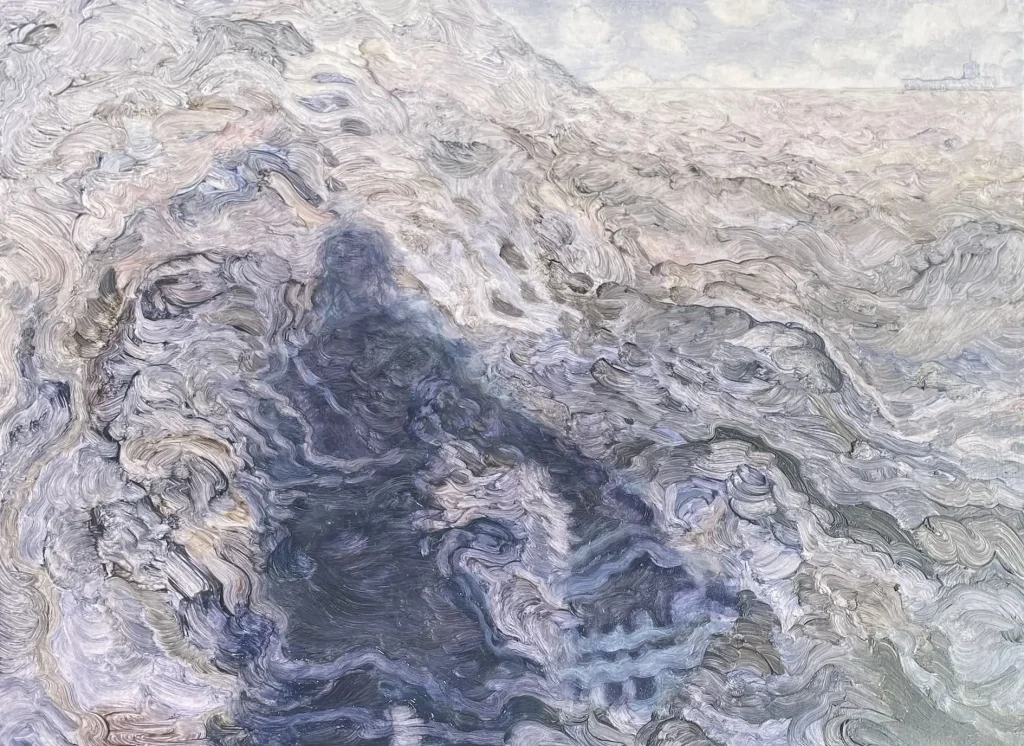
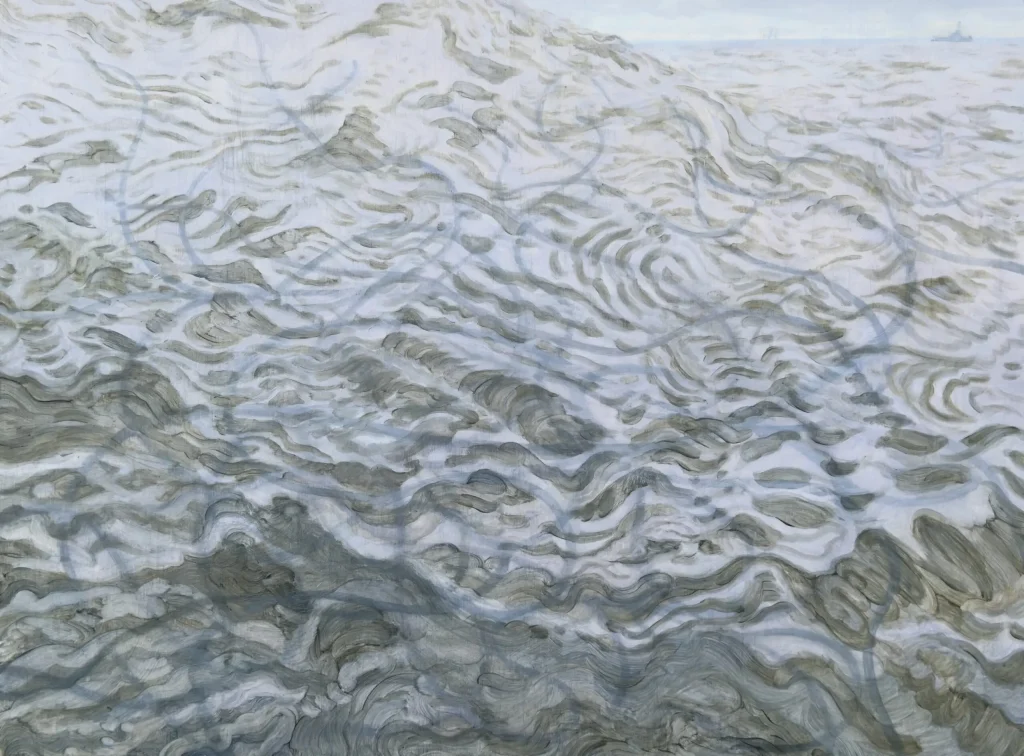
En sus cuadros, el mar es, por lo dicho, un engañoso sujeto en sí. Presa parcial del observador y su parcialidad. Pero activo. Un agente. Las olas no son formas, sino fuerzas; las aguas no son superficies, sino procesos. Hay en ellas una voluntad, no humana, ni divina, sino cósmica: la voluntad de la plenitud, entendida como exceso, como desbordamiento de lo dado, como negación del límite. Esta plenitud no es benigna, ni siquiera liberadora en sentido convencional: es, ante todo, indiferente. Devora sin odio, sin pasión, sin intención. Es el caos no como ausencia de orden, sino como orden de otro tipo, no domesticable, no traducible al lenguaje de las reglas. Y es precisamente contra esta plenitud que se yergue, en varios de sus trabajos, lo que podemos llamar el símbolo del sentido: la línea recta, el esqueleto, la estructura geométrica. Derrotada. Líneas que atraviesan la tela como trazos de ingeniero, como cálculos proyectados sobre lo informe, como intentos de domesticar lo inaprehensible. Son trazos fríos, precisos, sin emoción, que recuerdan planos arquitectónicos, diagramas de navegación, cartografías militares. Son la razón en su fase más dura: no la razón dialogante, sino la razón imperativa, la que quiere imponer previsibilidad al mundo.
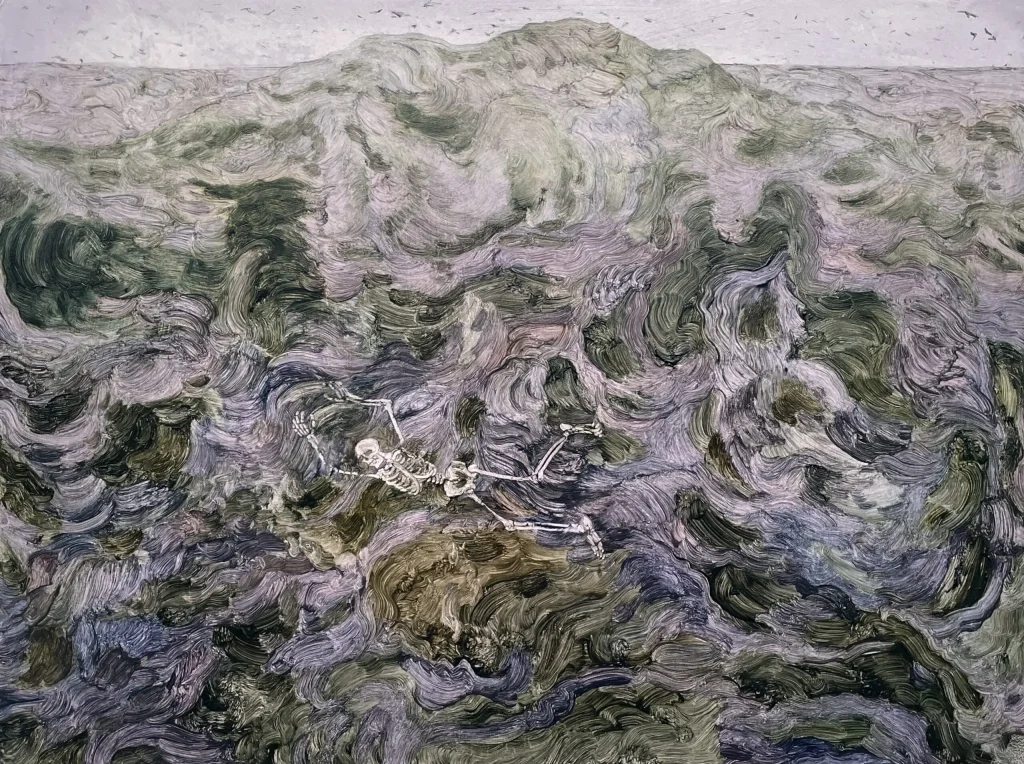
Acaso lo más perturbador en la obra de Cansick no es esta oposición manifiesta, sino su inversión sutil. Porque los esqueletos que flotan bajo la marea, o emergen entre las olas, no son restos de vida vencida por el mar, sino restos de la razón vencida por la vida. Son los cadáveres del sentido, las estructuras que el orden ha dejado tras de sí, como huellas de una batalla perdida. No son símbolos de muerte, sino de insuficiencia: el mar revela la fragilidad de lo que pretendía contenerlo. Tal revelación no se produce por un acto de violencia, sino por una absorción lenta, silenciosa, fúnebre…, casi litúrgica. Y es que la marea, en lugar de deshacer la línea, la incorpora. La geometría se disuelve de modo que el cálculo se vuelve irrelevante. En este sentido, la pintura de Cansick plantea la crisis de la noción misma de orden como garantía de sentido. Su perversión. De modo que el mar no es caos, sino plenitud; y la línea recta no es sentido, sino tiranía disfrazada de racionalidad.
Esta dialéctica no se juega en el terreno de lo sexual, ni en el de políticas identitarias, sí en el de la identidad a nivel más profundo: como personas, entes racionales complejos. En vez de oponer un «femenino» emocional a un «masculino» racional, como en tantas simplificaciones posmodernas, en lugar de caer en el sentimentalismo ni en el esencialismo, plantea un juego más profundo: la estructura misma de la institucionalidad humana. El mar como metáfora de aquello que no puede ser institucionalizado sin ser traicionado: la vida en su estado puro, no domesticada, no traducida a normas. Y las líneas, los esqueletos, las estructuras, como metáfora de las instituciones que intentan contenerla, regularla, predecirla… Intentos legítimos, necesarios, de dar forma al mundo. Fallidos por su pretensión de absoluto y eternidad, por negar su condición de ficciones humanas, construcciones provisionales. Fragilidad frente a lo que no puede ser reducido a geometría: la marea, el cuerpo, el deseo, la muerte.
La técnica pictórica de Cansick es un componente esencial del cuestionamiento. La materia de la pintura —el óleo, la textura, la superposición de capas— no representa el agua, sino que es agua, en tanto proceso.
El mar, en su obra, supera el símbolo de lo femenino, aunque en él se reconozca una matriz, una fuente, una gestación perpetua. También el de lo masculino, aunque en sus olas haya fuerza, impulso, desgarramiento. Es, más bien, el lugar donde ambos principios se deshacen, donde las categorías se funden, donde lo que llamamos identidad se vuelve líquido e inestable.
Cansick utiliza la pintura para cuestionar las condiciones bajo las cuales podemos ver, entender, institucionalizar cualquier cosa. El mar es su pretexto. Y lo dota de voz. Ahora bien, si el mar puede hablar, entonces todo lo que hemos construido para silenciarlo —las líneas, los huesos— debe ser repensado.
[Todas las imágenes, del sitio web de la artista: Home – Claire Cansick]


ENGLISH VERSION
Between the Tide: An Approach to the Work of Claire Cansick
Translated by Elena Valentin
The tide varies. So does the observer, once they become aware of what it means to have stopped, to have broken time, in its scaly belly…
Cansick’s work abandons the basic function of visual representation to become eloquent and challenge the observer—the one who looks and interprets—from an institutional framework that is not only that of contemporary art, but that of a deeper epistemological crisis: that of meaning versus plenitude, calculation versus overflow, structure versus the abyss.
Thus, we find ourselves before the sea not only as a natural phenomenon, but also as an ontological event, as the place where the oldest and most urgent dialectic plays out: that which pits rational, linear, predictable order against life in its raw, unpredictable, devouring state. Mathematics. With the expressiveness of painting, an institutional critique disguised as landscape.
In her paintings, the sea is, for the reasons stated, a deceptive subject in itself. Partially prey to the observer and their partiality. But active. An agent. The waves are not forms, but forces; the waters are not surfaces, but processes. There is in them a will, not human, nor divine, but cosmic: the will of plenitude, understood as excess, as an overflowing of the given, as a denial of the limit. This plenitude is not benign, not even liberating in a conventional sense: it is, above all, indifferent. It devours without hatred, without passion, without intention. It is chaos not as an absence of order, but as an order of another kind, not tameable, not translatable into the language of rules. And it is precisely against this plenitude that there rises, in several of her works, what we can call the symbol of meaning: the straight line, the skeleton, the geometric structure. Defeated. Lines that cross the canvas like an engineer’s strokes, like calculations projected onto the formless, like attempts to domesticate the ungraspable. They are cold, precise strokes, without emotion, reminiscent of architectural plans, navigation diagrams, military cartographies. They are reason in its hardest phase: not dialogical reason, but imperative reason, the kind that wants to impose predictability onto the world.
Perhaps the most disturbing aspect of Cansick’s work is not this manifest opposition, but its subtle inversion. Because the skeletons floating beneath the tide, or emerging among the waves, are not the remains of life conquered by the sea, but the remains of reason conquered by life. They are the corpses of meaning, the structures that order has left behind, like traces of a lost battle. They are not symbols of death, but of insufficiency: the sea reveals the fragility of what sought to contain it. This revelation does not occur through an act of violence, but through a slow, silent, funereal… almost liturgical absorption. And the tide, instead of undoing the line, incorporates it. The geometry dissolves in such a way that calculation becomes irrelevant. In this sense, Cansick’s painting posits the crisis of the very notion of order as a guarantee of meaning. Its perversion. So that the sea is not chaos, but plenitude; and the straight line is not meaning, but tyranny disguised as rationality.
This dialectic does not play out on the terrain of the sexual, nor that of identity politics, but rather on that of identity at a deeper level: as persons, complex rational beings. Instead of opposing an emotional “feminine” to a rational “masculine”, as in so many postmodern simplifications, instead of falling into sentimentalism or essentialism, it proposes a deeper game: the very structure of human institutionality. The sea as a metaphor for that which cannot be institutionalized without being betrayed: life in its pure state, untamed, not translated into norms. And the lines, the skeletons, the structures, as a metaphor for the institutions that try to contain it, regulate it, predict it… Legitimate, necessary attempts to give form to the world. Failed due to their pretension of absoluteness and eternity, due to their denial of their condition as human fictions, provisional constructions. Fragility facing that which cannot be reduced to geometry: the tide, the body, desire, death.
Cansick’s pictorial technique is an essential component of the questioning. The material of the painting—the oil, the texture, the layering of coats—does not represent water, it is water, as process.
The sea, in her work, surpasses the symbol of the feminine, although a matrix, a source, a perpetual gestation is recognized in it. Also that of the masculine, although in its waves there is force, impulse, rending. It is, rather, the place where both principles come undone, where categories melt, where what we call identity becomes liquid and unstable.
Cansick uses painting to question the conditions under which we can see, understand, institutionalize anything. The sea is her pretext. And she gives it a voice. Now, if the sea can speak, then everything we have built to silence it—the lines, the bones—must be rethought.
[All images, from the artist’s website: https://clairecansick.com/]