
Entre el deshielo y la institución: Sobre el Ártico como nueva ruta comercial
Por Juan Pablo Torres Muñiz
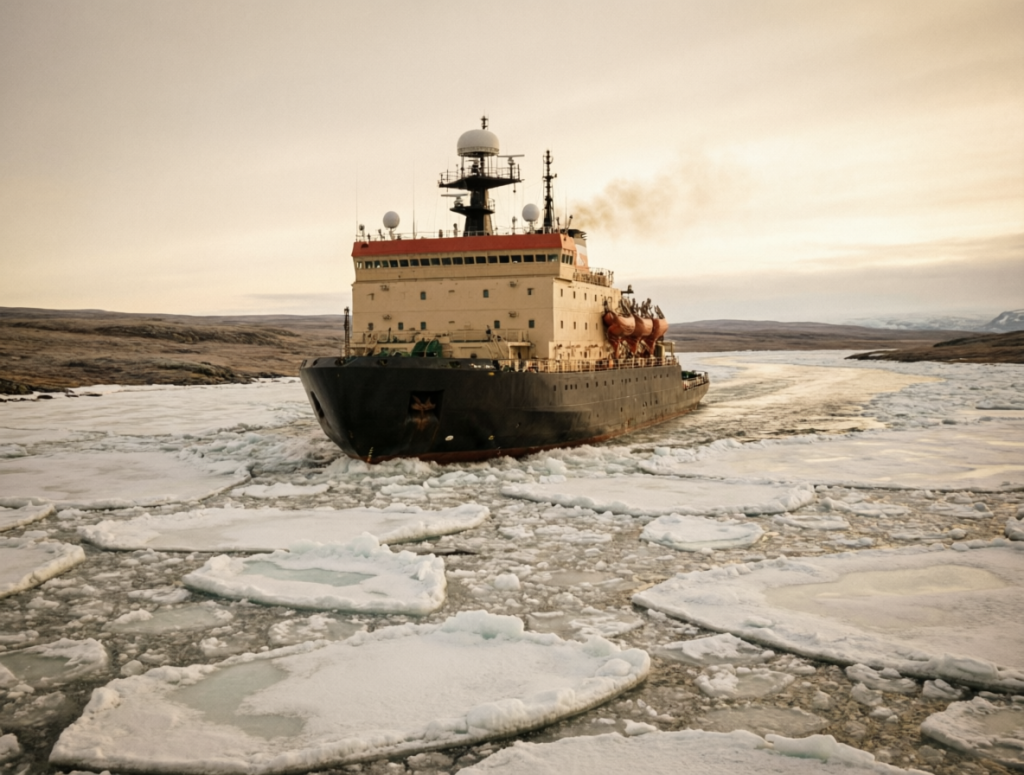
Durante cuatro siglos, marinos ingleses, holandeses y rusos se abrieron paso, y no pocas veces se dejaron la vida, en busca de un camino de agua por el norte del mundo. Hoy, cuando esto se escribe, la naviera Sea Legend cumple un programa de ocho salidas semanales, de mediados de agosto a comienzos de octubre, que lleva contenedores de Ningbo a Europa en veinte o veintidós días, frente a los treinta o cuarenta que exige la ruta de Suez (Gettransport, 2026a). La prensa económica insiste en que la ruta del Ártico ahorra hasta doce días a los cargueros asiáticos (La Hora, 2026). Cabe preguntarse, sin embargo, si dicho territorio cambia el mundo porque se derrite o si éste cambia en la medida en que alguien logre hacer operativo lo que el deshielo deja libre.
Qué mutaciones geopolíticas y geoeconómicas produce realmente el empleo de la ruta ártica, en qué punto de su historia nos hallamos y qué cabe esperar en el futuro próximo. Consideramos que el deshielo constituye una condición material necesaria, pero en modo alguno suficiente. El hielo que se retira deja un espacio —agua, niebla, oscuridad, viento— sobre el cual nada es realmente ruta hasta que se erigen las instituciones que permiten operar: un derecho que ampare, una autoridad que autorice, un seguro que asuma el riesgo, un casco que resista, un puerto que reciba. Los cambios atribuidos al Ártico son, pues, los de la disputa por normar el paso, y la cuestión decisiva para Occidente no es tanto quién posee más rompehielos como si conserva la capacidad de institucionalizar sin desinstitucionalizarse.
Cuando hablamos de la ruta del Ártico que recibe su nombre de —arktikós, «relativo al oso», por árktos, la constelación que señala el norte—, aludimos en realidad a tres realidades distintas: la Ruta del Mar del Norte, que bordea la costa septentrional de Rusia; el Paso del Noroeste, que atraviesa el archipiélago canadiense; y una eventual ruta central o transpolar, que en las lecturas más amplias de la llamada Ruta de la Seda Polar completa el conjunto (ChinaScope, 2026). Aquí nos ocuparemos de la primera, la única por la que hoy circula tráfico regular.
La búsqueda del Ártico fue, desde su origen, una empresa institucional antes que geográfica. La razón es que las rutas del sur estaban cerradas por el Tratado de Tordesillas (1494), que repartió entre España y Portugal dos ámbitos de monopolio sobre el descubrimiento, la navegación y el comercio, y solo a partir de la década de 1640 ambas coronas admitieron el derecho de extranjeros a navegar por ellos (Encyclopédie d’histoire numérique de l’Europe [EHNE], s. f.). Quienes quedaron excluidos miraron al norte. La Compañía de Moscovia financió en 1553 la expedición de Willoughby y Chancellor en busca del paso del nordeste (Encyclopedia.com, s. f.), y los holandeses, cuya ruta establecida hacia Asia estaba en manos de sus enemigos portugueses, enviaron a Barentsz en tres ocasiones entre 1594 y 1597 (Daniel Crouch Rare Books, s. f.). El hielo, nótese, no fue el primer obstáculo del comercio europeo con Asia: lo fue una norma.
La ironía es que, para romper aquel cierre, los excluidos se sirvieron de una doctrina nacida en Salamanca. Francisco de Vitoria, en su relección De Indis (1539), sostuvo el ius communicationis, un derecho de comunicación entre los pueblos que comprendía el tránsito, el comercio y la navegación (Sison, 2021); Grotius lo recogió y lo transformó en Mare Liberum (1609), escrito contra las pretensiones ibéricas de excluir a los demás de los mares (Thumfart, 2009; Encyclopaedia Britannica, s. f.). De modo que el principio de libertad de navegación que hoy esgrime Estados Unidos frente a las pretensiones rusas y canadienses sobre estrechos árticos (Todorov, 2017) tiene cuna escolástica hispánica, dato que el relato atlantista de «Occidente» suele omitir.
La hazaña no es ruta; solo la institución la vuelve recurrente. Nordenskiöld cruzó el paso del nordeste a bordo del Vega en 1878-1879, a costa de invernar atrapado en el hielo; en 1932 el rompehielos Alexander Sibiryakov, bajo la dirección de Otto Schmidt, lo completó de Arcángel al Pacífico en una sola navegación, y el 17 de diciembre de ese mismo año se fundó la Dirección General de la Ruta del Mar del Norte, Glavsevmorput (Foreign Affairs, s. f.). La secuencia importa: primero, el acto heroico; enseguida, el aparato estatal que lo convierte en servicio. Al noroeste sucedió lo contrario. La expedición de Franklin, en 1845, perdió a sus 129 hombres, y Amundsen, con el Gjøa, tardó de 1903 a 1906 en completar el paso (Museo Fram, s. f.); sin institución que lo sostuviera, no hubo ruta, y aún hoy Canadá lo considera aguas interiores mientras Estados Unidos sostiene que es un estrecho internacional (History.com, 2025).
El deshielo no basta para hacer navegable el Ártico como ruta comercial. No faltan razones para esperar lo contrario: el Ártico se calienta hasta cuatro veces más rápido que el promedio del planeta, y el mínimo de hielo marino de 2026, de 4,60 millones de kilómetros cuadrados, empató el décimo más bajo del registro satelital, con los últimos veinte años como los veinte más bajos (National Snow and Ice Data Center [NSIDC], 2026). Se proyecta, además, que el océano pueda quedar libre de hielo en algún día de finales de agosto o comienzos de septiembre entre las décadas de 2020 y 2030 (ScienceDaily, 2024). Sin embargo, el tráfico real no acompaña a la física. La carga total por la Ruta del Mar del Norte fue de 37,02 millones de toneladas en 2025, un 2,3 % menos que el año anterior, frente a un decreto que preveía 80 millones para 2024 y 200 para 2030; el 83 % son hidrocarburos (The Moscow Times, 2026). Los tránsitos propiamente dichos —buques que cruzan de un océano a otro— sumaron 103 viajes y 3,2 millones de toneladas (Centre for High North Logistics [CHNL], 2025), menos del 9 % del volumen de la ruta (Gettransport, 2026a).
El Dubai Tower, buque insignia del servicio de Sea Legend, es un portacontenedores de apenas 1732 TEU y baja clase de hielo, y buena parte de la actividad de la temporada depende de la escolta de rompehielos nucleares rusos (Port de Barcelona, 2026). Todo tránsito exige inscribirse ante un organismo de Rosatom, que gestiona por mandato gubernamental la ruta, dividida en veintiocho secciones, y expide los permisos (IndexBox, 2026); los seguros llegan a costar entre cinco y diez veces lo habitual (Gettransport, 2026a). Ninguna naviera europea o estadounidense opera un servicio comparable (Gettransport, 2026a). Dicho de otro modo, el agua está libre, pero el paso no lo está: pertenece, en la práctica, a quien controla los permisos, las escoltas y los cascos que resisten.
El cambio geoeconómico consiste menos en desplazar volúmenes que en crear una opción. Antes de los ataques hutíes de fines de 2023, el canal de Suez atendía unos ochenta portacontenedores semanales; a mediados de enero de 2026 eran veintiséis (FreightWaves, 2026). El regreso previsto se quebró en marzo, cuando el conflicto entre Irán, Israel y Estados Unidos hizo que las navieras revirtieran de nuevo sus servicios hacia el cabo de Buena Esperanza (Seatrade Maritime, 2026); en septiembre, el consorcio Gemini de Maersk y Hapag-Lloyd reinstaló varias líneas por Suez, pero el tráfico por el cuello de botella del mar Rojo seguía en agosto en torno a un 41 % por debajo del nivel previo a la crisis (Carra Globe, 2026). Frente a esa fragilidad, el Ártico ofrece, para cargas de alto valor como baterías y componentes automotrices, un trayecto unos treinta días más corto que el del Cabo (Automotive Logistics, 2026). Pero se trata de un complemento estacional, no de un sustituto: en el último año apenas una veintena de portacontenedores completó el tránsito (Port de Barcelona, 2026).
Lo que sí se redistribuye es el control. Sea Legend y New New Shipping, ambas chinas, operan la ruta desde que COSCO, la naviera estatal, se retiró en 2022 junto con otras líneas internacionales, y al menos seis empresas chinas planean más de cincuenta viajes esta temporada, la mayoría entre China y Rusia (CNN, 2026). En octubre de 2025, Rosatom y la Comisión Nacional de Desarrollo y Reforma de China firmaron un plan de acción sobre logística digital, puertos y buques de clase ártica (Modern Diplomacy, 2025). La alianza, con todo, tiene sus condiciones: informes de prensa señalan que China se ha negado a suministrar sistemas de propulsión para buques rusos de gran tonelaje por cumplimiento de las sanciones (Kyiv Post, 2026), y Arctic LNG 2, que exportó dieciséis cargamentos en 2025, opera bajo restricciones occidentales (gCaptain, 2026). La geoeconomía del Ártico es, así, la de un tándem que necesita el uno del otro y que tropieza, cada uno, con el sistema de sanciones y seguros que Occidente aún administra.
El cambio geopolítico depende del estatuto jurídico de la ruta y de la solidez de los foros que la gobiernan, y ambos se encuentran erosionados. Rusia funda su régimen de autorizaciones en el artículo 234 de la Convención del Mar, que faculta a los Estados ribereños a dictar normas contra la contaminación en áreas cubiertas de hielo dentro de su zona económica exclusiva; Estados Unidos objeta que dicho artículo no justifica exigir notificación previa o pilotos obligatorios, y considera internacionales los estrechos de Vilkitsky, Dmitri Laptev y Sannikov (Todorov, 2017; Lawfare, s. f.). Entretanto, el Consejo Ártico, creado en 1996 mediante la Declaración de Ottawa, mantiene en pausa sus reuniones de nivel político desde marzo de 2022, cuando los otros siete miembros se negaron a sesionar bajo presidencia rusa tras la invasión de Ucrania; solo el trabajo científico y de grupos se reanudó, de forma virtual (Arctic Council, 2026), y Moscú dejó de pagar su cuota a la secretaría (Belfer Center, s. f.). La Declaración de Ilulissat de 2008, que comprometía a los cinco Estados ribereños a resolver pacíficamente sus reclamos, se firmó justo un año después de que Rusia plantara su bandera en el lecho polar (Scientific American, s. f.); hoy ese pacto carece de foro donde renovarse.
A esta debilidad institucional corresponde una asimetría material. Rusia opera ocho rompehielos nucleares, desplegados por primera vez todos a la vez para mantener abiertas sus rutas de exportación (Gettransport, 2026b), mientras que Estados Unidos cuenta con un solo rompehielos pesado en servicio, el Polar Star, en operación desde 1976 (National Defense Magazine, 2025). China, por su parte, se define desde 2018 como «Estado cercano al Ártico» y proclama una Ruta de la Seda Polar (The Diplomat, 2018), etiqueta que no existe en el derecho internacional y sirve, más bien, para reclamar voz en la gobernanza regional (Konrad-Adenauer-Stiftung, s. f.). Y la propia Occidente se vio sacudida desde dentro: en enero de 2026, Washington declaró que adquiriría Groenlandia, y varios Estados europeos enviaron personal militar a la isla; el litigio se cerró el 22 de septiembre con un acuerdo trilateral que amplía la presencia estadounidense en Pituffik y exige aprobación unánime de Dinamarca, Groenlandia y Estados Unidos para cualquier instalación militar de un país ajeno a la OTAN (Al Jazeera, 2026).
Ahora bien, habrá quien diga que el problema expuesto es exclusivamente climático y que el mercado hará el resto: cuando el hielo desaparezca, la ruta funcionará todo el año y las instituciones serán un accesorio. La objeción confunde retroceso del hielo con navegabilidad. Aun bajo un escenario de emisiones intermedias, el Ártico quedaría libre de hielo únicamente entre agosto y octubre (ScienceDaily, 2024); la oscuridad invernal, la niebla y el hielo nuevo seguirán exigiendo cascos reforzados, cartografía, escolta y rescate, es decir, operaciones organizadas. Y el propio mercado, al que se atribuye la última palabra, no ha elegido: las navieras occidentales se retiraron, y quien permanece son operadores respaldados por Estados que pueden absorber costos y riesgos que ningún cálculo comercial aislado justificaría (Gettransport, 2026a; CNN, 2026).
Si, por otra parte, el Ártico mueve un puñado de portacontenedores y Suez se recupera, ¿cabría suponer el asunto irrelevante? Sólo si el cambio se midiera en toneladas. Pero las instituciones cambian por precedente, no por volumen: los tránsitos de contenedores pasaron de siete en 2023 a catorce en 2024 y veinticuatro en 2025 (Gettransport, 2026a); una naviera ha inaugurado el primer servicio regular; y esa misma empresa declara que aspira a navegar todo el año dentro de una década (CNN, 2026). Una institución, una vez constituida, solo se disuelve mediante otra institución, y la primera en constituirse en este espacio será probablemente la que fije las reglas de las siguientes. A ello se suma la lección del mar Rojo: para un armador, el valor de una ruta alternativa no radica en usarla siempre, sino en poder usarla cuando la otra falla.
Se dirá, por último, que las instituciones son epifenómenos del poder y que, en el Ártico, como en todas partes, hace lo que puede quien puede: la bandera de 2007, las amenazas sobre Groenlandia y la parálisis del Consejo lo prueban. Hay en ello una parte de verdad: toda institución se levanta sobre elementos operativos de la realidad, y una institución sin rompehielos, sin puertos ni flota es cascarón. Pero de ahí no se sigue que el poder prescinda de la forma, del concepto: Rusia no dice que domina la ruta, dice que aplica el artículo 234; China no reclama el Ártico, lo integra en un libro blanco y en un proyecto de rutas; Estados Unidos y Dinamarca no se disputaron Groenlandia a golpes, sino en una mesa de tratados. Los fuertes se disputan el derecho a escribir las normas.
La historia lo había anticipado: la exploración fue una respuesta a un monopolio institucional. Ahora, el cambio geoeconómico consiste en una opción estacional que resta poder de monopolio a los pasos meridionales, y el cambio geopolítico, en una competencia por fijar las reglas de un espacio cuyo foro común está paralizado.
La pregunta por el futuro próximo no debe plantearse en términos de cuántos meses de hielo faltan, sino de quién mandará durante la temporada abierta y bajo qué reglas; la ventana es amplia, pues las proyecciones sitúan entre las décadas de 2030 y 2050 el primer septiembre sin hielo (ScienceDaily, 2024). La segunda es que restaurar un foro donde Rusia, China y las potencias occidentales acuerden lo indispensable —seguridad marítima, búsqueda y rescate, protección ambiental, estatuto de los estrechos— es una necesidad de operación, no una cortesía diplomática; en ese cuadro, la ausencia de Estados Unidos en la Convención del Mar resta autoridad a sus propias objeciones.
El riesgo mayor para Occidente no proviene del hielo que se va ni de la flota ajena, sino de la carcoma interna que lo vuelve incapaz de sostener instituciones más allá del ciclo político inmediato: quien no institucionaliza, cede el espacio a quien sí lo hace. La libertad de navegar, como toda libertad, no existe sin instituciones que la sostengan.
Referencias bibliográficas:
Al Jazeera. (2026, 22 de septiembre). Trump signs «tremendous» Arctic security deal with Denmark, Greenland. https://www.aljazeera.com/news/2026/9/22/us-signs-tremendous-arctic-security-deal-with-denmark-greenland
Arctic Council. (2026, 12 de febrero). A 2026 Arctic Council update from the Chair of the Senior Arctic Officials. https://arctic-council.org/news/2026-arctic-council-update/
Automotive Logistics. (2026). Northern Sea Route container service: Sea Legend Shipping cuts China-Europe transit times for batteries and automotive components. https://www.automotivelogistics.media/news/challenges-remain-on-northern-sea-route-despite-tight-supply-for-china-exports/2727108
Belfer Center for Science and International Affairs. (s. f.). Revitalizing the Arctic Council. https://www.belfercenter.org/research-analysis/revitalizing-arctic-council
Carra Globe. (2026, septiembre). Red Sea shipping 2026: Carriers return as the risk rises. https://carraglobe.com/red-sea-carrier-return-2026/
Centre for High North Logistics. (2025). Main results of NSR transit navigation in 2025. https://chnl.no/news/main-results-of-nsr-transit-navigation-in-2025/
ChinaScope. (2026). China’s expanding Arctic strategy: From Greenland autonomy to the «Polar Silk Road». https://chinascope.org/archives/39935
CNN. (2026, 14 de agosto). How the Northern Sea Route is bringing China and Russia together. https://www.cnn.com/2026/08/14/china/china-arctic-northern-sea-route-russia-intl-hnk-vis-dst
Daniel Crouch Rare Books. (s. f.). Barentsz, Willem. https://crouchrarebooks.com/mapmakers/barentsz-willem/
Encyclopaedia Britannica. (s. f.). Mare Liberum. https://www.britannica.com/topic/Mare-Liberum
Encyclopédie d’histoire numérique de l’Europe. (s. f.). The Treaty of Tordesillas, June 7, 1494. https://ehne.fr/en/encyclopedia/themes/international-relations/europe-and-legal-regulation-international-relations/treaty-tordesillas-june-7-1494
Encyclopedia.com. (s. f.). Willem Barents. https://www.encyclopedia.com/people/history/explorers-travelers-and-conquerors-biographies/willem-barents
Foreign Affairs. (s. f.). The Soviet conquest of the Far North. https://www.foreignaffairs.com/russian-federation/soviet-conquest-far-north
FreightWaves. (2026). New data shows Suez route transits rose 27% in August. https://freightwaves.com/news/new-data-shows-suez-route-transits-rose-27-in-august
gCaptain. (2026). Northern Sea Route traffic slips in 2025 as sanctions constrain Russia’s Arctic ambitions. https://gcaptain.com/northern-sea-route-traffic-slips-in-2025-as-sanctions-constrain-russias-arctic-ambitions/
Gettransport. (2026a). Northern Sea Route container service 2026: Shipper’s guide. https://blog.gettransport.com/trends-in-logistic/northern-sea-route-arctic-container-service-2026/
Gettransport. (2026b). Most powerful icebreakers in the world 2026, ranked. https://blog.gettransport.com/trends-in-logistic/most-powerful-icebreakers-arctic-shipping-2026/
History.com. (2025). Northwest Passage. https://www.history.com/articles/northwest-passage
IndexBox. (2026, 10 de agosto). Sea Legend Line to launch first regular Arctic container service on Northern Sea Route. https://www.indexbox.io/blog/sea-legend-line-to-launch-first-regular-arctic-container-service-on-northern-sea-route/
Konrad-Adenauer-Stiftung. (s. f.). The self-proclaimed near-Arctic state. https://www.kas.de/en/web/auslandsinformationen/artikel/detail/-/content/der-selbsternannte-fast-arktisstaat
Kyiv Post. (2026). China declines to supply equipment for Russian Northern Sea Route fleet due to sanctions. https://www.kyivpost.com/post/80572
La Hora. (2026, 28 de septiembre). El deshielo del Ártico abre una nueva ruta comercial que puede cambiar el comercio entre Asia y Europa. https://lahora.gt/lh-economia/theconversation/2026/09/28/el-deshielo-del-artico-abre-una-nueva-ruta-comercial-que-puede-cambiar-el-comercio-entre-asia-y-europa/
Lawfare. (s. f.). Wrangling warships: Russia’s proposed law on Northern Sea Route navigation. https://www.lawfaremedia.org/article/wrangling-warships-russias-proposed-law-northern-sea-route-navigation
Modern Diplomacy. (2025, 24 de octubre). How Rosatom is turning Arctic geopolitics into infrastructure. https://moderndiplomacy.eu/2025/10/24/how-rosatom-is-turning-arctic-geopolitics-into-infrastructure/
Museo Fram. (s. f.). The Gjøa expedition. https://frammuseum.no/en/polar-history/expeditions/the-gjoa-expedition-1903-1906/
National Defense Magazine. (2025, 13 de enero). The icebreaker numbers game. https://www.nationaldefensemagazine.org/articles/2025/1/13/the-icebreaker-numbers-game
National Snow and Ice Data Center. (2026, 23 de septiembre). Arctic sea ice minimum ties for tenth lowest. https://nsidc.org/arcticseaicenews/
Port de Barcelona. (2026). The Arctic on the global logistics chessboard: A new era for shipping routes? PierNext. https://piernext.portdebarcelona.cat/en/logistics/arctic-global-logistics-chessboard-new-shipping-routes
¿Por qué la ruta del Ártico que va a cambiar el mundo para siempre? (s. f.). [Video]. YouTube. https://www.youtube.com/watch?v=DBuozI9xgEA
Scientific American. (s. f.). Nations claim large overlapping sections of Arctic seafloor. https://www.scientificamerican.com/article/nations-claim-large-overlapping-sections-of-arctic-seafloor/
ScienceDaily. (2024, 5 de marzo). Arctic could become «ice-free» within a decade. https://www.sciencedaily.com/releases/2024/03/240305134203.htm
Seatrade Maritime. (2026, 2 de marzo). Shipping lines reroute from Red Sea avoiding Houthi threat. https://www.seatrade-maritime.com/containers/shipping-lines-reroute-from-red-sea-avoiding-houthi-threat
Sison, A. J. G. (2021). Francisco de Vitoria on the right to free trade and justice. Business Ethics Quarterly. https://www.cambridge.org/core/services/aop-cambridge-core/content/view/16AEBC95B24FD91867A71081A24A16F9/S1052150X21000026a.pdf/francisco_de_vitoria_on_the_right_to_free_trade_and_justice.pdf
The Diplomat. (2018, enero). China issues its Arctic policy. https://thediplomat.com/2018/01/china-issues-its-arctic-policy/
The Moscow Times. (2026, 9 de febrero). Russia’s Northern Sea Route cargo volumes fall for second straight year. https://www.themoscowtimes.com/2026/02/09/russias-northern-sea-route-cargo-volumes-fall-for-second-straight-year-a91895
Thumfart, J. (2009). On Grotius’s Mare Liberum and Vitoria’s De Indis, following Agamben and Schmitt. Grotiana. https://philpapers.org/rec/THUOG_
Todorov, A. (2017). The Russia-USA legal dispute over the straits of the Northern Sea Route and similar case of the Northwest Passage. https://www.arcticandnorth.ru/upload/iblock/d65/04_Todorov.pdf
Torres Muñiz, J. P. (2022). Homo Institutionalis. Grupo Editorial Caja Negra.
(ENGLISH VERSION)
Between the Thaw and the Institution: On the Arctic as a New Trade Route
Translation by Tiffany Amber Elías Trimble
During four centuries, English, Dutch, and Russian sailors made their way, and not infrequently lost their lives, in search of a water route through the north of the world. Today, as this is written, the shipping company Sea Legend runs a program of eight weekly departures, from mid-August to early October, carrying containers from Ningbo to Europe in twenty or twenty-two days, compared with the thirty or forty required by the Suez route (Gettransport, 2026a). The business press insists that the Arctic route saves Asian cargo ships up to twelve days (La Hora, 2026). One may ask, however, whether that territory changes the world because it melts or whether the world changes to the extent that someone manages to make operative what the thaw leaves free.
What geopolitical and geoeconomic mutations does the use of the Arctic route really produce, at what point in its history are we, and what can be expected in the near future. We consider that the thaw constitutes a necessary material condition, but by no means a sufficient one. The ice that withdraws leaves a space —water, fog, darkness, wind— over which nothing is really a route until the institutions that make operation possible are erected: a law that protects, an authority that authorizes, an insurance company that assumes the risk, a hull that resists, a port that receives. The changes attributed to the Arctic are, then, those of the dispute over regulating the passage, and the decisive question for the West is not so much who possesses more icebreakers as whether it retains the capacity to institutionalize without deinstitutionalizing itself.
When we speak of the Arctic route that receives its name from —arktikós, «relative to the bear,» from árktos, the constellation that indicates the north—, we actually allude to three distinct realities: the Northern Sea Route, which borders the northern coast of Russia; the Northwest Passage, which crosses the Canadian archipelago; and an eventual central or transpolar route, which in the broadest readings of the so-called Polar Silk Road completes the set (ChinaScope, 2026). Here we will deal with the first, the only one along which regular traffic circulates today.
The search for the Arctic was, from its origin, an institutional enterprise before a geographical one. The reason is that the southern routes were closed by the Treaty of Tordesillas (1494), which divided between Spain and Portugal two spheres of monopoly over discovery, navigation, and trade, and only from the 1640s did both crowns admit the right of foreigners to navigate them (Encyclopédie d’histoire numérique de l’Europe [EHNE], n.d.). Those who were excluded looked north. The Muscovy Company financed in 1553 the expedition of Willoughby and Chancellor in search of the northeast passage (Encyclopedia.com, n.d.), and the Dutch, whose established route to Asia was in the hands of their Portuguese enemies, sent Barentsz on three occasions between 1594 and 1597 (Daniel Crouch Rare Books, n.d.). The ice, note, was not the first obstacle to European trade with Asia: a norm was.
The irony is that, to break that closure, the excluded availed themselves of a doctrine born in Salamanca. Francisco de Vitoria, in his relectio De Indis (1539), upheld the ius communicationis, a right of communication among peoples that included transit, trade, and navigation (Sison, 2021); Grotius took it up and transformed it into Mare Liberum (1609), written against Iberian pretensions to exclude others from the seas (Thumfart, 2009; Encyclopaedia Britannica, n.d.). Thus the principle of freedom of navigation that the United States today wields against Russian and Canadian claims over Arctic straits (Todorov, 2017) has a Hispanic scholastic cradle, a fact that the Atlanticist narrative of «the West» usually omits.
The feat is not a route; only the institution makes it recurrent. Nordenskiöld crossed the northeast passage aboard the Vega in 1878-1879, at the cost of wintering trapped in the ice; in 1932 the icebreaker Alexander Sibiryakov, under the direction of Otto Schmidt, completed it from Arkhangelsk to the Pacific in a single voyage, and on December 17 of that same year the General Directorate of the Northern Sea Route, Glavsevmorput, was founded (Foreign Affairs, n.d.). The sequence matters: first, the heroic act; then, the state apparatus that turns it into a service. In the northwest the opposite happened. Franklin’s expedition, in 1845, lost its 129 men, and Amundsen, with the Gjøa, took from 1903 to 1906 to complete the passage (Fram Museum, n.d.); without an institution to sustain it, there was no route, and even today Canada considers it internal waters while the United States maintains that it is an international strait (History.com, 2025).
The thaw is not enough to make the Arctic navigable as a commercial route. There is no lack of reasons to expect the opposite: the Arctic is warming up to four times faster than the planetary average, and the 2026 sea ice minimum, of 4.60 million square kilometers, tied the tenth lowest in the satellite record, with the last twenty years as the twenty lowest (National Snow and Ice Data Center [NSIDC], 2026). It is also projected that the ocean could be free of ice on some day in late August or early September between the 2020s and 2030s (ScienceDaily, 2024). However, real traffic does not accompany physics. The total cargo along the Northern Sea Route was 37.02 million tons in 2025, 2.3% less than the previous year, against a decree that envisioned 80 million for 2024 and 200 for 2030; 83% is hydrocarbons (The Moscow Times, 2026). Transits properly speaking —vessels crossing from one ocean to another— totaled 103 voyages and 3.2 million tons (Centre for High North Logistics [CHNL], 2025), less than 9% of the route’s volume (Gettransport, 2026a).
The Dubai Tower, flagship of Sea Legend’s service, is a container ship of barely 1,732 TEU and low ice class, and much of the season’s activity depends on the escort of Russian nuclear icebreakers (Port de Barcelona, 2026). Every transit requires registering with a Rosatom body, which manages the route by government mandate, divided into twenty-eight sections, and issues permits (IndexBox, 2026); insurance can cost between five and ten times the usual (Gettransport, 2026a). No European or American shipping company operates a comparable service (Gettransport, 2026a). In other words, the water is free, but the passage is not: it belongs, in practice, to whoever controls permits, escorts, and hulls that resist.
The geoeconomic change consists less in displacing volumes than in creating an option. Before the Houthi attacks of late 2023, the Suez Canal handled some eighty container ships per week; by mid-January 2026 there were twenty-six (FreightWaves, 2026). The expected return was broken in March, when the conflict between Iran, Israel, and the United States made shipping companies reverse their services again toward the Cape of Good Hope (Seatrade Maritime, 2026); in September, the Gemini consortium of Maersk and Hapag-Lloyd reinstalled several lines through Suez, but traffic through the Red Sea bottleneck was still in August around 41% below the pre-crisis level (Carra Globe, 2026). Faced with that fragility, the Arctic offers, for high-value cargo such as batteries and automotive components, a journey some thirty days shorter than that of the Cape (Automotive Logistics, 2026). But it is a seasonal complement, not a substitute: in the last year barely twenty container ships completed the transit (Port de Barcelona, 2026).
What is redistributed is control. Sea Legend and New New Shipping, both Chinese, have operated the route since COSCO, the state shipping company, withdrew in 2022 along with other international lines, and at least six Chinese companies plan more than fifty voyages this season, most between China and Russia (CNN, 2026). In October 2025, Rosatom and China’s National Development and Reform Commission signed an action plan on digital logistics, ports, and Arctic-class vessels (Modern Diplomacy, 2025). The alliance, however, has its conditions: press reports indicate that China has refused to supply propulsion systems for large-tonnage Russian vessels in compliance with sanctions (Kyiv Post, 2026), and Arctic LNG 2, which exported sixteen cargoes in 2025, operates under Western restrictions (gCaptain, 2026). The geoeconomics of the Arctic is, thus, that of a tandem whose members need each other and each of whom stumbles against the system of sanctions and insurance that the West still administers.
Geopolitical change depends on the legal status of the route and on the solidity of the forums that govern it, and both are eroded. Russia bases its authorization regime on Article 234 of the Convention on the Law of the Sea, which empowers coastal states to issue regulations against pollution in ice-covered areas within their exclusive economic zone; the United States objects that said article does not justify requiring prior notification or mandatory pilots, and considers the Vilkitsky, Dmitry Laptev, and Sannikov straits international (Todorov, 2017; Lawfare, n.d.). Meanwhile, the Arctic Council, created in 1996 through the Ottawa Declaration, has kept its political-level meetings paused since March 2022, when the other seven members refused to meet under Russian presidency after the invasion of Ukraine; only scientific and working-group work resumed, virtually (Arctic Council, 2026), and Moscow stopped paying its quota to the secretariat (Belfer Center, n.d.). The Ilulissat Declaration of 2008, which committed the five coastal states to resolve their claims peacefully, was signed just one year after Russia planted its flag on the polar seabed (Scientific American, n.d.); today that pact lacks a forum in which to renew itself.
To this institutional weakness corresponds a material asymmetry. Russia operates eight nuclear icebreakers, deployed for the first time all at once to keep its export routes open (Gettransport, 2026b), while the United States has only one heavy icebreaker in service, the Polar Star, in operation since 1976 (National Defense Magazine, 2025). China, for its part, has defined itself since 2018 as a «near-Arctic State» and proclaims a Polar Silk Road (The Diplomat, 2018), a label that does not exist in international law and serves, rather, to claim a voice in regional governance (Konrad-Adenauer-Stiftung, n.d.). And the West itself was shaken from within: in January 2026, Washington declared that it would acquire Greenland, and several European states sent military personnel to the island; the dispute was closed on September 22 with a trilateral agreement that expands the U.S. presence in Pituffik and requires unanimous approval from Denmark, Greenland, and the United States for any military installation of a country outside NATO (Al Jazeera, 2026).
Now, some will say that the problem set out is exclusively climatic and that the market will do the rest: when the ice disappears, the route will operate year-round and institutions will be an accessory. The objection confuses retreat of ice with navigability. Even under an intermediate emissions scenario, the Arctic would be free of ice only between August and October (ScienceDaily, 2024); winter darkness, fog, and new ice will continue to demand reinforced hulls, cartography, escort, and rescue, that is, organized operations. And the market itself, to which the last word is attributed, has not chosen: Western shipping companies withdrew, and those who remain are operators backed by states that can absorb costs and risks that no isolated commercial calculation would justify (Gettransport, 2026a; CNN, 2026).
If, on the other hand, the Arctic moves a handful of container ships and Suez recovers, should the matter be supposed irrelevant? Only if change were measured in tons. But institutions change by precedent, not by volume: container transits went from seven in 2023 to fourteen in 2024 and twenty-four in 2025 (Gettransport, 2026a); a shipping company has inaugurated the first regular service; and that same company declares that it aspires to navigate year-round within a decade (CNN, 2026). An institution, once constituted, is dissolved only by another institution, and the first to be constituted in this space will probably be the one that sets the rules for the following ones. To this is added the lesson of the Red Sea: for a shipowner, the value of an alternative route lies not in using it always, but in being able to use it when the other fails.
It will be said, finally, that institutions are epiphenomena of power and that, in the Arctic, as everywhere, whoever can does what they can: the flag of 2007, the threats over Greenland, and the paralysis of the Council prove it. There is a part of truth in this: every institution is raised on operative elements of reality, and an institution without icebreakers, without ports or fleet is a shell. But it does not follow that power dispenses with form, with concept: Russia does not say that it dominates the route, it says that it applies Article 234; China does not claim the Arctic, it integrates it into a white paper and a routes project; the United States and Denmark did not dispute Greenland with blows, but at a table of treaties. The strong dispute the right to write the norms.
History had anticipated it: exploration was a response to an institutional monopoly. Now, geoeconomic change consists in a seasonal option that reduces the monopoly power of the southern passages, and geopolitical change, in a competition to set the rules of a space whose common forum is paralyzed.
The question about the near future must not be posed in terms of how many months of ice are left, but of who will command during the open season and under what rules; the window is wide, since projections place the first ice-free September between the 2030s and 2050s (ScienceDaily, 2024). The second is that restoring a forum where Russia, China, and the Western powers agree on the indispensable —maritime security, search and rescue, environmental protection, status of the straits— is a necessity of operation, not a diplomatic courtesy; in that picture, the absence of the United States from the Convention on the Law of the Sea subtracts authority from its own objections.
The greatest risk for the West does not come from the ice that is leaving nor from the foreign fleet, but from the internal rot that makes it incapable of sustaining institutions beyond the immediate political cycle: whoever does not institutionalize cedes the space to whoever does. Freedom of navigation, like every freedom, does not exist without institutions that sustain it.