
¿Bonne sauvage?: Sobre la propuesta de Marcela Bolívar
Por Juan Pablo Torres Muñiz
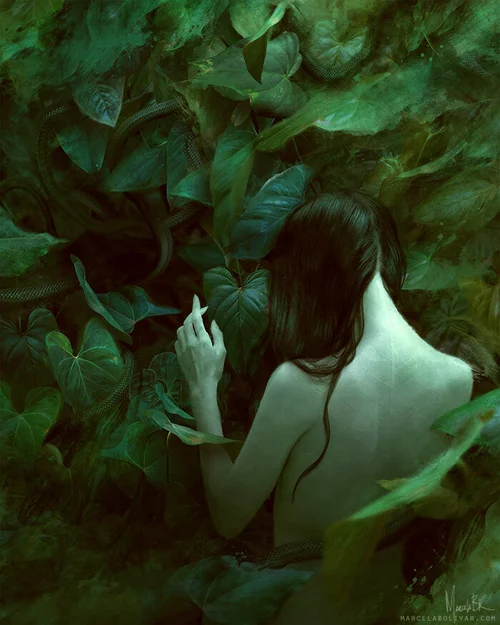
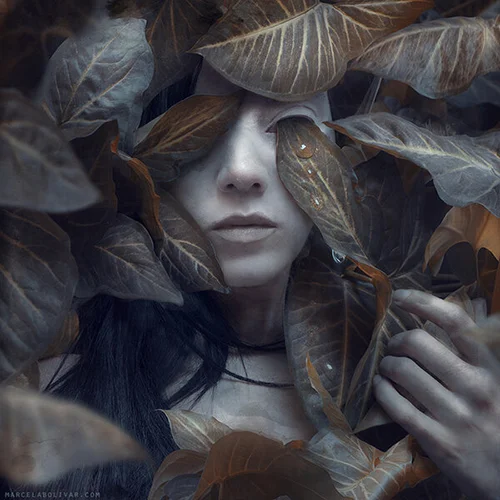
La imagen de la mujer se ha ligado siempre a la naturaleza, no por una asociación estética ni mero romanticismo, sino por una necesidad simbólica: la de nombrar lo que excede el control, lo que brota sin permiso, lo que crece y devora, da vida y la reclama. El bosque y el mar, lejos de ser sólo metáforas pintorescas, son estructuras arquetípicas que albergan la ambivalencia de lo femenino: la fertilidad y el caos, la acogida y el abismo. En este territorio, donde la vida no se regala, sino que se impone, lo mejor de la obra de Marcela Bolívar alcanza a encontrar su resonancia. No representa a la mujer en el bosque ni junto al mar, sino que la mujer es bosque, es mar: una fuerza, en buena medida, indómita, por supuesto, irreductible a función reproductiva ni a figura materna. Así, Marcela no busca precisamente encantar: toda plenitud lleva consigo el riesgo de la anegación, y toda dación de vida conlleva la posibilidad de perderse en ella.
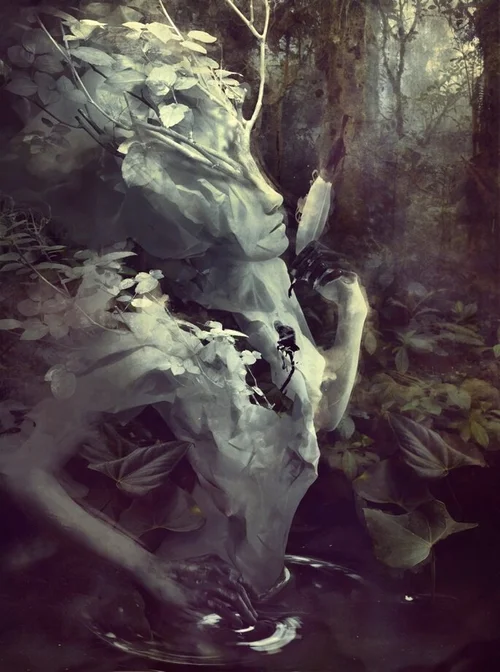
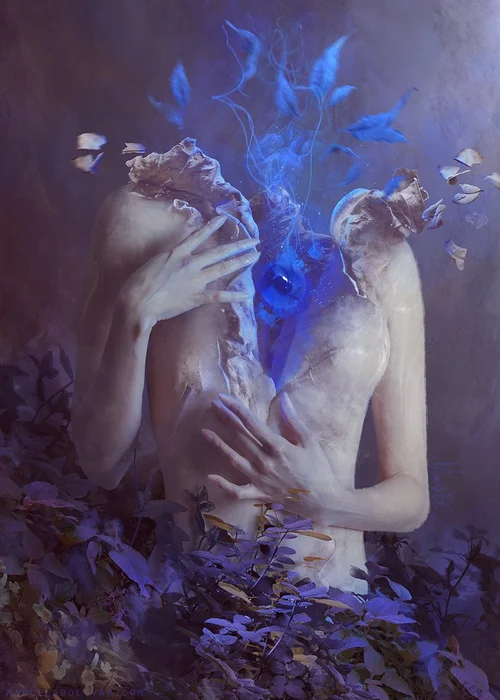
La temática central de Bolívar no es la naturaleza, ni siquiera la mujer como sujeto, sino la tensión entre identidad y desbordamiento. Sus mejores imágenes cuestionan, digamos, la contrainstitución romántica que sustituye al bendito patriarcado: la idealización de la mujer como esencia pura, como fuente de armonía, como puente hacia lo sagrado. Y la edulcoración de su inestabilidad. Este planteamiento, tan frecuente en cierto arte contemporáneo, no es para nada una liberación, sino una nueva forma de encarcelamiento: transforma a la mujer en un símbolo de redención ecológica, en una figura mítica que debe salvar al mundo caído con su intuición, su intemperie, su supuesta sabiduría ancestral. Estas imágenes de Bolívar rechazan tal lugar común con una lucidez feroz. Sus figuras irradian, se expanden, se confunden con lo vegetal, con lo acuático, con lo informe. Pero no lo hacen en nombre de una pureza originaria, sino como expresión de una subjetividad que se desborda, que se pierde, que se disuelve. Aquí se pone en cuestión el culto posmoderno a la experiencia femenina como acceso privilegiado a la verdad. En lugar de verdad en el cuerpo, hay fuerza, movimiento, peligro.
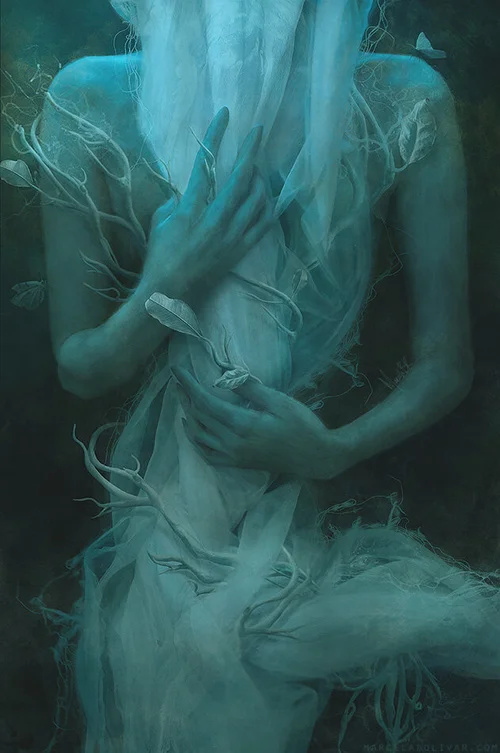
Su dominio técnico le permite atender una lógica interna que no se somete a la estética del detalle por el detalle, sino al imperativo de la coherencia simbólica. La superposición de materia, la transparencia, la textura rugosa o líquida, todo remite a una idea de formación continua, de identidad en estado de flujo. Sí, claro, expresionismo, pero acaso bastante más, la apuesta por un estructuralismo del desbordamiento. Y la habilidad de Bolívar reside en que este desbordamiento no se percibe como caos, sino como ley: una ley orgánica, aparentemente irracional, pero no por ello menos exigente.
A través de una manipulación deliberada de tonos, saturaciones y contrastes, Bolívar altera la percepción inmediata de la imagen, para seducir con su limpieza. La representación pictórica, como medio, suele asociarse con la fidelidad, con la prueba de lo real. Bolívar subvierte este supuesto institucional al imponer un sistema cromático que niega la neutralidad del registro. El color, en su obra, interpela. Revela que lo que vemos nunca es lo que es, sino lo que ha sido interpretado, tanto por el ojo como por el aparato, ya sea óptico o ideológico. Al intervenir digitalmente la imagen, ella no simula una realidad alternativa, sino que expone la ficción inherente a toda representación.
Estas imágenes alcanzan para alentar una conciencia aguda del riesgo de desaparecer en medio de la abundancia. La mujer-bosque es prisionera de su propia fecundidad. Y la mujer-mar es navegada o atravesada por la corriente que genera el mundo que gira. Bolívar no cae en la trampa de la bonne sauvage, esa figura que el imaginario poscolonial rescata para seguir explotándola: ahora no como sirvienta, sino como salvadora. Aquí, nada de redenciones. Y en ese gesto, profundamente ético, su obra cumple la función del arte auténtico: la cuestión desde dentro.
En efecto, el arte, cuando es verdadero, en lugar de afirmar identidades, sirve para desestabilizarlas.
[Todas las imágenes, del sitio web de la artista: Marcela Bolívar Art Portfolio]

ENGLISH VERSION
Bonne Sauvage?: On the Proposal of Marcela Bolívar
Translated by Rebeca Sanz
The image of woman has always been linked to nature, not by an aesthetic association nor mere romanticism, but by a symbolic necessity: that of naming what exceeds control, what springs forth without permission, what grows and devours, gives life and reclaims it. The forest and the sea, far from being just picturesque metaphors, are archetypal structures that harbor the ambivalence of the feminine: fertility and chaos, welcome and the abyss. In this territory, where life is not given but imposed, the best of Marcela Bolívar’s work manages to find its resonance. She does not represent woman in the forest or by the sea; rather, the woman is forest, is sea: a force, to a large extent, untamed, of course, irreducible to a reproductive function or a maternal figure. Thus, Marcela does not precisely seek to enchant: all plenitude carries the risk of inundation, and every giving of life entails the possibility of being lost in it.
The central theme of Bolívar is not nature, nor even woman as subject, but the tension between identity and overflow. Her best images question, let’s say, the romantic counter-institution that replaces the blessed patriarchy: the idealization of woman as pure essence, as a source of harmony, as a bridge to the sacred. And the sweetening of her instability. This approach, so frequent in certain contemporary art, is not at all a liberation, but a new form of imprisonment: it transforms woman into a symbol of ecological redemption, into a mythical figure who must save the fallen world with her intuition, her exposure, her supposed ancestral wisdom. These images by Bolívar reject such a commonplace with a fierce lucidity. Her figures radiate, expand, merge with the vegetal, the aquatic, the formless. But they do so not in the name of an original purity, but as an expression of a subjectivity that overflows, that gets lost, that dissolves. Here, the postmodern cult of feminine experience as privileged access to truth is called into question. Instead of truth in the body, there is force, movement, danger.
Her technical mastery allows her to attend to an internal logic that does not submit to the aesthetics of detail for detail’s sake, but to the imperative of symbolic coherence. The superposition of matter, transparency, rough or liquid texture, all refer to an idea of continuous formation, of identity in a state of flux. Yes, of course, expressionism, but perhaps considerably more, the bet on a structuralism of overflow. And Bolívar’s skill lies in the fact that this overflow is not perceived as chaos, but as law: an organic law, apparently irrational, but no less demanding for it.
Through a deliberate manipulation of tones, saturations, and contrasts, Bolívar alters the immediate perception of the image, to seduce with its cleanliness. Pictorial representation, as a medium, is often associated with fidelity, with the proof of the real. Bolívar subverts this institutional assumption by imposing a chromatic system that denies the neutrality of the record. Color, in her work, interrogates. It reveals that what we see is never what *is*, but what has been interpreted, both by the eye and by the apparatus, be it optical or ideological. By digitally intervening in the image, she does not simulate an alternative reality, but exposes the fiction inherent to all representation.
These images are enough to encourage an acute awareness of the risk of disappearing amidst abundance. The woman-forest is a prisoner of her own fecundity. And the woman-sea is navigated or traversed by the current generated by the spinning world. Bolívar does not fall into the trap of the bonne sauvage, that figure which the postcolonial imagination rescues only to continue exploiting her: now not as a servant, but as a savior. Here, no redemptions. And in that gesture, deeply ethical, her work fulfills the function of authentic art: it questions from within.
Indeed, art, when it is true, instead of affirming identities, serves to destabilize them.
[All images, from the artist’s website: https://www.marcelabolivar.com/]