La vertical y la luz: Aproximación a la muestra «Stravaig» de James Parker
Por Juan Pablo Torres Muñiz
Cuando se le pide a un niño que dibuje una casa, levanta las paredes a plomo, aunque el terreno sea una ladera y aunque el edificio que tiene delante se incline hacia el valle. Nadie le ha enseñado eso; lo lleva consigo. Lo que llamamos vertical es algo como una decisión de nuestra mirada: la dirección en que cae lo que soltamos, convertida en regla. Con ella viene un orden entero: arriba y abajo, sostén y caída, antes y después. ¿Qué ocurre, entonces, cuando al vagar uno se encuentra una y otra vez todo arreglado?
«Stravaig» es el verbo escocés para ir sin rumbo, y es el título que James Parker da a esta serie. Geometría y luz, la idea del orden racional (la vertical, la medida, el tiempo medido) como una propiedad del mundo y no una operación nuestra, cómo se sostiene al mismo tiempo, sin resolverla, la paradoja de que la luz que hace visible ese orden lo disuelve en un tiempo sin medida.
Bandas horizontales quedan atravesadas por distintas clases de líneas. La imaginación aprehende las partes una tras otra, pero llega un punto en que no puede reunirlas en una sola intuición y la unidad de medida fracasa. Lo dijo Kant. Pero Parker no pinta la inmensidad; coloca la regla humana en el cuadro para que se la vea fallar. El objeto vertical o vertizalizado es el testigo de cargo de lo inconmensurable. Sin plomada no hay escala, y sin escala imperaría la incomprensión del espacio como tal.
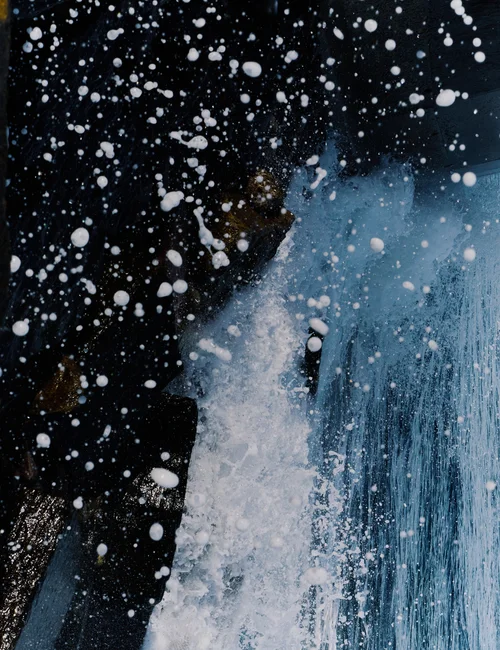
Una cortina blanca cae por el costado derecho del cuadro y, delante de ella, un enjambre de gotas queda suspendido contra el negro. No es el único caso. Aquí se repite cada tanto la tensión entre la captura y el destino previsible, previsto, normaldo. Aristóteles pensaba el peso como la tendencia de los cuerpos graves hacia su lugar natural; aunque la física moderna disolvió esa teleología, nuestra percepción no: seguimos viendo que el agua cae porque quiere caer. La imagen conserva ese residuo. Lo que queda inmóvil es la sucesión misma, de modo que contemplamos a la vez la ley, que es la caída, y el instante en que la ley se suspende para poder ser vista. Aquí se advierte por primera vez la paradoja del conjunto: el orden vertical es el que hace falta para que haya tiempo (caer es ocurrir), y es la luz, o más exactamente la brevedad de la luz, la que detiene ese tiempo.
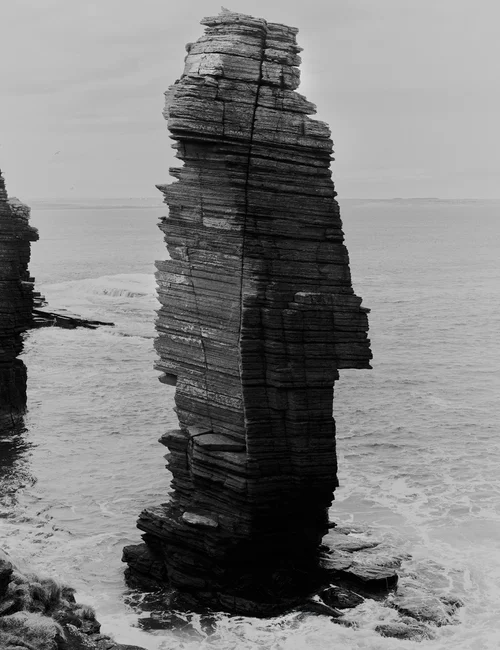
El monolito marino es la imagen más rigurosa de la serie y la más engañosa. Parece una columna impuesta: se alza solo, centrado, vertical, con una autoridad casi arquitectónica. Sin embargo, sus estratos son horizontales, y es ahí donde la vertical revela su carácter cronológico, porque según el principio de superposición lo que está más abajo es más antiguo. Subir por la columna es avanzar en el tiempo; la vertical, en el orden de la tierra, es un calendario. Una grieta la recorre de arriba abajo y anuncia su desplome. La autoridad de la columna resulta, por tanto, un espejismo: lo que vemos no es lo que se impuso sino lo que el mar todavía no se ha llevado. El orden es un resto de erosión, no un diseño. Esta inversión es la tesis de la serie en miniatura, y obliga a corregir una lectura demasiado directa de la vertical como imposición de una autoridad.
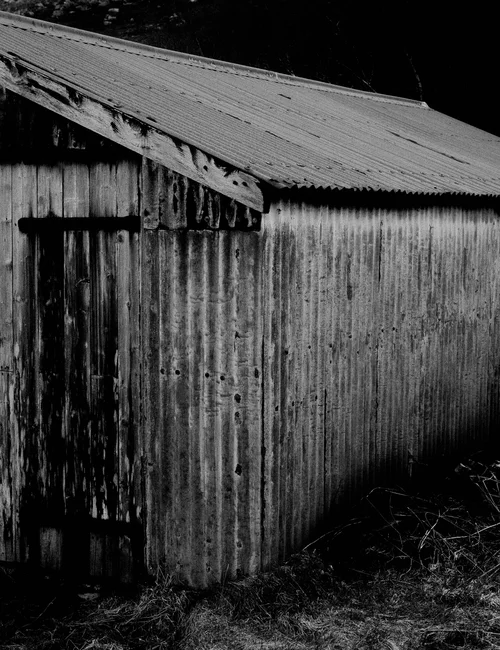
Con frecuencia, vemos que dos fuerzas en juego que no son geométricas: una franja de luz rasante que recorre la superficie y se hunde en sombra, y las marcas obra del tiempo en un cuerpo. Un material abstracto-institucional inscrito en un material físico que la intemperie va deshaciendo, y entre ambos la mirada del fotógrafo: material psicológico, que decide dónde cortar el encuadre y en qué instante dejar que la luz entre.
Animales, plantas introducen variaciones interesantes. No hace falta dramatizar el esquema; basta observar que en un mismo encuadre conviven cuerpos y códigos en contradicción.
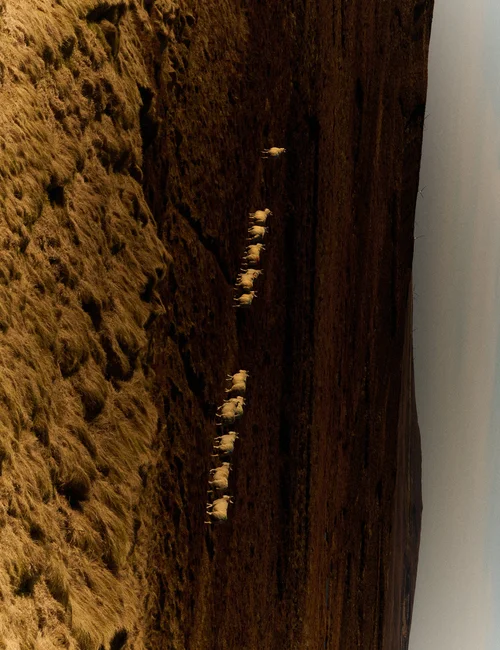
La explicitud de ciertas imágenes, como la de las ovejas subraya el problema de las convenciones. Todo indica que ésta se encuentra girada noventa grados. Pero es que nuestra perspectiva es determinada por una forma de congruencia que no niega a la otra. Decir arriba o abajo equivale a aludir, en parte, a Polo Sur y Norte, disponiendo su posición por efecto de políticas de lo más complejas, aunque fácilmente rastreables en su origen e intención.
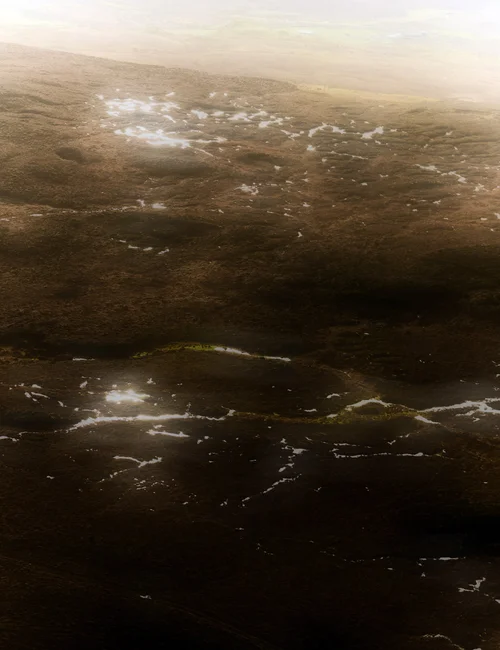
La vista aérea del páramo funciona como contraprueba y obliga a matizar. No hay en ella ninguna vertical: el horizonte se alza tan alto que casi no queda cielo, las charcas son astillas blancas esparcidas sin medida y una bruma dorada difumina el fondo. Aquí el orden no está en los objetos sino en la posición del ojo, elevado y oblicuo, que es la forma más radical de la vertical, a saber, ver desde arriba. La plomada pasa del cuadro al fotógrafo. Y ocurre algo revelador: es la imagen en la que la luz domina sin oposición, y la que más parece pertenecer a ninguna hora.
La técnica sostiene todo este desarrollo temático. Antes de cualquier objeto, la vertical está en el marco. El fotógrafo que vaga no sale al mundo con las manos vacías: lleva el rectángulo y, con él, la regla.
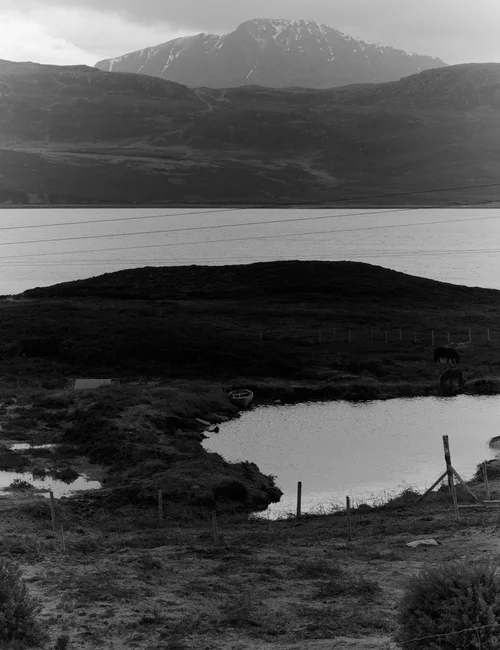
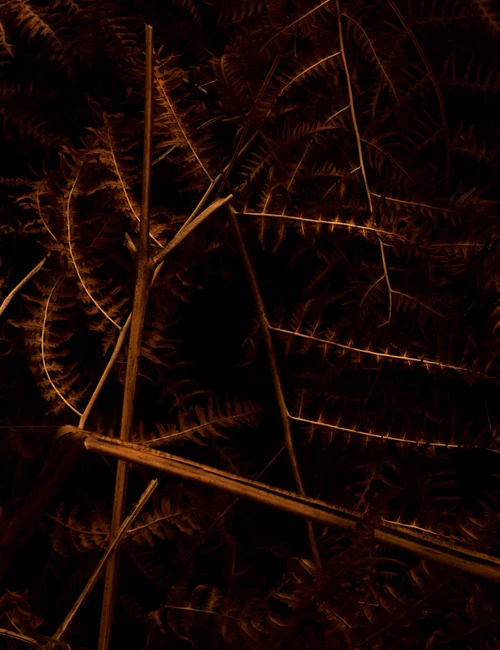
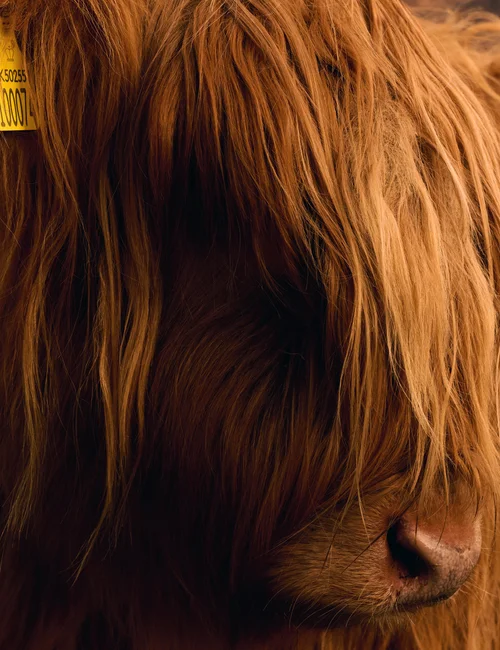
La luz recibe en la serie tratamientos distintos que cumplen una misma función. En el blanco y negro del lago, del cobertizo y del monolito es contraste: una luz que mide valores y reduce el color a una escala de grises, es decir, a un orden de más y menos. En los helechos, el color se concentra en una sola tonalidad cálida sobre negro, de modo que la luz no ilumina el espacio, sino que traza contornos, como lo haría un delineante. En el agua, un destello o una obturación brevísima detiene el movimiento y revela la forma esférica de las gotas. En la vaca y en el páramo, el color se vuelve denso, cálido y suave, con una compresión de planos que sugiere una óptica larga en el primer caso y una atmósfera cargada de bruma en el segundo. Son procedimientos diferentes, pero todos sustituyen la sucesión del tiempo por una imagen de lo que el tiempo deja a la vista.
En todo caso la luz hace lo contrario de la plomada. Ésta establece una dirección única y un tiempo que transcurre en ella; la luz, rasante, trasera, difusa o congelada, abre un tiempo sin sucesión. Así se cumple la inconmensurabilidad de la verdad desde nuestra perspectiva: no se la ve porque se la mida, sino a pesar de la medida, o más exactamente, gracias a que la medida fracasa dentro del cuadro.
La paradoja no es ningún descuido de la serie. Stravaig no promete la ausencia de orden, sino su comprobación. Solo quien va sin rumbo puede verificar que la plomada va con él.
La fotografía de paisaje, que suele recibirse como registro de lo salvaje, es aquí una demostración de las condiciones de medida desde las que algo puede aparecer como salvaje; el receptor neófito que busca naturaleza encuentra instituciones, de las que la más discreta y la más eficaz es el rectángulo vertical. ¿Hay acaso una imagen sin orden, o solo imágenes cuyo orden se ha desplazado del objeto al punto de vista? Vagar más podría ayudarnos. O no.
[Todas las imágenes, del sitio Web del artista: James Parker | | Automotive & Lifestyle Photographer | London]
(ENGLISH VERSION)
The Vertical and the Light: An Approach to the Exhibition «Stravaig» by James Parker
Translation by Tiffany Amber Elías Trimble
When a child is asked to draw a house, they raise the walls plumb, even if the terrain is a slope and even if the building before them leans toward the valley. No one has taught them that; they carry it with them. What we call vertical is something like a decision of our gaze: the direction in which what we drop falls, converted into a rule. With it comes an entire order: above and below, support and fall, before and after. What happens, then, when in one’s wandering one finds everything arranged again and again?
«Stravaig» is the Scots verb for going without a destination, and it is the title James Parker gives to this series. Geometry and light, the idea of rational order (the vertical, measure, measured time) as a property of the world and not an operation of ours, how the paradox is sustained at the same time, without resolving it, that the light which makes that order visible dissolves it into a time without measure.
Horizontal bands are traversed by different kinds of lines. The imagination grasps the parts one after another, but there comes a point at which it cannot gather them into a single intuition and the unit of measure fails. Kant said it. But Parker does not paint immensity; he places the human ruler in the painting so that it can be seen to fail. The vertical or verticalized object is the material witness of the immeasurable. Without a plumb line there is no scale, and without scale the incomprehension of space as such would reign.
A white curtain falls along the right side of the painting and, in front of it, a swarm of drops remains suspended against the black. It is not the only case. Here the tension between capture and the foreseeable, foreseen, normalized destination repeats itself every so often. Aristotle thought of weight as the tendency of heavy bodies toward their natural place; although modern physics dissolved that teleology, our perception did not: we continue to see that water falls because it wants to fall. The image preserves that residue. What remains motionless is succession itself, so that we contemplate at once the law, which is the fall, and the instant in which the law is suspended in order to be seen. Here the paradox of the whole is noticed for the first time: the vertical order is what is needed for there to be time (to fall is to occur), and it is light, or more exactly the brevity of light, that stops that time.
The marine monolith is the most rigorous image of the series and the most deceptive. It looks like an imposed column: it rises alone, centered, vertical, with an almost architectural authority. However, its strata are horizontal, and it is there that the vertical reveals its chronological character, because according to the principle of superposition what is lower is older. To climb the column is to advance in time; the vertical, in the order of the earth, is a calendar. A crack runs through it from top to bottom and announces its collapse. The authority of the column turns out, therefore, to be a mirage: what we see is not what was imposed but what the sea has not yet carried away. Order is a remnant of erosion, not a design. This inversion is the thesis of the series in miniature, and it obliges correcting a too direct reading of the vertical as the imposition of an authority.
Frequently, we see that two forces are at play that are not geometric: a strip of grazing light that runs across the surface and sinks into shadow, and the marks wrought by time on a body. An abstract-institutional material inscribed in a physical material that the weather is undoing, and between both the photographer’s gaze: psychological material, which decides where to cut the frame and at what instant to let the light in.
Animals, plants introduce interesting variations. There is no need to dramatize the scheme; it is enough to observe that in a single frame bodies and codes coexist in contradiction.
The explicitness of certain images, such as that of the sheep, underlines the problem of conventions. Everything indicates that it is rotated ninety degrees. But it is that our perspective is determined by a form of congruence that does not deny the other. To say above or below is equivalent to alluding, in part, to South and North Pole, disposing their position by effect of the most complex politics, though easily traceable in their origin and intention.
The aerial view of the moor functions as a counterproof and obliges nuance. There is no vertical in it: the horizon rises so high that almost no sky remains, the ponds are white splinters scattered without measure and a golden mist blurs the background. Here the order is not in the objects but in the position of the eye, elevated and oblique, which is the most radical form of the vertical, namely, seeing from above. The plumb line passes from the painting to the photographer. And something revealing occurs: it is the image in which light dominates without opposition, and the one that most seems to belong to no hour.
Technique sustains all this thematic development. Before any object, the vertical is in the frame. The photographer who wanders does not go out into the world empty-handed: they carry the rectangle and, with it, the rule.
Light receives in the series different treatments that fulfill the same function. In the black and white of the lake, the shed, and the monolith it is contrast: a light that measures values and reduces color to a scale of grays, that is, to an order of more and less. In the ferns, color concentrates in a single warm tonality against black, so that light does not illuminate the space, but traces contours, as a draftsman would. In the water, a flash or a very brief shutter speed stops movement and reveals the spherical form of the drops. In the cow and in the moor, color becomes dense, warm, and soft, with a compression of planes that suggests a long lens in the first case and an atmosphere laden with mist in the second. They are different procedures, but all substitute the succession of time for an image of what time leaves in view.
In any case light does the opposite of the plumb line. The latter establishes a single direction and a time that passes in it; light, grazing, rear, diffuse, or frozen, opens a time without succession. Thus the immeasurability of truth is fulfilled from our perspective: it is not seen because it is measured, but in spite of measure, or more exactly, thanks to the fact that measure fails within the painting.
The paradox is no oversight of the series. Stravaig does not promise the absence of order, but its verification. Only whoever goes without a destination can verify that the plumb line goes with them.
Landscape photography, which is usually received as a record of the wild, is here a demonstration of the conditions of measure from which something can appear as wild; the neophyte receiver who seeks nature finds institutions, of which the most discreet and the most efficacious is the vertical rectangle. Is there perhaps an image without order, or only images whose order has shifted from the object to the point of view? Wandering more could help us. Or not.