
Nada más que ausencia: Sobre la imposibilidad de la IA para hacer arte y el desconcierto de los certámenes literarios
Por Juan Pablo Torres Muñiz
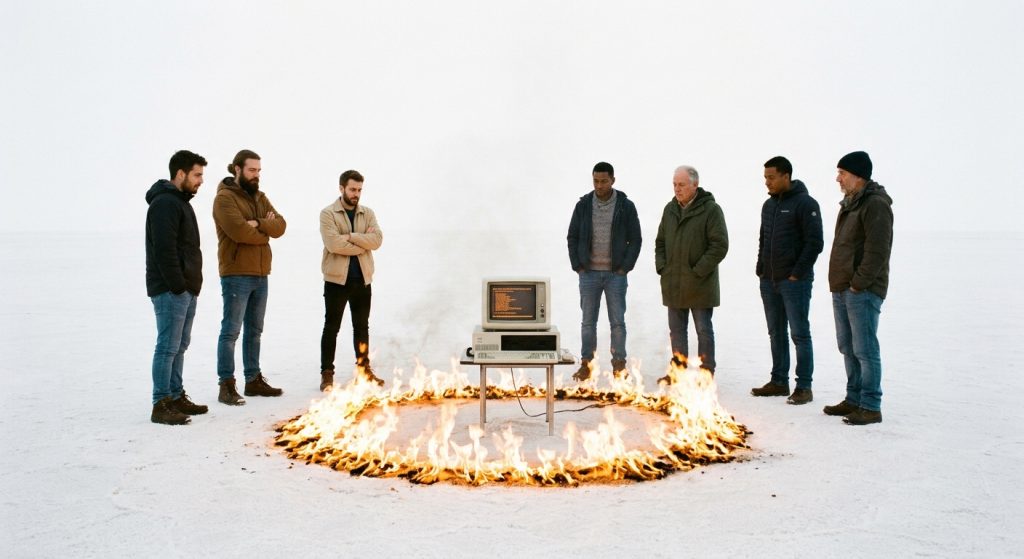
En boca de todos. El 25 de septiembre de 2026, la Academia Goncourt retiró de su primera selección la novela C’était ça ou mourir, de Thélyson Orélien, por considerar que era «con toda probabilidad en gran medida el producto de una inteligencia artificial» (EFE, 2026). Veintiséis días después, la editorial canadiense del autor admitió que la IA había intervenido en el proceso de escritura —contra lo que él mismo le había asegurado en varias ocasiones— y prescindió de él (Paponaud y AFP, 2026). Ese mismo día se abría en Francia la convocatoria del Prix Pascal, un galardón que invita a concursar con libros escritos con ayuda de ChatGPT, Claude, Gemini o LLaMA, a condición de que el autor declare su uso (Mouriquand, 2026). Qué oportuno.
El lector neófito podría concluir que el mundo literario francés atraviesa una crisis de nervios o que, nuevamente, juega a estar a la vanguardia. El atento advertirá algo más serio: tres instituciones —un premio, una casa editorial, un certamen recién nacido— se pronuncian en tres sentidos distintos sobre un mismo asunto sin que ninguna disponga de un concepto claro respecto de lo que juzga. Relativismo puro. Desde 2022, la pregunta de si una máquina puede hacer arte se ha respondido con entusiasmo comercial o con espanto gremial, y ambos eluden la cuestión previa: qué es el arte.
En este espacio compartimos una definición clara. Pero conviene, antes, partir de ciertos términos. Arte viene del latín ars, artis, traducción del griego téchnē: habilidad adquirida, fruto del ejercicio, contraria al supuesto don que desciende sin esfuerzo. Pero el arte que aquí importa no se agota en el ars; es además una institución, y institución procede de institutio, derivado de instituere, de in– («hacia dentro») y statuere («poner en pie»): levantar algo para que permanezca, un orden interior que organiza la vida de quienes participan de él. Una institución es una construcción racional humana que determina total o parcialmente el funcionamiento de una sociedad de personas; abstracta, en principio, mas nunca inmaterial, pues solo opera si se ancla en los tres géneros de materialidad que distingue el materialismo filosófico: el corpóreo (cuerpos, objetos, espacios), el psicológico o sensible (afectos, vivencias, intuiciones) y el abstracto (relaciones lógicas, normas, estructuras) (Bueno, 1972).
Entonces, el arte es la situación comunicativa cuestionadora institucionalizada en la que se entretejen cuatro materiales: el autor, persona de carne y hueso que aplica una técnica normada y competencias intelectivas; la obra, texto elocuente que confronta dialécticamente al receptor a propósito de los conceptos e instituciones de que se compone su mundo; el receptor, intérprete capaz de reexaminar sus propias categorías; y el marco institucional que, en un tiempo y un lugar, reconoce la obra como tal.
La capacidad de cuestionar instituciones excede, y por mucho, cuanto puede y podrá hacer la más potente IA, porque las instituciones no se componen solo de elementos racionales teóricos. Tienen un anclaje corpóreo y otro sensible-emocional, y es allí, no en el esquema abstracto que las describe, donde ocurre lo más importante de su vida real: se conducen de modo harto imprevisible, y de esa imprevisibilidad brotan nuevas formas de razonamiento a propósito de temas nuevos. Ello sucede porque quien cuestiona una institución lo hace desde su cuerpo, padeciendo su peso —la ley que castiga, la lengua que no alcanza, el rito que ya no consuela—, y el padecimiento obliga a la razón a reordenarse. La neurología lo corrobora en sentido inverso: Damasio (1994) mostró que pacientes con lesiones prefrontales ventromediales conservaban el intelecto y fracasaban, sin embargo, en las decisiones de su vida real, por haber perdido el vínculo entre emoción y razón; la emoción, lejos de estorbar a la razón, resultó una de sus condiciones. Un sistema al que nada afecta, que nada pierde ni gana con sus conclusiones y que cuenta únicamente con el tercer género de materialidad ya codificado —textos, imágenes, cifras—, es decir, con el registro de lo ya institucionalizado, no se encuentra en condiciones de padecer una institución, ni mucho menos. Searle (1980) lo advirtió con su célebre: manipular símbolos según reglas no basta para entender lo que significan. Y Bender et al. (2021) describieron los grandes modelos de lenguaje como sistemas que enlazan secuencias de formas lingüísticas según información probabilística sobre cómo suelen combinarse, sin referencia alguna al sentido.
Solo traicionando la lógica de su funcionamiento podría una IA producir formas nuevas de razonamiento. Estos sistemas operan estimando lo más probable a la luz de lo ya instituido; lo nuevo es, en su geometría, la cola de la distribución, aquello que el entrenamiento aprende a tratar como ruido o que el muestreo rescata por azar, y el azar produce variación, no razón. La evidencia empírica se acumula en tal dirección. Shumailov et al. (2024) demostraron que los modelos entrenados de manera recursiva con datos generados por otros modelos pierden primero las colas de la distribución original y terminan colapsando: sin la savia de lo humano, lo que sale es cada vez más uniforme. Doshi y Hauser (2024) hallaron que los relatos escritos con ideas de IA eran evaluados, individualmente, como más creativos, pero que, en conjunto, se parecían más entre sí que los escritos sin ella. Y esto, al ojo menos experto, lejos de la crítica que implica la exposición de un sistema de ideas coherente, que parte precisamente de una teoría del arte y no sólo de intuiciones e inclinaciones estéticas y justificaciones relativistas, lo que copa los campus de Occidente.
Cabe preguntar, desde luego, si un sistema podría ser programado para cuestionar su propio marco. Sí, y es lo que ocurre cuando ingenieros lo reentrenan o lo reconfiguran; pero entonces el cuestionamiento procede de ellos, personas con mundo, y no del sistema, que se limita a ejecutar el marco nuevo. El paralelo que ofrece Gödel (1931) —no como demostración, sino como estructura— es instructivo: un sistema formal consistente y suficientemente rico contiene enunciados que no puede decidir con sus propios medios, y para zanjarlos hay que salir de él, esto es, instituir otro.
Pero vamos a abordar la experiencia misma del trabajo de arte: la IA carece de lo que podemos denominar zona de tiro, mientras el artista no puede prescindir de ella. ¿A qué nos referimos con dicho término? Tomado del atletismo, el concepto designa ese espacio en que quien se ha preparado con rigor —ha entrenado, estudiado, razonado— se entrega a la prueba sin cálculos explícitos ni mediciones contrastadas, y en el que predomina una sensación de suspensión del tiempo. Es el lugar donde el artista obra sin detenerse a pensar en las causas y razones que determinan lo que hace y cómo lo hace. No es ausencia de razón, sino su sedimento. Lo que la psicología describió como «flujo» (Csikszentmihalyi, 1990) recoge parte de su fenomenología, no su estructura.
Quien se ha preparado con rigor entra en un estado en que obra sin deliberar las causas; la razón no ha sido abolida, sino absorbida por el cuerpo adiestrado, que ahora ejecuta lo que antes razonaba. Polanyi (1966) lo resumió en una fórmula que ha envejecido bastante bien: sabemos más de lo que podemos decir. Dreyfus y Dreyfus (1986) describieron cómo el experto, a diferencia del principiante que aplica reglas, actúa desde una captación global de la situación y no desde la deliberación explícita. La explicación llega después, siempre ulterior, cuando el artista, de vuelta de la prueba, intenta reconstruir con la razón el camino que su cuerpo ya hizo; de ahí que toda poética de autor sea una racionalización a posteriori, valiosa, pero siempre insuficiente. En la IA nada de esto tiene correlato. Su opacidad —que existe— es un déficit de análisis, en principio subsanable con más instrumentos; la del artista, en cambio, es el rastro que deja en una persona el límite de su razón. Nadie arriesga nada en el sistema cuando genera: no hay prueba, no hay suspensión del tiempo, no hay un cuerpo que se entrega. Donde no hay zona de tiro no hay ulterioridad, y sin ella la explicación no tiene de qué serlo.
El artista se expresa poniendo en cuestión la lógica misma que rige su mundo, y por eso la materialización de una obra, por planificada que sea, sobrepasa siempre el plan original y conserva un ámbito inexplicable para su autor. El plan se dibuja con las categorías vigentes; si la obra las pone en entredicho, no cabe en el plan que las presupone, y su hechura obliga a inventar, sobre la marcha, el lenguaje con el que la cuestión puede plantearse. Kant (1790, §§ 46-47) intuyó algo semejante al observar que el genio no puede describir ni indicar científicamente cómo realiza su producto, aunque su Kritik der Urteilskraft lo remita a un juicio sin concepto, y aquí se lo entiende al revés: la obra ha creado sus propios conceptos, y por eso los que ya se tienen no bastan para agotarla. Esto explica que el autor no tenga por qué responder teóricamente sobre lo que dice mediante su obra. No ilustra ella una tesis que luego deba defenderse con otras palabras; desarrolla en sí misma «el lenguaje» con el que ha de ser planteada la cuestión. Wimsatt y Beardsley (1946) lo dijeron a su manera al denunciar la falacia intencional: ni disponible ni deseable es la intención del autor como criterio para juzgar el poema. Una IA, en cambio, tiene un plan —la instrucción— y un resultado que lo excede estadísticamente; pero ese exceso es varianza y no desborde de una razón, y no hay un autor para quien resulte inexplicable.
El marco institucional, para reconocer una obra, presupone un autor que responda por ella como persona. La razón es que la obra es un enunciado dirigido a otro, y los enunciados cuestionadores se pagan: quien cuestiona se expone, y la persona, otra institución, es quien soporta esa exposición. La etimología del plagio lo deja ver: el término proviene del latín plagium, secuestro de personas; por ello, Marcial llamó plagiarius a quien recitaba como propios sus versos, y pidió a un amigo que actuara como defensor de la libertad de sus libritos, retenidos en boca ajen). El derecho contemporáneo ha llegado por su cuenta a una conclusión afín. El 2 de marzo de 2026, la Corte Suprema de los Estados Unidos se negó a revisar Thaler v. Perlmutter, con lo cual dejó en pie la decisión del Tribunal de Apelaciones del Distrito de Columbia que había confirmado la negativa de la Oficina de Derechos de Autor a registrar una imagen generada de forma autónoma por un sistema de IA, por exigir la ley autoría humana (Mayer Brown, 2026; Thaler v. Perlmutter, 2025). El mismo tribunal precisó que la exigencia no impide registrar obras hechas con asistencia de IA, siempre que el autor sea un ser humano y no la máquina (Thaler v. Perlmutter, 2025, p. 1049).
Los certámenes literarios muestran que quienes los administran carecen de una teoría del arte que les permita decir qué juzgan. La causa se advierte en sus criterios, que no hablan de obra, sino de procedencia. El Goncourt justificó la exclusión de Orélien por la integridad del premio y por el resultado convergente de análisis de investigadores y periodistas, y quiso enviar un mensaje: no respaldará textos generados con ayuda de IA (EFE, 2026). No dice que la novela sea mediocre; dice que probablemente no es de quien la firma. Es un criterio de aduana. La editorial canadiense, por su parte, reconoció que no sabe en qué medida se empleó la IA y que probablemente nunca lo sabrá, de modo que, para ella, lo fundamental es la confianza entre autores y editores (Paponaud y AFP, 2026). El autor, por su parte, sigue negando las acusaciones: afirma haber escrito el libro y compara su uso de herramientas con el de quien traduce (Mouriquand, 2026). Confunde así la prótesis con la autoría.
El exceso contrario completa el cuadro. En 2024, Rie Kudan recibió el Akutagawa, el más prestigioso premio literario japonés, por Tokyo-to Dojo-to, y reveló que alrededor del 5 % del libro lo conformaban frases generadas literalmente por ChatGPT; la comisión había elogiado la obra como prácticamente impecable, un miembro de ella defendió a la autora recordando que el libro mencionaba abiertamente la IA generativa, y el premio no le fue retirado (Excélsior, 2024). En Argentina, el premio Itaú incorporó en 2023 una mención especial para cuentos coescritos con IA (La Nación, 2023). En Francia, el Prix Pascal admite los grandes modelos de lenguaje y pide a los autores que declaren su uso, con el argumento de que, mientras otros persiguen la IA con detectores contradictorios, lo sensato es la transparencia; sus fundadores son emprendedores tecnológicos y el premio carece de dotación económica (Mouriquand, 2026). Otras convocatorias —el Certamen de Literatura Joven de la UANL de 2026 descalifica los trabajos con IA y los plagiados (Universidad Autónoma de Nuevo León, 2026); las bases de «Viva Leer Copec» excluyen en su segunda edición a quienes hayan sido acusados de uno u otro (Copec, 2026)— equiparan el uso de IA al plagio, como si la primera fuera una variante de la copia. No lo es. El plagio, que este año llevó a la Revista Nacional de Cultura de la UNED, en Costa Rica, a anular un premio de poesía y a ordenar la devolución del dinero (CRHoy, 2026), se detecta por cotejo con un texto previo del que alguien se apropia; la IA no copia, recombina, y por eso el cotejo no la alcanza: hay que recurrir a detectores estadísticos o a la declaración jurada de honradez.
Tres actitudes —prohibir, tolerar, convocar— y nadie dice qué hace que un texto sea obra de arte, y por eso tampoco se puede decir por qué importaría su procedencia. Quien no cuenta con una teoría del arte ni con una definición suya, y quien lo relativiza o lo reduce a mera expresión, no tiene cómo enfrentar la situación ni pronunciarse al respecto sin caer en más relativismo. Si arte es expresión, el texto de la máquina que conmueve a miles de lectores es arte, y el Goncourt ha cometido una injusticia. Si arte es lo que la institución consagra, el Prix Pascal tiene tanta legitimidad como el Goncourt, y viceversa. Si todo es relativo, la exclusión de Orélien es una preferencia de gusto, y su rehabilitación, otra. En cada caso, la única salida es declarar el desacuerdo una cuestión de perspectivas, que es precisamente el estado de cosas cuya impotencia revelan los certámenes. Y el estatus quo en el mundo anglosajón.
Podría objetarse, en primer término, que si el producto de una IA conmueve, engaña a un jurado o supera en pulcritud al humano, no hay razón para negarle el título de arte: el jurado del Akutagawa halló casi impecable una novela que contenía frases de máquina. La objeción confunde la estética con la poética. Que un texto provoque sensaciones y resista el escrutinio superficial prueba que la superficie es reproducible, no que sea arte; de otro modo, bastaría el efectismo, en el mejor caso cierto virtuosismo, y habríamos de llamar arte a toda falsificación lograda. El propio Goncourt concede lo decisivo: no excluyó a Orélien por considerar mala su novela, sino por sospechar de su procedencia, de modo que ni siquiera la institución cree que el valor resida en la superficie. La imposibilidad de distinguir, además, no es una propiedad de la obra, sino de los instrumentos de lectura, sea el detector o el jurado apresurado; y las obras mayores, que reclaman ciclos largos de lectura para ser comprendidas, son justamente las que ninguna reacción inmediata puede evaluar.
El arte siempre se ha servido de prótesis —la cámara, el sintetizador, el procesador de textos—, cada una acusada en su día de matarlo; la IA no sería sino la última. El yerro radica en suponer que toda prótesis es neutral respecto de la autoría. Cuando la Corte Suprema estadounidense reconoció en 1884, en Burrow-Giles Lithographic Co. v. Sarony, que una fotografía podía ser obra de un autor, lo hizo por entender que era producto de la concepción mental del fotógrafo —pose, luz, disposición— y no del aparato. La cámara amplía lo que alguien cuestiona; no cuestiona. La prótesis que sustituye la decisión autorial deja, en cambio, la obra sin autor, y eso fue lo que el tribunal de Washington vio en el caso Thaler: un solicitante que renunció a toda contribución propia. Nada impide que una persona haga arte sirviéndose de la IA; lo hará en la medida en que cuestione algo con ella, y entonces el arte no lo habrá hecho la IA.
No se apuesta contra ninguna técnica; lo que falta no es potencia de cálculo, que mayor escala remedia, sino la condición de estar instituido, de tener algo que perder en las instituciones que se cuestionan. Un ente que, con cuerpo y vivencia, se constituyera desde dentro de instituciones, las padeciera y respondiera por sus actos ante otros sería una persona, es decir, otra institución, y no la IA de la que hoy se habla, un modelo estadístico entrenado en registros. La evidencia disponible apunta a que la escala sin renovación humana empobrece la diversidad (Shumailov et al., 2024).
El arte exige un autor encarnado. La capacidad de cuestionar instituciones, nacida de una materialidad a la vez corpórea, sensible y racional, y de una zona de tiro de la que solo se sale al borde de la razón, excede lo que pueda una prótesis estadística; esta solo podría producir razonamientos nuevos traicionando su lógica, y entonces no sería ya ella quien los produce.
¿Qué implica todo ello? Para los premios, lo que corresponde no es perseguir ni celebrar la IA, sino dotarse de un concepto de obra que desplace el criterio de procedencia por el de cuestionamiento, y exigir a quien firma que responda como persona. Declarar el uso, como pide el Prix Pascal, es útil, en el mejor de los casos, como prueba de honradez, no como criterio de arte. Para la crítica y la enseñanza, la urgencia es formar en teoría del arte y en práctica rigurosa, pues sin esa formación el público seguirá reaccionando donde debiera responder. Para los artistas, la prótesis es lícita; delegar la zona de tiro, no: quien delega el entrenamiento delega el sitio donde el arte ocurre. Que una máquina nos haga reaccionar es cosa sabida. Que nos obligue a responder solo puede quien se jugó algo en la obra, y a eso, bien visto, ningún premio ha sabido todavía ponerle nombre.
Referencias bibliográficas:
Bender, E. M., Gebru, T., McMillan-Major, A., y Shmitchell, S. (2021). On the dangers of stochastic parrots: Can language models be too big? En Proceedings of the 2021 ACM Conference on Fairness, Accountability, and Transparency (pp. 610-623). Association for Computing Machinery. https://doi.org/10.1145/3442188.3445922
Bueno, G. (1972). Ensayos materialistas. Taurus.
Burrow-Giles Lithographic Co. v. Sarony, 111 U.S. 53 (1884).
Copec. (2026). Bases del concurso literario «Viva Leer Copec»: Segunda edición 2026. https://copec.cdn.modyo.com/uploads/37296efa-29eb-4288-8f0b-e8e823def779/original/Bases_Concurso_Literario_Cuenta_tu_cuento_2026.pdf
CRHoy. (2026). Revista Nacional de Cultura anula premio de poesía por presunto plagio. https://crhoy.com/cultura/revista-nacional-de-cultura-anula-premio-de-poesia-por-presunto-plagio/
Csikszentmihalyi, M. (1990). Flow: The psychology of optimal experience. Harper & Row.
Damasio, A. R. (1994). Descartes’ error: Emotion, reason, and the human brain. G. P. Putnam’s Sons.
Doshi, A. R., y Hauser, O. P. (2024). Generative AI enhances individual creativity but reduces the collective diversity of novel content. Science Advances, 10(28), Artículo eadn5290. https://doi.org/10.1126/sciadv.adn5290
Dreyfus, H. L., y Dreyfus, S. E. (1986). Mind over machine: The power of human intuition and expertise in the era of the computer. Free Press.
EFE. (2026, 25 de septiembre). Una novela sobre la crisis en Haití fue excluida del premio literario más importante de Francia por sospechas de uso de IA y plagio. Infobae. https://www.infobae.com/cultura/2026/09/25/una-novela-sobre-la-crisis-en-haiti-fue-excluida-del-premio-literario-mas-importante-de-francia-por-sospechas-de-uso-de-ia-y-plagio/
Excélsior. (2024). Escritora ganadora de prestigioso premio literario confiesa haber usado ChatGPT. https://www.excelsior.com.mx/expresiones/escritora-ganadora-premio-literario-confiesa-usado-chatgpt/1632010
Gödel, K. (1931). Über formal unentscheidbare Sätze der Principia Mathematica und verwandter Systeme I. Monatshefte für Mathematik und Physik, 38, 173-198. https://doi.org/10.1007/BF01700692
Kant, I. (1790). Kritik der Urteilskraft. Lagarde und Friederich.
La Nación. (2023). No es ciencia ficción: lanzan un concurso en el que pueden participar cuentos escritos con inteligencia artificial. https://www.lanacion.com.ar/cultura/no-es-ciencia-ficcion-lanzan-un-concurso-en-el-que-pueden-participar-cuentos-escritos-con-nid22042023/
Martial. (1993). Epigrams (Vol. 1; D. R. Shackleton Bailey, Ed. y Trad.). Harvard University Press. (Obra original ca. 86 d. C.)
Mayer Brown. (2026, 11 de marzo). Supreme Court denies review in AI authorship case. https://www.mayerbrown.com/en/insights/publications/2026/03/supreme-court-denies-review-in-ai-authorship-case
Mouriquand, D. (2026, 22 de octubre). Prix Pascal: nace en Francia un premio literario para libros coescritos con IA. Euronews. https://es.euronews.com/2026/10/22/prix-pascal-nace-en-francia-un-premio-literario-para-libros-coescritos-con-ia
Paponaud, E., y AFP. (2026, 21 de octubre). Caso Thélyson Orélien: su editor admite que se usó IA para escribir «C’était ça ou mourir». Euronews. https://es.euronews.com/2026/10/21/caso-thelyson-orelien-su-editor-admite-que-se-uso-ia-para-escribir-cetait-ca-ou-mourir
Platón. (1988). Sofista. En Diálogos V: Parménides, Teeteto, Sofista, Político (N. L. Cordero, Trad.). Gredos. (Obra original ca. 360 a. C.)
Polanyi, M. (1966). The tacit dimension. Doubleday.
Searle, J. R. (1980). Minds, brains, and programs. Behavioral and Brain Sciences, 3(3), 417-424. https://doi.org/10.1017/S0140525X00005756
Shumailov, I., Shumaylov, Z., Zhao, Y., Papernot, N., Anderson, R., y Gal, Y. (2024). AI models collapse when trained on recursively generated data. Nature, 631, 755-759. https://doi.org/10.1038/s41586-024-07566-y
Thaler v. Perlmutter, 130 F.4th 1039 (D.C. Cir. 2025).
Universidad Autónoma de Nuevo León. (2026). Certamen de Literatura Joven UANL 2026: Poesía, cuento y fanfiction. https://cultura.uanl.mx/convocatorias/certamen-de-literatura-joven-uanl-2026/
Wimsatt, W. K., Jr., y Beardsley, M. C. (1946). The intentional fallacy. The Sewanee Review, 54(3), 468-488.
(ENGLISH VERSION)
Nothing but Absence: On the Impossibility of AI Making Art and the Bewilderment of Literary Contests
Translation by Tiffany Amber Elías Trimble
On everyone’s lips. On September 25, 2026, the Goncourt Academy removed from its first selection the novel C’était ça ou mourir, by Thélyson Orélien, considering that it was «in all probability to a large extent the product of an artificial intelligence» (EFE, 2026). Twenty-six days later, the author’s Canadian publisher admitted that AI had intervened in the writing process —contrary to what he himself had assured it on several occasions— and dismissed him (Paponaud and AFP, 2026). That same day, the call for the Prix Pascal opened in France, an award that invites entries with books written with the help of ChatGPT, Claude, Gemini, or LLaMA, on condition that the author declares its use (Mouriquand, 2026). How timely. The neophyte reader might conclude that the French literary world is going through a crisis of nerves or that, once again, it is playing at being at the avant-garde. The attentive reader will notice something more serious: three institutions —an award, a publishing house, a newly born contest— pronounce themselves in three different directions on the same matter without any of them having a clear concept of what it judges. Pure relativism. Since 2022, the question of whether a machine can make art has been answered with commercial enthusiasm or with guild horror, and both evade the prior question: what is art.
In this space we share a clear definition. But it is best, first, to start from certain terms. Art comes from the Latin ars, artis, a translation of the Greek téchnē: acquired skill, fruit of exercise, contrary to the supposed gift that descends without effort. But the art that matters here is not exhausted in the ars; it is also an institution, and institution comes from institutio, derived from instituere, from in- («inward») and statuere («to set upright»): to raise something so that it remains, an inner order that organizes the life of those who participate in it. An institution is a human rational construction that determines totally or partially the functioning of a society of persons; abstract, in principle, but never immaterial, since it operates only if it is anchored in the three genres of materiality distinguished by philosophical materialism: the corporeal (bodies, objects, spaces), the psychological or sensible (affects, lived experiences, intuitions), and the abstract (logical relations, norms, structures) (Bueno, 1972).
Art, then, is the questioning communicative situation institutionalized in which four materials are interwoven: the author, a person of flesh and blood who applies a normed technique and intellective competences; the work, an eloquent text that dialectically confronts the receiver regarding the concepts and institutions of which their world is composed; the receiver, an interpreter capable of reexamining their own categories; and the institutional framework that, in a time and a place, recognizes the work as such.
The capacity to question institutions exceeds, and by far, what the most powerful AI can and will be able to do, because institutions are not composed only of theoretical rational elements. They have a corporeal anchoring and a sensible-emotional one, and it is there, not in the abstract scheme that describes them, where the most important part of their real life occurs: they conduct themselves quite unpredictably, and from that unpredictability new forms of reasoning about new themes spring. This happens because whoever questions an institution does so from their body, suffering its weight —the law that punishes, the language that does not reach, the rite that no longer consoles—, and suffering obliges reason to reorganize itself. Neurology corroborates it in the reverse sense: Damasio (1994) showed that patients with ventromedial prefrontal lesions retained their intellect and nevertheless failed in the decisions of their real life, for having lost the link between emotion and reason; emotion, far from hindering reason, turned out to be one of its conditions. A system that nothing affects, that loses nothing nor gains anything with its conclusions and that counts only on the third genre of materiality already codified —texts, images, figures—, that is, on the record of what is already institutionalized, is not in a condition to suffer an institution, much less so. Searle (1980) warned of it with his celebrated: manipulating symbols according to rules is not enough to understand what they mean. And Bender et al. (2021) described large language models as systems that link sequences of linguistic forms according to probabilistic information about how they usually combine, without any reference to meaning.
Only by betraying the logic of its functioning could an AI produce new forms of reasoning. These systems operate by estimating the most probable in light of what is already instituted; the new is, in their geometry, the tail of the distribution, that which training learns to treat as noise or that sampling rescues by chance, and chance produces variation, not reason. Empirical evidence accumulates in such a direction. Shumailov et al. (2024) demonstrated that models trained recursively with data generated by other models lose first the tails of the original distribution and end up collapsing: without the sap of the human, what comes out is increasingly uniform. Doshi and Hauser (2024) found that stories written with AI ideas were evaluated, individually, as more creative, but that, as a whole, they resembled each other more than those written without it. And this, to the less expert eye, far from the criticism implied by the exposition of a coherent system of ideas, which starts precisely from a theory of art and not only from intuitions and aesthetic inclinations and relativistic justifications, which floods the campuses of the West.
One may ask, of course, whether a system could be programmed to question its own framework. Yes, and that is what happens when engineers retrain or reconfigure it; but then the questioning proceeds from them, persons with a world, and not from the system, which limits itself to executing the new framework. The parallel offered by Gödel (1931) —not as a demonstration, but as a structure— is instructive: a consistent and sufficiently rich formal system contains statements that it cannot decide by its own means, and to settle them one must exit it, that is, institute another.
But let us address the very experience of the work of art: AI lacks what we may call the firing zone, while the artist cannot dispense with it. What do we mean by that term? Taken from athletics, the concept designates that space in which whoever has prepared rigorously —has trained, studied, reasoned— surrenders to the test without explicit calculations or contrasted measurements, and in which a sensation of suspension of time predominates. It is the place where the artist works without stopping to think about the causes and reasons that determine what they do and how they do it. It is not absence of reason, but its sediment. What psychology described as «flow» (Csikszentmihalyi, 1990) captures part of its phenomenology, not its structure.
Whoever has prepared rigorously enters a state in which they work without deliberating the causes; reason has not been abolished, but absorbed by the trained body, which now executes what it formerly reasoned. Polanyi (1966) summed it up in a formula that has aged rather well: we know more than we can say. Dreyfus and Dreyfus (1986) described how the expert, unlike the beginner who applies rules, acts from a global grasp of the situation and not from explicit deliberation. Explanation arrives afterward, always ulterior, when the artist, back from the test, attempts to reconstruct with reason the path their body has already made; hence every authorial poetics is an a posteriori rationalization, valuable, but always insufficient. In AI none of this has a correlate. Its opacity —which exists— is a deficit of analysis, in principle remediable with more instruments; that of the artist, by contrast, is the trace that the limit of their reason leaves in a person. No one risks anything in the system when it generates: there is no test, no suspension of time, no body that surrenders. Where there is no firing zone there is no ulteriority, and without it explanation has nothing to be an explanation of.
The artist expresses themselves by putting in question the very logic that governs their world, and for that reason the materialization of a work, however planned it may be, always surpasses the original plan and preserves an area inexplicable to its author. The plan is drawn with the prevailing categories; if the work calls them into question, it does not fit in the plan that presupposes them, and its making obliges inventing, on the spot, the language with which the question can be posed. Kant (1790, §§ 46-47) intuited something similar when he observed that genius cannot describe or indicate scientifically how it realizes its product, although his Kritik der Urteilskraft refers it to a judgment without concept, and here it is understood the other way around: the work has created its own concepts, and for that reason those already held are not enough to exhaust it. This explains that the author need not answer theoretically about what they say through their work. It does not illustrate a thesis that must later be defended with other words; it develops in itself «the language» with which the question must be posed. Wimsatt and Beardsley (1946) said it in their own way when they denounced the intentional fallacy: neither available nor desirable is the author’s intention as a criterion for judging the poem. An AI, by contrast, has a plan —the instruction— and a result that exceeds it statistically; but that excess is variance and not overflow of a reason, and there is no author for whom it is inexplicable.
The institutional framework, in order to recognize a work, presupposes an author who answers for it as a person. The reason is that the work is a statement directed to another, and questioning statements are paid for: whoever questions exposes themselves, and the person, another institution, is who bears that exposure. The etymology of plagiarism reveals it: the term comes from the Latin plagium, kidnapping of persons; hence, Martial called plagiarius whoever recited his verses as their own, and asked a friend to act as defender of the freedom of his little books, held in another’s mouth. Contemporary law has arrived on its own at a similar conclusion. On March 2, 2026, the Supreme Court of the United States refused to review Thaler v. Perlmutter, thereby leaving standing the decision of the District of Columbia Court of Appeals that had confirmed the Copyright Office’s refusal to register an image generated autonomously by an AI system, for requiring the law human authorship (Mayer Brown, 2026; Thaler v. Perlmutter, 2025). The same court specified that the requirement does not prevent registering works made with AI assistance, provided that the author is a human being and not the machine (Thaler v. Perlmutter, 2025, p. 1049).
Literary contests show that those who administer them lack a theory of art that would allow them to say what they judge. The cause is noticed in their criteria, which do not speak of work, but of provenance. The Goncourt justified the exclusion of Orélien by the integrity of the award and by the convergent result of analyses by researchers and journalists, and wished to send a message: it will not endorse texts generated with the help of AI (EFE, 2026). It does not say that the novel is mediocre; it says that it probably is not by whoever signs it. It is a customs criterion. The Canadian publisher, for its part, acknowledged that it does not know to what extent AI was employed and that it probably never will, so that, for it, the fundamental thing is trust between authors and editors (Paponaud and AFP, 2026). The author, for his part, continues denying the accusations: he claims to have written the book and compares his use of tools with that of someone who translates (Mouriquand, 2026). He thus confuses prosthesis with authorship.
The opposite excess completes the picture. In 2024, Rie Kudan received the Akutagawa, the most prestigious Japanese literary prize, for Tokyo-to Dojo-to, and revealed that around 5% of the book consisted of phrases generated literally by ChatGPT; the committee had praised the work as practically impeccable, one of its members defended the author by recalling that the book openly mentioned generative AI, and the prize was not withdrawn (Excélsior, 2024). In Argentina, the Itaú prize incorporated in 2023 a special mention for stories co-written with AI (La Nación, 2023). In France, the Prix Pascal admits large language models and asks authors to declare their use, with the argument that, while others pursue AI with contradictory detectors, the sensible thing is transparency; its founders are technology entrepreneurs and the prize lacks a monetary endowment (Mouriquand, 2026). Other calls —the 2026 UANL Young Literature Contest disqualifies works with AI and plagiarized ones (Universidad Autónoma de Nuevo León, 2026); the rules of «Viva Leer Copec» exclude in their second edition those who have been accused of one or the other (Copec, 2026)— equate the use of AI with plagiarism, as if the former were a variant of copying. It is not. Plagiarism, which this year led the Revista Nacional de Cultura de la UNED, in Costa Rica, to annul a poetry prize and order the return of the money (CRHoy, 2026), is detected by comparison with a prior text of which someone appropriates; AI does not copy, it recombines, and for that reason comparison does not reach it: one must resort to statistical detectors or to the sworn declaration of honesty.
Three attitudes —prohibit, tolerate, convene— and no one says what makes a text a work of art, and for that reason neither can it be said why its provenance would matter. Whoever does not count on a theory of art nor on a definition of it, and whoever relativizes it or reduces it to mere expression, has no way to face the situation nor to pronounce on it without falling into more relativism. If art is expression, the machine’s text that moves thousands of readers is art, and the Goncourt has committed an injustice. If art is what the institution consecrates, the Prix Pascal has as much legitimacy as the Goncourt, and vice versa. If everything is relative, the exclusion of Orélien is a preference of taste, and his rehabilitation, another. In each case, the only exit is to declare the disagreement a question of perspectives, which is precisely the state of affairs whose impotence the contests reveal. And the status quo in the Anglophone world.
It could be objected, in the first place, that if the product of an AI moves, deceives a jury, or surpasses the human in polish, there is no reason to deny it the title of art: the Akutagawa jury found almost impeccable a novel that contained machine phrases. The objection confuses aesthetics with poetics. That a text provokes sensations and resists superficial scrutiny proves that the surface is reproducible, not that it is art; otherwise, effectism would suffice, in the best case a certain virtuosity, and we would have to call art every successful forgery. The Goncourt itself concedes the decisive point: it did not exclude Orélien for considering his novel bad, but for suspecting its provenance, so that not even the institution believes that value resides in the surface. The impossibility of distinguishing, moreover, is not a property of the work, but of the instruments of reading, be it the detector or the hasty jury; and the major works, which demand long cycles of reading to be understood, are precisely those that no immediate reaction can evaluate.
Art has always availed itself of prostheses —the camera, the synthesizer, the word processor—, each accused in its day of killing it; AI would be but the latest. The error lies in supposing that every prosthesis is neutral with respect to authorship. When the U.S. Supreme Court recognized in 1884, in Burrow-Giles Lithographic Co. v. Sarony, that a photograph could be the work of an author, it did so by understanding that it was the product of the photographer’s mental conception —pose, light, arrangement— and not of the apparatus. The camera amplifies what someone questions; it does not question. The prosthesis that substitutes the authorial decision leaves, by contrast, the work without an author, and that was what the Washington court saw in the Thaler case: an applicant who renounced all personal contribution. Nothing prevents a person from making art availing themselves of AI; they will do so to the extent that they question something with it, and then the art will not have been made by the AI.
No bet is being placed against any technique; what is lacking is not computing power, which greater scale remedies, but the condition of being instituted, of having something to lose in the institutions that are questioned. An entity that, with body and lived experience, were constituted from within institutions, suffered them, and answered for its acts before others would be a person, that is, another institution, and not the AI of which we speak today, a statistical model trained on records. The available evidence points to the fact that scale without human renewal impoverishes diversity (Shumailov et al., 2024).
Art demands an embodied author. The capacity to question institutions, born of a materiality at once corporeal, sensible, and rational, and of a firing zone from which one exits only at the edge of reason, exceeds what a statistical prosthesis can do; this one could only produce new reasonings by betraying its logic, and then it would no longer be it who produces them.
What does all this imply? For awards, what corresponds is not to pursue nor to celebrate AI, but to provide themselves with a concept of work that displaces the criterion of provenance with that of questioning, and to demand of whoever signs that they answer as a person. Declaring use, as the Prix Pascal asks, is useful, at best, as proof of honesty, not as a criterion of art. For criticism and teaching, the urgency is to train in theory of art and in rigorous practice, since without that training the public will continue reacting where it should be responding. For artists, the prosthesis is licit; delegating the firing zone, not: whoever delegates the training delegates the place where art occurs. That a machine makes us react is a known thing. That it obliges us to respond can only be done by whoever risked something in the work, and to that, well considered, no award has yet known how to give a name.