Blanda y frágil frontera: Aproximación a la obra de Hannah Motzel Brown
Por Juan Pablo Torres Muñiz
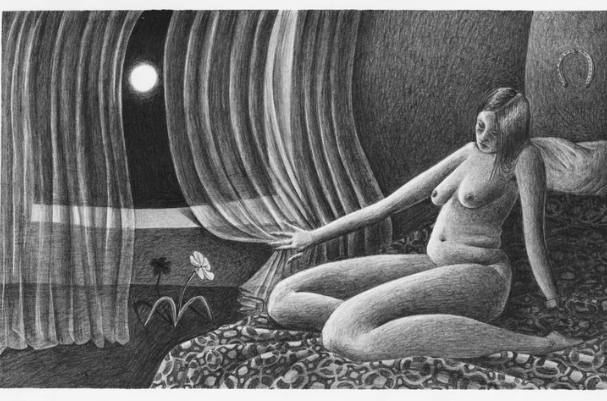
Una persona sola en un cuarto. Alguien duerme, o finge dormir; se descalza, se despoja de la ropa, deja caer una mano sobre la manta, corre una cortina. Vermeer alumbró el mundo desde ahí, Bonnard propuso lo propio. Todavía hoy, cuando casi nada de lo que ocurre en esos cuartos permanece en ellos, porque la imagen de lo íntimo circula en pantallas como moneda corriente, la escena conserva la gracia propia del mínimo misterio. Acaso porque en ella confluyen, sin avisar, las cosas más comunes y más difíciles de pensar: el cuerpo que somos, la casa que hacemos, la mirada de los otros que dejamos fuera o permitimos entrar, la memoria con que tapizamos lo que nos rodea. Cualquier lector, lo sepa o no, ha pasado por ahí; cualquiera ha debido decidir alguna vez qué parte de sí cabía en un cuarto y cuál no.
Este es el territorio de Hannah Motzel Brown. De los bolígrafos pasó al grafito, y del grafito al portaminas. Lo más cómodo sería despachar sus dibujos con el vocabulario que su propio circuito de difusión le ofrece: intimidad, quietud, delicadeza, empatía. La prensa dizque especializada la ha etiquetado, desde luego, bajo el rótulo del feminismo, a partir de lo cual se puede seguir con el rollo de emancipación del cuerpo, reapropiación de la mirada, denuncia de la presión estética, celebración de la sororidad y largo etcétera. Pero de ser así de reducible, la obra no cuestionaría nada. Dejaremos de lado la jerga que funciona como certificado de corrección política. Una obra reducida a ejemplo de una causa ha dejado de ser pregunta para convertirse en respuesta, y sobre ello ya hemos dicho que ninguna obra lo es sin dejar de ser arte en sentido estricto.
El trabajo de la artista no versa sobre una identidad, sino sobre la institucionalidad mínima de la persona: sobre cómo un sujeto de carne y hueso, a la escala más pequeña de su mundo (una piel, una manta, una cortina, un recuerdo), construye, habita y gestiona fronteras blandas entre lo que es y lo que lo rodea; asimismo, muestra que lo femenino funciona ahí como caso concreto a través del cual se discuten conceptos universales, no como esencia que la obra se limite a confirmar.
La vivencia, la sensibilidad, el sentir, es necesaria como canal de la creación, aunque insuficiente como fin, pues la obra que se queda en ella cae en el idealismo de la queja emocional y no pasa a confrontar categorías. El riesgo es real y así lo revelan títulos como Crying Girl o Love Note, que parecen ofrecer, a primera vista, justamente lo que el público quiere hallar, la emoción de fácil identificación. La cuestión decisiva, entonces, es si el dibujo detiene la vivencia en su documentación o la hace pasar por los otros géneros de materialidad, el corpóreo del grafito y el abstracto de las relaciones de luz y de forma. Sí, y esa travesía es la que permite hablar de poética y no de simple estética, es decir, de producción racional de un efecto y no de mera impresión sensible.
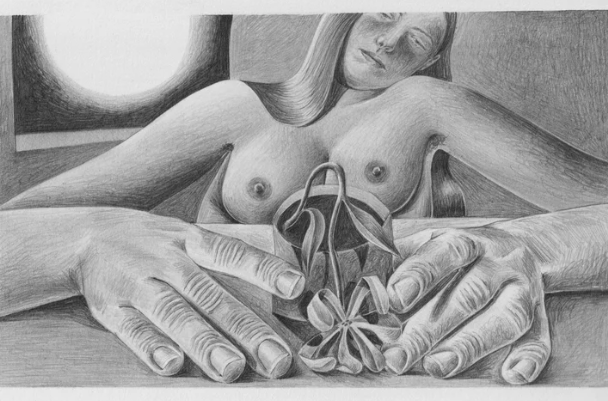
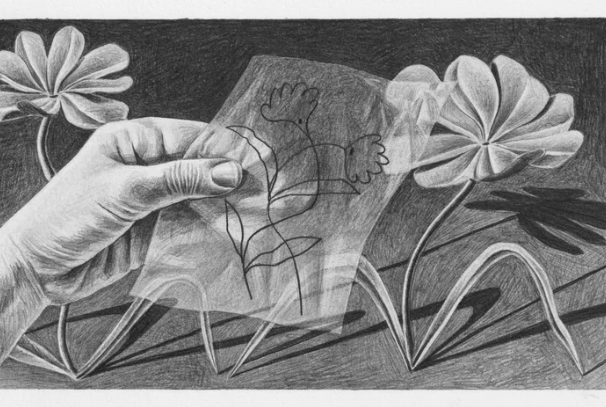
La obra se sirve del repertorio simbólico más consolidado de la tradición, el que emparenta a la mujer con la naturaleza, con la flor, con la ofrenda, con la pureza y la seducción, y lo hace sin renunciar al poder de atracción que ese repertorio conserva. Pieles junto a pétalos, cortinas hiper livianas; y títulos como Dark Flower o Every Bloom Is a Prayer alientan la lectura más trillada. Pero no basta con dibujar una mujer entre flores para hacer arte, ni basta con volver crudo el trazo para proclamar una ruptura. Lo que distancia a esta obra de la mera iteración del idilio es que la flor no cubre el cuerpo: convive con él en igualdad de materia, y ese cuerpo viene con su historia a cuestas, con las pecas, cicatrices, rasguños, rubor, y la sangre que sube a la superficie, todo vertido en gamas de gris: hecho sombra. Al introducir imperfecciones, el dibujo desmonta la identidad de lo femenino con lo puro y lo inmutable sin caer, y esto es importante, en el extremo opuesto, el de la reducción constructivista que disuelve el cuerpo en puro discurso.
Que la propia artista no se dé por cerrada en lo femenino confirma esta lectura. Es clara la evolución de su trabajo, que pasa de la impronta de la femineidad al abordaje de temas más neutros, por decirlo de algún modo, aunque mediante los mismos elementos de composición.
Cabría decir que, en todo caso, la piel es el tema central, y es un tema de frontera. Se trata del lugar en que el cuerpo deja de ser cuerpo y empieza a ser mundo, la membrana por la que la materia corpórea se vuelve sensible y se deja leer según relaciones abstractas de claridad y de pliegue. Que el psicoanálisis hablara en su momento del yo-piel, de la envoltura psíquica que contiene al sujeto, no nos obliga a ningún psicologismo; basta advertir que la obra, por vías propias, llega a lo mismo que cualquier materialismo bien entendido, a saber, que la persona no es una sustancia aislada que habita un cuerpo, sino una institución social cuyos bordes se negocian constantemente. La muestra Personal Record lo dice con doble sentido, probablemente sin proponérselo: récord es registro, archivo, lo que la piel conserva de cuanto le ha pasado, y es también marca atlética, el esfuerzo de superarse a sí mismo. En un caso y otro, el cuerpo aparece como aquello que acumula y como aquello que se entrena; y ambos sentidos encuentran, como veremos, su equivalente exacto en el modo de trabajar.
Kenneth Clark estableció en su momento la distinción canónica entre el desnudo como forma ideal, que la tradición europea fue consagrando, y el cuerpo sin vestido a secas; John Berger, por su parte, la radicalizó al señalar que estar desnudo es ser uno mismo, mientras que ser desnudo es ser visto como objeto por los demás. La obra de Hannah Motzel Brown se despliega en el hiato entre ambas visiones, no como ofrecimiento, sino como estado de cosas. La dibujante combina ambos extremos y los coloca a un tiempo en un cuerpo, el de la mujer, que habitualmente era su objeto y no su sujeto, para más INRI el suyo propio, lo cual disuelve la oposición entre quien mira y quien es mirado.
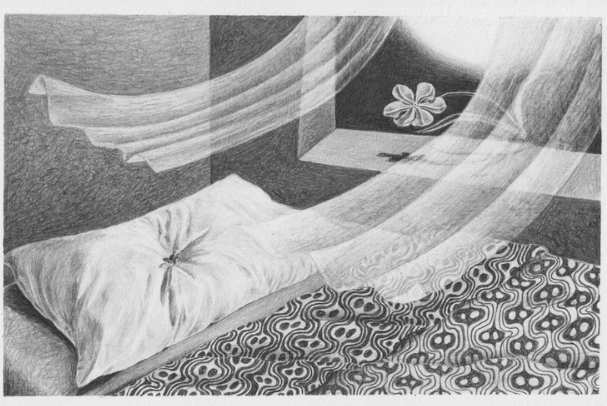
Si algo atraviesa los títulos es la insistencia en el hogar y sus adyacencias. La obra desmiente la naturalización del hogar como cuna natural de la comodidad; de hecho, parece afirmar que quien habita las imágenes puede hacer un hogar con cualquier cosa. Si el hogar se hace, no es dado; si se hace con cualquier cosa, una manta, un campo de margaritas, un patrón que vibra, no le pertenece a ninguna esencia. La casa que aquí aparece es, entonces, una institución portátil y mínima, elaborada con operaciones concretas, y por eso mismo frágil: cortinas que se corren, telas livianas, un sueño de siesta bajo el sol.
De ello, pasamos a la desacralización. Por un lado, se traslada lo sagrado de la institución eclesial, con sus liturgias y sus dogmas, a la escala de la persona, de modo que el culto deja de ser una institución pública para convertirse en gesto privado, el de atender. Por otro, la idolatría se vuelve pregunta: ¿quién es el ídolo y quién su adorador? La mujer ha sido, durante siglos, el ídolo por excelencia, objeto de culto estético y erótico; pero también la persona que dibuja se rinde ante la luz sobre un vaso, por ejemplo, es decir, ante un mundo que desborda sus conceptos. Es lo que hemos llamado belleza: un fenómeno que rebasa las categorías del sujeto y produce un asombro cuestionador, no una mera impresión sensible.
Por otra parte, la insistencia en el sueño, la siesta, la noche, el sonambulismo, el descenso, ubica a las figuras en momentos en que la gestión que la persona hace de sí misma se suspende o se afloja y asoma lo que queda al margen del orden construido. De entre todas las figuraciones posibles del interior femenino, la obra escoge con frecuencia la del pensar, no la del esperar ni la del seducir, de modo que la figura pasa de objeto de contemplación a sujeto de intelección, que es, en nuestra definición, el modo de estar del autor y del receptor ante la obra.
Si reunimos estos ejes, aparece una figura común. Piel, tela, cortina, pétalo, vidrio, patrón, sueño, recuerdo: todo cuanto la obra dibuja con más cuidado es membrana, límite blando entre un adentro y un afuera. La obra no ofrece, entonces, una imagen de la identidad femenina, sino un inventario de los dispositivos con que una persona maneja sus bordes. Lo que el dibujo hace es ponerlas a todas, por un momento, a la misma altura, en una misma superficie, y mostrar que ninguna es natural. Precisamente por eso, y no por lo que dice de la mujer, resulta una crítica del orden institucional más general. Veamos cómo…
Hannah trabaja sobre papel con grafito, y de modo característico con portaminas, avanzando de minas duras a minas blandas. Antes del grafito empleó el bolígrafo, de línea irrevocable. Ambos medios comparten una condición: no admiten el gesto desbordado. La mina del portaminas deja una línea uniforme, impersonal, que enfría la mano del dibujante; el bolígrafo no se borra. Se trata de instrumentos de acumulación lenta, donde el efecto se construye grano a grano, y ese proceder constituye la preparación racional que permite luego entregarse, sin cálculos explícitos, a la zona de tiro: el ataque del motivo.
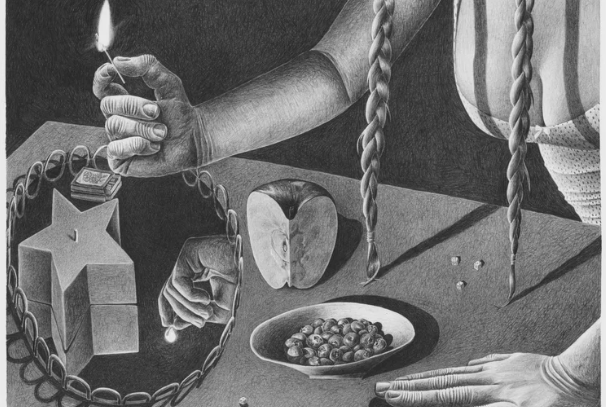
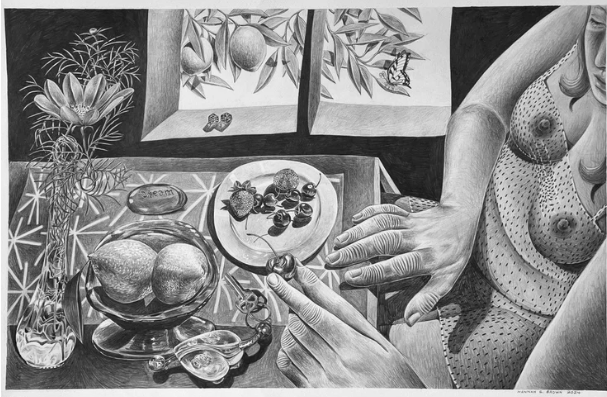
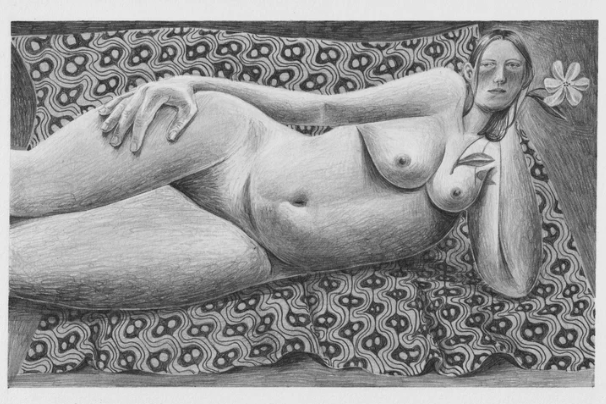
El grisalla, o más exactamente el trabajo en escala de grises, da un segundo paso en la misma dirección. Es una operación de dos extremos y una mediación continua: una gradación ordenada de valores, una relación abstracta que organiza la obra al margen de toda psicología. Pero la renuncia al color tiene además un efecto temático. Al traducir lo cromático a lo tonal, el dibujo sustrae la identificación inmediata y atractiva que el color ofrece y obliga a leer el cuerpo como estructura de luz y de pliegue, no como etiqueta; tal abstracción, lejos de empobrecer la figura, la despoja del lenguaje de la piel como signo social para devolverla a su condición de materia que recibe y rechaza luz, como las articulaciones de los dedos, que, según la crítica, atrapan y rechazan la claridad como lo hacen los vestidos arrugados.
La igualdad de factura, el modo en que todo es tratado con la misma mano y la misma textura de grafito, podría leerse como indiferenciación, como una especie de monismo de la superficie en que todo da igual; pero las diferencias de comportamiento de la luz, los pliegues que atrapan o rechazan claridad, desmienten esa lectura. La homogeneidad de la factura declara más bien la continuidad entre la persona y las instituciones que la envuelven. El cuerpo no está dentro de la casa, de la ropa, del rito: es, en buena medida, la casa, la ropa y el rito.
Atención al detalle…
[Todas las imágenes, del sitio Web de la artista: https://www.hbrowndesigns.com/ ]
(ENGLISH VERSION)
Soft and Fragile Border: An Approach to the Work of Hannah Motzel Brown
Translation by Tiffany Amber Elías Trimble
A person alone in a room. Someone sleeps, or pretends to sleep; takes off their shoes, strips off their clothes, lets a hand fall on the blanket, draws a curtain. Vermeer illuminated the world from there, Bonnard proposed the same. Even today, when almost nothing of what happens in those rooms remains in them, because the image of the intimate circulates on screens as common currency, the scene preserves the grace proper to the minimal mystery. Perhaps because in it converge, without warning, the most common and most difficult things to think: the body that we are, the house that we make, the gaze of others that we leave outside or allow to enter, the memory with which we tapestry what surrounds us. Any reader, whether they know it or not, has passed through there; anyone has had to decide at some point what part of themselves fit in a room and what did not.
This is the territory of Hannah Motzel Brown. From ballpoint pens she moved to graphite, and from graphite to mechanical pencil. The easiest thing would be to dismiss her drawings with the vocabulary that her own circuit of diffusion offers: intimacy, stillness, delicacy, empathy. The supposedly specialized press has labeled her, of course, under the rubric of feminism, from which one can continue with the whole routine of emancipation of the body, reappropriation of the gaze, denunciation of aesthetic pressure, celebration of sorority, and so on and so forth. But if it were that reducible, the work would question nothing. We will set aside the jargon that functions as a certificate of political correctness. A work reduced to an example of a cause has ceased to be a question and become an answer, and on this we have already said that no work is one without ceasing to be art in the strict sense.
The artist’s work does not deal with an identity, but with the minimal institutionality of the person: with how a subject of flesh and blood, at the smallest scale of their world (a skin, a blanket, a curtain, a memory), constructs, inhabits, and manages soft borders between what they are and what surrounds them; likewise, it shows that the feminine functions there as a concrete case through which universal concepts are discussed, not as an essence that the work merely confirms.
Lived experience, sensibility, feeling, is necessary as a channel of creation, though insufficient as an end, since the work that remains in it falls into the idealism of emotional complaint and does not go on to confront categories. The risk is real and titles like Crying Girl or Love Note reveal it, titles that seem to offer, at first sight, precisely what the public wants to find, the emotion of easy identification. The decisive question, then, is whether the drawing halts lived experience in its documentation or makes it pass through the other genres of materiality, the corporeal of graphite and the abstract of relations of light and form. Yes, and that crossing is what allows speaking of poetics and not of simple aesthetics, that is, of rational production of an effect and not of mere sensory impression.
The work avails itself of the most consolidated symbolic repertoire of tradition, the one that links woman with nature, with the flower, with the offering, with purity and seduction, and does so without renouncing the power of attraction that this repertoire preserves. Skins next to petals, hyper-light curtains; and titles like Dark Flower or Every Bloom Is a Prayer encourage the most trite reading. But it is not enough to draw a woman among flowers to make art, nor is it enough to make the stroke raw to proclaim a rupture. What distances this work from the mere iteration of the idyll is that the flower does not cover the body: it coexists with it in equality of matter, and that body comes with its history on its back, with freckles, scars, scratches, blush, and the blood that rises to the surface, all poured into ranges of gray: made shadow. By introducing imperfections, the drawing dismantles the identity of the feminine with the pure and the immutable without falling, and this is important, into the opposite extreme, that of the constructivist reduction that dissolves the body into pure discourse.
That the artist herself does not consider herself closed within the feminine confirms this reading. The evolution of her work is clear, passing from the imprint of femininity to the approach of more neutral themes, so to speak, though by means of the same elements of composition.
It could be said that, in any case, skin is the central theme, and it is a border theme. It is the place where the body ceases to be body and begins to be world, the membrane through which corporeal matter becomes sensitive and lets itself be read according to abstract relations of clarity and fold. That psychoanalysis spoke in its time of the skin-ego, of the psychic envelope that contains the subject, obliges us to no psychologism; it is enough to note that the work, by its own paths, arrives at the same as any well-understood materialism, namely, that the person is not an isolated substance that inhabits a body, but a social institution whose edges are constantly negotiated. The exhibition Personal Record says it with a double meaning, probably without intending to: record is register, archive, what the skin preserves of all that has happened to it, and it is also athletic mark, the effort to surpass oneself. In one case and the other, the body appears as that which accumulates and as that which is trained; and both senses find, as we will see, their exact equivalent in the way of working.
Kenneth Clark established in his time the canonical distinction between the nude as ideal form, which the European tradition was consecrating, and the body without clothes plain and simple; John Berger, for his part, radicalized it by pointing out that being naked is being oneself, while being nude is being seen as an object by others. Hannah Motzel Brown’s work unfolds in the gap between both visions, not as an offering, but as a state of affairs. The drawer combines both extremes and places them at once in a body, that of woman, which was usually its object and not its subject, and to top it off her own, which dissolves the opposition between who looks and who is looked at.
If anything runs through the titles it is the insistence on the home and its adjacencies. The work contradicts the naturalization of the home as the natural cradle of comfort; in fact, it seems to affirm that whoever inhabits the images can make a home with anything. If the home is made, it is not given; if it is made with anything, a blanket, a field of daisies, a vibrating pattern, it belongs to no essence. The house that appears here is, then, a portable and minimal institution, elaborated with concrete operations, and for that very reason fragile: curtains that are drawn, light fabrics, a nap in the sun.
From this, we pass to desacralization. On one hand, the sacred is transferred from the ecclesiastical institution, with its liturgies and dogmas, to the scale of the person, so that worship ceases to be a public institution and becomes a private gesture, that of attending. On the other, idolatry becomes a question: who is the idol and who their worshipper? Woman has been, for centuries, the idol par excellence, object of aesthetic and erotic cult; but also the person who draws surrenders before the light on a glass, for example, that is, before a world that overflows her concepts. It is what we have called beauty: a phenomenon that exceeds the categories of the subject and produces a questioning astonishment, not a mere sensory impression.
On the other hand, the insistence on sleep, the nap, the night, somnambulism, descent, places the figures in moments when the management that the person makes of themselves is suspended or loosened and what remains on the margin of the constructed order emerges. Among all the possible figurations of the feminine interior, the work frequently chooses that of thinking, not that of waiting nor that of seducing, so that the figure passes from object of contemplation to subject of intellection, which is, in our definition, the mode of being of the author and the receiver before the work.
If we gather these axes, a common figure appears. Skin, fabric, curtain, petal, glass, pattern, dream, memory: everything that the work draws with most care is membrane, soft limit between an inside and an outside. The work does not offer, then, an image of feminine identity, but an inventory of the devices with which a person manages their edges. What the drawing does is place them all, for a moment, at the same height, on the same surface, and show that none is natural. Precisely for that reason, and not for what it says about woman, it results in a critique of the more general institutional order. Let us see how…
Hannah works on paper with graphite, and characteristically with mechanical pencil, advancing from hard leads to soft leads. Before graphite she used ballpoint pen, of irrevocable line. Both media share a condition: they do not admit the overflowing gesture. The mechanical pencil lead leaves a uniform, impersonal line, which cools the drawer’s hand; the ballpoint pen does not erase. These are instruments of slow accumulation, where the effect is built grain by grain, and that procedure constitutes the rational preparation that later allows surrendering, without explicit calculations, to the firing zone: the attack of the motif.
Grisaille, or more exactly work in grayscale, takes a second step in the same direction. It is an operation of two extremes and a continuous mediation: an ordered gradation of values, an abstract relation that organizes the work on the margin of all psychology. But the renunciation of color has additionally a thematic effect. By translating the chromatic into the tonal, the drawing subtracts the immediate and attractive identification that color offers and forces reading the body as a structure of light and fold, not as a label; such abstraction, far from impoverishing the figure, strips it of the language of skin as social sign to return it to its condition of matter that receives and rejects light, like the joints of the fingers, which, according to criticism, catch and reject clarity as wrinkled dresses do.
The equality of facture, the way in which everything is treated with the same hand and the same texture of graphite, could be read as undifferentiation, as a kind of monism of the surface in which everything is the same; but the differences in the behavior of light, the folds that catch or reject clarity, contradict that reading. The homogeneity of facture declares rather the continuity between the person and the institutions that envelop them. The body is not inside the house, the clothes, the rite: it is, to a good extent, the house, the clothes, and the rite.
Attention to detail…