
Máscaras sin rostro: Sobre la desaparición del actor, el ídolo sintético y la institución de la fama
Por Juan Pablo Torres Muñiz
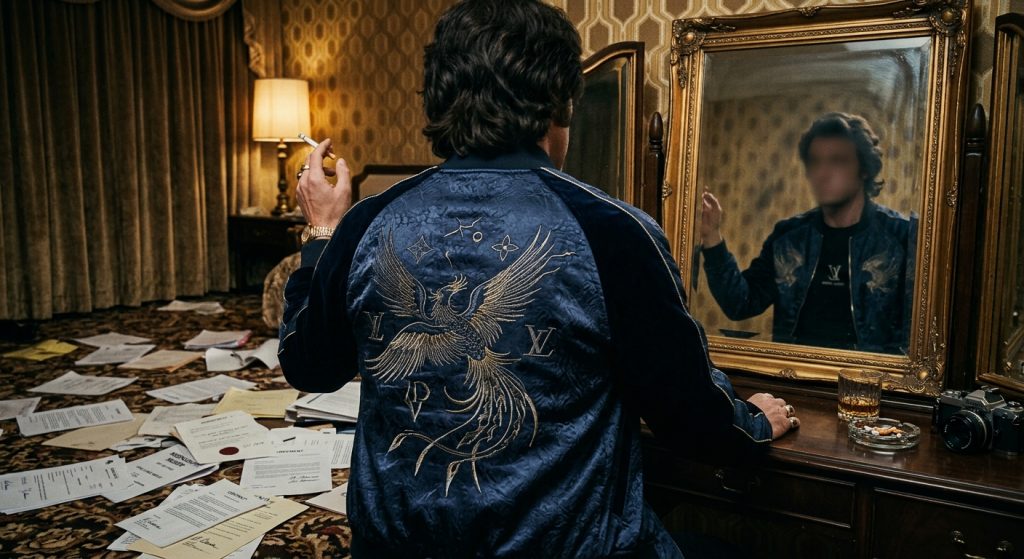
Una joven de veintiún años, ataviada de Huang Rong —la heroína de las novelas de artes marciales de Jin Yong—, se detiene ante los teléfonos de los turistas en los estudios de Hengdian, en la provincia china de Zhejiang. Hasta hace poco habría estado rodando microdramas en esos mismos platós; pero el género de los microdramas con actores de carne y hueso se ha hundido bajo una marea de series generadas por inteligencia artificial, y ella, como otros jóvenes intérpretes, ha vuelto a la forma más antigua del oficio: presente ante gente también presente, como se decía: en carne y hueso.
A varios miles de kilómetros, en Seúl, un recuento publicado en octubre de 2026 sostiene que, de los cincuenta y cinco ídolos —grupos y solistas— que debutaron entre enero y ese mes, trece eran virtuales (Korea Daily, 2026); cifra de elaboración propia de su autor, que conviene tomar como indicio y no como censo. Y aun los más célebres entre ellos no son, en rigor, máquinas, sino máscaras: el grupo PLAVE lo forman cinco intérpretes anónimos que cantan y bailan bajo avatares animados en tiempo real (Korea Times, 2025). En la India, en fin, un actor llamado Dhanush vio reestrenarse en agosto de 2025 una película suya de 2013 con un desenlace distinto: el personaje que moría, vivía, por obra de una intervención de IA que la productora defendió como legítima y que el actor denunció como contraria a su voluntad, aunque la empresa sostuvo que ninguna objeción formal le había sido comunicada (Variety, 2025; Hollywood Reporter India, 2025).
Nso vemos ante la separación del rostro respecto de la persona y su puesta a disposición de quien paga.
Durante cerca de un siglo, una profesión entera —la del actor de cine y televisión, a la que en las dos últimas décadas se ha sumado la del influencer— ha encarnado en nuestras sociedades la fama, el glamour y el carisma. Sus miembros más conspicuos fueron convertidos en ídolos de alcance planetario; se les encomendó vender jabones, automóviles, bancos y causas; y, por una deriva visible desde el último tercio del siglo XX, se les concedió además la condición de portavoces ideológicos y políticos, con una frecuencia que invita a sospechar de la estructura antes que de las personas. Que ese rubro empiece a ser sustituido por figuras diseñadas con inteligencia artificial suele despacharse como anécdota tecnológica o asunto laboral —¿cuántos empleos?, ¿cuánta compensación?— o, peor, como frivolidad farandulesca. Un mayor detenimiento permite descubrir que lo que se ventila es la suerte de una institución, la de la persona en su forma pública, y con ella la de una sociedad entera habituada a mirarse en rostros ajenos para saber cómo se vive, cómo se ama, cómo se envejece y qué se debe desear.
Toca preguntarse, por tanto, qué significa que actores e influencers reales sean reemplazados por personajes sintéticos: no solo qué hechos documentados autorizan a hablar de desaparición —y cuáles obligan a matizarla—, sino qué se pierde, qué se revela y qué se instala en su lugar.
Para tratar la cuestión conviene partir de las palabras: bien entendidas, apuntan adonde se debe por sí solas. Actor viene del latín actor, «el que impulsa, el que lleva a cabo», derivado de agere; el griego, que no tuvo esa raíz, nombraba al intérprete con otra más inquietante: hypokritḗs, el que responde, el que da la réplica y, por extensión, el que finge, de donde nuestro «hipócrita» (RAE y ASALE, 2014). Más reveladora aún es persona, que el latín tomó para designar la máscara del actor y, por extensión, el personaje, y que el diccionario académico remite, con cautela, a un posible origen etrusco (phersu) (RAE y ASALE, 2014); la etimología popular que la hacía derivar de per-sonare, «sonar a través» de la máscara, es hermosa, pero indemostrada. La persona no es un dato biológico sino una institución: la categoría jurídica, moral y política con que una comunidad reconoce a un sujeto, y que, como todo artefacto, remite a las operaciones que la producen. Que el vocablo nazca en el escenario no es casual. La persona fue, desde el principio, un rostro instituido, un papel con efectos sociales que se lleva y se deja: la máscara no es lo opuesto de la persona, sino su origen.
Ídolo procede del griego eídōlon, «imagen», «apariencia», «fantasma», y Platón lo emplea en el Sofista para la copia que aparenta lo que no es. Nótese el dato: el ídolo es, por etimología, un simulacro de persona, de modo que el ídolo sintético no desvirtúa el término sino que lo devuelve a su sentido primero. Carisma viene del griego chárisma, «don gratuito», «gracia», y fue Max Weber quien, tomándolo del léxico paulino, lo convirtió en categoría sociológica: la cualidad extraordinaria que se atribuye a una persona y en virtud de la cual se la tiene por dotada de fuerzas inaccesibles a los demás; pero Weber advertía también que el carisma es inestable por naturaleza y tiende a rutinizarse, esto es, a institucionalizarse (Weber, 2014). Glamour, en cambio, es palabra de mago: variante escocesa de gramarye, «encantamiento», alteración de grammar en el sentido medieval de saber oculto de los letrados, popularizada por Walter Scott, y que como «encanto seductor» asociado a Hollywood y a la alta costura está documentada hacia 1939 (Harper, s. f.). Fama, en fin, viene del latín fama, «lo que se dice», emparentada con fari, «hablar» (RAE y ASALE, 2014): la fama es, desde el origen, algo que se dice de alguien y no algo que alguien es. Gracia, hechizo y rumor: tres palabras que, puestas juntas, confiesan lo que la industria del espectáculo ha tardado un siglo en disimular, a saber, que se trata de una fabricación de efectos.
La teoría del cine y de la cultura ha estudiado ese dispositivo con minuciosidad. Edgar Morin vio en la estrella un híbrido de divinidad y mercancía, un «olímpico» moderno que la industria fabrica y la audiencia adora (Morin, 1957); Richard Dyer la analizó como texto social, una imagen construida que encarna valores ideológicos de su época y los vuelve deseables (Dyer, 1998); Daniel Boorstin, con ironía célebre, definió al famoso moderno como alguien conocido por ser conocido, pseudoacontecimiento hecho persona (Boorstin, 1992); P. David Marshall sostuvo que la celebridad es una forma de poder cultural que legitima, para la sociedad capitalista, el ideal de la individualidad y organiza los afectos de las audiencias (Marshall, 1997); y Chris Rojek distinguió entre la fama adscrita, la lograda y la atribuida, esta última fabricada por intermediarios culturales (Rojek, 2001). Mucho antes, en 1936, Walter Benjamin había advertido que el actor de cine, privado del público ante el que se mide el de teatro, actúa ante un aparato, y que, para compensar la pérdida del aura, el capital cinematográfico fomenta el culto a la estrella, que no conserva el aura de la persona sino el «hechizo de la personalidad», encanto falso de una mercancía.
El término turbo-capitalismo fue acuñado por Luttwak (1999) para describir un capitalismo desregulado y acelerado por la globalización, y que aquí empleamos, como en otros textos, para nombrar la fase en que la mercantilización alcanza hasta la identidad y el afecto.
Una última precisión terminológica. Por figura sintética entenderemos aquella cuyo rostro, voz o conducta es producido por modelos generativos y no por la actuación de una persona identificable ante una cámara; por avatar o virtual, la figura animada por un intérprete humano mediante captura de movimiento, que mantiene a una persona detrás. La distinción importa, porque entre PLAVE y una «actriz» generada de principio a fin media la misma distancia que entre una máscara y un molde.
La sustitución de actores e influencers por figuras sintéticas es real, está documentada y avanza desde la base de la pirámide hacia su cúspide. Decimos «sustitución» y no «desaparición» a sabiendas. Nada autoriza, a octubre de 2026, a afirmar que el actor humano se haya extinguido; sí, a afirmar que el rubro —entendido como la ocupación masiva y relativamente estable de miles de intérpretes que vivían de la pantalla, escalonados desde el figurante hasta la estrella— viene siendo desmontado por su extremo inferior, y que el desmontaje es lo bastante rápido como para que su efecto sobre la cúspide deje de ser una hipótesis. La causa es contable: el intérprete es el elemento más caro, más lento y menos escalable de una cadena de producción audiovisual, y un modelo generativo permite producir sin él y a una fracción del coste. Donde la ecuación pesa más —formatos breves, repetitivos, de margen estrecho— el reemplazo llega primero, y llega por abajo, porque es en el extremo inferior donde el rostro individual importa menos al comprador y donde el intérprete carece de sindicato, de agente y de nombre que defender.
China ofrece el caso más nítido. Según la Asociación China de Servicios de Radiodifusión en Red, en el primer trimestre de 2026 se estrenaron unos 128.000 microdramas, más del 95 % de ellos generados íntegramente por IA, frente a una cifra cercana a cero un año antes (Ang, 2026; Tang, 2026). Ahora bien, la cifra cuenta títulos, no horas vistas ni empleos perdidos, y la agencia CNA subrayó que se refiere a obras producidas sin cámaras ni actores, no a las producciones convencionales que usan IA para el guion, los efectos o el doblaje (MLQ.ai, 2026). Pero, según informó la televisión estatal CCTV, hacia julio los cachés de los protagonistas habían caído más de un 50 %, los de los actores intermedios más de un 80 %, y el jornal de los figurantes había descendido a dos cifras (Global Times, 2026). En Hengdian, donde actores como Cheng Qiao llegaban a cobrar entre ochocientos y mil quinientos yuanes diarios (Guan, 2026), los estudios se vacían; Chris Shaw, de la Puttnam School of Film and Animation del Lasalle College de Singapur, declaró a Fortune que muchos actores y estudios se habían esfumado de pronto (Ang, 2026). Una serie de sesenta episodios que costaba entre 500.000 y 600.000 yuanes con actores vivos puede obtenerse por unos 200.000 con IA (Tang, 2026), y algunas empresas de Hangzhou generan dramas de cien minutos por menos de 20.000 (Ang, 2026, citando a Caixin). La ecuación, como se ve, no deja margen a la nostalgia.
El fenómeno desborda el microdrama y, desde luego, China. La televisora hongkonesa TVB estrenó en septiembre de 2025 You, and Only You, la primera serie del territorio con personajes generados por IA, y ya emplea a sus actores virtuales en campañas publicitarias; Singapur celebró en 2026 su sexagésimo primer cumpleaños nacional con dos películas, Bersama Majulah y Trace Project, en las que, salvo el guion, todo —incluidos los intérpretes— fue generado por IA; y la plataforma iQiyi, fundada para ofrecer contenidos de autoría humana, anunció en abril de 2026 que se reconvertía en una red social de contenidos generados por IA (Ang, 2026). En Corea, el recuento que citábamos al comienzo ubica en 2026 un año de inflexión en la virtualización del idol (Korea Daily, 2026), y el trabajo de Rest of World añade lo que el brillo del espectáculo suele ocultar: los idols virtuales gozan de horarios más holgados pero de menos protecciones laborales, pues sus identidades y sus contratos están envueltos en secreto, y la asimetría de poder con las agencias puede ser todavía mayor que la de los idols humanos (Rest of World, 2025).
En el terreno del influencer, el hito es el del 15 de junio de 2025, cuando Luo Yonghao, una de las grandes figuras de la venta en directo en China, presentó en la plataforma Youxuan de Baidu un doble digital suyo y otro de su coanfitriona, entrenados con cinco años de transmisiones; según Baidu y la prensa que la reseñó, la sesión superó los trece millones de visionados y generó ventas de 55 millones de yuanes, muy por encima de la sesión humana del mes anterior (SAYS, 2025; Baidu, 2025). El propio Luo reconoció que el efecto de su doble lo había asustado (SAYS, 2025). Es el doble de un humano que lo autoriza. El otro extremo, la influencer enteramente inventada, se organiza por otras vías: el 31 de agosto de 2026, Instagram renombró su etiqueta a «perfil generado por IA» y anunció que limitaría el alcance de las cuentas con personas sintéticas que no la adopten (Unite.AI, 2026), y en la India un informe sectorial, cuya metodología no hemos podido verificar, afirma que los creadores de IA de gama media compiten ya con los humanos por los mismos presupuestos de marca (BuzzInContent, 2026). Las cifras de mercado que circulan para 2026 oscilan, según el informe, entre unos ocho y unos cuarenta y seis mil millones de dólares (YouMind, 2026; Creatives Takeover, 2026; Today News Week, 2026); esa dispersión de casi seis veces delata propaganda sectorial y no estadística. La tendencia es cierta; su tamaño, nos es desconocido.
En Hollywood, que es la sede simbólica del fenómeno aunque no su epicentro, el episodio emblemático es el de Tilly Norwood, personaje generado por la productora londinense Particle6. El 30 de septiembre de 2025 el sindicato SAG-AFTRA declaró que «Tilly Norwood» no es una actriz, sino un personaje generado por un programa entrenado con el trabajo de incontables intérpretes sin permiso ni compensación (SAG-AFTRA, 2025; TechCrunch, 2025); en julio de 2026, su creadora anunció una película, Misaligned, en la que encabezará el reparto (CBS News, 2026). El contrato colectivo 2026-2030, ratificado el 4 de junio de 2026 por el 91,42 % de los votos, con una participación del 19,25 %, consagra que los productores no tienen la intención de emplear un sintético en un papel humano salvo que aporte «valor añadido significativo» (SAG-AFTRA, 2026; Deadline, 2026); según informes, las partes no pactaron una definición de la expresión (Pebblous, 2026). Quien conozca la historia de los contratos sabrá que una excepción sin definición es, en la práctica, una puerta con la cerradura por dentro.
El reemplazo avanza porque el intérprete se ve empujado a vender su propio doble. Lo que se presenta como consentimiento es las más de las veces capitulación. Cuando el trabajo escasea, el activo que queda es el rostro, y éste, a diferencia del trabajo, puede alquilarse sin presencia. Pero un activo cuya oferta se multiplica pierde precio; quien lo vende hoy contribuye a abaratarlo mañana. La evidencia china es elocuente. A la actriz Dai Zongqi, de treinta y tres años y con currículo, un director de casting le ofreció 500 yuanes por una licencia de un año para usar su cara en microdramas de IA; ella hizo la cuenta en público, cuarenta y dos yuanes al mes, algo más de uno al día, y se preguntó si, de venderla, llegaría a reconocerse en pantalla (Tang, 2026). Según un agente de casting de Shanghái, las tarifas habituales por proyecto y sin exclusividad van de 500 a 1.500 yuanes para rostros desconocidos y de 3.000 a 5.000 para actores de segunda fila o influencers, y 10.000 yuanes compran cincuenta rostros a la vez, para un solo drama y con derechos perpetuos; su consejo a los recién llegados es vender pronto, porque, cuando el mercado tenga suficientes caras, los precios caerán (Tang, 2026). Otra intérprete lo resumió con una frase que merece placa: antes se les pagaba por hora; ahora, por píxel (Tang, 2026).
En la cúspide, la misma operación se parece a un negocio entre iguales: la actriz Joey Wang —Wang Zuxian—, retirada desde 2004, licenció en julio de 2026 su imagen digital de los veinte y los treinta años a un videojuego de NetEase, por tres años y, según la prensa, por una suma de siete cifras, y Qi Wei prestó la suya en agosto a una serie animada con IA (Tang, 2026). Nótese la inversión: lo que se alquila no es una actuación, sino una edad, la juventud de una cara fijada para siempre. En Japón, la agencia Aoni Production anunció en 2024 una alianza con la empresa CoeFont para crear versiones de IA de las voces de sus intérpretes, entre ellas la de Masako Nozawa, voz de Goku, para usos «no actorales»; menos de un mes después, veintiséis actores de doblaje, entre ellos Kōichi Yamadera y Ryūsei Nakao, fundaron el movimiento «No More Mudan Seisei AI» contra el uso no autorizado de sus voces, que reunió, en su campaña de financiación, más de tres veces su meta inicial de diez millones de yenes con 907 aportantes (Japan Today, 2024; Anime News Network, 2024). La reacción japonesa se centra, adviértase, en lo no autorizado y no en el principio de la réplica de voces, lo que revela hasta qué punto el consentimiento se ha convertido en el campo de batalla. En octubre de 2026, el sindicato japonés de actores ha elaborado guías para el uso de IA generativa, y se informa de que tanto un panel del Ministerio de Justicia como un tribunal han afirmado que la voz del actor está protegida por el derecho a la propia imagen (Anime News Network, 2026).
Por eso importa distinguir entre libertad contractual y libertad en el sentido de la tesis del Homo Institutionalis: no la ausencia de normas, sino la capacidad de criticar y transformar las condiciones en que se opera. La intérprete que firma un contrato de adhesión redactado por quien le ofrece la única fuente de ingresos disponible no ejerce su libertad; se somete. Los propios actores lo saben: en la India, un intérprete de Bollywood, que pidió el anonimato, comparó los contratos entre artistas y productores con guiones de terror, en los que los derechos pertenecen por entero al productor (BOOM, 2025); y en Hengdian, la abogada consultada por The World of Chinese advierte que una sola cláusula vaga puede dejar un rostro disponible para cualquier uso, en cualquier lugar, para siempre, y que casi ningún figurante tiene ni abogado ni poder para exigir mejor texto (Tang, 2026). El intérprete se vuelve así accionista de su propia sustitución.
El cuadro occidental repite la estructura, aunque con mejores modales. Cuando OpenAI puso en circulación Sora 2, a finales de septiembre de 2025, la voz y la imagen de Bryan Cranston pudieron generarse en algunos resultados sin su consentimiento ni compensación, y la empresa hubo de corregir el rumbo veinte días después mediante un comunicado conjunto con el sindicato SAG-AFTRA y las agencias CAA y UTA, que reafirmó un régimen de aceptación previa (SAG-AFTRA et al., 2025). Nótese el orden de los factores: primero se tomó, luego se pidió permiso. Que el actor más célebre de su generación necesitara un sindicato, tres agencias y la cortesía de un directivo para recobrar el control de su cara dice poco bueno de lo que aguarda al figurante sin sindicato de Hengdian. Y el convenio de 2023, que puso fin a una huelga de ciento dieciocho días, había fijado ya la lógica que hoy se generaliza: el estudio puede crear réplicas digitales de los intérpretes siempre que medien consentimiento informado y compensación (Reuters, 2023). El derecho, entonces, no impide el reemplazo, apenas determina los términos de su tarifa.
Cabría esperar que la ley, al menos, devolviera el rostro a su dueño. Dinamarca lo intenta: el 8 de octubre de 2026 su Gobierno presentó ante el Parlamento un proyecto que prohibiría difundir imitaciones digitales realistas del rostro, la voz o los movimientos de una persona sin su consentimiento, y que espera entrar en vigor el 1 de enero de 2027 (Min, 2026). Es la medida más audaz de cuantas conocemos. Al tramitarse como reforma de la ley de propiedad intelectual, el rostro queda dentro de una categoría de bienes que se ceden y se licencian, mientras que los derechos de la personalidad son, por naturaleza, inalienables; la crítica de varios juristas apunta precisamente a esa torsión (Project Liberty, 2026). Protegemos la cara convirtiéndola en propiedad, y lo que es propiedad tiene precio y tiene mercado. La defensa corre así el riesgo de consumar lo que pretende evitar.
La fama fue siempre una prótesis del capital, el modelo generativo no la corrompe; por el contrario, la eleva a su culmen. El cine de estudio descubrió pronto que lo que vendía no era una película sino un rostro…, perecedero, caprichoso y propiedad de quien lo llevaba, y que el negocio consistía en resolver ese triple inconveniente mediante contrato. Así nació la persona de estudio: un intérprete atado por siete años, cuyo nombre, biografía, peinado, matrimonios y opiniones administraba el departamento de publicidad (Schatz, 1996). Olivia de Havilland, que demandó a Warner Bros. en 1943 para que su contrato no se alargara con los períodos de suspensión, vio confirmado en 1944 por la corte de apelaciones de California el límite de siete años (De Havilland v. Warner Bros. Pictures, Inc., 1944); la anécdota importa menos por el triunfo que por lo que revela: la estrella más cotizada necesitó un tribunal para poder irse.
Seamos claros: el estudio poseía lo que importaba de la persona y arrendaba lo que sobraba. El cuerpo era un insumo que había que alimentar, peinar y retocar; la vida psíquica era un guion de «personalidad» redactado por publicistas; el sistema de criterios residía en el contrato, en el derecho de imagen y en la costumbre de la industria. Benjamin vio el mecanismo con admirable precisión en 1936: el culto a la estrella no conserva el aura de la persona, sino el «hechizo de la personalidad», encanto falso de una mercancía. La persona de estudio es, por tanto, un artefacto con una pieza viva dentro, y el capital lo sabía: de ahí el empeño en cercar esa pieza.
La plataforma heredó el esquema y lo democratizó hacia abajo. El influencer es un estudio de una sola persona, que se produce, se publicita y se vigila a sí mismo; el material de su figura ya no es la biografía fabricada por publicistas, sino la correlación de datos que la plataforma extrae de su comportamiento y del de su audiencia: eso que hemos llamado persona de plataforma. El doble digital de Luo Yonghao muestra el eslabón siguiente: entrenada con cinco años de transmisiones, la persona de plataforma se desprende del hombre y vende sin él (SAYS, 2025). Estudio, plataforma, modelo: tres components de una misma operación, que consiste en separar de la persona lo que el mercado paga —la cara, la voz, la cadencia— y dejar atrás lo que el mercado soporta con dificultad: el cansancio, la edad, la enfermedad, el desacuerdo. El estudio de los años treinta habría firmado sin vacilar con una estrella que no envejeciera, no enfermara, no se casara con quien no debía y no discutiera el papel. Lo que hoy desaparece, entonces, no es una vocación, sino la última resistencia de la materia viva a una institución que siempre quiso prescindir de ella.
Un modelo generativo no inventa caras, hace más bien algo como destilarlas: aprende de millones de imágenes e interpretaciones y devuelve una media, y las medias, como mostraron Langlois y Roggman (1990), resultan en promedio más atractivas que la mayoría de los rostros individuales que las componen; la tecnología hereda así una ventaja estética de fábrica y, con ella, un sesgo hacia lo homogéneo. Ese material no es de nadie y es de todos: es el cuerpo colectivo de quienes actuaron, cantaron y posaron ante una cámara sin saber que harían de cantera. El sindicato SAG-AFTRA lo dijo sin rodeos al negar a «Tilly Norwood» la condición de actriz: es un personaje generado por un programa entrenado con el trabajo de innumerables intérpretes, sin permiso ni compensación (SAG-AFTRA, 2025). El caso de Dhanush muestra hasta dónde llega la expropiación: ni siquiera el personaje, esa porción de persona que el actor había compartido con el público, pertenece ya a quien se la dio (Variety, 2025).
Conviene mirar la escala completa, porque el fenómeno no es binario. En un extremo está Hatsune Miku, lanzada en 2007 por Crypton Future Media con muestras de voz de la actriz de doblaje Saki Fujita y con una imagen que la empresa abrió después al uso no comercial de sus aficionados; había allí una persona con nombre detrás de la voz y una coautoría declarada (Hatsune Miku, s. f.). En el medio está PLAVE, donde la máscara occulta, pero no suprime a quien la lleva. En el otro extremo, el de «Tilly Norwood» o el de las series de Hangzhou, nadie lleva nada. Lo decisivo no es lo artificial del producto, sino la posibilidad de que alguien responda por él.
Aquí la etimología trabaja de nuevo a nuestro favor. El griego llamó hypokritḗs al que responde, y Hobbes, en el Leviatán, recogió la vieja idea de que la persona es el actor que habla con palabras ajenas, mientras que el autor es quien las posee y responde por ellas: la máscara teatral explica el vínculo jurídico. En la persona de estudio el esquema funcionaba con dos piezas y un arbitraje: actor humano, autor corporativo, contrato entre ambos. En la figura sintética queda solo el autor, y éste es una sociedad mercantil: la persona jurídica actuando sin actor. Mauss reconstruyó el largo trayecto por el que la noción de persona pasó del papel ritual y del personaje a la conciencia moral y al yo que se sabe responsable (Mauss, 1971); la figura sintética lo recorre en sentido inverso, de vuelta al primer peldaño: papel sin conciencia, máscara sin rostro.
El numen que las sociedades de masas depositaron en rostros humanos migra hacia un numen técnico-corporativo, con lo que la devoción, lejos de extinguirse, cambia de objeto. Y es que ninguna sociedad vive sin referentes comunes sobre los cuales proyectar admiración, deseo y temor. Durkheim entendió que lo sagrado es la imagen que una comunidad se da de sí misma, fijada en un emblema que concentra la efervescencia colectiva; Otto describió lo numinoso como aquello que a la vez fascina y estremece; y Weber advirtió que el carisma existe en el reconocimiento de los seguidores y tiende a rutinizarse. Una sociedad que vació sus templos necesitaba otros emblemas, y la industria del espectáculo se los fabricó con cuerpos humanos: la estrella fue el tótem laico del siglo XX, y de ahí que Morin pudiera llamarla un olímpico moderno.
PLAVE, cuyas máscaras animadas ocultan a cinco intérpretes anónimos, vendió más de 1,25 millones de copias de su álbum Caligo Pt.2 en la primera semana de abril de 2026 y entró por primera vez en las listas Billboard 200 y Billboard Artist 100 (Alvinology, 2026); en noviembre de 2025 llenó el Gocheok Sky Dome de Seúl en dos funciones que, según la prensa, reunieron a unas treinta y siete mil personas (Outlook Respawn, 2025). Hay fervor, fila y peregrinación: liturgia completa con un objeto distinto. La India muestra la otra cara, la del carisma convertido en poder. La política tamil conoce desde hace décadas la ruta que lleva de la pantalla al gobierno —M. G. Ramachandran, J. Jayalalithaa— (The Bridge Chronicle, 2026), y en mayo de 2026 el actor Vijay, cuyo partido, el TVK, había fundado apenas en 2024, lo condujo a ser la primera fuerza del estado y, con 108 escaños propios y el apoyo de otras formaciones hasta sumar 120, a formar gobierno (Onmanorama, 2026). Pero obsérvese lo que ocurría en esas mismas contiendas: las formaciones tamiles recurrieron a versiones generadas por IA de dos líderes fallecidos, el dirigente Karunanidhi y la actriz convertida en política Jayalalithaa, cuyas voces e imágenes volvieron a hablar en actos públicos y mensajes de campaña (Al Jazeera, 2024; Kumar, 2024); quien produjo el vídeo de Karunanidhi justificó la operación diciendo que reutilizar a oradores de gran carisma era un modo eficaz de atraer la atención (Kumar, 2024). El carisma, que Weber describía como cualidad de una persona reconocida por sus seguidores, se vuelve activo de partido que sobrevive a su portador: rutinización llevada a la letra. Lo mismo ocurre, a escala industrial, con la figura sintética: el numen pertenece a quien posee el modelo.
Debord definió el espectáculo como una relación social entre personas mediada por imágenes (Debord, 1999); la figura sintética ofrece una mediación sin mediado. Baudrillard distinguió las fases en que la imagen refleja una realidad, la enmascara, disimula su ausencia y, por último, no guarda relación alguna con realidad alguna, siendo su propio simulacro puro (Baudrillard, 1993); el ídolo sintético pertenece a esa última fase y recupera así el sentido platónico de eídōlon. Barthes fijó la fórmula del pacto fotográfico —«eso ha sido»— (Barthes, 1990), y el cine heredó de la fotografía la promesa de que alguien estuvo ahí: el actor era el testigo de la escena y la garantía de que la imagen tenía un original. La imagen sintética rompe ese pacto sin avisar; de ahí el afán de los reguladores por restablecerlo por la vía del rótulo.
El títere pierde incluso la fricción residual que le permitía decir que no, y que con ello la figura pública deja de ser un testigo para convertirse en un altavoz. Conviene precisar el sentido de la palabra «títere», que nada tiene de reproche moral. Que durante un siglo los intérpretes más célebres hayan servido de portavoces de jabones, bancos y causas, y que hayan pasado de la publicidad a la política y al activismo, no obedece a una docilidad peculiar de su gremio, sino a una lógica estructural: la atención es el único insumo común de la mercancía y de la opinión, y quien acumula una puede prestarla a la otra. Marshall lo formuló al sostener que la celebridad es un poder cultural que legitima el ideal de la individualidad en la sociedad capitalista (Marshall, 1997); Street, al estudiar a los políticos famosos, mostró que la representación política y la escénica se retroalimentan (Street, 2004); y Garthwaite y Moore (2013) estimaron, a propósito de las primarias demócratas de 2008, que el respaldo de Oprah Winfrey a Obama pudo valer alrededor de un millón de votos. El dato, con las reservas propias de toda estimación, muestra que la notoriedad es un capital convertible en poder sin pasar por la deliberación.
Pero ese altavoz humano tenía una virtud que los anunciantes toleraban a regañadientes: había alguien detrás. Una opinión expresada por una persona es un testimonio, y todo testimonio supone que quien lo presta puede ser interpelado, desmentido, abandonado por su público o arrepentido. El intérprete podía decir que no: lo dijo Cranston al hallar su cara en vídeos ajenos (SAG-AFTRA et al., 2025); lo dijo Dhanush ante el cambio de su desenlace (Variety, 2025); lo dijeron los veintiséis dobladores japoneses y los novecientos siete aportantes que financiaron su campaña (Japan Today, 2024; Anime News Network, 2024); lo dijo Dai Zongqi al hacer pública la cuenta de lo que valía su rostro (Tang, 2026). Ese «no» es el último vestigio de lo que la tesis del Homo Institutionalis entiende por libertad. Para el capital es una externalidad: costosa, imprevisible, contagiosa.
El mercado ha empezado a anunciar su supresión como virtud. Según la agencia AFP, los influencers virtuales de una nueva generación en Asia prometen permanecer jóvenes, a la moda y libres de escándalo, precisamente porque son generados por computadora (Agence France-Presse, 2021). Libres de escándalo: es decir, de la posibilidad de que la persona se desvíe del guion que la sostiene. El escándalo era la forma que adoptaba la libertad de las figuras de estudio, y el modelo generativo la suprime por construcción. Una figura sin biografía no puede ser cancelada, ni sindicarse, ni envejecer, ni arrepentirse; tampoco, y esto es lo que más importa, puede dar testimonio. De ahí las consecuencias políticas. Un portavoz sintético dice lo que se le encargue, en mil lenguas a la vez, sin que nadie responda; un líder puede resucitar, como Karunanidhi, o hablar desde la cárcel con una voz clonada, como el exprimer ministro pakistaní Imran Khan durante la campaña de 2024 (Al Jazeera, 2024). Los Estados no han permanecido ajenos: China exige desde el 1 de septiembre de 2025 que el contenido generado por IA lleve una etiqueta visible y otra incrustada en sus metadatos (Covington & Burling LLP, 2025), y el artículo 50 del reglamento europeo de IA obliga, desde el 2 de agosto de 2026, a revelar los deepfakes (Reed Smith, 2026). Lo que ambos regímenes reconocen, cada uno a su manera, es que saber quién habla ha dejado de ser un dato obvio.
Así, nos vemos en el tránsito de una sociedad de figuras a una sociedad de interfaces. Una figura es un referente compartido, finito, corpóreo y mortal: millones de personas miran el mismo rostro, y de la coincidencia de miradas nace la comunidad de gustos, de chistes, de nostalgias. Una interfaz es una superficie que responde: se adapta a quien la consulta, no duerme y puede, en principio, presentar a cada usuario el rostro que prefiera. La explicación causal es doble. Por un lado, el modelo generativo reduce casi a cero el coste marginal de cada rostro adicional, de modo que se desvanece la escasez de caras que sostenía la economía de la fama. Por otro, las plataformas han educado a la audiencia para esperar reciprocidad: Horton y Wohl describieron en 1956 la «interacción parasocial», la ilusión de intimidad con un intérprete que no puede devolver la mirada (Horton y Wohl, 1956), y la interfaz sintética resuelve esa asimetría fingiendo la respuesta. El doble de Luo Yonghao vende sin descanso (SAYS, 2025); el chatbot Xiaoice, concebido en China en 2014 para entablar vínculos emocionales duraderos con sus usuarios (Zhou et al., 2020), anticipó que la compañía simulada podía diseñarse como producto.
Cuando cada espectador pueda encargar el rostro que su deseo requiera, el panteón compartido se desintegra, y con él uno de los últimos espacios en que una sociedad masiva se reconocía a sí misma. Se pierde además algo más callado, el espejo del tiempo. Una sociedad aprendía a envejecer mirando a quienes envejecían en pantalla; la actriz Joey Wang, que licenció la imagen digital de sus veinte y treinta años a un videojuego, ilustra el nuevo orden: la juventud como activo perpetuo y el cuerpo real arrinconado por su propio doble (Tang, 2026). Y el deseo, enseñó Girard, es mimético: deseamos lo que nos muestran que otros desean (Girard, 1985). Si el modelo del deseo es una figura entrenada para maximizar nuestra atención, lo que se nos propone desear ya no es la preferencia de un semejante, sino el cálculo de una empresa.
Si todo lo anterior es cierto, lo humano sobrevive como excepción certificada. China obliga a rotular lo sintético (Covington & Burling LLP, 2025); Europa hace lo propio y Dinamarca proyecta su derecho de autor sobre la cara (Reed Smith, 2026; Min, 2026); el convenio de SAG-AFTRA admite al sintético donde aporte «valor añadido significativo», sin decir qué es eso; Hengdian convierte el cuerpo presente en atracción de parque temático (Global Times, 2026). En agosto de 2026, Niu Lai, una película de animación rudimentaria, obra de una madre y un hijo sin experiencia cinematográfica, recaudó 60 millones de yuanes en China y superó en taquilla a Spider-Man: Brand New Day, en un mercado anegado de contenidos generados (Ang, 2026). Obsérvese la forma que adopta esa supervivencia: no la de una profesión, sino la de un sello. La persona, que siempre fue una institución, tendrá que ser certificada por otras instituciones —un registro, un etiquetado, un tribunal— para ser reconocida como tal; lo que gane en garantía lo perderá en espontaneidad. Y como todo certificado tiene precio, quien pueda pagarlo vivirá entre rostros humanos; quien no, entre interfaces.
Pero el ídolo siempre fue una ficción: Mickey Mouse fue un ídolo planetario sin carne, Miku da conciertos con público desde hace casi veinte años (Hatsune Miku, s. f.), y el actor es, etimológicamente, un simulador. Si la figura de estudio ya era un artefacto, ¿qué más da que el artefacto prescinda del cuerpo? Mickey y Miku nunca pretendieron ser alguien; su convención era pública, su autoría reconocible y, en el caso de Miku, un nombre humano respaldaba la voz. La figura sintética fotorrealista, en cambio, extrae su fuerza del índice: se parece a un ser humano que estuvo ahí, y esa semejanza es lo que vende. Lo nuevo no es la ficción, sino la ruptura de la cadena de responsabilidad que hemos descrito; alguien debía responder, y ahora responde una empresa. El dibujo animado fue un género entre otros, mientras que el modelo generativo puede sustituir, a coste marginal, la categoría entera del intérprete, desde el figurante hasta la estrella.
Si la persona es una institución, se defiende instituyendo: el derecho al rostro, a la voz y al nombre ha de concebirse como indisponible, y no como propiedad cedible que el apremio económico acabe por transferir. Si la máquina, por sofisticada que sea, no puede cuestionar el marco que la genera, una cultura de figuras producidas por máquinas es una cultura sin crítico del marco. El gran intérprete lo fue casi siempre por lo que hizo contra su tipo, contra el guion, contra la expectativa; el modelo, que destila la media del pasado, solo puede devolver a una sociedad su propio promedio, y a eso le llamaremos novedad. Horkheimer y Adorno habían advertido que la industria cultural fabrica una pseudoindividualidad (Horkheimer y Adorno, 1998); la figura sintética es esa pseudoindividualidad en estado puro, sin el estorbo de un individuo.
El siglo XX hizo de unos pocos rostros las máscaras de todos; el XXI amenaza con hacer de todos los rostros la materia prima de unas pocas máscaras.
Referencias bibliográficas:
Agence France-Presse. (2021, 21 de noviembre). New world order: Asia’s virtual influencers offer metaverse glimpse. Malay Mail. https://www.malaymail.com/news/life/2021/11/21/new-world-order-asias-virtual-influencers-offer-metaverse-glimpse/2022506
Al Jazeera. (2024, 12 de febrero). How AI is resurrecting dead Indian politicians as election looms. https://www.aljazeera.com/economy/2024/2/12/how-ai-is-used-to-resurrect-dead-indian-politicians-as-elections-loom
Alvinology. (2026, 25 de julio). Virtual K Pop group PLAVE to hold first Singapore concert this October as part of debut world tour. https://alvinology.com/2026/07/25/virtual-k-pop-group-plave-to-hold-first-singapore-concert-this-october-as-part-of-debut-world-tour/
Ang, A. (2026, 7 de octubre). Will AI kill the Asian entertainment industry, or reinvent it? Fortune. https://fortune.com/2026/10/07/ai-entertainment-china-technology/
Barthes, R. (1990). La cámara lúcida: Nota sobre la fotografía (J. Sala-Sanahuja, Trad.). Paidós. (Obra original publicada en 1980)
Baudrillard, J. (1993). Cultura y simulacro (P. Rovira, Trad.). Kairós. (Obra original publicada en 1981)
Benjamin, W. (2003). La obra de arte en la época de su reproductibilidad técnica (A. E. Weikert, Trad.). Ítaca. (Obra original publicada en 1936)
Boorstin, D. J. (1992). The image: A guide to pseudo-events in America. Vintage.
Bueno, G. (1972). Ensayos materialistas. Taurus.
Chen, X. (2026, 13 de agosto). Out-of-work Chinese actors turn to theme parks as immersive characters after AI squeezes short-drama jobs. Global Times. https://www.globaltimes.cn/page/202608/1368144.shtml
Covington & Burling LLP. (2025, 18 de marzo). China releases new labeling requirements for AI-generated content. Inside Privacy. https://www.covingtonblogs.com/2025/03/18/china-releases-new-labeling-requirements-for-ai-generated-content/
Debord, G. (1999). La sociedad del espectáculo (J. L. Pardo, Trad.). Pre-Textos. (Obra original publicada en 1967)
De Havilland v. Warner Bros. Pictures, Inc., 67 Cal. App. 2d 225 (1944).
Durkheim, É. (1993). Las formas elementales de la vida religiosa (S. González Noriega, Trad.). Alianza. (Obra original publicada en 1912)
Dyer, R. (1998). Stars (Ed. rev.). British Film Institute.
Garthwaite, C., y Moore, T. J. (2013). Can celebrity endorsements affect political outcomes? Evidence from the 2008 US Democratic presidential primary. The Journal of Law, Economics, and Organization, 29(2), 355–384.
Girard, R. (1985). Mentira romántica y verdad novelesca (J. Jordá, Trad.). Anagrama. (Obra original publicada en 1961)
Harper, D. (s. f.). Glamour. En Online Etymology Dictionary. https://www.etymonline.com/word/glamour
Hatsune Miku. (s. f.). En Wikipedia. https://en.wikipedia.org/wiki/Hatsune_Miku
Hobbes, T. (1996). Leviathan (R. Tuck, Ed.). Cambridge University Press. (Obra original publicada en 1651)
Horkheimer, M., y Adorno, T. W. (1998). Dialéctica de la Ilustración: Fragmentos filosóficos (J. J. Sánchez, Trad.). Trotta. (Obra original publicada en 1947)
Horton, D., y Wohl, R. R. (1956). Mass communication and para-social interaction: Observations on intimacy at a distance. Psychiatry, 19(3), 215–229.
Im, H. (임희윤). (2026, 26 de septiembre). [임희윤의 시대&뮤직] 올해 데뷔 아이돌 넷 중 하나는 ‘인간 아님’ [Sidae & Music de Im Hee-yoon: Uno de cada cuatro ídolos que debutan este año «no es humano»]. Sidae. https://www.sidae.com/article/2026092609174047501
Instagram. (2026, 31 de agosto). Bringing more transparency to AI-generated profiles on Instagram. Instagram Creators. https://creators.instagram.com/blog/ai-generated-profile-label
Korea Daily. (2026). [Por completar: título, fecha y URL no verificados; su recuento de 55 debuts y 13 virtuales no coincide con el de Im (2026)].
Kumar, S. (2024, 3 de abril). Parties use deepfake videos of dead leaders ahead of India elections. Eastern Eye. https://www.easterneye.biz/deepfakes-in-indian-elections
Langlois, J. H., y Roggman, L. A. (1990). Attractive faces are only average. Psychological Science, 1(2), 115–121.
Luttwak, E. (1999). Turbo-capitalism: Winners and losers in the global economy. HarperCollins.
Marshall, P. D. (1997). Celebrity and power: Fame in contemporary culture. University of Minnesota Press.
Mauss, M. (1971). Sociología y antropología (T. Rubio de Martín-Retortillo, Trad.). Tecnos. (Obra original publicada en 1950)
Min, R. (2026, 8 de octubre). Denmark introduces bill to protect people’s faces and voices from deepfakes. Euronews. https://www.euronews.com/2026/10/08/denmark-introduces-a-bill-protecting-peoples-faces-and-voices-from-deepfakes
Morin, E. (1957). Les stars. Éditions du Seuil.
Onmanorama. (2026). Tamil Nadu elections [Página temática]. https://www.onmanorama.com/topic/general-topics/76/tamil-nadu-elections.html
Otto, R. (1980). Lo santo: Lo racional y lo irracional en la idea de Dios (F. Vela, Trad.). Alianza. (Obra original publicada en 1917)
Outlook Respawn. (2025). PLAVE makes history with virtual K-pop concert. https://respawn.outlookindia.com/pop-culture/pop-culture-news/plave-makes-history-with-virtual-k-pop-concert
Pebblous Data Communication Team. (2026). The Hollywood deal that made studios bargain before using AI actors. Pebblous. https://blog.pebblous.ai/blog/sag-aftra-ai-consent-collective-bargaining/en/
Platón. (1988). Diálogos V: Parménides, Teeteto, Sofista, Político (N. L. Cordero, Trad.). Gredos.
Project Liberty. (2026, 20 de enero). A new law aims to copyright your face and likeness [Boletín]. https://email.projectliberty.io/do-we-need-to-copyright-our-own-faces-now
Real Academia Española y Asociación de Academias de la Lengua Española. (2014). Diccionario de la lengua española (23.ª ed.). https://dle.rae.es
Reed Smith. (2026). EU AI Act next level: Applies as of 2 August 2026. Technology Law Dispatch. https://www.reedsmith.com/our-insights/blogs/technology-law-dispatch/102nfi5/eu-ai-act-next-level-applies-as-of-2-august-2026/
Reuters. (2023, 10 de noviembre). Hollywood actors secure safeguards around AI use on screen. Malay Mail. https://www.malaymail.com/news/showbiz/2023/11/10/hollywood-actors-secure-safeguards-around-ai-use-on-screen/101351
Rojek, C. (2001). Celebrity. Reaktion Books.
SAG-AFTRA. (2025, 30 de septiembre). SAG-AFTRA slams AI actress: “Tilly Norwood is not an actor — It has no life experience to draw from, no emotion” [Declaración]. ICG Local 600. https://www.icg600.com/news-articles/news/sag-aftra-slams-ai-actress-tilly-norwood-not-actor-it-has-no-life-experience-draw-no-emotion
SAG-AFTRA. (2026, 5 de junio). SAG-AFTRA members approve 2026 TV/Theatrical contracts tentative agreement. https://www.sagaftra.org/sag-aftra-members-approve-2026-tvtheatrical-contracts-tentative-agreement
SAG-AFTRA, OpenAI, Cranston, B., United Talent Agency, Creative Artists Agency y Association of Talent Agents. (2025, 20 de octubre). SAG-AFTRA, OpenAI, Bryan Cranston collaborate to ensure voice and likeness protections in Sora 2 [Comunicado conjunto]. SAG-AFTRA. https://www.sagaftra.org/sag-aftra-openai-bryan-cranston-collaborate-ensure-voice-and-likeness-protections-sora-2
SAYS. (2025). These AI avatars made RM32.8 million in a single stream & outsold human influencers. https://says.com/my/says/ai-avatar-influencers-china
Schatz, T. (1996). The genius of the system: Hollywood filmmaking in the studio era. Henry Holt.
SoraNews24. (2024, 18 de octubre). 26 anime voice actors and actresses form group to speak out against unauthorized generative AI. https://soranews24.com/2024/10/18/26-anime-voice-actors-and-actresses-form-group-to-speak-out-against-unauthorized-generative-ai/
Street, J. (2004). Celebrity politicians: Popular culture and political representation. The British Journal of Politics and International Relations, 6(4), 435–452.
Tang, V. (2026, 7 de septiembre). As AI takes over micro-dramas, will actors have to sell their likenesses to stay in work? The World of Chinese. https://www.theworldofchinese.com/2026/09/chinese-ai-micro-dramas-actors-sell-likeness/
Team THR India. (2025, 6 de agosto). ‘Raanjhanaa’: Eros says ‘no formal objection’ was communicated by Dhanush’s team after actor slams AI re-release. Hollywood Reporter India. https://www.hollywoodreporterindia.com/features/insight/raanjhanaa-eros-says-no-formal-objection-was-communicated-by-dhanushs-team-after-actor-slams-ai-re-release
TechNode. (2025, 17 de junio). Luo Yonghao’s digital avatar draws over 13 million viewers in AI-powered Baidu live commerce debut. https://technode.com/2025/06/17/luo-yonghaos-digital-avatar-draws-over-13-million-viewers-in-ai-powered-baidu-live-commerce-debut/
The Bridge Chronicle. (2026). Vijay issues first statement after TVK’s landmark 2026 TN win, responds to Narendra Modi. https://www.thebridgechronicle.com/amp/story/lifestyle/entertainment/vijay-tvk-win-2026-first-statement-responds-modi-aks21
TheWrap. (2026). SAG-AFTRA members ratify new contract with over 91% approval. https://www.thewrap.com/industry-news/labor-unions/sag-aftra-members-ratify-new-contract/
Variety. (2025). [Por verificar el título exacto: «Eros, Aanand L. Rai dispute AI-altered Raanjhanaa ending»]. https://variety.com/2025/film/global/eros-aanand-l-rai-dispute-ai-altered-raanjhanaa-ending-1236470128
Weber, M. (2014). Economía y sociedad: Esbozo de sociología comprensiva (J. Medina Echavarría et al., Trads.). Fondo de Cultura Económica. (Obra original publicada en 1922)
WION. (2026). Thalapathy vs Ilaya Thalapathy: MK Stalin proves to be no stallion as upstart Vijay wins Tamil Nadu on debut. https://wionews.com/india-news/thalapathy-vs-ilaya-thalapathy-mk-stalin-proves-to-be-no-stallion-as-upstart-vijay-wins-tamil-nadu-on-debut-race-of-tvk-assembly-election-analysis-1777893828716
Zhou, L., Gao, J., Li, D., y Shum, H.-Y. (2020). The design and implementation of XiaoIce, an empathetic social chatbot. Computational Linguistics, 46(1), 53–93.
(ENGLISH VERSION)
Faceless Masks: On the Disappearance of the Actor, the Synthetic Idol, and the Institution of Fame
Translation by Tiffany Amber Elías Trimble
A twenty-one-year-old woman, dressed as Huang Rong —the heroine of Jin Yong’s martial arts novels—, stops in front of tourists’ phones at the Hengdian studios in China’s Zhejiang province. Until recently she would have been filming microdramas on those same sets; but the genre of microdramas with flesh-and-blood actors has collapsed under a tide of series generated by artificial intelligence, and she, like other young performers, has returned to the oldest form of the trade: present before people also present, in the flesh, as they say.
Several thousand kilometers away, in Seoul, a count published in October 2026 maintains that, of the fifty-five idols —groups and soloists— who debuted between January and that month, thirteen were virtual (Korea Daily, 2026); a figure compiled by its own author, which should be taken as an indication and not as a census. And even the most celebrated among them are not, strictly speaking, machines, but masks: the group PLAVE is made up of five anonymous performers who sing and dance under animated avatars in real time (Korea Times, 2025). In India, finally, an actor named Dhanush saw a 2013 film of his re-released in August 2025 with a different ending: the character who died, lived, through an AI intervention that the production company defended as legitimate and that the actor denounced as contrary to his will, although the company maintained that no formal objection had been communicated to it (Variety, 2025; Hollywood Reporter India, 2025).
We thus find ourselves before the separation of the face from the person and its placement at the disposal of whoever pays.
For nearly a century, an entire profession —that of the film and television actor, to which in the last two decades that of the influencer has been added— has embodied in our societies fame, glamour, and charisma. Its most conspicuous members were turned into idols of planetary reach; they were entrusted with selling soaps, automobiles, banks, and causes; and, by a drift visible since the last third of the twentieth century, they were additionally granted the status of ideological and political spokespersons, with a frequency that invites suspicion of the structure rather than of the persons. That this line of work is beginning to be replaced by figures designed with artificial intelligence is usually dismissed as a technological anecdote or a labor matter —how many jobs?, how much compensation?— or, worse, as show-business frivolity. Greater attention reveals that what is at stake is the fate of an institution, that of the person in its public form, and with it that of an entire society accustomed to looking at others’ faces to know how one lives, how one loves, how one grows old, and what one should desire.
One must ask, therefore, what it means that real actors and influencers are replaced by synthetic characters: not only what documented facts authorize speaking of disappearance —and which oblige us to qualify it—, but what is lost, what is revealed, and what is installed in its place.
To address the question it is best to start from words: rightly understood, they point by themselves to where one should go. Actor comes from the Latin actor, «the one who impels, the one who carries out,» derived from agere; Greek, which did not have that root, named the performer with a more unsettling one: hypokritḗs, the one who responds, the one who gives the reply and, by extension, the one who feigns, whence our «hypocrite» (RAE and ASALE, 2014). More revealing still is person, which Latin took to designate the actor’s mask and, by extension, the character, and which the academic dictionary refers, with caution, to a possible Etruscan origin (phersu) (RAE and ASALE, 2014); the popular etymology that derived it from per-sonare, «to sound through» the mask, is beautiful, but unproven. The person is not a biological datum but an institution: the juridical, moral, and political category with which a community recognizes a subject, and which, like every artifact, refers back to the operations that produce it. That the word is born on the stage is no accident. The person was, from the beginning, an instituted face, a role with social effects that is worn and set aside: the mask is not the opposite of the person, but its origin.
Idol comes from the Greek eídōlon, «image,» «appearance,» «phantom,» and Plato employs it in the Sophist for the copy that feigns what it is not. Note the datum: the idol is, by etymology, a simulacrum of a person, so that the synthetic idol does not distort the term but returns it to its first meaning. Charisma comes from the Greek chárisma, «free gift,» «grace,» and it was Max Weber who, taking it from the Pauline lexicon, turned it into a sociological category: the extraordinary quality attributed to a person and by virtue of which that person is held to be endowed with forces inaccessible to others; but Weber also warned that charisma is unstable by nature and tends to become routinized, that is, to become institutionalized (Weber, 2014). Glamour, by contrast, is a magician’s word: a Scottish variant of gramarye, «enchantment,» an alteration of grammar in the medieval sense of the hidden knowledge of the lettered, popularized by Walter Scott, and as «seductive charm» associated with Hollywood and haute couture it is documented around 1939 (Harper, n.d.). Fame, finally, comes from the Latin fama, «what is said,» related to fari, «to speak» (RAE and ASALE, 2014): fame is, from the origin, something that is said of someone and not something that someone is. Grace, spell, and rumor: three words that, put together, confess what the entertainment industry has taken a century to disguise, namely, that this is a manufacture of effects.
Film and cultural theory have studied that device minutely. Edgar Morin saw in the star a hybrid of divinity and commodity, a modern «Olympian» that the industry manufactures and the audience adores (Morin, 1957); Richard Dyer analyzed it as a social text, a constructed image that embodies the ideological values of its era and makes them desirable (Dyer, 1998); Daniel Boorstin, with celebrated irony, defined the modern celebrity as someone known for being known, a pseudo-event made person (Boorstin, 1992); P. David Marshall maintained that celebrity is a form of cultural power that legitimizes, for capitalist society, the ideal of individuality and organizes the affections of audiences (Marshall, 1997); and Chris Rojek distinguished between ascribed, achieved, and attributed fame, the latter manufactured by cultural intermediaries (Rojek, 2001). Much earlier, in 1936, Walter Benjamin had warned that the film actor, deprived of the audience before which the theater actor is measured, acts before an apparatus, and that, to compensate for the loss of aura, film capital fosters the cult of the star, which preserves not the aura of the person but the «spell of the personality,» the false charm of a commodity.
The term turbo-capitalism was coined by Luttwak (1999) to describe a deregulated capitalism accelerated by globalization, and we use it here, as in other texts, to name the phase in which commodification reaches even identity and affection.
One last terminological precision. By synthetic figure we will understand one whose face, voice, or conduct is produced by generative models and not by the performance of an identifiable person before a camera; by avatar or virtual, the figure animated by a human performer through motion capture, which keeps a person behind it. The distinction matters, because between PLAVE and an «actress» generated from beginning to end lies the same distance as between a mask and a mold.
The replacement of actors and influencers by synthetic figures is real, is documented, and advances from the base of the pyramid toward its summit. We say «replacement» and not «disappearance» knowingly. Nothing authorizes, as of October 2026, affirming that the human actor has become extinct; yes, affirming that the line of work —understood as the massive and relatively stable occupation of thousands of performers who lived off the screen, staggered from the extra to the star— is being dismantled from its lower end, and that the dismantling is fast enough that its effect on the summit ceases to be a hypothesis. The cause is accounting: the performer is the most expensive, slowest, and least scalable element of an audiovisual production chain, and a generative model allows producing without him and at a fraction of the cost. Where the equation weighs most —brief, repetitive, narrow-margin formats— replacement arrives first, and it arrives from below, because it is at the lower end where the individual face matters least to the buyer and where the performer lacks a union, an agent, and a name to defend.
China offers the clearest case. According to the China Association of Network Broadcasting Services, in the first quarter of 2026 some 128,000 microdramas were released, more than 95% of them generated entirely by AI, compared with a figure near zero a year earlier (Ang, 2026; Tang, 2026). Now, the figure counts titles, not hours viewed or jobs lost, and the agency CNA stressed that it refers to works produced without cameras or actors, not to conventional productions that use AI for the script, effects, or dubbing (MLQ.ai, 2026). But, as state television CCTV reported, by July the fees of leads had fallen more than 50%, those of intermediate actors more than 80%, and the daily wage of extras had dropped to two figures (Global Times, 2026). In Hengdian, where actors like Cheng Qiao came to charge between eight hundred and fifteen hundred yuan a day (Guan, 2026), the studios are emptying; Chris Shaw, of the Puttnam School of Film and Animation at Lasalle College Singapore, told Fortune that many actors and studios had suddenly vanished (Ang, 2026). A sixty-episode series that cost between 500,000 and 600,000 yuan with living actors can be obtained for about 200,000 with AI (Tang, 2026), and some Hangzhou companies generate hundred-minute dramas for less than 20,000 (Ang, 2026, citing Caixin). The equation, as can be seen, leaves no room for nostalgia.
The phenomenon overflows the microdrama and, of course, China. The Hong Kong broadcaster TVB premiered in September 2025 You, and Only You, the territory’s first series with AI-generated characters, and already employs its virtual actors in advertising campaigns; Singapore celebrated in 2026 its sixty-first national birthday with two films, Bersama Majulah and Trace Project, in which, except for the script, everything —including the performers— was generated by AI; and the platform iQiyi, founded to offer content of human authorship, announced in April 2026 that it was converting into a social network of AI-generated content (Ang, 2026). In Korea, the count we cited at the beginning places 2026 as a turning point in the virtualization of the idol (Korea Daily, 2026), and the work of Rest of World adds what the brilliance of the spectacle usually hides: virtual idols enjoy more relaxed schedules but fewer labor protections, since their identities and contracts are wrapped in secrecy, and the power asymmetry with the agencies may be even greater than that of human idols (Rest of World, 2025).
In the field of the influencer, the milestone is that of June 15, 2025, when Luo Yonghao, one of the great figures of live selling in China, presented on Baidu’s Youxuan platform a digital double of himself and another of his co-host, trained with five years of broadcasts; according to Baidu and the press that reviewed it, the session surpassed thirteen million views and generated sales of 55 million yuan, well above the human session of the previous month (SAYS, 2025; Baidu, 2025). Luo himself acknowledged that the effect of his double had frightened him (SAYS, 2025). It is the double of a human who authorizes it. The other extreme, the entirely invented influencer, is organized by other means: on August 31, 2026, Instagram renamed its label to «AI-generated profile» and announced that it would limit the reach of accounts with synthetic persons that do not adopt it (Unite.AI, 2026), and in India a sector report, whose methodology we have not been able to verify, affirms that mid-range AI creators already compete with humans for the same brand budgets (BuzzInContent, 2026). The market figures circulating for 2026 range, according to the report, between some eight and some forty-six billion dollars (YouMind, 2026; Creatives Takeover, 2026; Today News Week, 2026); that dispersion of almost six times betrays sector propaganda and not statistics. The trend is certain; its size is unknown to us.
In Hollywood, which is the symbolic seat of the phenomenon although not its epicenter, the emblematic episode is that of Tilly Norwood, a character generated by the London production company Particle6. On September 30, 2025, the SAG-AFTRA union declared that «Tilly Norwood» is not an actress, but a character generated by a program trained with the work of countless performers without permission or compensation (SAG-AFTRA, 2025; TechCrunch, 2025); in July 2026, its creator announced a film, Misaligned, in which she will head the cast (CBS News, 2026). The 2026-2030 collective agreement, ratified on June 4, 2026 by 91.42% of the votes, with a turnout of 19.25%, enshrines that producers do not intend to employ a synthetic in a human role unless it brings «significant added value» (SAG-AFTRA, 2026; Deadline, 2026); according to reports, the parties did not agree on a definition of the expression (Pebblous, 2026). Anyone familiar with the history of contracts will know that an exception without a definition is, in practice, a door with the lock on the inside.
The replacement advances because the performer is pushed to sell his own double. What is presented as consent is most often capitulation. When work is scarce, the asset that remains is the face, and this, unlike work, can be rented without presence. But an asset whose supply multiplies loses price; whoever sells it today contributes to making it cheaper tomorrow. The Chinese evidence is eloquent. To the actress Dai Zongqi, thirty-three years old and with a résumé, a casting director offered 500 yuan for a one-year license to use her face in AI microdramas; she did the math in public, forty-two yuan a month, a little more than one a day, and asked herself whether, if she sold it, she would come to recognize herself on screen (Tang, 2026). According to a Shanghai casting agent, the usual rates per project and without exclusivity range from 500 to 1,500 yuan for unknown faces and from 3,000 to 5,000 for second-tier actors or influencers, and 10,000 yuan buys fifty faces at once, for a single drama and with perpetual rights; his advice to newcomers is to sell early, because, when the market has enough faces, prices will fall (Tang, 2026). Another performer summed it up with a phrase that deserves a plaque: before they paid you by the hour; now, by the pixel (Tang, 2026).
At the summit, the same operation resembles a deal between equals: the actress Joey Wang —Wang Zuxian—, retired since 2004, licensed in July 2026 her digital image from her twenties and thirties to a NetEase video game, for three years and, according to the press, for a seven-figure sum, and Qi Wei lent hers in August to an AI animated series (Tang, 2026). Note the inversion: what is rented is not a performance, but an age, the youth of a face fixed forever. In Japan, the agency Aoni Production announced in 2024 an alliance with the company CoeFont to create AI versions of its performers’ voices, among them that of Masako Nozawa, the voice of Goku, for «non-acting» uses; less than a month later, twenty-six voice actors, among them Kōichi Yamadera and Ryūsei Nakao, founded the movement «No More Mudan Seisei AI» against the unauthorized use of their voices, which gathered, in its funding campaign, more than three times its initial goal of ten million yen with 907 contributors (Japan Today, 2024; Anime News Network, 2024). The Japanese reaction centers, note, on the unauthorized and not on the principle of voice replication, which reveals to what extent consent has become the battlefield. In October 2026, the Japanese actors’ union has drafted guidelines for the use of generative AI, and it is reported that both a Ministry of Justice panel and a court have affirmed that the actor’s voice is protected by the right to one’s own image (Anime News Network, 2026).
That is why it matters to distinguish between contractual freedom and freedom in the sense of the Homo Institutionalis thesis: not the absence of norms, but the capacity to criticize and transform the conditions in which one operates. The performer who signs a contract of adhesion drafted by whoever offers her the only available source of income does not exercise her freedom; she submits. The actors themselves know it: in India, a Bollywood performer, who asked for anonymity, compared contracts between artists and producers to horror scripts, in which the rights belong entirely to the producer (BOOM, 2025); and in Hengdian, the lawyer consulted by The World of Chinese warns that a single vague clause can leave a face available for any use, in any place, forever, and that almost no extra has either a lawyer or the power to demand better text (Tang, 2026). The performer thus becomes a shareholder in his own replacement.
The Western picture repeats the structure, though with better manners. When OpenAI released Sora 2, in late September 2025, the voice and image of Bryan Cranston could be generated in some results without his consent or compensation, and the company had to correct course twenty days later through a joint statement with the SAG-AFTRA union and the CAA and UTA agencies, which reaffirmed a regime of prior acceptance (SAG-AFTRA et al., 2025). Note the order of the factors: first it was taken, then permission was asked. That the most celebrated actor of his generation needed a union, three agencies, and the courtesy of an executive to recover control of his face says little good about what awaits the unionless extra of Hengdian. And the 2023 agreement, which ended a hundred-and-eighteen-day strike, had already fixed the logic that is now generalized: the studio may create digital replicas of performers provided there is informed consent and compensation (Reuters, 2023). The law, then, does not prevent replacement, it merely determines the terms of its fee.
One might expect the law, at least, to return the face to its owner. Denmark tries: on October 8, 2026 its Government presented before Parliament a bill that would prohibit disseminating realistic digital imitations of a person’s face, voice, or movements without their consent, and which is expected to enter into force on January 1, 2027 (Min, 2026). It is the boldest measure of those we know. By being processed as a reform of intellectual property law, the face falls within a category of goods that are ceded and licensed, whereas personality rights are, by nature, inalienable; the criticism of several jurists points precisely to that torsion (Project Liberty, 2026). We protect the face by turning it into property, and what is property has a price and has a market. The defense thus runs the risk of consummating what it seeks to prevent.
Fame was always a prosthesis of capital, the generative model does not corrupt it; on the contrary, it raises it to its culmination. Studio cinema discovered early that what sold was not a film but a face…, perishable, capricious, and the property of whoever bore it, and that the business consisted in resolving that triple inconvenience through contract. Thus was born the studio person: a performer bound for seven years, whose name, biography, hairstyle, marriages, and opinions were administered by the publicity department (Schatz, 1996). Olivia de Havilland, who sued Warner Bros. in 1943 so that her contract would not be extended by suspension periods, saw confirmed in 1944 by the California appellate court the seven-year limit (De Havilland v. Warner Bros. Pictures, Inc., 1944); the anecdote matters less for the triumph than for what it reveals: the most sought-after star needed a court to be able to leave.
Let us be clear: the studio possessed what mattered of the person and leased what was left over. The body was an input that had to be fed, combed, and retouched; the psychic life was a «personality» script written by publicists; the system of criteria resided in the contract, in image rights, and in the custom of the industry. Benjamin saw the mechanism with admirable precision in 1936: the cult of the star preserves not the aura of the person, but the «spell of the personality,» the false charm of a commodity. The studio person is, therefore, an artifact with a living piece inside, and capital knew it: hence the determination to fence in that piece.
The platform inherited the scheme and democratized it downward. The influencer is a one-person studio, who produces, publicizes, and monitors himself; the material of his figure is no longer the biography fabricated by publicists, but the correlation of data that the platform extracts from his behavior and that of his audience: what we have called the platform person. Luo Yonghao’s digital double shows the next link: trained with five years of broadcasts, the platform person detaches from the man and sells without him (SAYS, 2025). Studio, platform, model: three components of a single operation, which consists in separating from the person what the market pays for —the face, the voice, the cadence— and leaving behind what the market bears with difficulty: fatigue, age, illness, disagreement. The studio of the 1930s would have signed without hesitation with a star who did not age, did not fall ill, did not marry the wrong person, and did not dispute the role. What disappears today, then, is not a vocation, but the last resistance of living matter to an institution that always wanted to dispense with it.
A generative model does not invent faces, it rather does something like distilling them: it learns from millions of images and performances and returns an average, and averages, as Langlois and Roggman (1990) showed, turn out on average more attractive than most of the individual faces that compose them; the technology thus inherits an aesthetic advantage from the factory and, with it, a bias toward the homogeneous. That material belongs to no one and to everyone: it is the collective body of those who acted, sang, and posed before a camera without knowing they would serve as a quarry. The SAG-AFTRA union said it bluntly when denying «Tilly Norwood» the status of actress: she is a character generated by a program trained with the work of innumerable performers, without permission or compensation (SAG-AFTRA, 2025). The Dhanush case shows how far expropriation reaches: not even the character, that portion of person that the actor had shared with the public, belongs any longer to whoever gave it (Variety, 2025).
It is worth looking at the full scale, because the phenomenon is not binary. At one extreme is Hatsune Miku, launched in 2007 by Crypton Future Media with voice samples from voice actress Saki Fujita and with an image that the company later opened to non-commercial use by its fans; there was a named person behind the voice and a declared co-authorship (Hatsune Miku, n.d.). In the middle is PLAVE, where the mask conceals, but does not suppress, whoever wears it. At the other extreme, that of «Tilly Norwood» or the Hangzhou series, no one wears anything. What is decisive is not the artificiality of the product, but the possibility that someone answers for it.
Here etymology works again in our favor. Greek called hypokritḗs the one who responds, and Hobbes, in Leviathan, took up the old idea that the person is the actor who speaks with others’ words, while the author is the one who possesses them and answers for them: the theatrical mask explains the juridical bond. In the studio person the scheme worked with two pieces and an arbitration: human actor, corporate author, contract between them. In the synthetic figure only the author remains, and this is a commercial company: the legal person acting without an actor. Mauss reconstructed the long journey by which the notion of person passed from the ritual role and the character to the moral conscience and the self that knows itself responsible (Mauss, 1971); the synthetic figure traverses it in reverse, back to the first rung: role without conscience, mask without face.
The numen that mass societies deposited in human faces migrates toward a technical-corporate numen, so that devotion, far from being extinguished, changes object. And it is that no society lives without common referents on which to project admiration, desire, and fear. Durkheim understood that the sacred is the image that a community gives of itself, fixed in an emblem that concentrates collective effervescence; Otto described the numinous as that which at once fascinates and makes one tremble; and Weber warned that charisma exists in the recognition of followers and tends to become routinized. A society that emptied its temples needed other emblems, and the entertainment industry manufactured them with human bodies: the star was the secular totem of the twentieth century, and hence Morin could call it a modern Olympian.
PLAVE, whose animated masks conceal five anonymous performers, sold more than 1.25 million copies of its album Caligo Pt.2 in the first week of April 2026 and entered the Billboard 200 and Billboard Artist 100 charts for the first time (Alvinology, 2026); in November 2025 it filled Seoul’s Gocheok Sky Dome with two shows that, according to the press, gathered some thirty-seven thousand people (Outlook Respawn, 2025). There is fervor, queue, and pilgrimage: a complete liturgy with a different object. India shows the other face, that of charisma turned into power. Tamil politics has known for decades the route that leads from the screen to government —M. G. Ramachandran, J. Jayalalithaa— (The Bridge Chronicle, 2026), and in May 2026 the actor Vijay, whose party, the TVK, he had founded barely in 2024, led it to become the leading force in the state and, with 108 seats of its own and the support of other formations up to 120, to form a government (Onmanorama, 2026). But observe what was happening in those same contests: the Tamil formations resorted to AI-generated versions of two deceased leaders, the leader Karunanidhi and the actress turned politician Jayalalithaa, whose voices and images returned to speak at public events and campaign messages (Al Jazeera, 2024; Kumar, 2024); whoever produced the Karunanidhi video justified the operation by saying that reusing orators of great charisma was an effective way of attracting attention (Kumar, 2024). Charisma, which Weber described as a quality of a person recognized by his followers, becomes a party asset that survives its bearer: routinization taken to the letter. The same occurs, on an industrial scale, with the synthetic figure: the numen belongs to whoever owns the model.
Debord defined the spectacle as a social relation between people mediated by images (Debord, 1999); the synthetic figure offers a mediation without a mediated. Baudrillard distinguished the phases in which the image reflects a reality, masks it, dissimulates its absence, and, finally, bears no relation to any reality, being its own pure simulacrum (Baudrillard, 1993); the synthetic idol belongs to that last phase and thus recovers the Platonic sense of eídōlon. Barthes fixed the formula of the photographic pact —»that has been»— (Barthes, 1990), and cinema inherited from photography the promise that someone was there: the actor was the witness of the scene and the guarantee that the image had an original. The synthetic image breaks that pact without warning; hence the regulators’ eagerness to restore it by way of the label.
The puppet loses even the residual friction that allowed it to say no, and with it the public figure ceases to be a witness and becomes a loudspeaker. It is worth specifying the meaning of the word «puppet,» which has nothing of moral reproach. That for a century the most celebrated performers have served as spokespersons for soaps, banks, and causes, and that they have passed from advertising to politics and activism, does not obey a peculiar docility of their guild, but a structural logic: attention is the only common input of commodity and of opinion, and whoever accumulates one can lend it to the other. Marshall formulated it by maintaining that celebrity is a cultural power that legitimizes the ideal of individuality in capitalist society (Marshall, 1997); Street, in studying famous politicians, showed that political and stage representation feed back into each other (Street, 2004); and Garthwaite and Moore (2013) estimated, regarding the 2008 Democratic primaries, that Oprah Winfrey’s endorsement of Obama could have been worth around a million votes. The datum, with the reservations proper to any estimate, shows that notoriety is a capital convertible into power without passing through deliberation.
But that human loudspeaker had a virtue that advertisers tolerated grudgingly: there was someone behind it. An opinion expressed by a person is a testimony, and every testimony supposes that whoever lends it can be questioned, contradicted, abandoned by his public, or repentant. The performer could say no: Cranston said it upon finding his face in others’ videos (SAG-AFTRA et al., 2025); Dhanush said it before the change of his ending (Variety, 2025); the twenty-six Japanese voice actors and the nine hundred seven contributors who financed their campaign said it (Japan Today, 2024; Anime News Network, 2024); Dai Zongqi said it by making public the math of what her face was worth (Tang, 2026). That «no» is the last vestige of what the Homo Institutionalis thesis understands by freedom. For capital it is an externality: costly, unforeseeable, contagious.
The market has begun to advertise its suppression as a virtue. According to the AFP agency, the virtual influencers of a new generation in Asia promise to remain young, fashionable, and free of scandal, precisely because they are computer-generated (Agence France-Presse, 2021). Free of scandal: that is, of the possibility that the person deviates from the script that sustains him. Scandal was the form adopted by the freedom of studio figures, and the generative model suppresses it by construction. A figure without a biography cannot be canceled, nor unionized, nor grow old, nor repent; neither, and this is what matters most, can it give testimony. Hence the political consequences. A synthetic spokesperson says what is entrusted to it, in a thousand languages at once, without anyone answering; a leader can be resurrected, like Karunanidhi, or speak from prison with a cloned voice, like former Pakistani prime minister Imran Khan during the 2024 campaign (Al Jazeera, 2024). States have not remained aloof: China has required since September 1, 2025 that AI-generated content bear a visible label and another embedded in its metadata (Covington & Burling LLP, 2025), and Article 50 of the European AI regulation obliges, since August 2, 2026, to disclose deepfakes (Reed Smith, 2026). What both regimes recognize, each in its own way, is that knowing who speaks has ceased to be an obvious datum.
Thus, we find ourselves in the transition from a society of figures to a society of interfaces. A figure is a shared, finite, corporeal, and mortal referent: millions of people look at the same face, and from the coincidence of gazes is born the community of tastes, of jokes, of nostalgias. An interface is a surface that responds: it adapts to whoever consults it, does not sleep, and can, in principle, present each user with the face he prefers. The causal explanation is twofold. On one hand, the generative model reduces almost to zero the marginal cost of each additional face, so that the scarcity of faces that sustained the economy of fame vanishes. On the other, platforms have educated the audience to expect reciprocity: Horton and Wohl described in 1956 «parasocial interaction,» the illusion of intimacy with a performer who cannot return the gaze (Horton and Wohl, 1956), and the synthetic interface resolves that asymmetry by feigning the response. Luo Yonghao’s double sells without rest (SAYS, 2025); the chatbot Xiaoice, conceived in China in 2014 to establish lasting emotional bonds with its users (Zhou et al., 2020), anticipated that simulated company could be designed as a product.
When each viewer can order the face his desire requires, the shared pantheon disintegrates, and with it one of the last spaces in which a mass society recognized itself. Something quieter is also lost, the mirror of time. A society learned to grow old by watching those who grew old on screen; the actress Joey Wang, who licensed the digital image of her twenties and thirties to a video game, illustrates the new order: youth as a perpetual asset and the real body cornered by its own double (Tang, 2026). And desire, Girard taught, is mimetic: we desire what we are shown that others desire (Girard, 1985). If the model of desire is a figure trained to maximize our attention, what is proposed to us to desire is no longer the preference of a fellow being, but the calculation of a company.
If all of the above is true, the human survives as a certified exception. China obliges labeling the synthetic (Covington & Burling LLP, 2025); Europe does the same and Denmark projects its copyright over the face (Reed Smith, 2026; Min, 2026); the SAG-AFTRA agreement admits the synthetic where it brings «significant added value,» without saying what that is; Hengdian turns the present body into a theme-park attraction (Global Times, 2026). In August 2026, Niu Lai, a rudimentary animated film, the work of a mother and son with no cinematic experience, grossed 60 million yuan in China and surpassed Spider-Man: Brand New Day at the box office, in a market flooded with generated content (Ang, 2026). Observe the form that this survival adopts: not that of a profession, but that of a seal. The person, who was always an institution, will have to be certified by other institutions —a registry, a labeling, a court— to be recognized as such; what it gains in guarantee it will lose in spontaneity. And since every certificate has a price, whoever can pay it will live among human faces; whoever cannot, among interfaces.
But the idol was always a fiction: Mickey Mouse was a planetary idol without flesh, Miku has been giving concerts with audiences for almost twenty years (Hatsune Miku, n.d.), and the actor is, etymologically, a simulator. If the studio figure was already an artifact, what does it matter that the artifact dispenses with the body? Mickey and Miku never pretended to be someone; their convention was public, their authorship recognizable and, in Miku’s case, a human name backed the voice. The photorealistic synthetic figure, by contrast, draws its force from the index: it resembles a human being who was there, and that resemblance is what sells. The new thing is not the fiction, but the breaking of the chain of responsibility we have described; someone had to answer, and now a company answers. The animated cartoon was a genre among others, whereas the generative model can replace, at marginal cost, the entire category of the performer, from the extra to the star.
If the person is an institution, it is defended by instituting: the right to the face, to the voice, and to the name must be conceived as unavailable, and not as transferable property that economic pressure ends up transferring. If the machine, however sophisticated it may be, cannot question the framework that generates it, a culture of figures produced by machines is a culture without a critic of the framework. The great performer was almost always so for what he did against his type, against the script, against expectation; the model, which distills the average of the past, can only return to a society its own average, and that we will call novelty. Horkheimer and Adorno had warned that the culture industry manufactures a pseudo-individuality (Horkheimer and Adorno, 1998); the synthetic figure is that pseudo-individuality in its pure state, without the hindrance of an individual.
The twentieth century made a few faces the masks of all; the twenty-first threatens to make all faces the raw material of a few masks.