Cosa seria: Aproximación a la obra de Yue Minjun
Por Juan Pablo Torres Muñiz
Ante un rostro desencajado por la carcajada, solemos dar por sentados la alegría, el alivio o el contagio. La confusión entre esta algarabía y la felicidad es, además, de lo más común. Pero quien ha reído a destiempo —al chiste del superior, ante una anécdota interminable o en un velorio para no llorar— sabe bien de apariencias forzadas y, seguramente, de «felicidad obligatoria», como dice Anthony Daniels (2013), evocando una novela de Norman Manea. Sostener el gesto duele, más cuanto más deba durar.
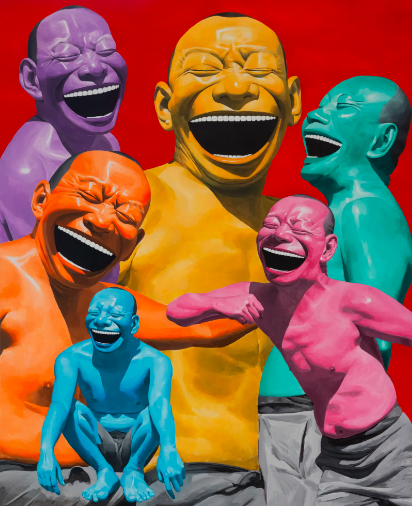
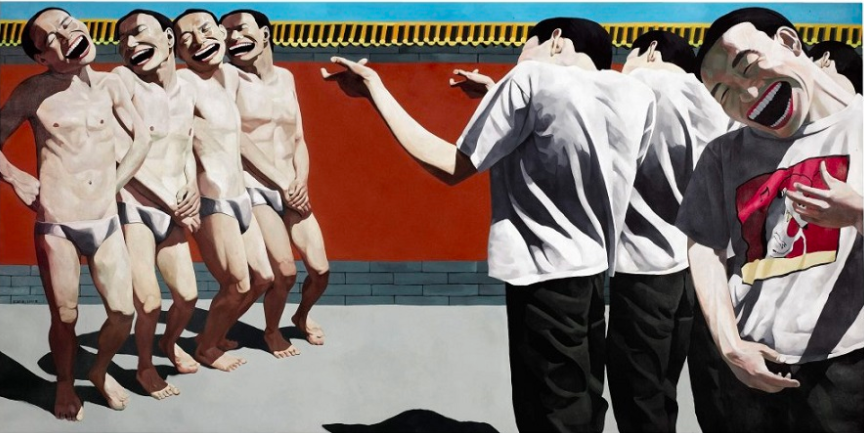
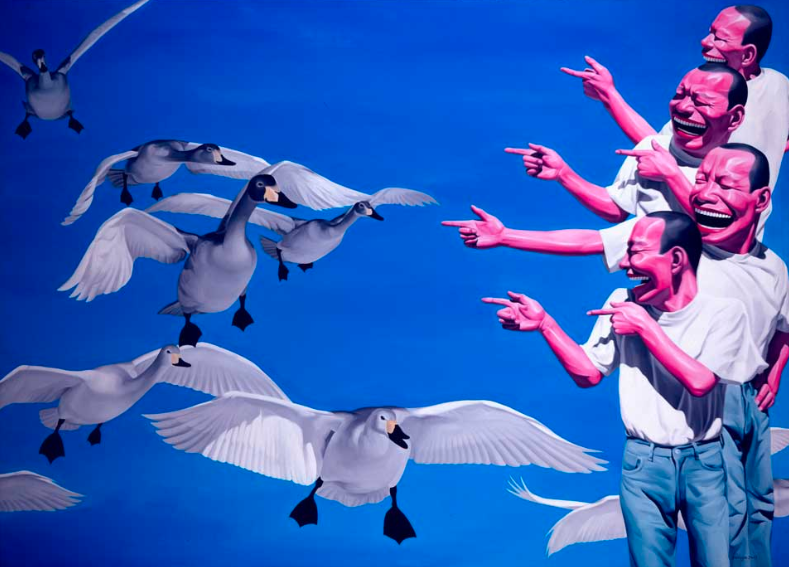
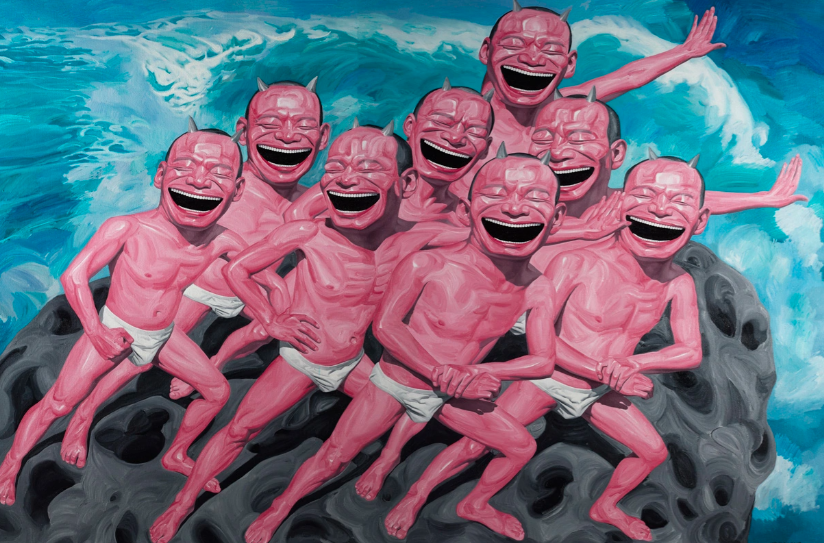
Yue Minjun nació en 1962 en Daqing, trabajó como electricista y en perforación marina, y retrató a sus compañeros antes de estudiar pintura al óleo en la Universidad Normal de Hebei, donde se tituló en 1989. Lo demás es un rostro: el suyo, rosado, de ojos apretados y boca abierta sobre una hilera compacta de dientes, multiplicado en hombres idénticos que ríen en un bote, bajo planetas, en un jardín o ante un pelotón de fusilamiento. En 2007, Ejecución (1995) se vendió por cerca de 5,9 millones de dólares.
¿Chiste o protesta? Menuda reducción. El arte no es desahogo biográfico ni expresión de un ánimo, sino una situación comunicativa en la que una obra confronta al receptor con los conceptos e instituciones de su mundo, dentro de un marco institucional. Su operación propia es el cuestionamiento: una fricción entre categorías que, al desbordar las del receptor, produce asombro y amplía su libertad. Así entendida, la risa de Yue no puede reducirse a alegría, burla o desesperación: la obra pone en crisis, precisamente, esa lectura.
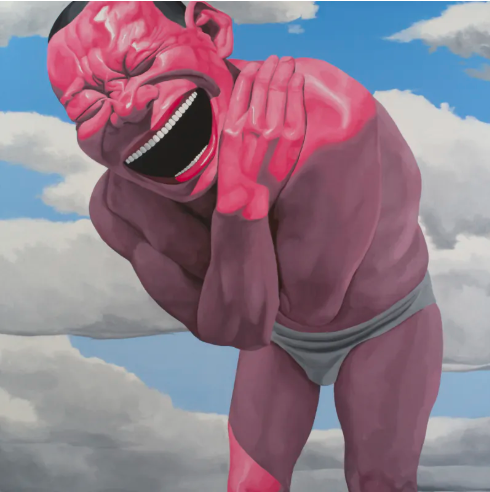
La convivencia supone que el rostro revela lo que sentimos. Yue desmonta el supuesto llevando el gesto más allá de lo verosímil: sus hombres ríen sin interlocutor ni causa visible, con los ojos cerrados, ajenos, si se quiere, a toda causalidad. De este modo, la expresión se desliga del estado emocional, deja de ser síntoma y aparece como convención, uniforme facial. La alusión es directa: el realismo socialista pintaba obreros sonrientes y dichosos.
Yue pinta su cara tantas veces que la institución del retrato se extravía casi por completo: la aparente transparencia de la imagen del sujeto único se vuelve todo lo contrario: una fórmula que, además, pierde al individuo en multitud y hace oscilar la obra entre sujeto y cuerpo político. El artista compara esa insistencia con los iconos religiosos, que se afirman al repetirse. De este modo, pone en entredicho el afán de imagen definitiva, de caracterización y definición. Con ello, paradójicamente, Yue se ha convertido a sí mismo en una marca y, por lo tanto, ha desembocado en kitsch, lo que, no obstante, lejos de restar potencia a su propuesta se la ha añadido.
Por si fuera poco, Yue se mete de lleno con la Historia. Ejecución (1995), óleo de 150 × 300 centímetros, retoma la composición de El fusilamiento del emperador Maximiliano, de Manet, que refiere a El tres de mayo de 1808, de Goya. Pero el pintor elimina el pathos: los brazos caen, las víctimas parecen no temer a la muerte y los hombres fingen sostener fusiles como si jugaran. Verdugos y víctimas visten camisetas y ropa interior; no hay uniformes que organicen la jerarquía, las miradas no se cruzan y el muro del fondo está sellado, sin testigos. Lo mismo pasa con otras representaciones suyas. En general, su obra no cuestiona solo matanzas o imposiciones dictatoriales, sino el estatuto de la imagen de la atrocidad: la suposición de que mostrar el horror equivale a comprenderlo y de que el espectador puede, por tanto, sentirse inocente. En todo caso, la risa no suaviza ninguna forma de violencia: vuelve más incómodo el acto de mirarla.
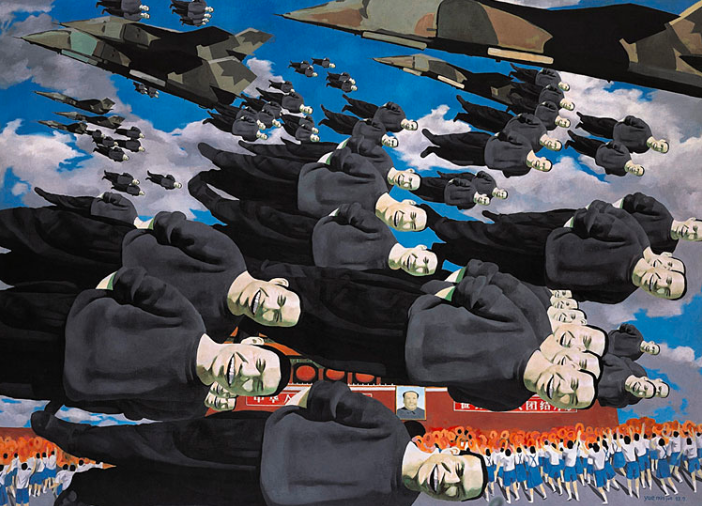
Li Xianting acuñó en 1992 los términos «realismo cínico» y «pop político» para describir un arte posterior a 1989 que abandonaba idealismo y heroísmo en favor de lo mundano y absurdo. Yue rechaza el rótulo: afirma que intenta dar sentido al mundo; nada cinismo ni absurdo, solamente. La etiqueta de pintor disidente, así como la de la sala que exhibe sus cuadros no son nada neutrales. La lectura del héroe que desafía al Estado resulta cómoda para el receptor «occidental» porque confirma lo que ya pensaba. Pero esto atiende también la intención del artista, que admitió desde un principio su intención de hacerse famoso. La saturación y la fórmula forman, además, parte del argumento de la propuesta. Reducir la obra al contexto chino sería ignorar la prevención del propio artista al respecto. Yue interroga una condición de cualquier hombre instituido: tener que mostrar un semblante para convivir. La historia china amplía las resonancias, pero no agota la lectura.
Sin un lenguaje pictórico que sostenga todo, lo anterior sería una ocurrencia. Yue se formó en el óleo y recibió instrucción en el realismo socialista, que transforma en caricatura. La factura es deliberadamente inexpresiva. Los lienzos son grandes, de colores vivos; el cielo, cerúleo, y las carnes, de un rosa cargado. Las superficies son lisas, la luz pareja y la composición frontal, casi de friso. Una pintura matizada emocionalmente desmentiría su tema. La planitud es máscara, el rosa su maquillaje y los ojos cerrados impiden el encuentro de miradas. La hilera de dientes convierte la boca en un dispositivo repetitivo: dentro de cada rostro ya está, en miniatura, la serialidad del conjunto.
La apropiación del canon requiere oficio. Yue no alude vagamente a Goya o Manet: toma su armazón compositivo, deja que el espectador espere el patetismo y le entrega una farsa. Solo se parodia bien aquello que se domina; además, el artista se abstiene de explicar el chiste.
Bergson (1911) observó que la repetición idéntica hace sospechar un mecanismo allí donde esperaríamos vida: el gesto se vuelve automático, casi una marioneta. Yue lleva esa intuición al extremo. La carcajada, que normalmente acontece, se extingue y deja paso a otra experiencia, queda fijada en un presente sin salida. Sus figuras no ríen una vez: están condenadas a reír. El instante deja de ser tránsito y se convierte en recinto. Si el infierno puede pensarse como la perpetuación de una condición de la que no cabe escapar, estas caras lo representan sin llamas ni tormentos visibles: basta una felicidad impuesta que no puede cesar. Los ojos cerrados clausuran el mundo; la boca abierta no comunica, repite. La eternidad de la risa no es plenitud, sino condena. El castigo no es reír, sino no poder convertir la risa en pasado nunca.
La risa también nos compromete como espectadores. Primero puede contagiarnos, porque reconocemos la forma familiar de la alegría; luego, la falta de causa nos retira esa comodidad. Reímos —o creemos estar a punto de hacerlo— y descubrimos que el gesto se ha independizado de nosotros. La obra convierte así la recepción en experiencia de su argumento: también nosotros podemos quedar atrapados en una expresión social que ya no sabemos justificar. No es que cada carcajada esconda necesariamente sufrimiento, sino que ninguna expresión garantiza por sí sola la verdad de una vida interior.
Las implicaciones alcanzan al receptor, que no necesita conocer la historia china para verse interpelado; a la crítica, que debe resistirse tanto a la lectura subjetivista como al relato tranquilizador del disidente heroico; y al propio Yue, cuyo riesgo es que el mercado transforme la risa en marca.
En fin, todo esto es cosa seria.
(ENGLISH VERSION)
A Serious Matter: An Approach to the Work of Yue Minjun
Translated by Tiffany Amber Elías Trimble
Faced with a face contorted by laughter, we tend to take joy, relief, or contagiousness for granted. Confusing this uproarious laughter with happiness is also exceedingly common. Yet anyone who has laughed at the wrong moment—at a superior’s joke, during an interminable anecdote, or at a funeral to keep from crying—knows all too well how appearances can be forced and is surely familiar with “compulsory happiness,” as Anthony Daniels (2013) puts it, recalling a novel by Norman Manea. Maintaining the expression hurts, and the longer it must be sustained, the more it hurts.
Yue Minjun was born in 1962 in Daqing, worked as an electrician and in offshore drilling, and painted portraits of his coworkers before studying oil painting at Hebei Normal University, where he graduated in 1989. The rest is a face: his own, pink-skinned, with tightly shut eyes and an open mouth displaying a tightly packed row of teeth, multiplied into identical men laughing in a boat, beneath planets, in a garden, or before a firing squad. In 2007, Execution (1995) sold for nearly $5.9 million.
A joke or a protest? What a reductive dichotomy. Art is neither biographical catharsis nor the expression of a state of mind, but a communicative situation in which an artwork confronts its recipient with the concepts and institutions of their world within an institutional framework. Its defining operation is questioning: a friction between categories that, by exceeding those of the recipient, produces astonishment and expands their freedom. Understood in this way, Yue’s laughter cannot be reduced to joy, mockery, or despair: the work calls precisely that interpretation into question.
Social life presupposes that the face reveals what we feel. Yue dismantles this assumption by pushing the expression beyond the bounds of plausibility: his men laugh without an interlocutor or any visible cause, their eyes closed, seemingly indifferent to all causality. In this way, expression becomes detached from emotional state, ceases to be a symptom, and appears instead as a convention, a facial uniform. The allusion is direct: socialist realism painted smiling, happy workers.
Yue paints his own face so many times that the institution of portraiture is almost entirely displaced: the apparent transparency of the image of a singular subject becomes its opposite, a formula that also dissolves the individual into a multitude and makes the work oscillate between subject and political body. The artist compares this insistence to religious icons, which assert themselves through repetition. In this way, he calls into question the pursuit of a definitive image, characterization, and definition. Paradoxically, Yue has thereby turned himself into a brand and, consequently, arrived at kitsch, which, far from diminishing the force of his proposition, has actually enhanced it.
As if that were not enough, Yue engages directly with History. Execution (1995), an oil painting measuring 150 × 300 centimeters, reworks the composition of Manet’s The Execution of Emperor Maximilian, which in turn refers to Goya’s The Third of May 1808. But the painter eliminates the pathos: the arms hang down, the victims seem unafraid of death, and the men pretend to hold rifles as though they were playing. Executioners and victims wear T-shirts and underwear; there are no uniforms to establish a hierarchy, gazes do not meet, and the wall in the background is sealed off, with no witnesses. The same applies to other representations by Yue. In general, his work questions not only massacres or dictatorial impositions, but also the status of the image of atrocity: the assumption that showing horror is equivalent to understanding it and that the spectator can therefore consider themselves innocent. In any case, laughter softens no form of violence; it makes the act of looking at it more uncomfortable.
In 1992, Li Xianting coined the terms “cynical realism” and “political pop” to describe an artistic movement that emerged after 1989 and abandoned idealism and heroism in favor of the mundane and the absurd. Yue rejects the label: he claims that he is trying to make sense of the world; there is nothing cynical or absurd about it, nothing more. The label of dissident painter, just like that of the gallery exhibiting his paintings, is by no means neutral. The interpretation of the hero who defies the state is comfortable for the “Western” recipient because it confirms what they already believed. Yet this interpretation also accommodates the artist’s own intentions, since he admitted from the outset that he wanted to become famous. Saturation and formula are also part of the work’s argument. Reducing the work to its Chinese context would ignore the artist’s own reservations on that score. Yue interrogates a condition shared by every socially constituted person: having to put on a face in order to live alongside others. Chinese history broadens the work’s resonances, but does not exhaust its possible readings.
Without a pictorial language capable of sustaining all this, the foregoing would amount to little more than a clever idea. Yue trained in oil painting and received instruction in socialist realism, which he transforms into caricature. His handling is deliberately expressionless. The canvases are large and brightly colored; the sky is cerulean, and the flesh tones are a saturated pink. The surfaces are smooth, the lighting even, and the composition frontal, almost like a frieze. A painting emotionally inflected would contradict its subject. Flatness is a mask, pink is its makeup, and closed eyes prevent gazes from meeting. The row of teeth turns the mouth into a repetitive device: each face already contains, in miniature, the seriality of the whole.
Appropriating the canon requires skill. Yue does not vaguely allude to Goya or Manet: he takes their compositional framework, lets the spectator anticipate pathos, and delivers a farce. Only what one has mastered can be effectively parodied; moreover, the artist refrains from explaining the joke.
Bergson (1911) observed that identical repetition makes us suspect a mechanism where we would expect life: the gesture becomes automatic, almost puppet-like. Yue takes this insight to its extreme. Laughter, which ordinarily occurs, fades, and gives way to another experience, is fixed in a present with no way out. His figures do not laugh once: they are condemned to laugh. The instant ceases to be a passage and becomes an enclosure. If hell can be conceived as the perpetuation of a condition from which there is no escape, these faces represent it without flames or visible torments: an imposed happiness that cannot cease is enough. The closed eyes shut out the world; the open mouth does not communicate but repeats. The eternity of laughter is not fulfillment but damnation. The punishment is not to laugh, but never to be able to turn laughter into something past.
Laughter also implicates us as spectators. At first, it may be contagious because we recognize the familiar form of joy; then, the absence of a cause deprives us of that comfort. We laugh—or believe we are about to—and discover that the gesture has become independent of us. The work thus turns the act of reception into an experience of its own argument: we, too, can become trapped in a social expression that we no longer know how to justify. This does not mean that every burst of laughter necessarily conceals suffering, but that no expression, by itself, guarantees the truth of an inner life.
The implications extend to the recipient, who need not know Chinese history to feel addressed; to critics, who must resist both subjectivist interpretations and the reassuring narrative of the heroic dissident; and to Yue himself, whose risk is that the market will turn laughter into a brand.
In short, this is a serious matter.