Envolvente, luminosa: Aproximación a la obra de Li Hei Di
Por Juan Pablo Torres Muñiz
Lugares comunes. Ante un cuerpo de mujer o una flor, el comentario suele gatillarse antes siquiera de haber sido requerido: misterio femenino, gracia natural, la mujer como fuente de vida, el vegetal como metáfora (dócil) de lo materno. Son lecturas cómodas, casi automáticas: reducen a un solo gesto —el halago— una operación pictórica que, examinada de cerca, resulta bastante más exigente. Hay propuestas, sin embargo, que dificultan abiertamente esa reducción. He aquí el caso de la obra de Li Hei Di (Shenyang, 1997). Sus lienzos —masas vegetales, cuerpos que apenas se insinúan, luces que atraviesan capas de veladura— invitan, en efecto, a adentrarse en su atmósfera. Pero conviene resistirlo. La pregunta pertinente no es qué tan hermosas resultan sus superficies orgánicas, sino qué tipo de comprensión de la realidad —qué arquitectura del pensamiento— proponen frente a la que damos por sentada.
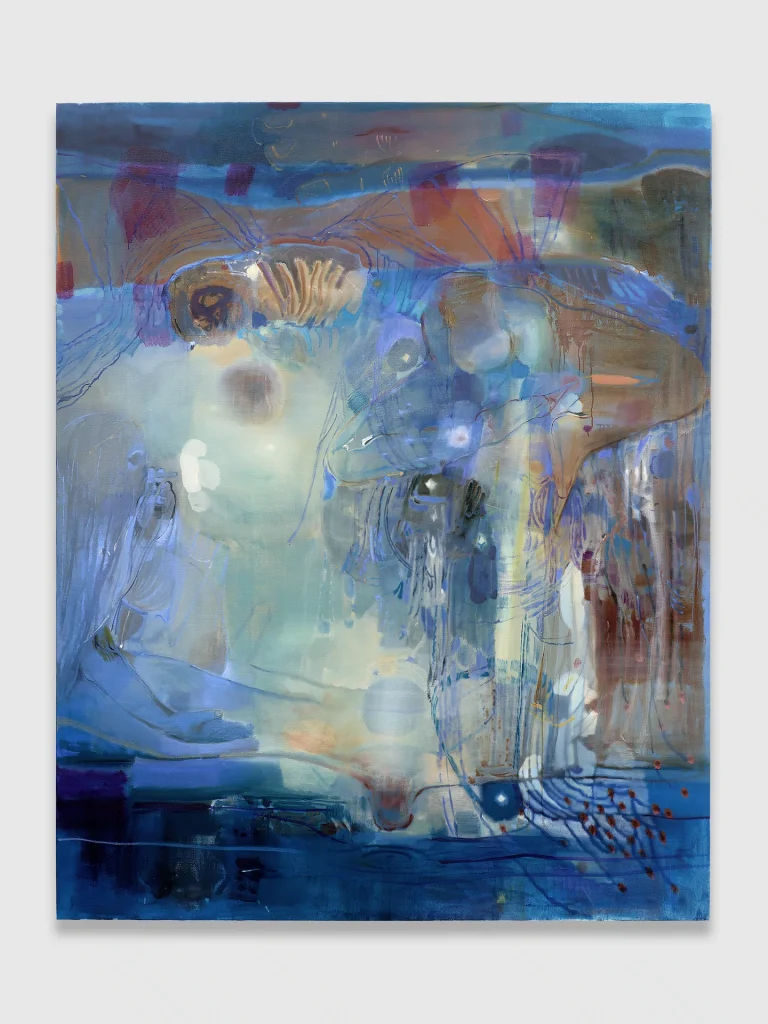
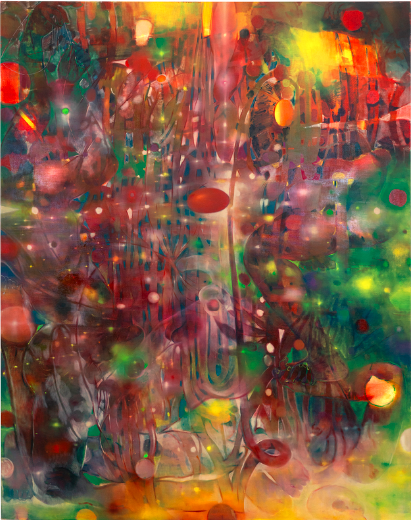
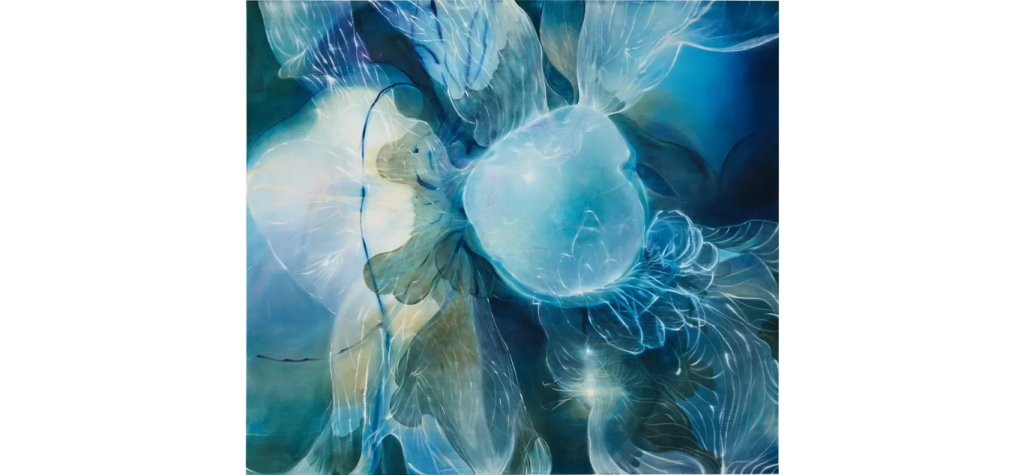
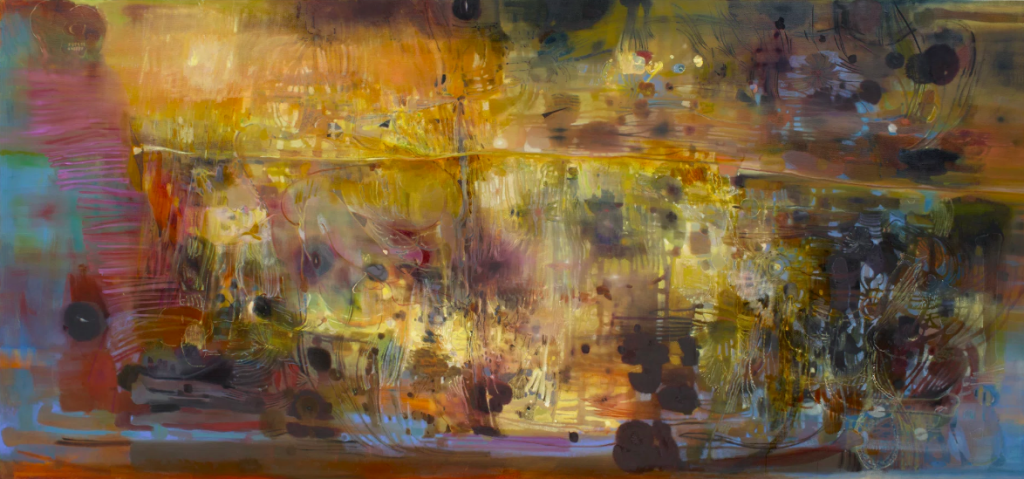
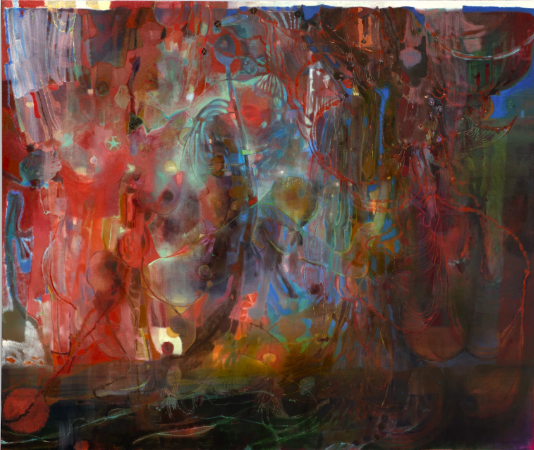
El arte cuestiona no solo las instituciones sociales visibles —familia, poder, gobierno— sino también, y de manera más profunda, las instituciones cognitivas que organizan silenciosamente nuestra relación con lo real, entre ellas la más elemental: la razón lineal, esa que ordena los hechos en secuencia, causa tras efecto, principio y fin, y que Occidente ha asumido como el único modo legítimo de conocer. La obra de Li Hei Di se sitúa exactamente frente a esa institución, mas sin proclama alguna: basta con mirar cómo están construidos sus cuadros. Sus composiciones no organizan la mirada del espectador de izquierda a derecha, ni de arriba abajo, ni siguiendo ningún eje narrativo previsible; se despliegan, más bien, desde un núcleo —a menudo un foco de luz, una zona incandescente entre rojos y naranjas— hacia una periferia de enredo orgánico que se extiende en todas direcciones a la vez, sin jerarquía de lectura. Es una comprensión radial, no lineal, de la composición pictórica, y esa estructura formal plantea en sí misma, el primer cuestionamiento: la realidad —al menos la realidad interior, la de la experiencia y el deseo— no se organiza en cadena, sino en red; toda pretensión de leerla como una secuencia ordenada de causas y consecuencias es, cuando menos, una simplificación forzada. Capas, no secuencia; paisaje, no relato: el vocabulario mismo con que Li describe su método es ya una declaración notable.
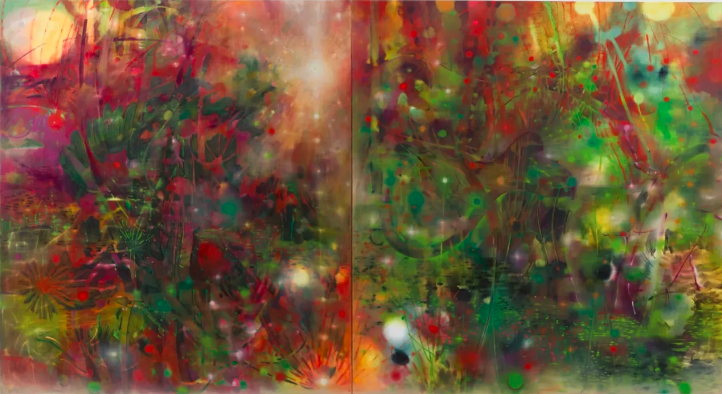
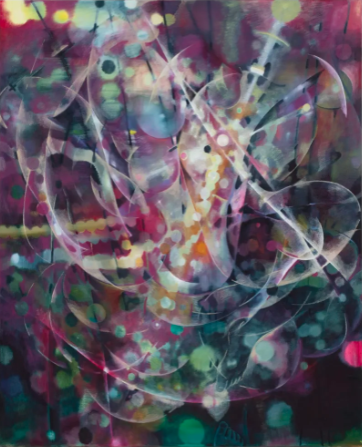
Esa luz que se abre paso —motivo constante en su producción— no funciona, examinada con atención, como un simple símbolo de vitalidad o pureza opuesto a la oscuridad circundante; es en sí misma una conquista contra la oscuridad, y esa oscuridad —lejos de operar como simple contraste decorativo— porta su propia complejidad semántica. Basta reparar en los títulos con que la artista bautiza sus lienzos —Empty Your Heart with Mortal Dreams, In the Excitement of Dying, Solace of the Night Sky, Liquid Meadow in the Lust of Dawn— para advertir que la vegetación, en su pintura, no remite a una naturaleza benévola y nutricia, sino a un territorio de intoxicación, de éxtasis rayano en la muerte, de enredo que atrapa tanto como seduce. A menudo, veremos cómo hebras espectrales se retuercen y se aferran dentro de un magenta, carmesí, esmeralda, añil y amarillo neón espesados, mientras destellos de luz emergen y atraviesan esas capas translúcidas, desenredando el lienzo en medio de un movimiento, ora liberación ora estrangulamiento. No hay aquí gracia complaciente: hay, más bien, la representación de un interior —físico y emocional a la vez— comunicado consigo mismo de manera confusa, no deliberada, casi involuntaria, como el propio título de la obra que da nombre a este texto sugiere: una lumbre en medio del caos orgánico, no su resolución.
Esta insistencia en lo orgánico como territorio de enredo antes que de armonía se apoya, además, en una referencia cultural que Li reivindica de manera explícita y que aleja su iconografía de cualquier lectura naturalista ingenua: el cine wuxia de finales del siglo XX, en particular Una historia china de fantasmas (1987), de Ching Siu-tung, Swordsman II (1992) y La serpiente verde (1993), de Tsui Hark, films en los que estanques de loto se transforman, criaturas cambian de naturaleza y fuegos fatuos recorren la superficie del agua. De ese imaginario cinematográfico —mutante, ajeno a la lógica causal de la narrativa occidental clásica— Li Hei Di extrae la idea de que ninguna forma permanece fija el tiempo suficiente para dejarse nombrar con certeza.
En el aspecto técnico, esta propuesta se apoya en un modo de pintar en que la mirada implica una comprensión gradual, jamás terminada. Sus lienzos, realizados al óleo sobre lino o tela, se construyen mediante veladuras atmosféricas superpuestas; a través de ellas, ciertos apéndices humanos apenas se dejan entrever cuando quien observa se detiene el tiempo suficiente ante la obra. No hay, por tanto, una forma que se entregue de inmediato a la mirada, sino una figura que surge o se retira según la atención que reciba, en un proceso que reproduce formalmente la composición radial antes referida. La artista ha descrito sus figuras como presencias fantasmales, seres translúcidos; esa cualidad espectral deriva lógicamente de negarle al cuerpo la solidez que la pintura figurativa tradicional le concede por convención. La paleta, por su parte, recorre un espectro que va de rojos y naranjas ambientales a rosas y morados casi empalagosos, hasta llegar a verdes y azules profundos; en ese recorrido el color no ilustra el enredo orgánico, sino que lo intoxica y lo satura hasta el punto de que la percepción del espectador también queda atrapada en la maraña que la pintura describe.
La obra de Li Hei Di le hace frente a esa exigencia de racionalismo lineal, pero no propone ningún irracionalismo —respuesta fácil—, sino una lumbre —focal, real, buscada activamente contra la falta de sol— que ilumina sin resolver el enredo que la rodea, exigente, precisamente por no ofrecer un camino único de lectura. Así, la seducción de estas imágenes no reside en la promesa de un secreto último que el espectador pudiera finalmente capturar, sino en la constatación, honesta y hasta cierto punto inquietante, de que ciertos territorios de la experiencia —el deseo, la memoria, el cuerpo mismo— se organizan de un modo que la razón lineal simplemente no alcanza a nombrar, y que solo una disposición adecuada a recorrer el enredo sin pretender desenredarlo del todo, puede aproximarse a ellos sin traicionarlos.
(ENGLISH VERSION)
Enveloping: An Approach to the Work of Li Hei Di
Translation by Tiffany Amber Elías Trimble
Commonplaces. Before a woman’s body or a flower, the comment usually triggers before it has even been requested: feminine mystery, natural grace, woman as source of life, the vegetal as a (docile) metaphor for the maternal. These are comfortable, almost automatic readings: they reduce to a single gesture—flattery—a pictorial operation that, examined closely, proves considerably more demanding. There are proposals, however, that openly hinder that reduction. Here is the case of the work of Li Hei Di (Shenyang, 1997). Her canvases—vegetal masses, bodies barely insinuated, lights that traverse layers of glaze—invite, in effect, an entry into their atmosphere. But it is advisable to resist it. The pertinent question is not how beautiful her organic surfaces are, but what type of understanding of reality—what architecture of thought—they propose against the one we take for granted.
Art questions not only visible social institutions—family, power, government—but also, and more deeply, the cognitive institutions that silently organize our relation with the real, among them the most elementary: linear reason, that which orders facts in sequence, cause after effect, beginning and end, and which the West has assumed as the only legitimate mode of knowing. Li Hei Di’s work stands exactly before that institution, but without any proclamation: it suffices to look at how her paintings are constructed. Her compositions do not organize the viewer’s gaze from left to right, nor from top to bottom, nor following any foreseeable narrative axis; they unfold, rather, from a nucleus—often a focus of light, an incandescent zone between reds and oranges—toward a periphery of organic entanglement that extends in all directions at once, without hierarchy of reading. It is a radial, not linear, understanding of pictorial composition, and that formal structure poses in itself the first questioning: reality—at least interior reality, that of experience and desire—is not organized in a chain, but in a network; every pretension of reading it as an ordered sequence of causes and consequences is, at the very least, a forced simplification. Layers, not sequence; landscape, not narrative: the very vocabulary with which Li describes her method is already a notable declaration.
That light that opens its way—a constant motif in her production—does not function, examined with attention, as a simple symbol of vitality or purity opposed to the surrounding darkness; it is in itself a conquest against darkness, and that darkness—far from operating as a simple decorative contrast—carries its own semantic complexity. It suffices to notice the titles with which the artist baptizes her canvases—Empty Your Heart with Mortal Dreams, In the Excitement of Dying, Solace of the Night Sky, Liquid Meadow in the Lust of Dawn—to notice that vegetation, in her painting, does not refer to a benevolent and nurturing nature, but to a territory of intoxication, of ecstasy bordering on death, of entanglement that traps as much as it seduces. Often, we will see how spectral threads twist and cling within a thickened magenta, crimson, emerald, indigo, and neon yellow, while flashes of light emerge and traverse those translucent layers, unraveling the canvas amid a movement, now liberation, now strangulation. There is no complacent grace here: there is, rather, the representation of an interior—physical and emotional at once—communicating with itself in a confused, non-deliberate, almost involuntary manner, as the very title of the work that gives its name to this text suggests: a light in the midst of organic chaos, not its resolution.
This insistence on the organic as a territory of entanglement rather than of harmony is supported, moreover, by a cultural reference that Li reclaims explicitly and that distances her iconography from any naive naturalist reading: the wuxia cinema of the late 20th century, in particular A Chinese Ghost Story (1987), by Ching Siu-tung, Swordsman II (1992), and Green Snake (1993), by Tsui Hark, films in which lotus ponds transform, creatures change nature, and will-o’-the-wisps travel across the water’s surface. From that cinematographic imaginary—mutant, alien to the causal logic of classic Western narrative—Li Hei Di extracts the idea that no form remains fixed long enough to let itself be named with certainty.
On the technical aspect, this proposal rests on a mode of painting in which the gaze implies a gradual, never finished understanding. Her canvases, executed in oil on linen or canvas, are constructed by means of superimposed atmospheric glazes; through them, certain human appendages barely let themselves be glimpsed when the observer stops long enough before the work. There is, therefore, no form that delivers itself immediately to the gaze, but a figure that emerges or withdraws according to the attention it receives, in a process that formally reproduces the radial composition referred to above. The artist has described her figures as phantom presences, translucent beings; that spectral quality derives logically from denying the body the solidity that traditional figurative painting grants it by convention. The palette, for its part, traverses a spectrum that goes from ambient reds and oranges to almost cloying pinks and purples, until reaching deep greens and blues; in that journey color does not illustrate the organic entanglement, but intoxicates and saturates it to the point that the viewer’s perception also remains trapped in the tangle that the painting describes.
Li Hei Di’s work confronts that demand for linear rationalism, but it proposes no irrationalism—the easy response—but rather a light—focal, real, actively sought against the lack of sun—that illuminates without resolving the entanglement that surrounds it, demanding, precisely because it offers no single path of reading. Thus, the seduction of these images does not reside in the promise of an ultimate secret that the viewer could finally capture, but in the honest and to a certain point unsettling confirmation that certain territories of experience—desire, memory, the body itself—are organized in a mode that linear reason simply cannot name, and that only a disposition adequate to traversing the entanglement without pretending to untangle it completely can approach them without betraying them.