
Fabulación continua: Conversación con Joselito Sabogal sobre su obra
Por Juan Pablo Torres Muñiz
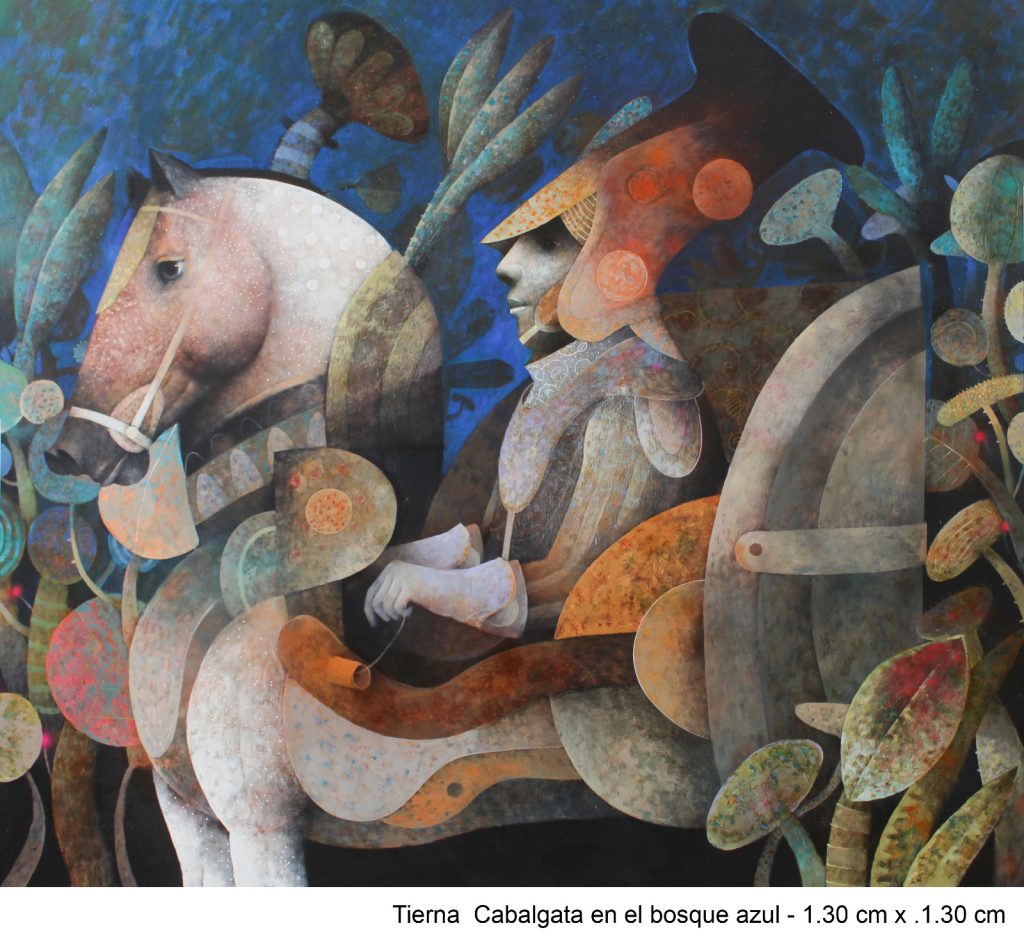
Nada de dejarse atrapar por las clasificaciones fáciles del mercado artístico contemporáneo. Las raíces del imaginario de Joselito Sabogal se hunden en una tradición de figuración mística que la modernidad líquida ha preferido arrinconar en el sótano de lo decorativo o lo pintoresco. Lejos de cualquier ortodoxia, este artista peruano ha construido un universo visual donde convergen la herencia prehispánica —con sus deidades telúricas y su concepción cíclica del tiempo—, la potencia expresiva del muralismo mexicano, particularmente la ferocidad compositiva de Siqueiros, y el onirismo del surrealismo, aunque sin el gesto automático ni la psicología de manual que a menudo acompañan a esa escuela. Lo suyo es una iconografía de reinvención de mitologías. Sus seres, suspendidos en atmósferas densas, habitan una temporalidad suspendida que es la de la fabulación continua, la del mito que se rehúsa a caducar porque sigue siendo necesario para nombrar lo que la razón instrumental no alcanza a procesar.
La temática de su obra pasa por la pretendida división entre naturaleza y humanidad. En los lienzos de Sabogal, los límites se disuelven: la humanidad, digamos, no se encuentra fuera de la naturaleza, sino que es una de sus manifestaciones, y la violencia que ejerce sobre el entorno no es sino la violencia que ejerce sobre sí misma. La fuerza del medio natural aparece en su obra no como una amenaza exterior, sino como una presencia cotidiana, a veces abismal. El carácter bestial que, según su visión, permea nuestro pensamiento, no se representa como una caída o una degeneración, sino como una capa constitutiva de la psique que la civilización no ha logrado domeñar del todo. Sabogal asume la tradición iconográfica precolombina con sus formas geométricas, sus planos superpuestos y su sentido ritual del espacio, pero la somete a una torsión que revela su fragilidad y su distancia. La herencia, para él, no es un patrimonio que se exhibe con orgullo, sino una pregunta que se formula desde la precariedad del presente.
Conversamos con él al respecto…
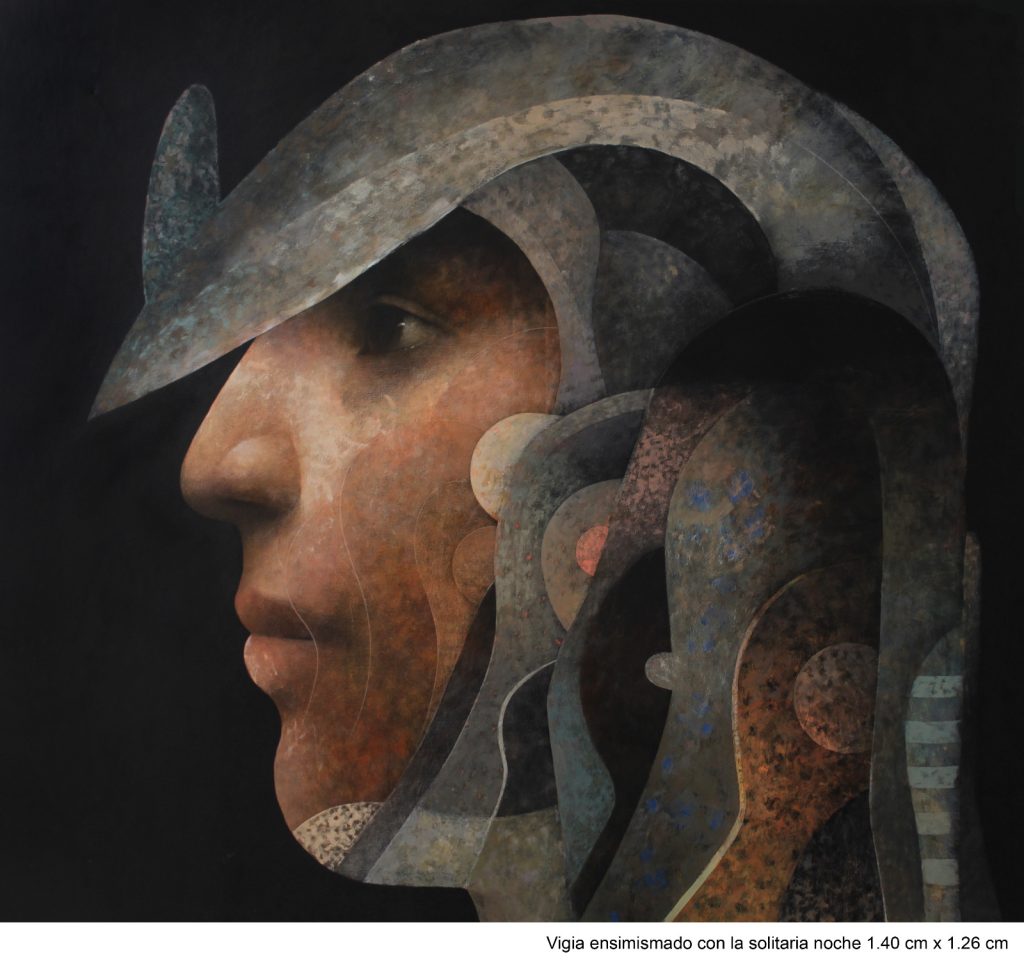
¿Por qué la pintura? ¿Qué te lleva o te trae a ella?
Antes que la pintura, para mí está el dibujo. La pintura vino a ser algo como la culminación de esa idea acariciada en el dibujo: darle color a todo el andamiaje del sueño preconcebido. Me atrae siempre su finalización, que no queda exenta de sufrimiento, al igual que un parto, metafóricamente hablando.
¿En qué medida consideras que es de veras tu único camino que podías haber seguido?
Siempre me he hecho esa pregunta. Llevo años tratando de llevar todo mi sueño, todo mi ideario a otra disciplina como la escultura o las artes digitales, tan en boga hoy en día, pero la pintura me seduce más, y ahora diría incluso que muchísimo más, porque vengo hallando técnicas que se prestan más a mi expresión.
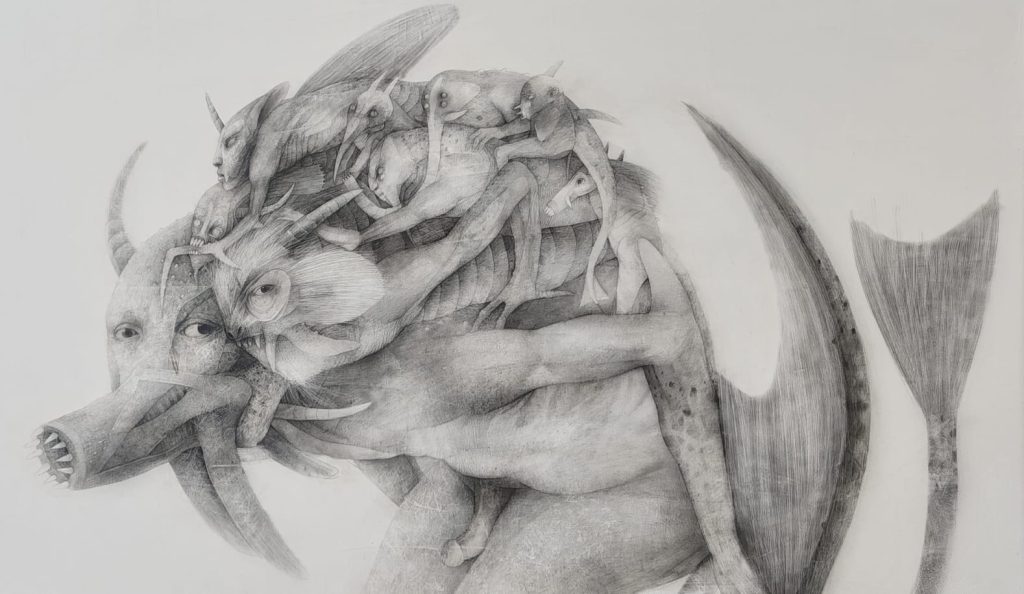
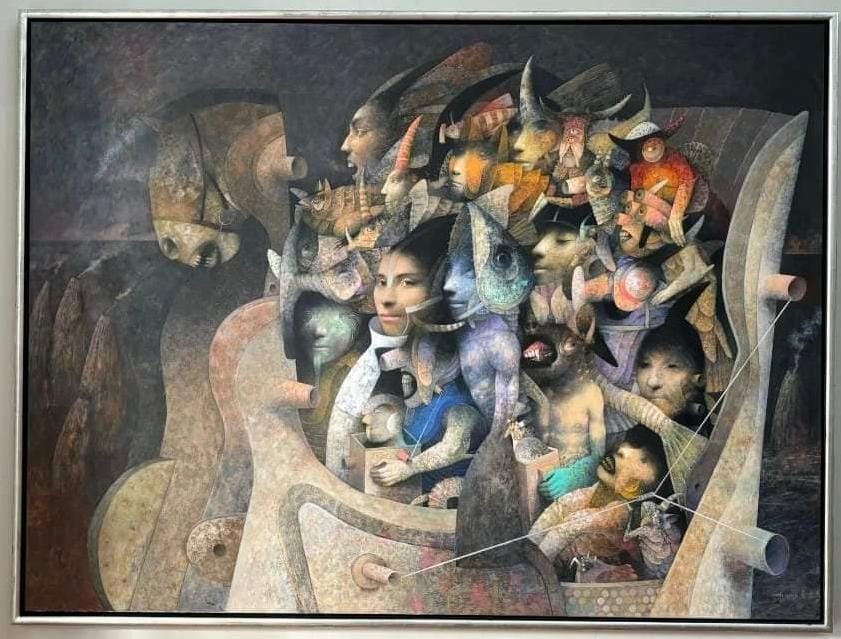
Las criaturas que habitan tu pintura emergen en alegorías móviles: se desplazan, si bien en una u otra dirección, también, y siempre, hacia el frente, como una declaración ante el espectador: se trata de hombres y animales cuyos rostros materializan una tradición. ¿A qué apelan? ¿Hay en ello un rumbo fijo?
Los habitantes de mi imaginario son seres atemporales que perviven en mí, afloran siempre dependiendo de mi sentir y los plasmo. Pero, a la par, hay otros seres a la espera de su turno de ser revelados. Por eso siempre pinto conceptos o series diversificadas; así puedo mostrar un abanico de seres y también de formas. A menudo, mis criaturas figuran en una y otra imagen, siempre en modo místico, y en un continuo éxodo.
¿Cómo cobran forma tus cuadros? ¿Qué tanta planificación hay detrás, y cuánto de la fuerza expresiva de las imágenes se descubre en el proceso mismo de la pintura?
Por lo general, esbozo ideas y bocetos previos, pero no soy de copiar al cien por ciento, solo uso bases, en cierto modo. Ya en el camino surgen nuevos aditamentos, acorde nuevos sentimientos. Y eso se percibe cuando la obra se finaliza; en cierto modo la obra ideal habita en mí, en búsqueda perpetua de formas de expresión, y hacia allá voy continuamente.
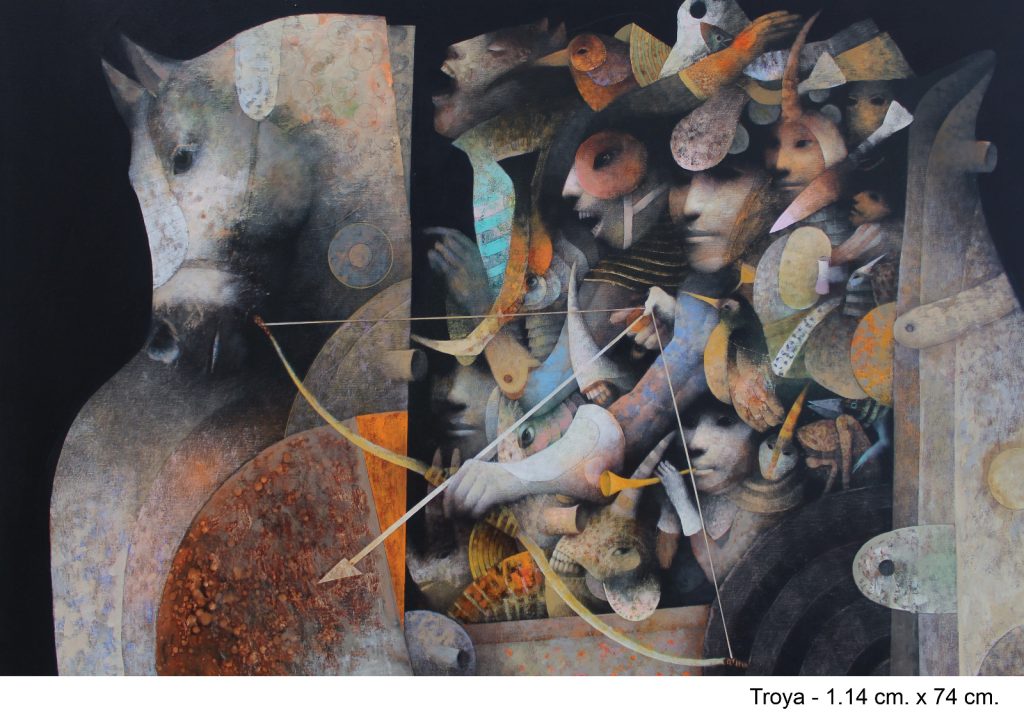
Tu marca personal es bastante clara, no obstante, la relativa variedad de tu obra. ¿De qué manera influye en ti el entorno, las condiciones mismas en que desarrollas tu obra?
El entorno influye porque, ante ciertas imágenes o noticias rebosantes de desamor y desgracias, en las que los habitantes de este tercer planeta generan maldad para con otros, pintar esos mundos, mis mundos, me sirve como una válvula de escape. No soy fatalista, creo que son estacionarias esas cosas, pero trato en todo caso de sacar lo positivo de lo negativo.
¿De qué otras artes te nutres directa o indirectamente?
Me nutro del cine. Muchas veces. Antes más que ahora. Igual, de la fotografía, creo yo. Me gusta en demasía la sencillez y austeridad de una foto en blanco y negro.
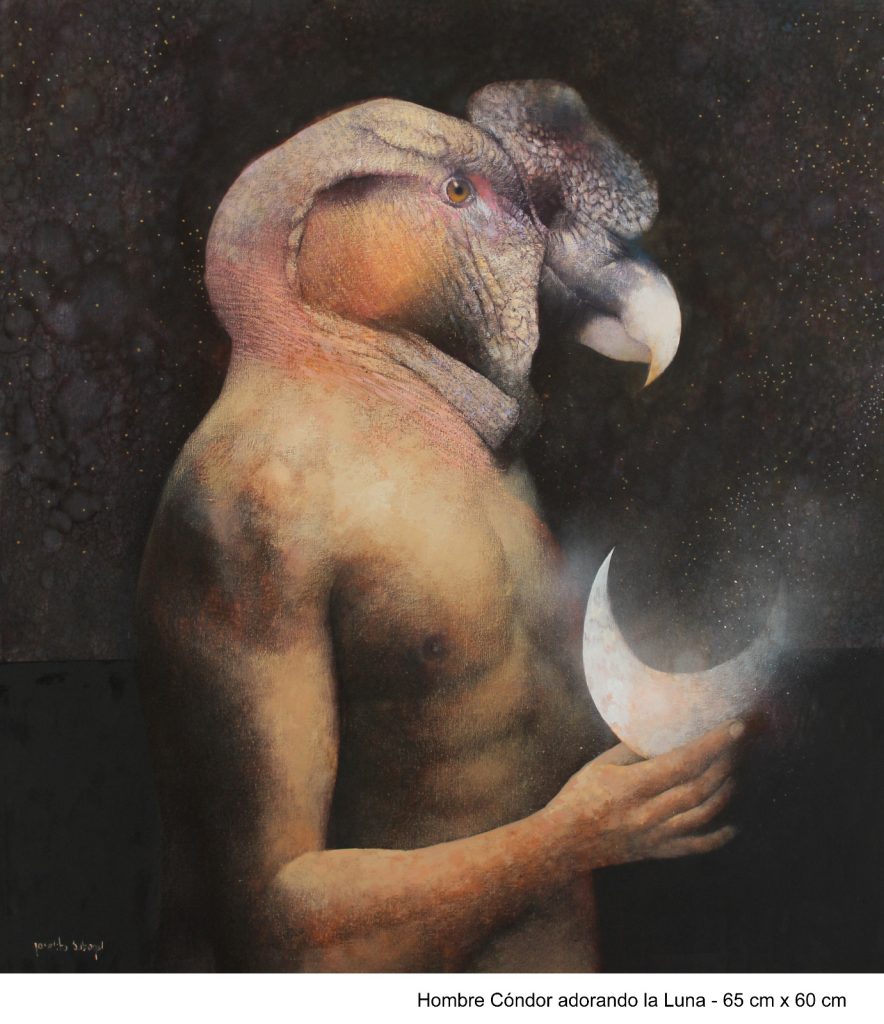
¿Cómo es que tu visión de otras obras de arte plástico, así como de otras manifestaciones artísticas en general, afecta en tu obra?
Siempre con respeto, a sabiendas de que cada artista tiene una verdad, un color, una identidad y un sentir propio. Los artistas no somos deportistas y, en ese sentido, no andamos en competencia alguna. El artista comparte y brinda mediante su arte una carga de sentimientos que lo hacen vibrar. Por ello, mi respeto y admiración también a muchos creadores, ya sean nacionales o internacionales.
¿Cabría hablar de evolución en tu obra? De ser así, ¿en qué ha consistido, desde tu perspectiva? Si no es el caso, ¿qué ha cambiado de un principio a esta parte en tu labor?
Claro que hay evolución. Siempre hay cambios. Uno los desarrolla en el camino, como pequeños acertijos; o en las formas, en el color; así, descubrimos que ciertos materiales permiten poder plasmar mejor nuestras ideas. En mi caso, esos cambios se visualizan por los conceptos diversos que plasmo, igualmente, por la técnica de ejecución, que casi nunca se limita a pintar tradicionalmente con óleo o acrílico, sino que pasa por conectar con nuevos materiales, etc.
¿Qué depara el futuro para tu obra? ¿O qué nueva obra le deparas al futuro?
Eso es lo hermoso, que uno camina en la incertidumbre de la vida misma, y crear es para mí un componente más de esa vida. Sólo sé que se van develando nuevos seres que estaban dormidos o esperando ser mostrados, eso para mí es oxígeno.
(ENGLISH VERSION)
Continuous Fabulation: A Conversation with Joselito Sabogal about His Work
Translation by Tiffany Amber Elías Trimble
Nothing about being caught by the facile classifications of the contemporary art market. The roots of Joselito Sabogal’s imaginary sink into a tradition of mystical figuration that liquid modernity has preferred to relegate to the basement of the decorative or the picturesque. Far from any orthodoxy, this Peruvian artist has constructed a visual universe where pre-Hispanic heritage converges —with its telluric deities and its cyclical conception of time—, the expressive power of Mexican muralism, particularly the compositional ferocity of Siqueiros, and the oneiricism of Surrealism, though without the automatic gesture nor the manual psychology that often accompanies that school. His is an iconography of the reinvention of mythologies. His beings, suspended in dense atmospheres, inhabit a suspended temporality that is that of continuous fabulation, that of the myth that refuses to expire because it remains necessary to name what instrumental reason cannot process.
The thematic focus of his work concerns the supposed division between nature and humanity. On Sabogal’s canvases, limits dissolve: humanity, let’s say, is not outside nature, but is one of its manifestations, and the violence it exerts on the environment is none other than the violence it exerts on itself. The force of the natural environment appears in his work not as an external threat, but as an everyday presence, sometimes abyssal. The bestial character that, according to his vision, permeates our thought, is not represented as a fall or degeneration, but as a constitutive layer of the psyche that civilization has not fully tamed. Sabogal assumes the pre-Columbian iconographic tradition with its geometric forms, its superimposed planes, and its ritual sense of space, but subjects it to a torsion that reveals its fragility and its distance. Heritage, for him, is not a patrimony exhibited with pride, but a question formulated from the precariousness of the present.
We spoke with him about it…
Why painting? What leads you or brings you to it?
Before painting, for me, there is drawing. Painting came to be something like the culmination of that idea cherished in the drawing: giving color to the entire scaffolding of the preconceived dream. I am always attracted by its completion, which is not exempt from suffering, like childbirth, metaphorically speaking.
To what extent do you consider it truly your only path you could have followed?
I have always asked myself that question. I have spent years trying to take all my dreams, all my ideology, to another discipline like sculpture or digital arts, so fashionable today, but painting seduces me more, and now I would even say much more, because I have been finding techniques that lend themselves better to my expression.
The creatures inhabiting your painting emerge in mobile allegories: they move, albeit in one direction or another, also, and always, forward, as a declaration before the viewer: they are men and animals whose faces materialize a tradition. What do they appeal to? Is there a fixed course in this?
The inhabitants of my imaginary are timeless beings that survive within me, they surface depending on my feelings and I capture them. But, at the same time, there are other beings waiting their turn to be revealed. That is why I always paint diverse concepts or series; this way I can show a range of beings and also of forms. Often, my creatures appear in one image and another, always in mystical mode, and in a continuous exodus.
How do your paintings take shape? How much planning is behind them, and how much of the expressive force of the images is discovered in the painting process itself?
Generally, I sketch ideas and previous sketches, but I am not one to copy one hundred percent, I only use bases, in a way. Along the way, new additions arise, according to new feelings. And that is perceived when the work is finished; in a way, the ideal work inhabits me, in perpetual search for forms of expression, and I go continuously towards that.
Your personal stamp is quite clear, despite the relative variety of your work. How does your environment, the very conditions in which you develop your work, influence you?
The environment influences because, faced with certain images or news overflowing with lovelessness and misfortunes, in which the inhabitants of this third planet generate evil towards others, painting those worlds, my worlds, serves as an escape valve for me. I am not a fatalist, I believe those things are stationary, but I try, in any case, to bring out the positive from the negative.
What other arts nourish you directly or indirectly?
I am nourished by cinema. Many times. More before than now. Also by photography, I believe. I greatly like the simplicity and austerity of a black and white photo.
How does your vision of other works of visual art, as well as other artistic manifestations in general, affect your work?
Always with respect, knowing that each artist has a truth, a color, an identity, and their own feeling. Artists are not athletes and, in that sense, we are not in any competition. The artist shares and offers, through their art, a load of feelings that make them vibrate. Therefore, my respect and admiration also go to many creators, whether national or international.
Could one speak of evolution in your work? If so, what has it consisted of, from your perspective? If not, what has changed from the beginning to now in your work?
Of course there is evolution. There are always changes. One develops them along the way, like small riddles; whether in forms, in color; thus, we discover that certain materials allow us to better capture our ideas. In my case, these changes are visualized through the diverse concepts I capture, likewise, through the execution technique, which almost never limits itself to painting traditionally with oil or acrylic, but rather involves connecting with new materials, etc.
What does the future hold for your work? Or what new work do you hold for the future?
That is the beautiful part, that one walks in the uncertainty of life itself, and creating is for me one more component of that life. I only know that new beings that were asleep or waiting to be shown are being revealed, that for me is oxygen.