
Lo que alumbra la sombra: Sobre la muestra «Nightwalkers» de Olivier Venac
Por Juan Pablo Torres Muñiz
La fotografía documental, en su acepción más extendida, se ha prestado a una confusión sistemática: confunde el registro de una situación con la comprensión de aquello que la situación significa. Durante décadas, el prestigio de lo documental ha descansado en la presunción de que la cámara, bien emplazada, ofrece un acceso directo a lo real, sin mediaciones, sin filtros ni, casi, interpretación. Esta ingenuidad, propia del positivismo fotográfico más elemental, ha generado montañas de imágenes que ilustran situaciones sin problematizarlas, es decir, hacerlas fuente temática más allá del testimonio básico. Felizmente, hay quienes han sabido trascender este registro indicial para generar una interrogación activa sobre los límites de lo visible y lo invisible, sobre los umbrales donde la apariencia se pliega para revelar otra cosa. La muestra Nightwalkers de Olivier Venac se inscribe en esta tradición. Mucho más que una serie sobre la noche, lo es desde la noche: ahí, en la zona crepuscular donde nuestras certezas diurnas se disuelven y emerge otra lógica, acaso más primitiva, más antigua, ligada de lleno a los ciclos biológicos y a los ritos de paso, para regir la percepción.
La originalidad de Venac reside en que concibe la noche como un medio activo, una sustancia que modela los cuerpos, los gestos y los encuentros. Sus imágenes, por decirlo de algún modo, no son iluminadas contra la oscuridad sino desde ella; así, la sombra deja de ser un accidente que revela suficientemente lo que hay, y se convierte en una suerte de personaje más del drama, una presencia que reclama su lugar en la composición. El fotógrafo no busca vencer a la noche, ni domesticarla, ni reducirla a una anécdota visual. La habita y la deja obrar sobre su mirada y sobre su lente.
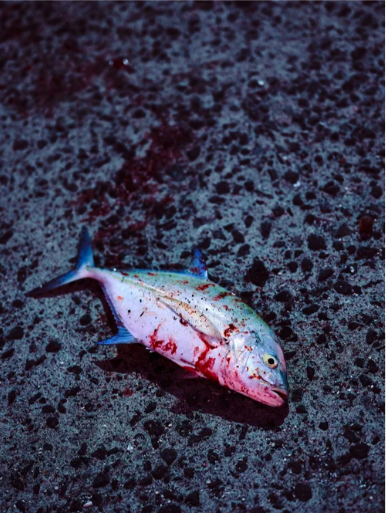
Uno de los temas centrales que Venac pone en cuestión es la noche misma como escenario de revelaciones, y en particular el paradójico alumbramiento de la muerte. En sus imágenes, la muerte es más bien una dimensión constitutiva de la vida, que su fin; algo que emerge en los intersticios de lo cotidiano cuando la vigilancia de la razón se afloja y el cuerpo recupera sus ritmos ancestrales. La muerte, en Nightwalkers, no se representa de forma directa, sino a través de sus signos: la quietud de un animal capturado, la suspensión del movimiento en un instante que podría ser el último, la mirada que se pierde en un punto donde el tiempo parece haberse detenido. Esta muerte alumbrada por la noche dista del tránsito cristiano y tampoco se acerca a la muerte heroica de las épicas; es la muerte material, biológica, la que ocurre en los márgenes de nuestra atención, la que la fotografía rescata del olvido precisamente porque no puede nombrarla del todo.
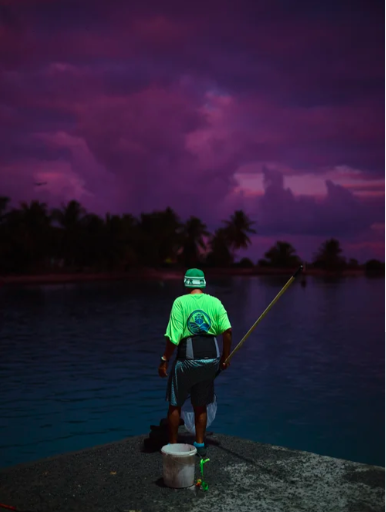
La cacería y la pesca aparecen en la serie como operaciones que articulan el vínculo entre el hombre y su entorno de una manera radicalmente distinta a la depredación industrial contemporánea. Venac ni una ni otra actividad, tampoco las presenta como prácticas nostálgicas; más bien expone su tensión constitutiva: el acecho, la espera, el momento suspendido entre la vida y la muerte, la mirada del depredador que es también la mirada de quien sabe que él mismo es presa potencial de otras fuerzas. La pesca nocturna, en particular, adquiere un carácter casi ritual: el anzuelo que se hunde en el agua no es solo un instrumento de captura, sino una extensión del deseo humano hacia lo profundo, hacia ese seno marino que da la vida y la retiene, que atrae al hombre con la promesa de un secreto y con frecuencia lo devora.
La convivencia de las criaturas depredadoras constituye otro de los ejes conceptuales de la serie. Venac fotografió comunidades de animales que operan bajo la lógica de la noche: sus encuentros no están regidos por la moral ni por la ley, sino por la necesidad y por el reconocimiento de una común vulnerabilidad. En estas imágenes, la frontera entre depredador y presa se vuelve porosa; los animales comparten el mismo territorio, la misma penumbra, el mismo destino de quienes deben procurarse el alimento para sobrevivir otra noche más. El artista sugiere así una comunidad más allá de la especie, una hermandad de los que se mueven en la oscuridad, que bien podría leerse como una alegoría de nuestra propia condición: también nosotros, urbanos, tecnificados, deslumbrados por las pantallas, seguimos siendo criaturas de la noche, sujetos a pulsiones que la razón no logra domesticar del todo.
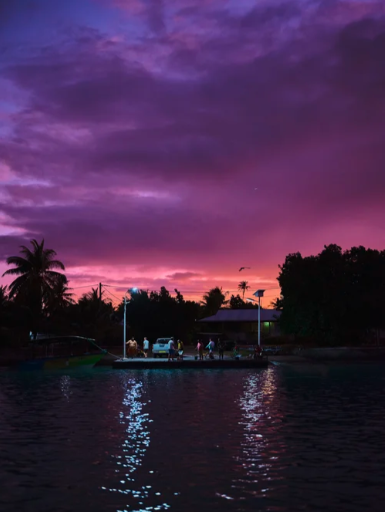
El mar, en esta muestra fotográfica, es la fuente de vida y el seno del misterio, el elemento que atrae al hombre con la promesa de una plenitud que nunca termina de conceder. Venac fotografía el mar nocturno como una superficie donde las certezas se disuelven: sin horizonte definido, ni una separación clara siempre entre el agua y el cielo, a menudo sin puntos de referencia que permitan orientarse. Esta pérdida de coordenadas es a la vez amenazante y liberadora. El hombre se siente atraído por esa inmensidad oscura, quizá porque intuye que ahí, en la indiferenciación primordial, podría encontrar una respuesta a preguntas que el mundo diurno, ordenado, clasificado, se ha vuelto incapaz de formular. Pero el mar también engaña, también seduce y devora. La estadística de ahogados en la costa que el artista conoce bien, no es un dato anecdótico sino un recordatorio de que la naturaleza no negocia con nuestros deseos ni con nuestras angustias.
La técnica de Venac es inseparable de esta problematización. El uso de exposiciones largas, en ocasiones de varios minutos, no responde a un afán de efectismo, sino a la necesidad de registrar lo que el ojo humano apenas alcanza a vislumbrar. La película de alta sensibilidad, que amplifica los ruidos y las texturas, convierte la imagen en una superficie donde lo borroso y lo nítido dialogan sin resolverse en una síntesis complaciente. El grano, ese artefacto que la fotografía digital ha combatido tanto como ha tratado de emular, es aquí un elemento expresivo de primer orden: la huella material del tiempo de exposición, la prueba de que la imagen fue capturada en condiciones límite. La ausencia de flash y de cualquier iluminación artificial complementaria es otra decisión crucial: la luz que modela los cuerpos y los paisajes en Nightwalkers es siempre la luz disponible, la de la luna, las estrellas, los faros lejanos, el resplandor de una hoguera o el reflejo de la ciudad en el horizonte. Esta opción confiere a las imágenes una coherencia tonal que refuerza la atmósfera general, pero también un estatuto ontológico preciso: la fotografía no impone su luz sobre la realidad, sino que se pliega a la luz que la realidad le ofrece.
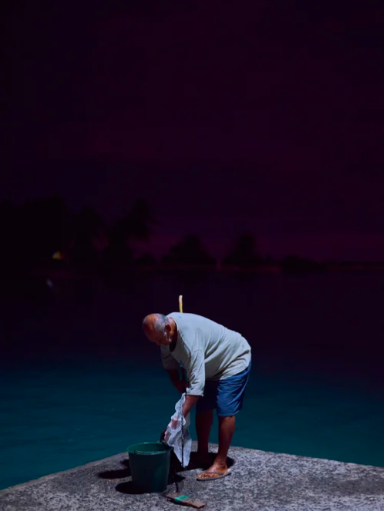
El encuadre, por otra parte, revela una mirada que se resiste a la frontalidad y al centramiento. Venac sitúa con frecuencia a sus figuras en los bordes, en los márgenes, dejando que la mayor parte de la imagen sea ocupada por el paisaje nocturno o por el vacío. Esta composición descentrada obliga al espectador a buscar, a explorar la superficie de la fotografía sin encontrar nunca un punto de reposo definitivo. Es una invitación a habitar la noche del mismo modo que el fotógrafo la ha habitado: dispuesto a dejarse sorprender por lo que emerge de la oscuridad. Además, lo que interesa no es la calidad de la luz, sino su intensidad; no la temperatura del ambiente, sino su densidad dramática.
Nightwalkers despliega una paleta cromática tan contenida como deliberada. Lejos de la neutralidad o del gesto nostálgico que a veces acompaña la monocromía, el tratamiento del color en estas imágenes es un dispositivo de interrogación tan afilado como el encuadre o la iluminación. No hay primarios estridentes ni otras complacencias cromáticas; cada tono emerge de la noche como una pregunta que la luz diurna ha evitado formular.
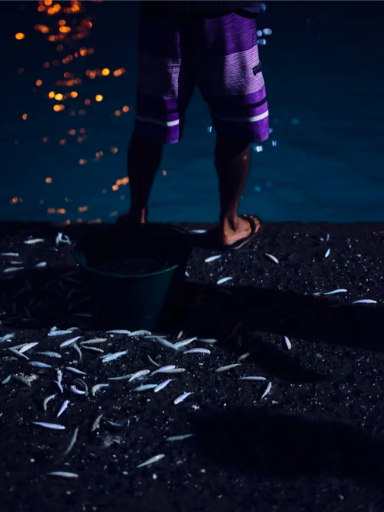
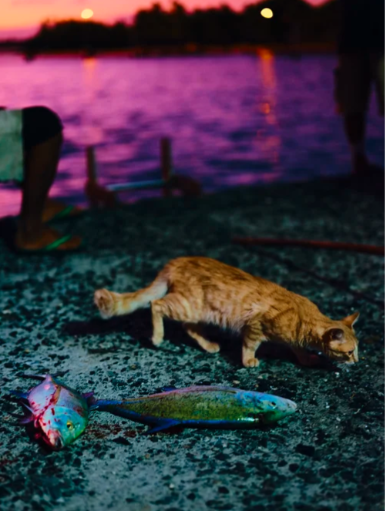
El color, en la muestra, distingue los dominios de lo vivo y lo inerte, lo humano y lo animal, lo visible y lo que apenas se sostiene en el umbral de la percepción. Las carnaciones, cuando aparecen, son siempre frías, azuladas, como si la sangre hubiera aprendido a circular bajo otra temperatura. Los pescados capturados muestran un plateado que no es brillo sino reflejo de una muerte todavía fresca, un resplandor que la película registra con una fidelidad casi clínica. El agua, por su parte, no es azul en el sentido convencional sino un conglomerado de vetas turquesas y negras, una superficie que promete y amenaza en la misma vibración cromática. Esta paleta no busca la belleza decorativa sino la verdad material: el color es aquí el testimonio de una temperatura, de una humedad, de una presión atmosférica que el espectador puede sentir sin salir del marco.
Lo más notable del uso del color es acaso la capacidad del artista para desestabilizar las categorías con las que solemos ordenar la experiencia. Venac logra que el color no sea un atributo de los objetos sino una emanación de sus relaciones. La muerte ya no es negra ni blanca, sino de un azul denso que recuerda la tinta de los cefalópodos. La vida, por su parte, no se aferra al rojo caliente sino a irisaciones verdes que parecen brotar de la putrefacción misma. En tal sentido, la obra bajo análisis constituye una lección sobre cómo el color, bien empleado, puede ser tan elocuente como cualquier otro recurso fotográfico, y sobre todo sobre cómo la noche —esa gran reductora de estímulos— deviene, en manos de Venac, un laboratorio cromático donde se deciden las diferencias esenciales entre un cuerpo y otro, entre un instante y su pérdida.
Notable.
[Todas las imágenes, del sitio web del artista: https://olivierlavenac.com/]
(ENGLISH VERSION)
What the Shadow Illuminates: On Olivier Venac’s Nightwalkers Exhibition
Translation by Tiffany Amber Elías Trimble
Documentary photography, in its most widespread meaning, has lent itself to a systematic confusion: it mistakes the recording of a situation for the understanding of what that situation means. For decades, the prestige of the documentary has rested on the presumption that the camera, properly placed, offers direct access to the real, without mediation, without filters, and almost without interpretation. This naivety, characteristic of the most elementary photographic positivism, has generated mountains of images that illustrate situations without problematizing them, that is, without making them a thematic source beyond basic testimony. Fortunately, there are those who have known how to transcend this indexical recording to generate an active interrogation of the limits of the visible and the invisible, of the thresholds where appearance folds to reveal something else. Olivier Venac’s exhibition *Nightwalkers* belongs to this tradition. Much more than a series *about the night*, it is a series *from the night*: there, in the twilight zone where our daytime certainties dissolve and another logic emerges, perhaps more primitive, more ancient, fully linked to biological cycles and rites of passage, to govern perception.
Venac’s originality lies in the fact that he conceives of the night as an active medium, a substance that shapes bodies, gestures, and encounters. His images, so to speak, are not illuminated *against* the darkness but *from within* it; thus, shadow ceases to be an accident that sufficiently reveals what is there, and becomes a kind of character in the drama, a presence that claims its place in the composition. The photographer does not seek to conquer the night, nor to domesticate it, nor to reduce it to a visual anecdote. He inhabits it and lets it act upon his gaze and his lens.
One of the central themes that Venac calls into question is the night itself as a stage for revelations, and in particular the paradoxical illumination of death. In his images, death is rather a constitutive dimension of life, not its end; something that emerges in the interstices of the everyday when the vigilance of reason loosens and the body recovers its ancestral rhythms. Death, in *Nightwalkers*, is not represented directly, but through its signs: the stillness of a captured animal, the suspension of movement in an instant that could be the last, the gaze lost at a point where time seems to have stopped. This death illuminated by the night is far from the Christian passage and does not resemble the heroic death of epics; it is material, biological death, the one that occurs on the margins of our attention, the one that photography rescues from oblivion precisely because it cannot fully name it.
Hunting and fishing appear in the series as operations that articulate the bond between man and his environment in a way radically different from contemporary industrial predation. Venac neither condemns these activities nor presents them as nostalgic practices; rather, he exposes their constitutive tension: stalking, waiting, the moment suspended between life and death, the predator’s gaze which is also the gaze of one who knows that he himself is potential prey for other forces. Night fishing, in particular, takes on an almost ritual character: the hook sinking into the water is not just a capture instrument, but an extension of human desire towards the depths, towards that marine womb that gives life and retains it, that attracts man with the promise of a secret and often devours him.
The coexistence of predatory creatures constitutes another conceptual axis of the series. Venac photographed communities of animals operating under the logic of the night: their encounters are governed neither by morality nor by law, but by necessity and the recognition of a shared vulnerability. In these images, the boundary between predator and prey becomes porous; the animals share the same territory, the same penumbra, the same destiny of those who must procure food to survive another night. The artist thus suggests a community beyond species, a brotherhood of those who move in darkness, which could well be read as an allegory of our own condition: we too, urban, technological, dazzled by screens, remain creatures of the night, subject to drives that reason cannot fully tame.
The sea, in this photographic exhibition, is the source of life and the womb of mystery, the element that attracts man with the promise of a fulfillment it never quite grants. Venac photographs the nocturnal sea as a surface where certainties dissolve: no defined horizon, nor always a clear separation between water and sky, often no points of reference for orientation. This loss of coordinates is both threatening and liberating. Man feels drawn to that dark immensity, perhaps because he intuits that there, in primordial indistinction, he might find an answer to questions that the ordered, classified, diurnal world has become incapable of formulating. But the sea also deceives, also seduces and devours. The drowning statistics along the coast, which the artist knows well, are not anecdotal data but a reminder that nature does not negotiate with our desires or our anxieties.
Venac’s technique is inseparable from this problematization. The use of long exposures, sometimes several minutes long, does not respond to a desire for effect, but to the need to register what the human eye barely glimpses. The high-sensitivity film, which amplifies noise and textures, turns the image into a surface where the blurry and the sharp dialogue without resolving into a complacent synthesis. Grain, that artifact that digital photography has fought as much as it has tried to emulate, is here an expressive element of the first order: the material trace of the exposure time, the proof that the image was captured under极限 conditions. The absence of flash and any supplementary artificial lighting is another crucial decision: the light that models the bodies and landscapes in *Nightwalkers* is always available light, that of the moon, the stars, distant lighthouses, the glow of a bonfire, or the reflection of the city on the horizon. This choice gives the images a tonal coherence that reinforces the general atmosphere, but also a precise ontological status: the photograph does not impose its light on reality, but adapts to the light that reality offers it.
The framing, on the other hand, reveals a gaze that resists frontality and centering. Venac frequently places his figures at the edges, in the margins, leaving most of the image occupied by the nocturnal landscape or by emptiness. This decentered composition forces the viewer to search, to explore the surface of the photograph without ever finding a definitive point of rest. It is an invitation to inhabit the night just as the photographer has inhabited it: ready to be surprised by what emerges from the darkness. Furthermore, what matters is not the quality of light, but its intensity; not the ambient temperature, but its dramatic density.
*Nightwalkers* deploys a chromatic palette as contained as it is deliberate. Far from the neutrality or nostalgic gesture that sometimes accompanies monochromy, the treatment of color in these images is an interrogative device as sharp as the framing or the lighting. There are no strident primaries or other chromatic complacencies; each tone emerges from the night as a question that daylight has avoided formulating.
Color, in the exhibition, distinguishes the realms of the living and the inert, the human and the animal, the visible and that which barely holds on the threshold of perception. Flesh tones, when they appear, are always cold, bluish, as if the blood had learned to circulate at a different temperature. The captured fish show a silvery sheen that is not brightness but a reflection of a death still fresh, a glow that the film registers with almost clinical fidelity. The water, for its part, is not blue in the conventional sense but a conglomerate of turquoise and black veins, a surface that promises and threatens in the same chromatic vibration. This palette does not seek decorative beauty but material truth: color here is the testimony of a temperature, a humidity, an atmospheric pressure that the viewer can feel without leaving the frame.
Perhaps the most notable aspect of the use of color is the artist’s ability to destabilize the categories with which we usually order experience. Venac achieves that color is not an attribute of objects but an emanation of their relationships. Death is no longer black or white, but a dense blue reminiscent of cephalopod ink. Life, for its part, does not cling to hot red but to green iridescences that seem to spring from putrefaction itself. In this sense, the work under analysis constitutes a lesson on how color, well used, can be as eloquent as any other photographic resource, and above all on how the night —that great reducer of stimuli— becomes, in Venac’s hands, a chromatic laboratory where the essential differences between one body and another, between an instant and its loss, are decided.
Noteworthy.
[file content end]