
Algo espantoso que, pese a todo, nos sostiene: Aproximación a la obra de Enrico Robusti
Por Juan Pablo Torres Muñiz
En la línea impresionista que, lejos de detenerse en la fugacidad del impacto luminoso, se descompone, a través del trazo, la forma y las texturas, también las apariencias sociales, la obra de Enrico Robusti merece mención especial. El mismo afán de captar la impresión de una época encontró en ciertos artistas, de Daumier a Degas, un instrumento afilado para la observación de los modos de vida urbanos, los hábitos domésticos y las jerarquías inconfesadas. Robusti retoma esa herencia con una ferocidad terrible: no persigue la vibración de la luz, sino la de la conducta humana en su estado más crudo, cuando la máscara social se resquebraja y asoma el interior histérico, inconsistente, voraz. Cambia el paisaje por el interior doméstico, la atmósfera por la digestión, y la armonía cromática por la disonancia moral.
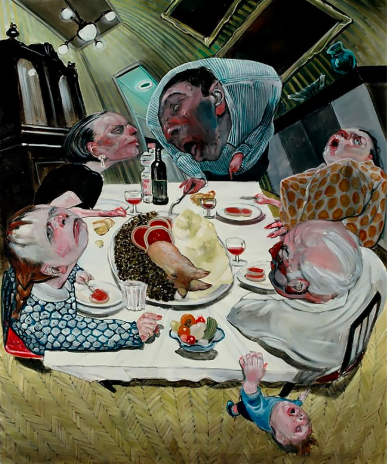
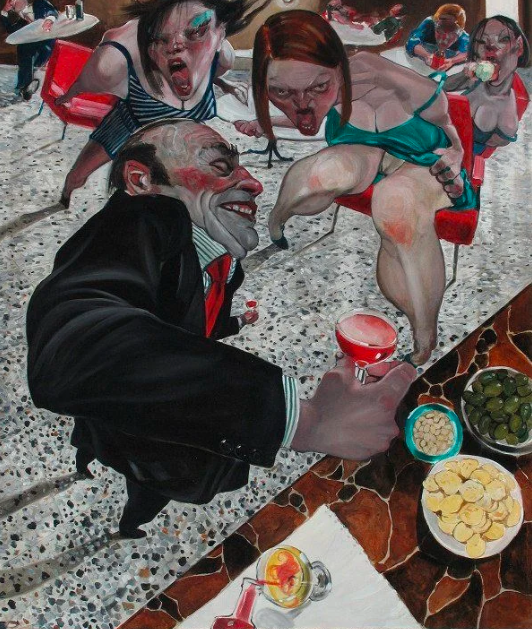
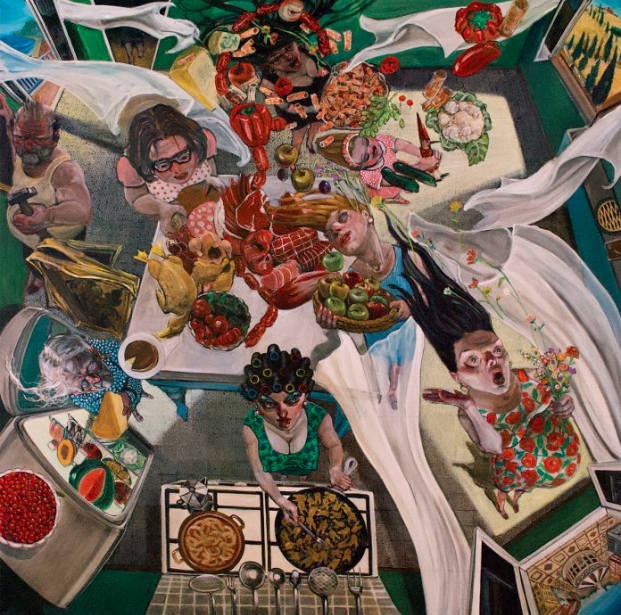
Lo que sus lienzos ponen en cuestión no son ya vicios menores sino las instituciones mismas de la vida contemporánea. El dinero, la gula, la sexualización de todo vínculo, el abuso de autoridad, la corrupción como práctica ventilada: todo ello se exhibe en sus grandes formatos como en una autopsia de la normalidad burguesa. Los títulos largos, casi narrativos —Noi siamo due persone cresciute nell’abbondanza, Vi dispiace se con questa manina assaggio questo zampone— funcionan como epígrafes que desarman cualquier tentación de leer las imágenes como mera anécdota. La agresividad que brota de esas figuras es el envés de una interioridad sin consistencia, construida a partir de afectos sucedáneos y ceremonias vacías. Paradójicamente, la obra de Robusti no propone una salida hacia el individuo aislado ni hacia la crítica moralizante: apela a una forma distinta de sociedad, ya no virtualizada, sino arraigada en lo doméstico y lo callejero. Sus familias y sus comités de socios compinches se reúnen en espacios reales, compartiendo mesa, comida, culpa y complicidad. No hay escape hacia lo íntimo puro, sino exposición de una socialidad degradada que, por ello mismo, vuelve pensable otra.
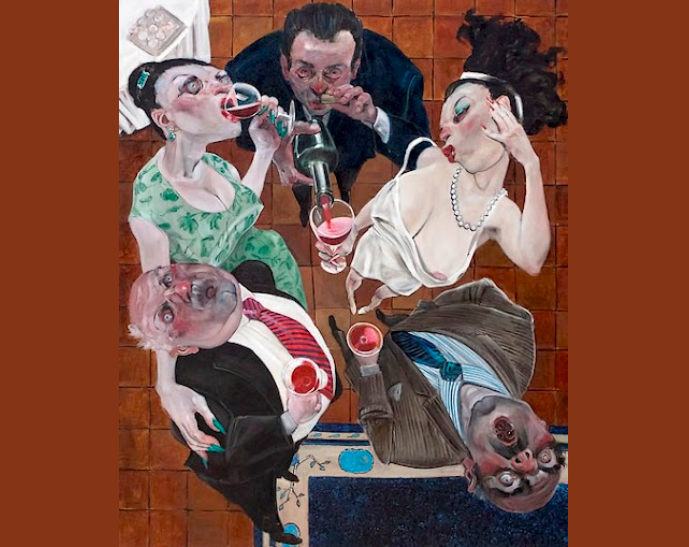
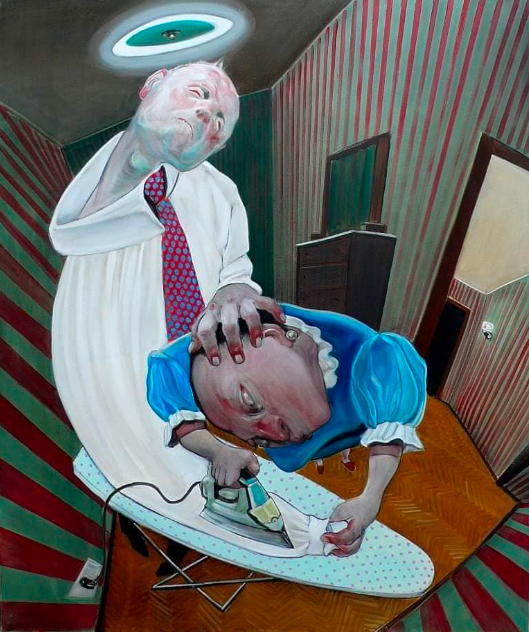
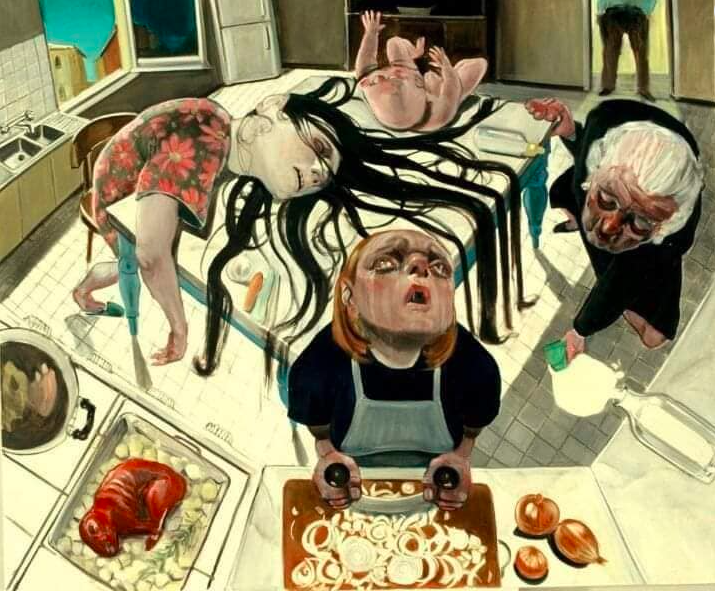
La deformación de las imágenes opera como el mecanismo principal de esa exposición. Robusti emplea una perspectiva forzada, casi esférica, comparable al efecto ojo de pez (fisheye) en fotografía, que curva las líneas del espacio doméstico hasta crear una suerte de ojo omnisciente que todo lo abarca y todo lo distorsiona a la vez. Las habitaciones, las mesas, los cuerpos parecen girar en una centrifugadora que expulsa cualquier semblante de orden. Los comensales se agrandan o empequeñecen según su lugar en el banquete, los rostros se estiran en muecas fijas, las manos se multiplican en gestos de posesión o ansiedad. No es sólo que los personajes sean grotescos; es que la geometría misma de lo real se vuelve cómplice de esa deformación.
Su técnica, profundamente trabada con esa visión, bebe de fuentes deliberadamente heterogéneas: el dibujo satírico de George Grosz y Otto Dix, el claroscuro barroco de Van Dyck, la monumentalidad festiva de Rubens, pero reconfigurados bajo el imperativo de una mirada contemporánea que no se permite el lujo del idealismo. El óleo sobre grandes telas es su soporte habitual, y en él despliega una paleta de colores a menudo estridentes, donde los rojos carnales y los amarillos grasientos compiten con los azules fríos del mobiliario burgués. La pincelada se exhibe en su materialidad espesa; las texturas se acumulan, sobre todo en las zonas del alimento y de la piel, como si la pintura misma participara de la digestión que representa. La composición huye del centro único y se fragmenta en múltiples puntos de fuga que obligan al ojo a desplazarse sin descanso, sin encontrar un reposo moral.
Lo que Robusti consigue así no es una colección de tipos sociales caricaturizados, sino un cuestionamiento pictórico de los vínculos que aún nos sostienen, por más que se muestren en su desnudez más incómoda.
[Todas las imágenes, de las redes sociales del artista.]
(ENGLISH VERSION)
The Dreadful That Sustains Us: An Approach to the Work of Enrico Robusti
Translation by Tiffany Amber Elías Trimble
In the Impressionist lineage that, far from stopping at the fleetingness of luminous impact, decomposes, through stroke, form and textures, also social appearances, the work of Enrico Robusti deserves special mention. The same eagerness to capture *the impression of an epoch* found in certain artists, from Daumier to Degas, a sharpened instrument for observing urban ways of life, domestic habits, and unconfessed hierarchies. Robusti takes up that heritage with a terrible ferocity: he does not pursue the vibration of light, but that of human conduct in its rawest state, when the social mask cracks and the hysterical, inconsistent, voracious interior peeks out. He changes landscape for the domestic interior, atmosphere for digestion, and chromatic harmony for moral dissonance.
What his canvases call into question are no longer minor vices but the very institutions of contemporary life. Money, gluttony, the sexualization of every bond, abuse of authority, corruption as an open practice: all of this is exhibited on his large-format works as in an autopsy of bourgeois normality. The long, almost narrative titles —Noi siamo due persone cresciute nell’abbondanza, Vi dispiace se con questa manina assaggio questo zampone— function as epigraphs that dismantle any temptation to read the images as mere anecdote. The aggressiveness that springs from these figures is the reverse side of an inconsistent interiority, built from substitute affections and empty ceremonies. Paradoxically, Robusti’s work does not propose an escape towards the isolated individual nor towards moralizing critique: it appeals to a different form of society, no longer virtualized, but rooted in the domestic and the street. His families and his committees of crony partners gather in real spaces, sharing table, food, guilt, and complicity. There is no escape towards pure intimacy, but rather an exposure of a degraded sociality which, by that very fact, makes another one thinkable.
The deformation of images operates as the main mechanism of that exposure. Robusti employs a forced, almost spherical perspective, comparable to the fisheye effect in photography, which curves the lines of domestic space, creating a kind of omniscient eye that encompasses everything and distorts everything at once. The rooms, the tables, the bodies seem to spin in a centrifuge that expels any semblance of order. The diners grow larger or shrink according to their place at the banquet, faces stretch into fixed grimaces, hands multiply in gestures of possession or anxiety. It is not just that the characters are grotesque; it is that the very geometry of the real becomes complicit in that deformation.
His technique, deeply intertwined with that vision, draws from deliberately heterogeneous sources: the satirical drawing of George Grosz and Otto Dix, the Baroque chiaroscuro of Van Dyck, the festive monumentality of Rubens, but reconfigured under the imperative of a contemporary gaze that does not allow itself the luxury of idealism. Oil on large canvases is his usual support, and on it he deploys a often strident palette, where fleshy reds and greasy yellows compete with the cold blues of bourgeois furniture. The brushstroke is exhibited in its thick materiality; textures accumulate, especially in the areas of food and skin, as if the painting itself participated in the digestion it represents. The composition flees from a single center and fragments into multiple vanishing points, forcing the eye to move without rest, without finding moral repose.
What Robusti achieves thus is not a collection of caricatured social types, but a pictorial questioning of the bonds that still sustain us, even as they show themselves in their most uncomfortable nakedness.