
Hacer camino: Aproximación a la muestra «Metamorphoses» de Frédéric Fontenoy
Por Juan Pablo Torres Muñiz
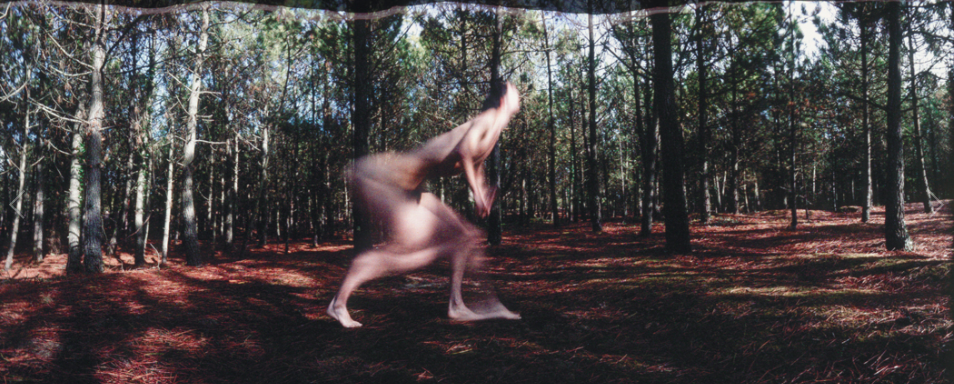
Decir que la obra la de este artista dialoga directamente con el mal llamado surrealismo, equivaldría a poco o nada, sin la aclaración de que, si es el caso, ocurre lejos de cualquier vertiente dizque onírica o guiada por el mítico inconsciente; en su exploración se da más bien una suerte de imposición del cuerpo, ineludible, contra la estructuración de un plan del todo coherente. Asimismo, se percibe en Metamorphose, la herencia de las Distorsiones de André Kertész, que ya ponían en crisis la supuesta objetividad fotográfica al someter la figura humana a la torsión óptica. Sin embargo, la originalidad de Fontenoy radica en la traslación de estas inquietudes al espacio natural y en el empleo de una técnica —la fotografía panorámica de escaneo por rendija (slit-scan)— que no distorsiona a posteriori, sino que registra la distorsión como un proceso temporal inherente al acto de desplazamiento. No es una deformación aplicada, sino una que emerge de la interacción entre el cuerpo-movimiento y la tecnología-percepción.
La muestra fue concebida por el fotógrafo francés Frédéric Fontenoy a partir de 1988 e interroga los fundamentos constitutivos del Homo sapiens como entidad biológica y sujeto institucional. Aquí se desmontan, a través de la técnica y la imagen, las ficciones modernas que escinden al hombre de su condición animal y que idealizan su libertad como un estado de naturaleza. Fontenoy, a través de un método original que sintetiza influencias históricas, consigue hacer visible la paradoja esencial de la criatura humana: su doble naturaleza, a la vez salvaje y ordenadora, su libertad como construcción racional y no como regreso primitivista, y su aparente condena a transformar el caos elemental en un mundo geométrico y significante.
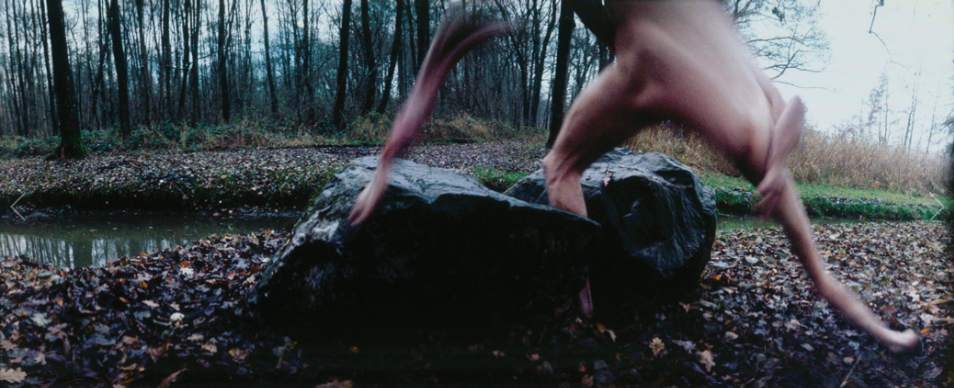
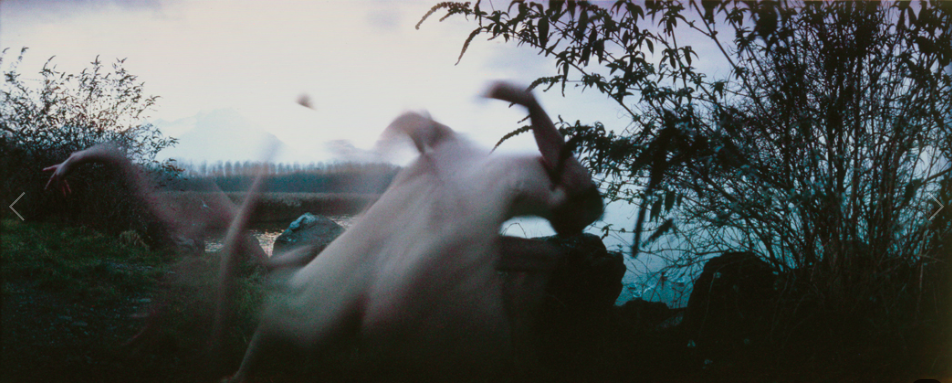
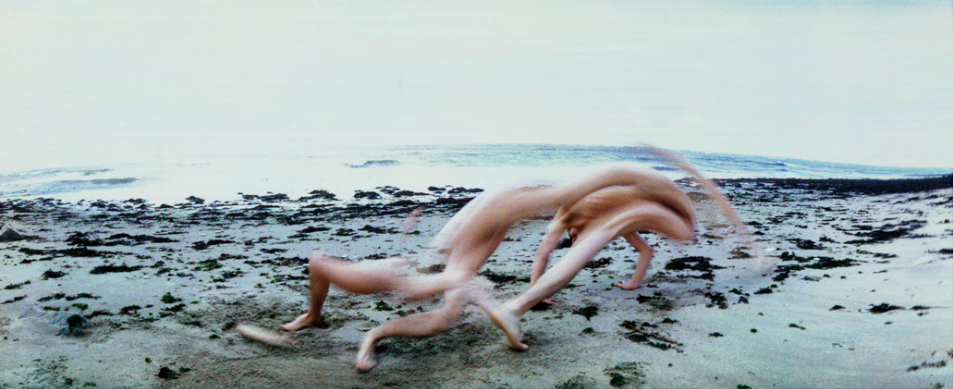
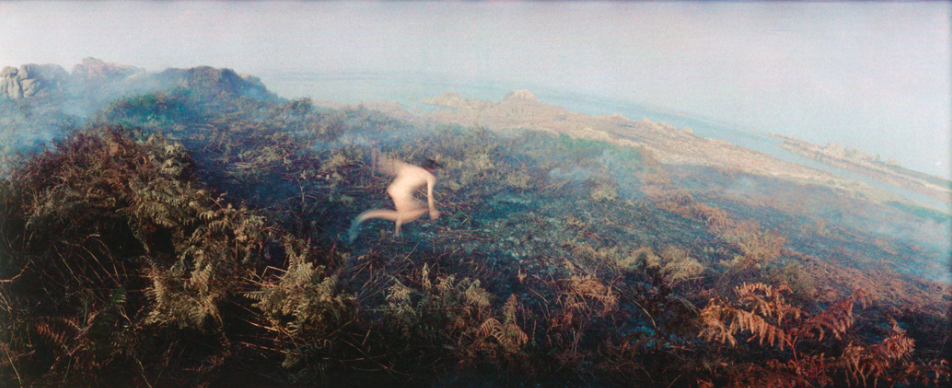
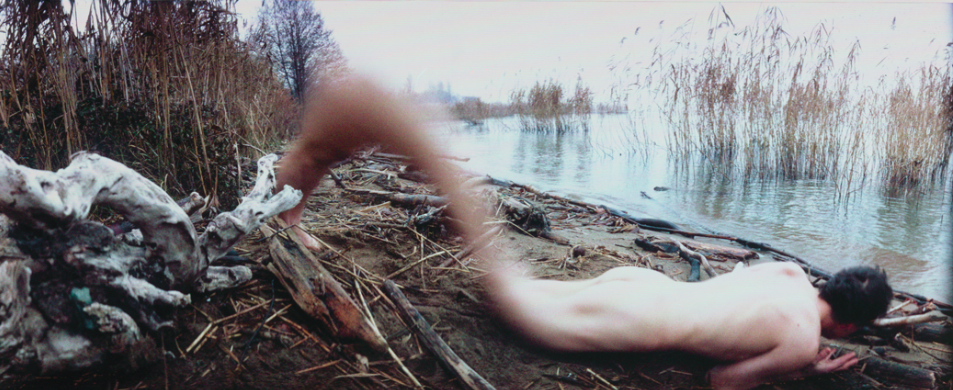
El artista se las arregla para desmontar la falaz escisión cartesiana entre el hombre y la naturaleza. Las imágenes muestran cuerpos desnudos, no como de visitantes en un paisaje virgen, sino como una extensión orgánica del mismo, pero también como causa de conflicto en el hombre: parece que nada más huye. El cuerpo se retuerce en aguas heladas, se funde con la arena de la ribera o salta sobre un suelo denso, recordándonos de dónde procedemos. Pero Fontenoy no idealiza un retorno edénico; por el contrario, subraya la corporeidad material y perecedera que nos vincula irrevocablemente al mundo silvestre, que no es sino el ámbito de lo informe y lo fluido, donde la figura humana, lejos de erigirse en centro, se disuelve en múltiples brazos y torsos. Esta disolución es clave: el sujeto no huye de su animalidad, sino que la habita plenamente, reconociéndose como parte constitutiva de un flujo material mayor, aunque persiga, a través de su misma carrera, trazar un sentido, una linealidad que haga del espacio silvestre, paisaje.
La obra rechaza explícitamente el idealismo simplón de una libertad entendida como fusión absoluta con la naturaleza y ejercicio ilimitado de la voluntad. Esa noción, sugiere Fontenoy, es una fantasía peligrosa. En el estado puro de naturaleza que evoca, desprovisto del ejercicio de las facultades racionales y técnicas, el hombre no es un ser libre, sino «presa fácil», un organismo más en un entorno que lo supera. La verdadera libertad, que la serie explora con crudeza, es una construcción. Surge precisamente del distanciamiento crítico de lo elemental, de la capacidad de tomar esa materia bruta —el cuerpo, el paisaje, el tiempo— y someterla a un orden. El acto fotográfico mismo, minuciosamente planificado con una cámara panorámica de 360 grados, es la metáfora de esta construcción. La libertad no se corresponde con el abandono al instinto, sino con el trazo de un sentido en el caos, la imposición de una geometría —la del encuadre, la del movimiento calculado— sobre lo amorfo. Del mismo modo que el cuerpo en movimiento, registra su paso, siempre en uno o varios sentidos, pero sentidos al fin.
El Homo sapiens está condenado a conocer, a explorar el espacio que lo rodea y a transformarlo, en la medida de lo posible, en un hábitat inteligible. El artista captura este impulso en el instante mismo de la metamorfosis: el cuerpo no yace, se encuentra siempre en acto: salta, gira, se retuerce; ejerce su energía sobre el entorno. La serie constituye, en sí misma, un «mundo» en el sentido etimológico de kosmos: un todo ordenado y ornamentado, creado a partir de la materia prima de la naturaleza y el cuerpo. No podemos escapar del deber de ordenar, y ese orden, por necesario que sea, implica siempre una violencia sobre la fluidez originaria, una fractura de lo informe. Las imágenes, con sus cuerpos elongados y multiplicados, son el testimonio de esa violencia creadora.
El proceso técnico empleado por Fontenoy no congela un instante, sino que más bien registra la duración como una dimensión espacial. El resultado es una imagen donde el cuerpo aparece estirado, duplicado, desintegrado y recombinado en un flujo continuo. Así, aquí se hace literal la metamorfosis: visibiliza el tiempo interno del gesto, la huella material de la existencia como devenir. El cuerpo deja de ser un objeto estático para convertirse en una suerte de proceso, más un verbo que un sustantivo. Esta disolución de los límites corporales estables sirve perfectamente al cuestionamiento de la individualidad aislada y celebra, en cambio, una condición híbrida y permeable entre el organismo y su entorno.
La paleta tiende a eliminar el color —atributo a menudo asociado a lo vital y lo sensorial inmediato—; de este modo, Frédéric eleva la imagen a un plano de abstracción conceptual. Esta elección refuerza la idea de que lo que contemplamos no es una escena real, sino una construcción intelectual, un diagrama de fuerzas donde se debaten la materialidad salvaje y la voluntad de forma.
Animal que, dotado de conciencia y técnica, no puede sino distanciarse de la naturaleza para poder habitarla significativamente. Objetividad. Una propuesta necesaria.
[Todas las imágenes, del sitio web del artista: fredericfontenoy.com/index.html]
ENGLISH VERSION
Making a Path: An Approach to Frédéric Fontenoy’s Exhibition Metamorphose
Translation by Tiffany Trimble
To say that this artist’s work dialogues directly with the so-called Surrealism would mean little or nothing without clarifying that, if this is the case, it occurs far from any so-called dreamlike or mythical unconscious-guided strand. His exploration presents more of an imposition of the body, ineluctable, against the structuring of a wholly coherent plan. Likewise, one perceives in Metamorphose the legacy of André Kertész’s Distortions, which already put into crisis the supposed photographic objectivity by subjecting the human figure to optical torsion. However, Fontenoy’s originality lies in the transposition of these concerns into the natural space and in the use of a technique—slit-scan panoramic photography—that does not distort a posteriori, but rather records distortion as a temporal process inherent to the act of movement. It is not an applied deformation, but one that emerges from the interaction between body-movement and technology-perception.
The exhibition was conceived by French photographer Frédéric Fontenoy starting in 1988 and interrogates the constitutive foundations of Homo sapiens as a biological entity and an institutional subject. Here, through technique and image, the modern fictions that sever man from his animal condition and idealize his freedom as a state of nature are dismantled. Fontenoy, through an original method that synthesizes historical influences, manages to make visible the essential paradox of the human creature: its dual nature, both savage and ordering; its freedom as a rational construction and not as a primitivist return; and its apparent condemnation to transform elemental chaos into a geometrical and significant world.
The artist manages to dismantle the fallacious Cartesian split between man and nature. The images show naked bodies, not as visitors in a virgin landscape, but as an organic extension of it, yet also as a source of conflict within man: nothing more than flight. The body writhes in icy waters, merges with the sand of the riverbank, or leaps upon dense ground, reminding us of where we come from. But Fontenoy does not idealize an Edenic return; on the contrary, he emphasizes the material and perishable corporeality that irrevocably links us to the wild world, which is but the realm of the formless and the fluid, where the human figure, far from erecting itself as the center, dissolves into multiple arms and torsos. This dissolution is key: the subject does not flee from its animality, but fully inhabits it, recognizing itself as a constitutive part of a greater material flow, even as it seeks, through its very motion, to trace a meaning, a linearity that turns the wild space into a landscape.
The work explicitly rejects the simplistic idealism of a freedom understood as absolute fusion with nature and the unlimited exercise of will. This notion, Fontenoy suggests, is a dangerous fantasy. In the pure state of nature it evokes, stripped of the exercise of rational and technical faculties, man is not a free being, but «easy prey,» just another organism in an environment that surpasses him. True freedom, which the series explores with rawness, is a construction. It arises precisely from the critical distancing from the elemental, from the capacity to take that raw matter—the body, the landscape, time—and subject it to an order. The photographic act itself, meticulously planned with a 360-degree panoramic camera, is the metaphor of this construction. Freedom does not correspond to abandoning oneself to instinct, but to tracing a meaning in the chaos, imposing a geometry—that of the frame, of the calculated movement—onto the formless. Just as the body in motion registers its passage, always in one or several directions, but with sense nonetheless.
Homo sapiens is condemned to know, to explore the space around him and to transform it, as much as possible, into an intelligible habitat. The artist captures this impulse in the very instant of metamorphosis: the body does not lie still; it is always in action: jumping, turning, writhing; it exerts its energy upon the environment. The series itself constitutes a «world» in the etymological sense of kosmos: an ordered and ornamented whole, created from the raw material of nature and the body. We cannot escape the duty to order, and this order, however necessary, always implies a violence upon the original fluidity, a fracture of the formless. The images, with their elongated and multiplied bodies, are the testimony of this creative violence.
The technical process employed by Fontenoy does not freeze an instant; rather, it records duration as a spatial dimension. The result is an image where the body appears stretched, duplicated, disintegrated, and recombined in a continuous flow. Thus, metamorphosis is made literal here: it visualizes the internal time of the gesture, the material trace of existence as becoming. The body ceases to be a static object to become a sort of process, more a verb than a noun. This dissolution of stable bodily limits perfectly serves the questioning of isolated individuality and celebrates, instead, a hybrid and permeable condition between the organism and its environment.
The palette tends to eliminate color—an attribute often associated with vitality and immediate sensorial experience—; in this way, Fontenoy elevates the image to a plane of conceptual abstraction. This choice reinforces the idea that what we contemplate is not a real scene, but an intellectual construction, a diagram of forces where savage materiality and the will to form are debated.
Animal that, endowed with consciousness and technique, can do nothing but distance itself from nature in order to inhabit it meaningfully. Objectivity. A necessary proposal.