
En el límite: Aproximación a la fotografía de Bryan Derballa
Por Juan Pablo Torres Muñiz
En el vasto campo de la fotografía contemporánea, la vertiente documental y el retrato han transitado desde la solemnidad del estudio y la pose calculada hacia una estética de la inmediatez, una búsqueda de la verdad en lo casual, en el gesto fugaz que delata la tensión entre la persona y su mundo. Esta aproximación, que encuentra en la dinámica juvenil su territorio más fértil, en el mejor de los casos, evita la belleza idealizada y la reemplaza por la elocuencia de lo real, la manifestación de una vitalidad que se define en su interacción con el entorno. La obra del fotógrafo estadounidense Bryan Derballa se inscribe en esta tradición.
Lo hace ver fácil…
Sus imágenes, lejos de simples instantáneas, constituyen un hondo cuestionamiento del marco institucional de la experiencia moderna, especialmente la de la juventud, presentándola como muchísimo más que una etapa de irreflexión: una edad de responsabilidad radical, impulsada por la necesidad de portar una luz propia, de cruzar límites y explorar la naturaleza salvaje que persiste en las fronteras de la civilización, y contra su propia perversión, inclusive, sin desbarrar en la mera provocación. Se trata de una vuelta al ritual, mas sin romantizaciones primitivistas; simplemente, por apelación al instinto, al cuerpo, a la comunidad de individuos cercanos, a la noción de norma referente, y de libertad como una construcción permanente.
Aquí vemos la juventud, pero no como la idealiza el mercado pletórico —un consumidor necesitado de modelos, atrapado en una adolescencia perpetua—, sino como la encarnación del sujeto autónomo y social, en su momento más crítico y formativo. Sus sujetos no son, ni mucho menos, rebeldes sin causa, sino individuos que gestionan su libertad, entendida como una fuerza que opera contra otras fuerzas en el marco de una sociedad. La vitalidad juvenil en sus fotos es la manifestación de un afán de gobierno en el doble rango normativo de los límites de uno mismo y de los demás. Exploraciones sobre la delgada línea entre la norma y la transgresión, la seguridad de lo conocido y el impulso por explorar territorios nuevos, tanto geográficos como existenciales.
Derballa tematiza la institución de la amistad como un pacto de supervivencia y descubrimiento. Sus retratos grupales refieren a comunidades provisionales forjadas en la experiencia compartida. El individuo se define en relación al grupo, pero sin disolverse en él; cada sujeto porta su propia luz —a menudo, literalmente—, su propia voluntad, en una dialéctica constante entre ética (el impulso de expansión personal) y moral (la normativa que salvaguarda al conjunto).
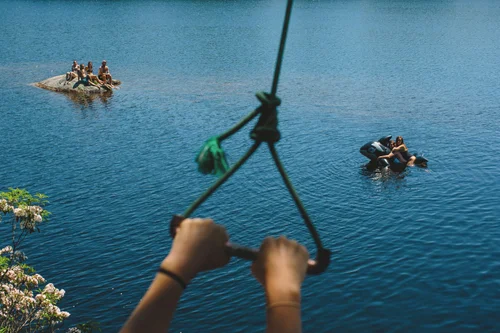
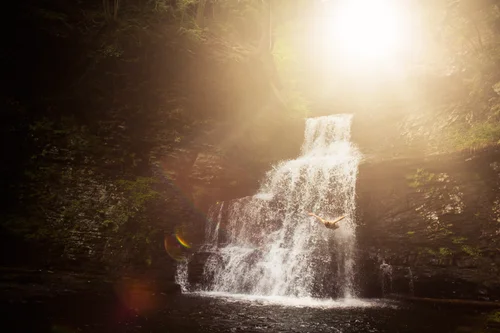
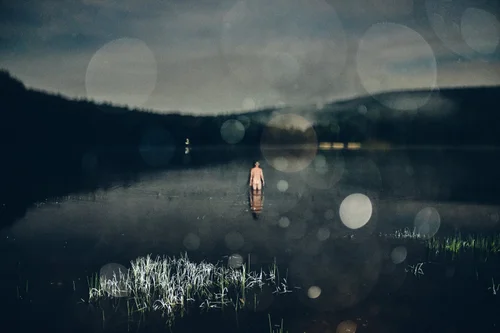
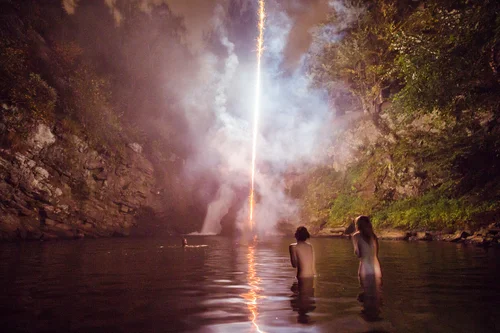
La naturaleza, otro de sus grandes temas, constituye un espacio liminal donde las instituciones de la civilización se suspenden parcialmente, obligando al sujeto a operar con criterios más elementales. Internarse en el bosque, nadar en un lago helado o escalar una roca no son actos de ocio, sino actos de autoafirmación, ejercicios en los que la persona se enfrenta a la realidad material lejos del amparo de las construcciones urbanas. Y en este punto, el tacto del artista es fundamental para evadir la pose y seducir con la impresión de intromisión secreta, de captura auténtica de un momento irrepetible.
Sus retratos ponen en entredicho la noción de identidad como algo fijo. Sus sujetos son capturados en momentos de transición, de posibilidad abierta, definidos más por su potencial que por sus realizaciones. La elección de fotografiar en los márgenes —tanto geográficos como sociales— es una declaración de principios: es en la frontera donde las instituciones se revelan en su arbitrariedad y donde la persona debe generar nuevas normas para sobrevivir. Cuestiona así la institución del progreso lineal, mostrando la persistencia de la fuerza del instinto, que coexiste con la modernidad y la desafía permanentemente.
La técnica y expresividad de Bryan Derballa están férreamente sujetas a su proyecto temático. Su aproximación es eminentemente analógica, una elección que no responde a la nostalgia, sino a una necesidad conceptual. El uso de película, con su grano, su latitud limitada y la imprevisibilidad inherente al proceso químico, dota a sus imágenes de una materialidad que contrasta con la perfección aséptica de la fotografía digital. Esta técnica implica una relación distinta con el tiempo y el sujeto; cada disparo exige una conexión profunda, una observación muy detenida, al límite de la razón técnica, aprovechando la imperfección para acariciar siempre la verdad en tanto movimiento.
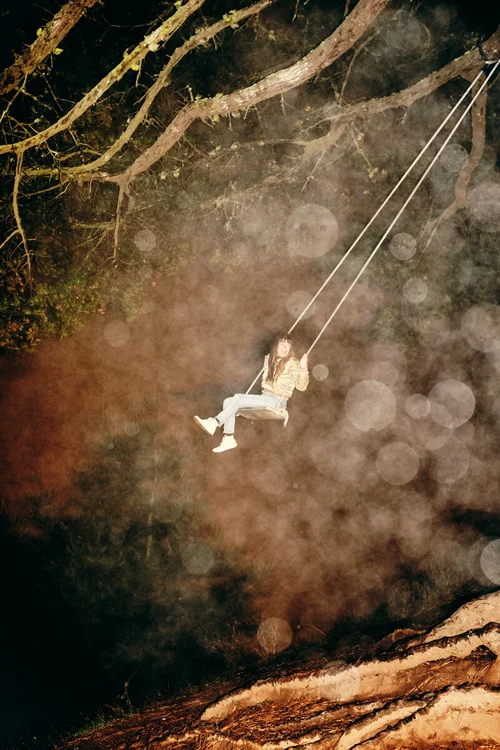
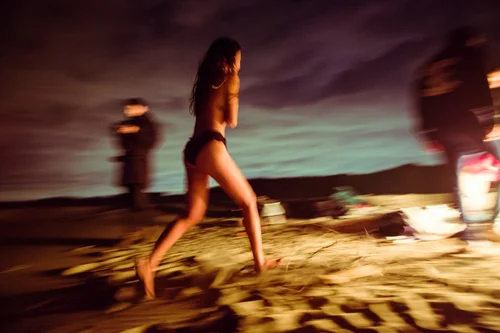
Su uso de la luz natural es notable. Prefiere la luz suave y difusa del amanecer o el atardecer, que envuelve a sus sujetos en una atmósfera a la vez melancólica y vibrante. Esta elección funciona como una metáfora de la juventud misma: un estado transitorio, lleno de una belleza efímera y una promesa de futuro. La composición de sus imágenes a menudo rompe con buena parte de las reglas académicas, utilizando encuadres descentrados, horizontes caídos o un enfoque selectivo que aísla al sujeto de un fondo desenfocado, generando una sensación de intimidad y extrañamiento. Sus retratos, incluso los más casuales, revelan una profunda capacidad de conexión con sus modelos; logra que la cámara se vuelva casi invisible, capturando gestos y miradas que trascienden la pose y revelan la complejidad interior de la persona.
Una visión elocuente y cuestionadora, del tiempo que nos atraviesa, y tan a menudo, simplemente, dejamos pasar.
[Todas las imágenes, del sitio web del artista: Bryan Derballa | 510.684.9589 | lovebryan@gmail.com]

ENGLISH VERSION
On the Edge: An Approach to the Photography of Bryan Derballa
Translated by Rebeca Sanz
In the vast field of contemporary photography, the documentary vein and portraiture have moved from the solemnity of the studio and the calculated pose towards an aesthetic of immediacy, a search for truth in the casual, in the fleeting gesture that betrays the tension between the person and their world. This approach, which finds in youth dynamics its most fertile territory, at its best, avoids idealized beauty and replaces it with the eloquence of the real, the manifestation of a vitality defined by its interaction with the environment. The work of American photographer Bryan Derballa falls within this tradition.
He makes it look easy…
His images, far from simple snapshots, constitute a deep questioning of the institutional framework of the modern experience, especially that of youth, presenting it as far more than a stage of thoughtlessness: an age of radical responsibility, driven by the need to carry one’s own light, to cross boundaries and explore the wild nature that persists at the frontiers of civilization, and even against its own perversion, without straying into mere provocation. It is a return to ritual, but without primitivist romanticizations; simply, through an appeal to instinct, to the body, to the community of close individuals, to the notion of a reference norm, and of freedom as a permanent construction.
Here we see youth, but not as idealized by the burgeoning market—a consumer in need of models, trapped in a perpetual adolescence—but as the embodiment of the autonomous and social subject, in its most critical and formative moment. His subjects are far from being rebels without a cause; they are individuals who manage their freedom, understood as a force that operates against other forces within the framework of a society. The youthful vitality in his photos is the manifestation of a striving for governance within the dual normative framework of one’s own limits and those of others. Explorations on the thin line between norm and transgression, the security of the known and the impulse to explore new territories, both geographical and existential.
Derballa thematizes the institution of friendship as a pact of survival and discovery. His group portraits refer to provisional communities forged in shared experience. The individual is defined in relation to the group, but without dissolving into it; each subject carries their own light—often, literally—their own will, in a constant dialectic between ethics (the impulse for personal expansion) and morals (the norms that safeguard the collective).
Nature, another of his major themes, constitutes a liminal space where the institutions of civilization are partially suspended, forcing the subject to operate by more elementary criteria. Venturing into the forest, swimming in an icy lake, or climbing a rock are not acts of leisure, but acts of self-affirmation, exercises in which the person confronts material reality far from the shelter of urban constructions. And at this point, the artist’s tact is essential to evade the pose and seduce with the impression of secret intrusion, of an authentic capture of an unrepeatable moment.
His portraits call into question the notion of identity as something fixed. His subjects are captured in moments of transition, of open possibility, defined more by their potential than by their accomplishments. The choice to photograph at the margins—both geographical and social—is a declaration of principles: it is at the frontier that institutions are revealed in their arbitrariness and where the person must generate new norms to survive. He thus questions the institution of linear progress, showing the persistence of the force of instinct, which coexists with modernity and permanently challenges it.
The technique and expressiveness of Bryan Derballa are firmly tied to his thematic project. His approach is eminently analog, a choice that responds not to nostalgia, but to a conceptual necessity. The use of film, with its grain, its limited latitude, and the inherent unpredictability of the chemical process, endows his images with a materiality that contrasts with the aseptic perfection of digital photography. This technique implies a different relationship with time and the subject; each shot demands a deep connection, a very careful observation, at the limit of technical reason, harnessing imperfection to always caress the truth as movement.
His use of natural light is remarkable. He prefers the soft, diffuse light of dawn or dusk, which envelops his subjects in an atmosphere both melancholic and vibrant. This choice functions as a metaphor for youth itself: a transient state, full of ephemeral beauty and a promise of the future. The composition of his images often breaks with many academic rules, using off-center frames, tilted horizons, or a selective focus that isolates the subject from a blurred background, generating a sense of intimacy and estrangement. His portraits, even the most casual, reveal a profound capacity for connection with his models; he manages to make the camera almost invisible, capturing gestures and gazes that transcend the pose and reveal the inner complexity of the person.
An eloquent and questioning vision of the time that runs through us, and so often, we simply let pass by.
[All images, from the artist’s website: https://www.bryanderballa.com/]